



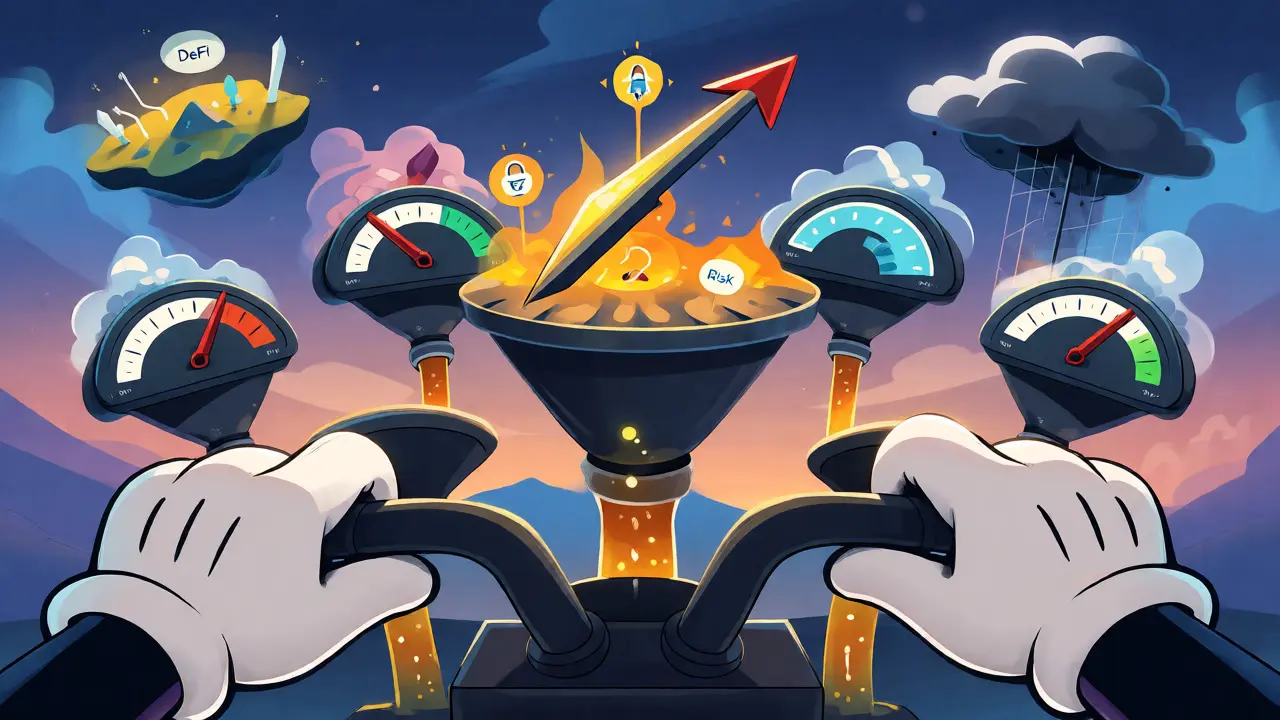
Most people lose money in crypto not because they picked the wrong coin, but because they held it for too long. They bought when the hype peaked and sold when the panic set in. Altcoin rotation is the antidote to this emotional trap. It’s a tactical approach where you move capital between different cryptocurrency sectors-like Decentralized Finance (DeFi), Layer 2 scaling networks, and Gaming/GameFi-based on momentum and fundamental data rather than gut feeling.
Think of it like surfing. You don’t stay on one wave forever; you paddle out to catch the next big swell. In crypto, capital flows in cycles. Money often moves from Bitcoin to large-cap infrastructure, then into high-growth narratives like AI or gaming, before rotating back to safety. The goal isn’t to predict the future perfectly. It’s to position yourself ahead of the crowd by spotting where liquidity is heading next. But here’s the catch: if you do it wrong, you’ll get chopped up by volatility and fees. Let’s break down how to do it right.
The Core Mechanics of Sector Rotation
At its heart, rotation is about relative strength. You aren’t just looking for assets that go up; you’re looking for assets that are going up faster than the market average. This requires a disciplined framework. You can’t just guess which sector is hot. You need a process.
First, define your universe. Not every altcoin deserves attention. Exclude tokens with poor liquidity, unaudited smart contracts, or massive upcoming token unlocks that will dilute value. Once you have a clean list, classify them strictly. Is a token an L2? A DeFi protocol? A gaming asset? Many projects blur these lines. For example, some Layer 2s also host major DeFi protocols. Decide on a primary classification rule and stick to it to avoid confusion.
Next, measure performance over multiple timeframes. A 7-day spike might be noise, but a 30-day or 90-day trend shows real momentum. Calculate total returns after fees and slippage. If you’re trading on-chain, gas costs eat into profits. A 10% gain means nothing if you paid 5% in bridge fees and swaps.
| Sector | Primary Growth Metric | Risk Factor | Best Signal for Entry |
|---|---|---|---|
| DeFi | Total Value Locked (TVL), Protocol Fees | Smart contract exploits, Oracle failures | Rising TVL + Increasing Fee Revenue |
| Layer 2 | Transactions per second, Sequencer Revenue | Weak token value capture, Centralization | Growing Active Users + Bridge Inflows |
| Gaming/GameFi | Daily Unique Active Wallets (dUAW) | High failure rate, Low retention | Sustained dUAW + Organic Player Hours |
| AI & RWA | Partnerships, Real-world Asset Minting | Narrative-driven volatility, Hype cycles | Institutional Adoption News |
Decoding the Major Sectors: DeFi, L2, and Gaming
To rotate effectively, you need to understand what drives each sector. They behave differently, and treating them all the same is a recipe for disaster.
DeFi is the financial backbone of crypto. It includes decentralized exchanges, lending platforms, and stablecoins. As of October 2026, DeFi TVL hovered around $90 billion, with Ethereum still dominating at over 55% of the share. Why does this matter? Because DeFi generates actual revenue. When users trade or borrow, they pay fees. These fees flow back to token holders or the treasury. This makes DeFi more resilient during bear markets compared to pure speculation plays. However, it’s not without risk. Smart contract bugs and liquidation cascades can wipe out gains overnight. Look for protocols with rising fee revenue, not just inflated TVL driven by temporary incentives.
Layer 2 networks are scaling solutions built on top of Ethereum. They process transactions off the main chain to reduce costs and increase speed. Examples include Arbitrum, Optimism, and Base. The problem with L2s is "token value capture." Just because a network has millions of transactions doesn’t mean the governance token benefits. Often, fees go to sequencers or validators, not token holders. When rotating into L2s, look beyond price action. Check developer activity. Electric Capital’s data showed thousands of active developers on chains like Base and Arbitrum. High developer engagement suggests long-term viability, even if short-term price action is flat.
Gaming and GameFi offer the highest potential upside but also the highest failure rate. DappRadar reported that gaming daily unique active wallets dropped significantly in recent quarters, with hundreds of games becoming inactive. This sector is hit-or-miss. One successful game can send a token soaring 10x, while dozens of others fade into obscurity. Don’t rely solely on wallet counts, as bots can inflate these numbers. Instead, focus on retention metrics. Are players coming back? Is there organic economic activity inside the game? If a game relies entirely on new player deposits to pay old players, it’s a Ponzi structure waiting to collapse.

Building Your Rotation Dashboard
You can’t manage what you don’t measure. A successful rotation strategy needs a dashboard. You don’t need complex algorithms, but you do need consistent data points. Here is a simple scoring system you can use to rank sectors:
- Relative Price Momentum (30%): How is the sector performing against Bitcoin and the total crypto market cap over 30 days?
- Capital Flow Acceleration (20%): Is net inflow increasing? Use tools like DefiLlama to track TVL changes week-over-week.
- Fundamental Usage (15%): Are active addresses, transaction counts, or fee revenues growing?
- Liquidity and Security (15%): Is the token easy to buy and sell without moving the price? Has it passed recent audits?
- Developer Activity (10%): Are commits increasing on GitHub? This is a slow-moving signal but crucial for long-term holds.
- Narrative Sentiment (10%): What are social media mentions doing? Be careful here; sentiment can be manipulated.
Score each sector weekly. If DeFi scores 8/10 and Gaming scores 4/10, shift weight toward DeFi. But remember, this is a guide, not a law. Always adjust for macro conditions. If Bitcoin crashes, correlation goes to one. Everything falls together. In those moments, cash or stablecoins are the best sector to hold.
The Risks: Why Naive Rotation Fails
Academic research supports momentum strategies, but it also warns of their pitfalls. A 2026 study found that cross-sectional momentum portfolios often suffer from severe drawdowns. In plain English: chasing winners works until it suddenly doesn’t. And when it fails, it fails hard.
One major risk is the "fat tail" event. Crypto markets are prone to sudden, violent shifts. A hack on a major bridge or a regulatory announcement can change the landscape in hours. If you’re heavily rotated into a single narrative, you’re exposed. Diversification within sectors helps. Don’t just buy one DeFi token; buy a basket of three or four uncorrelated ones.
Another trap is hindsight bias. Influencers love to point out sectors that pumped last month. By the time you see the tweet, the easy money is gone. You’re buying the top. To avoid this, wait for confirmation. Don’t jump in on the first green candle. Wait for a breakout above resistance combined with rising volume. If the sector has already risen 50% in a week, let it breathe. Maybe it consolidates. Maybe it drops. Entering late turns a good strategy into a bad trade.
Also, consider tax implications. Every swap is a taxable event in many jurisdictions, including the US. Frequent rotation can create a nightmare come tax season. Keep meticulous records. Tools like Koinly or CoinTracker can help, but you must verify the data. Missing a cost basis adjustment can lead to overpaying taxes.
Practical Implementation Steps
So, how do you actually execute this? Start small. Do not allocate your entire portfolio to rotation strategies immediately. Begin with 10-20% of your altcoin holdings. Here is a step-by-step workflow:
- Set Your Baseline: Keep 50% of your portfolio in Bitcoin and Ethereum. These are your anchors. They provide stability and deep liquidity.
- Select Your Sector Basket: Pick two or three sectors you understand well. For example, DeFi and Layer 2. Avoid sectors you can’t explain simply.
- Define Entry Rules: Only enter a sector when its composite score exceeds a threshold (e.g., 7/10) AND it shows relative strength against BTC for two consecutive weeks.
- Size Positions: Cap any individual altcoin at 5% of your total portfolio. This limits damage if one project fails.
- Monitor Weekly: Review your dashboard every Sunday. Check for deteriorating fundamentals, such as falling TVL or declining active users.
- Execute Exits: Have a pre-defined exit rule. For example, sell half the position if the token breaks below its 20-day moving average. Sell the rest if the sector score drops below 5/10.
This rules-based approach removes emotion. You’re not guessing; you’re following a system. It won’t win every trade, but it prevents catastrophic losses from holding onto dead projects too long.
Current Market Context (October 2026)
As of mid-October 2026, the market is showing mixed signals. DeFi TVL has recovered slightly from July lows, but growth is uneven. Ethereum remains the dominant hub, but Base and Solana are gaining ground in specific niches. Gaming interest has cooled significantly compared to previous cycles, suggesting caution. Layer 2 activity is robust, but token prices haven’t always followed suit due to weak value accrual mechanisms.
This environment favors a defensive rotation strategy. Focus on quality over hype. Large-cap L1s and established DeFi protocols are safer bets than micro-cap gaming coins. Watch for institutional adoption news, particularly in Real World Assets (RWA), which has shown strong returns recently. If you see capital flowing into RWAs, consider allocating a small portion there, but keep the bulk in proven sectors.
Remember, the goal of rotation is risk-adjusted return. If you make 20% but take on 80% drawdown risk, you’ve failed. If you make 10% with only 15% drawdown, you’ve succeeded. Patience and discipline beat aggressive chasing almost every time.
How often should I rebalance my altcoin portfolio?
For most retail investors, weekly or monthly rebalancing is sufficient. Daily rebalancing increases transaction fees and tax complexity without necessarily improving returns. Weekly checks allow you to react to significant market shifts, while monthly reviews align with broader trend analysis. Adjust frequency based on your trading style and available time.
What is the biggest mistake in altcoin rotation?
Chasing past performance is the most common error. Investors often buy a sector after it has already surged, missing the initial move and exposing themselves to a correction. Another major mistake is ignoring liquidity. Buying a low-volume token can lead to huge slippage when you try to exit, eroding profits. Always ensure you can enter and exit positions smoothly.
Is TVL a reliable metric for DeFi rotation?
TVL is useful but flawed. It can be inflated by double-counting assets across bridges or by temporary incentive programs. A better approach is to combine TVL with fee revenue and active user growth. If TVL rises but fees remain flat, the growth might be superficial. Look for protocols where TVL growth correlates with sustainable economic activity.
How do token unlocks affect rotation strategies?
Token unlocks introduce supply shocks that can depress prices. Before entering a position, check the vesting schedule. If a large percentage of tokens is unlocking soon, consider avoiding the asset or reducing your position size. Unlocks often create selling pressure from early investors and team members, which can counteract positive momentum.
Can I automate altcoin rotation?
Yes, several platforms offer automated rotation tools or index funds that rebalance automatically. However, automation lacks nuance. It may not account for fundamental changes like a smart contract exploit or a regulatory ban. Use automation for execution efficiency, but retain manual oversight for strategic decisions and risk management.




Write a comment