


Most people think Bitcoin mining is just buying a machine and plugging it in. They are wrong. It is an energy-intensive commodity operation that behaves more like running a steel mill than trading stocks. If you want to start a Bitcoin mining business, you need to understand that electricity economics-not the price of Bitcoin-determine whether you survive or go bankrupt. The network difficulty adjusts every two weeks, making older machines obsolete faster than you can pay off their loans. This guide breaks down the real numbers for capital planning, how to negotiate power contracts without getting trapped by take-or-pay clauses, and the specific risks that kill small operators.
The Reality of Modern Mining Economics
You cannot ignore the structural decline in revenue per unit of work. The April 2024 halving cut the block subsidy from 6.25 BTC to 3.125 BTC. This means your income per terahash (TH) dropped overnight unless Bitcoin’s price rose enough to compensate. According to the Cambridge Digital Mining Industry Report, global mining consumed approximately 138 TWh of electricity annually, representing about 0.54% of world usage. That scale creates intense competition. You are not competing against hobbyists anymore; you are competing against industrial players with sub-$0.04/kWh power rates and fleets of modern ASICs.
To stay viable, you need hardware efficiency below 15 J/TH. Older machines running at 25-38 J/TH are rapidly becoming unprofitable even when Bitcoin prices are high. A credible business plan assumes a "bear case" where Bitcoin price stagnates while difficulty continues to rise. If your break-even point relies on optimistic price forecasts, you will likely run out of cash before the next bull market arrives.
Capital Planning: Beyond the Sticker Price
Buying the ASICs is only the beginning. Let’s look at concrete numbers using current market data. Bitmain’s S21 XP air-cooled miner lists at $4,590 per unit, delivering 270 TH/s at 13.5 J/TH. If you buy 100 units, that is $459,000 just for the miners. But this number excludes shipping, import duties, sales tax, and spares. More importantly, it ignores infrastructure.
You must budget for racks, PDUs, cabling, transformers, switchgear, and ventilation systems. A common mistake is sizing electrical capacity based only on the miner’s nameplate load. Cooling fans, pumps, and power-factor losses add significant draw. For a 100-unit fleet drawing roughly 364.5 kW continuously, you might need 450-500 kW of total connected capacity to handle peaks and cooling loads. Failing to account for this leads to overloaded circuits and frequent downtime.
| Cost Category | Estimated Amount (USD) | Notes |
|---|---|---|
| ASIC Hardware | $459,000 | 100 units @ $4,590/unit |
| Infrastructure & Electrical | $150,000 - $250,000 | Racks, PDUs, transformers, wiring |
| Cooling & Ventilation | $50,000 - $100,000 | Depends on site climate and method |
| Site Prep & Permitting | $30,000 - $80,000 | Zoning, fire safety, grid interconnection |
| Working Capital (6-12 mo) | $100,000+ | Electricity bills, repairs, salaries |
Do not use gross mining revenue as cash flow. You must set aside reserves for depreciation and replacement. Machines fail. Hashboards burn out. Power supplies die. Budget for a spare parts inventory equal to 5-10% of your fleet value. Also, remember that hosting fees, if applicable, eat directly into margins. If you host your own equipment, you bear the full cost of maintenance labor and facility security.

Negotiating Power Contracts Without Getting Burned
Power is usually your largest controllable operating cost. A standard retail rate often kills profitability. You need a contract that reflects industrial usage patterns. However, the headline price per kWh is misleading. Look closely at the fine print.
Beware of take-or-pay clauses. These require you to pay for contracted electricity whether you use it or not. During periods of low hashprice, you might want to shut down miners to save money. If your contract forces you to pay for unused power, those savings vanish. D-Central and other industry analysts highlight this as a major trap for new entrants. Ensure your contract allows for economic curtailment-the right to reduce consumption when mining becomes unprofitable.
In regions like Texas, grid demand response programs offer another layer of complexity. You might earn credits for shutting down during peak grid stress. But who owns those credits? Does the utility keep them, or do you? Specify this in writing. Also, distinguish between emergency curtailment (grid stability) and economic curtailment (your choice). Your restart obligations matter too. Some contracts penalize rapid cycling of heavy loads, which can damage transformers and increase demand charges.
A flexible portfolio is safer than a rigid one. Consider mixing fixed-price base load with indexed spot exposure. This hedges against both price spikes and opportunities to buy cheap power when renewable generation floods the grid. Always verify that your counterparty has the legal right to resell electricity and sufficient interconnection rights. Insolvency in the energy sector is real; ensure your ASICs are protected if your power provider goes bust.
Risk Management: What Kills Miners?
Public company data reveals the fragility of mining operations. Riot Platforms reported an all-in power cost of 3.7 cents/kWh in 2025, yet their cost to mine one Bitcoin was nearly $50,000. Why? Because difficulty growth, equipment depreciation, and corporate overhead offset the low energy rate. Low power costs do not guarantee profit if your hardware is inefficient or your uptime is poor.
Key risks include:
- Hashprice Volatility: Revenue per TH fluctuates daily. Stress test your model assuming a 50% drop in hashprice.
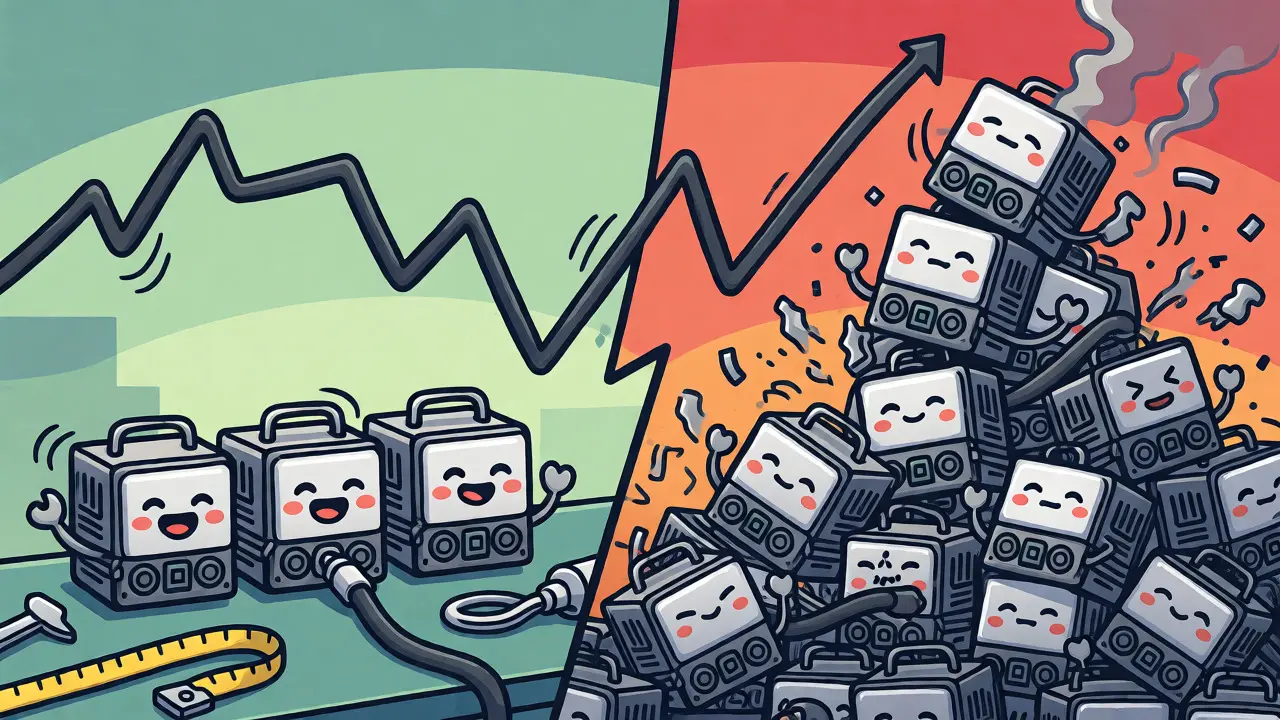
- Equipment Obsolescence: Newer chips arrive every 12-18 months. Residual value of old ASICs drops sharply. Plan for replacement cycles, not indefinite life.
- Regulatory Changes: While no federal ban exists in the US, local zoning and environmental rules can halt projects. Proposed excise taxes on mining electricity remain a policy risk.
- Counterparty Failure: Hosting providers can lose access to your machines or suffer outages. Require service-level agreements (SLAs) with penalties for downtime.
- Liquidity Crunches: Electricity bills come monthly; Bitcoin payouts vary. Maintain a cash reserve covering at least six months of operating expenses.
Treasury management is critical. Do not borrow against optimistic Bitcoin prices. Calculate your "shutdown price"-the Bitcoin price at which variable costs exceed revenue. Include pool fees, hosting, and restart costs in this calculation. If Bitcoin falls below this line, you stop mining to preserve cash. Many operators fail because they keep mining at a loss, hoping for a rebound, while bleeding working capital.
Launch Sequence: Start Small, Scale Smart
Do not launch with a 10 MW facility on day one. Follow a phased approach:
- Form Entity & Get Advice: Set up your LLC or Corp. Consult a tax professional familiar with virtual currency property treatment.
- Secure Site Control: Obtain options on land or hosting capacity. Verify grid feasibility studies before signing long-term leases.
- Pilot Phase: Buy a small fleet (e.g., 5-10 units). Install them and monitor actual performance vs. theoretical specs.
- Validate Data: Measure real uptime, actual kWh consumption, failure rates, and payout accuracy. Check if cooling works as advertised.
- Scale in Tranches: Only expand after the pilot meets financial targets. Stagger purchases to avoid timing the market poorly.
This approach limits downside risk. If the pilot fails, you have limited capital exposure. If it succeeds, you have proven data to secure financing for expansion. Remember, mining is a margin game. Every cent saved on power or every hour of extra uptime adds directly to net profit.
Frequently Asked Questions
What is the minimum power cost needed for profitable Bitcoin mining?
While it varies by hardware efficiency and Bitcoin price, most modern operators aim for power costs below $0.05/kWh. Rates above $0.08/kWh make profitability difficult unless Bitcoin prices are exceptionally high. Industrial-scale operations often secure rates near $0.03-$0.04/kWh through direct PPAs or stranded gas sources.
How does the Bitcoin halving affect my business plan?
The halving reduces the block reward paid to miners by 50%. In April 2024, the reward dropped from 6.25 BTC to 3.125 BTC. This immediately cuts revenue per unit of work unless Bitcoin's price doubles or transaction fees rise significantly. Your business model must account for this structural revenue decline over time.
Should I join a mining pool or mine solo?
For businesses, joining a pool is almost always better. Solo mining offers the full block reward but has extreme variance-you might go months without finding a block. Pools provide steady, predictable income based on your contributed hash rate. Full Pay-Per-Share (FPPS) pools are popular for cash-flow stability, though they charge higher fees than PPLNS models.
What happens if my hosting provider goes bankrupt?
This is a significant risk. If the provider holds custody of your machines, retrieving them can be legally complex and costly. Ideally, retain ownership and control of your ASICs. Contractually specify that your equipment remains your property and outline clear remedies for insolvency, including immediate access rights and liability coverage for theft or negligence.
Are there tax implications for mining Bitcoin in the US?
Yes. The IRS treats mined Bitcoin as ordinary income at its fair market value when you receive it. You also owe self-employment tax if you operate as a sole proprietor. Later, when you sell the Bitcoin, you may owe capital gains tax based on the difference between the sale price and your initial basis. Keep detailed records of timestamps and values.





Ejike Ugwu
1 Nov 2026 at 14:35It’s all a rigged game, man.
You think you’re buying power contracts? You’re signing your soul away to the grid overlords who want to squeeze every last satoshi out of your pockets while they pump water into dams or burn gas for nothing.
The halving was just a trapdoor set by the whales so they could dump on us retail suckers when we finally get our machines running.
I told my brother in Lagos not to touch this stuff because the electricity here is already unstable enough without some corporate entity deciding when we can mine based on their 'demand response' whims.
They talk about sub-$0.04/kWh rates like it’s easy money, but that’s only if you live next to a stranded gas flare that nobody else wants.
For the rest of us, it’s a slow bleed where you pay more for the privilege of securing their ledger than you ever make back.
The S21 XP looks shiny, sure, but wait until the hash difficulty spikes and your ROI goes from two years to never.
These industrial players with their transformers and switchgear are just waiting for the little guys to fail so they can buy up our hardware for pennies on the dollar.
Don’t let them fool you with the 'steel mill' analogy; it’s more like being a serf working the land for a lord who controls both the rain and the harvest price.
If you don’t have six months of cash sitting around doing nothing, you’re already dead in the water.
The risk isn’t just market volatility; it’s the systemic design meant to keep small operators dependent on centralized energy providers.
Every time I read about another hosting provider going bust, I feel sick knowing people lost their entire life savings to legal battles over custody rights.
This whole industry smells like desperation disguised as innovation.
Be careful, friends, because the moment you plug in, you become part of their machine, not the other way around.