



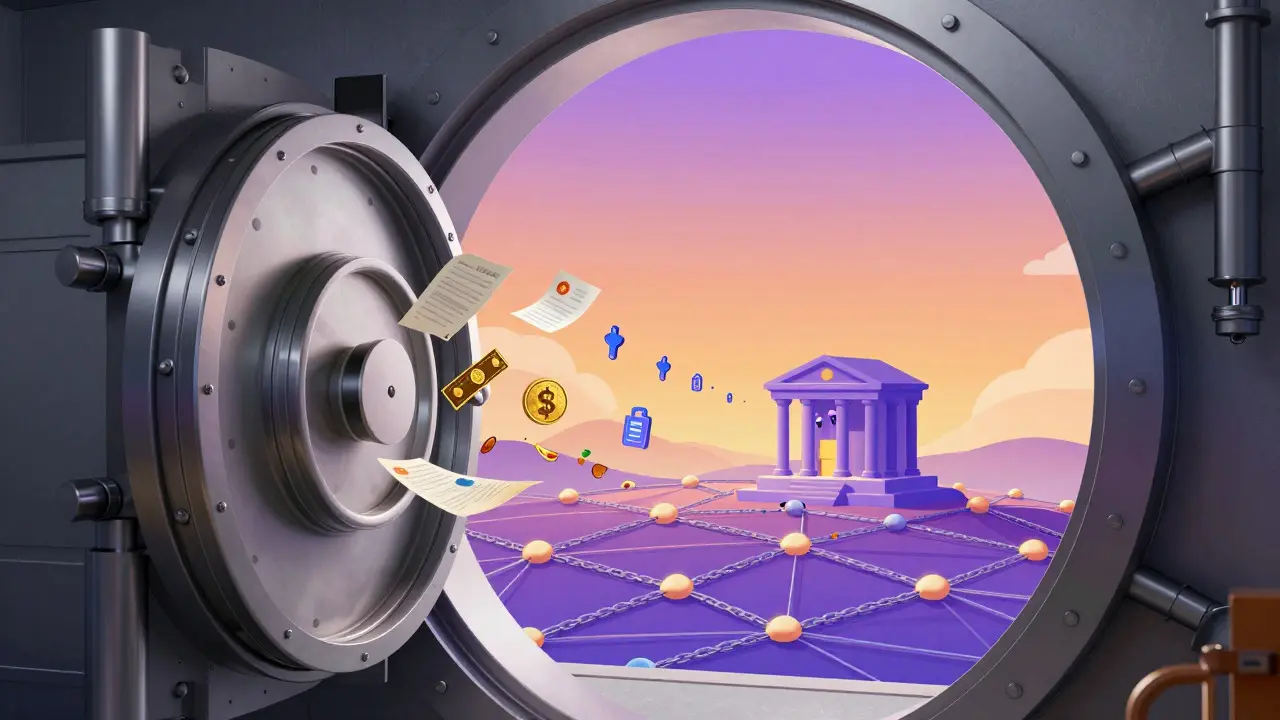
Imagine moving $50,000 from Ethereum to Arbitrum. In 2024, that meant waiting minutes, paying high gas fees, and praying a bridge didn't get hacked. Today, it takes seconds and costs pennies. This shift isn't just a technical upgrade; it's the birth of a new financial layer where liquidity hubs act as the circulatory system for global digital assets.
We are standing at the edge of a massive structural change in how value moves across blockchains. The era of isolated 'walled gardens' is ending. Instead, we are seeing the rise of standardized rails-interoperability protocols-that allow different networks to talk to each other natively. For businesses and developers, this means the end of fragmented user experiences and the beginning of seamless, multi-chain applications. But with great power comes complexity. Which standard will win? How do you secure these bridges? And where is the real money flowing?
The New Infrastructure: From Bridges to Rails
For years, blockchain interoperability was synonymous with risky token bridges. You locked tokens on one chain and minted them on another, relying on custodians or complex cryptographic proofs. It worked, but it was fragile. A single point of failure could drain billions, as seen in past exploits. The current landscape has evolved into what experts call 'programmable infrastructure.'
Today, four dominant models define this space:
- Relay Chain Architectures: Pioneered by Cosmos IBC, this model treats chains as sovereign entities that communicate via standardized messages. It’s like having a dedicated postal service between countries rather than shipping packages through a third-party courier.
- Omnichain Messaging: Protocols like LayerZero act as universal translators, allowing any smart contract on any chain to send data to any other. This is the 'internet of chains' approach.
- Intent-Based Execution: A newer paradigm where users state their goal (e.g., "I want ETH on Base"), and a network of solvers competes to fulfill it at the best price. This drastically reduces failed transactions.
- Notary Systems: Centralized or multi-sig validators that verify cross-chain actions. While less decentralized, they offer speed and simplicity for enterprise use cases.
The key difference? Speed and cost. Traditional custodial bridges still average 2-5 minutes per transfer with fees around $4.27. In contrast, intent-based solutions like Across Protocol settle in 8-15 seconds for under $0.33. That’s not just an improvement; it’s a category change.
Standardization: The IEEE and ERC-7683 Effect
You can’t build reliable infrastructure without rules. In March 2025, the IEEE Computer Society approved standard IEEE 3221.01-2025. This might sound dry, but it’s huge. It establishes baseline security requirements for cross-chain communication, including 99.995% uptime and cryptographic verification latency under 30 seconds. Before this, every protocol had its own definition of 'secure.' Now, there’s a benchmark.
Simultaneously, the Ethereum Foundation is pushing ERC-7683, part of the Open Intents Framework (OIF). This standard defines how intents should be formatted-using 32-byte chain identifiers and 256-bit nonces. As of mid-2025, 73 projects have already adopted this format. Why does it matter? Because when everyone speaks the same language, integration time drops. Developers no longer need to write custom adapters for every chain pair. They write once, deploy everywhere.
This standardization is critical for institutional adoption. Banks and asset managers don’t want to audit 50 different bridge protocols. They want one compliant, verified rail. That’s exactly what Chainlink CCIP is positioning itself to be. With 62 connected blockchains and integration into major DeFi protocols like Aave V4, CCIP has become the de facto standard for enterprise-grade cross-chain settlement.

Liquidity Hubs: Where the Money Actually Flows
Interoperability is the road; liquidity is the traffic. If you can move assets easily but there’s no one on the other side to buy or sell them, you’re stuck. This is where Liquidity Hubs come in.
A liquidity hub is a concentrated pool of assets and trading activity that serves as a primary entry/exit point for multiple chains. Currently, three ecosystems dominate this role:
- Ethereum Mainnet: Still the anchor, holding 48.7% of total DeFi liquidity. It’s the 'reserve currency' of crypto.
- Arbitrum: The leading Layer 2, capturing 19.3% of liquidity due to low fees and high throughput. It’s the workhorse for high-frequency trading.
- Base: Coinbase’s L2, rising fast to 14.1% share, driven by consumer apps and easy on-ramps.
These hubs aren’t just storage silos; they’re active markets. When you swap USDC on Optimism for WETH on Base, the execution likely happens via a solver that pulls liquidity from these central hubs. This creates a flywheel: more liquidity attracts more users, which attracts more protocols, which brings more liquidity.
But beware of fragmentation. If liquidity is too concentrated in one hub, you create a bottleneck. If it’s too spread out, you suffer from slippage and poor pricing. The ideal future state is 'dynamic liquidity routing,' where assets flow automatically to where they’re needed most, based on real-time demand signals.
Security and Trust: The Elephant in the Room
Let’s be honest: trust is the biggest barrier to mass adoption. The 2022 Wormhole exploit, which drained $325 million, still haunts institutional investors. Even though Wormhole has since secured its architecture, the lesson remains: cross-chain bridges are prime targets.
In 2025, security researchers from Trail of Bits identified 17 critical vulnerabilities across major interoperability protocols. Their CEO, Dan Guido, warned that 'dual-oracle models create single points of failure under sophisticated attack scenarios.' This is why the industry is moving away from simple message relays toward formal verification and decentralized validator sets.
Cosmos IBC scores highest on security (9.2/10) because it requires native integration-meaning both chains must explicitly support the connection. There’s no middleman. However, this flexibility trade-off limits its reach to only 78 zones. In contrast, omnichain protocols like LayerZero support 58+ chains but rely on oracle networks that can be attacked if not properly diversified.
For enterprises, compliance is equally important. The SEC’s April 2025 guidance classified certain bridge operators as money service businesses, forcing 12 protocols to implement KYC layers. This sounds restrictive, but it also legitimizes the space. If a bridge is regulated, it’s auditable. And if it’s auditable, institutions can use it.
Who Wins? A Comparative Look at Leading Protocols
No single protocol dominates all aspects of interoperability. Each has strengths and weaknesses depending on your use case. Here’s how the top contenders stack up in 2026:
| Protocol | Model | Connected Chains | Avg. Settlement Time | Key Strength | Main Weakness |
|---|---|---|---|---|---|
| Cosmos IBC | Relay Chain | 78 Zones | Seconds | Highest Security (9.2/10) | Requires Native Integration |
| Chainlink CCIP | Omnichain Messaging | 62 Blockchains | 10-30 Seconds | Enterprise Compliance & Institutional Trust | Higher Fees (0.05%) |
| LayerZero | Omnichain Messaging | 58 Chains | 15-45 Seconds | Broadest Chain Support | Dual-Oracle Security Risks |
| Across Protocol | Intent-Based | Major L1s/L2s | 8-15 Seconds | Lowest Fees (<$0.33) & Speed | Dependent on Solver Network Depth |
| Axelar | Generalized Messaging | 31 Chains | >45 Seconds (Peak) | High Success Rate (98.7%) | Latency Issues During Congestion |
If you’re building a consumer app, Across Protocol or similar intent-based solutions offer the best user experience. If you’re a bank settling trades, Chainlink CCIP provides the necessary compliance and reliability. If you’re a developer wanting maximum reach with minimal setup, LayerZero is hard to beat, provided you manage the security overhead carefully.
The Road Ahead: Consolidation and Real-World Assets
What does the next two years look like? Delphi Digital predicts a 60% consolidation among interoperability protocols by 2027. The winners will be those that achieve the best balance of security, decentralization, and scalability. We’ll see smaller, niche bridges disappear, absorbed by larger, standardized networks.
More importantly, the focus is shifting from speculative DeFi to real-world assets (RWAs). Boston Consulting Group projects the RWA market will reach $16 trillion by 2030. For this to happen, tokenized bonds, stocks, and commodities need to move seamlessly across jurisdictions and chains. Liquidity hubs will evolve into primary on-ramps for these assets, acting as the bridge between traditional finance and Web3.
JP Morgan’s Onyx division already integrated CCIP in early 2025, processing $220 million daily in cross-chain settlements. This is just the beginning. As regulatory clarity improves and standards mature, we’ll see more legacy financial institutions join the fray. The result? A global financial system where value flows as freely as email, regardless of the underlying network.
The cross-chain future isn’t about choosing one chain over another. It’s about making the choice irrelevant. By standardizing interoperability and concentrating liquidity in efficient hubs, we’re building the foundation for a truly open, global economy. The question isn’t whether this will happen-it’s how quickly you’ll adapt to it.
What is the safest way to move assets between chains in 2026?
For most users, intent-based protocols like Across Protocol offer a good balance of speed and safety, as they rely on competitive solver networks rather than single custodians. For large institutional transfers, Chainlink CCIP is often preferred due to its compliance features and established track record. Always check the specific security audits and insurance funds backing the protocol you choose.
Why are liquidity hubs important for DeFi?
Liquidity hubs reduce slippage and improve pricing efficiency. Without concentrated liquidity, cross-chain swaps would be expensive and slow because there wouldn’t be enough buyers/sellers on the destination chain. Hubs like Ethereum, Arbitrum, and Base ensure that assets can be swapped instantly at fair market rates, enabling complex DeFi strategies to function smoothly.
How does IEEE 3221.01-2025 affect blockchain developers?
It provides a clear set of technical requirements for building secure cross-chain applications. Developers can now design their systems to meet a recognized standard, which simplifies auditing and increases investor confidence. It essentially removes guesswork from security implementation, ensuring that all compliant protocols meet a minimum threshold of reliability.
Will all blockchains eventually merge into one?
Unlikely. Different chains serve different purposes (privacy, speed, cost, governance). Interoperability allows them to coexist and specialize. Think of it like different transportation modes (planes, trains, cars). They don’t merge into one vehicle, but they connect at hubs so you can switch seamlessly. The future is multi-chain, not single-chain.
What are the main risks of using cross-chain bridges?
The primary risks are smart contract bugs, oracle manipulation, and counterparty risk. While standards like IEEE 3221.01-2025 mitigate some of these, no system is 100% safe. Users should diversify their holdings across multiple trusted protocols and avoid keeping large amounts of idle assets on bridges. Monitoring protocol health and insurance coverage is essential.



Write a comment