

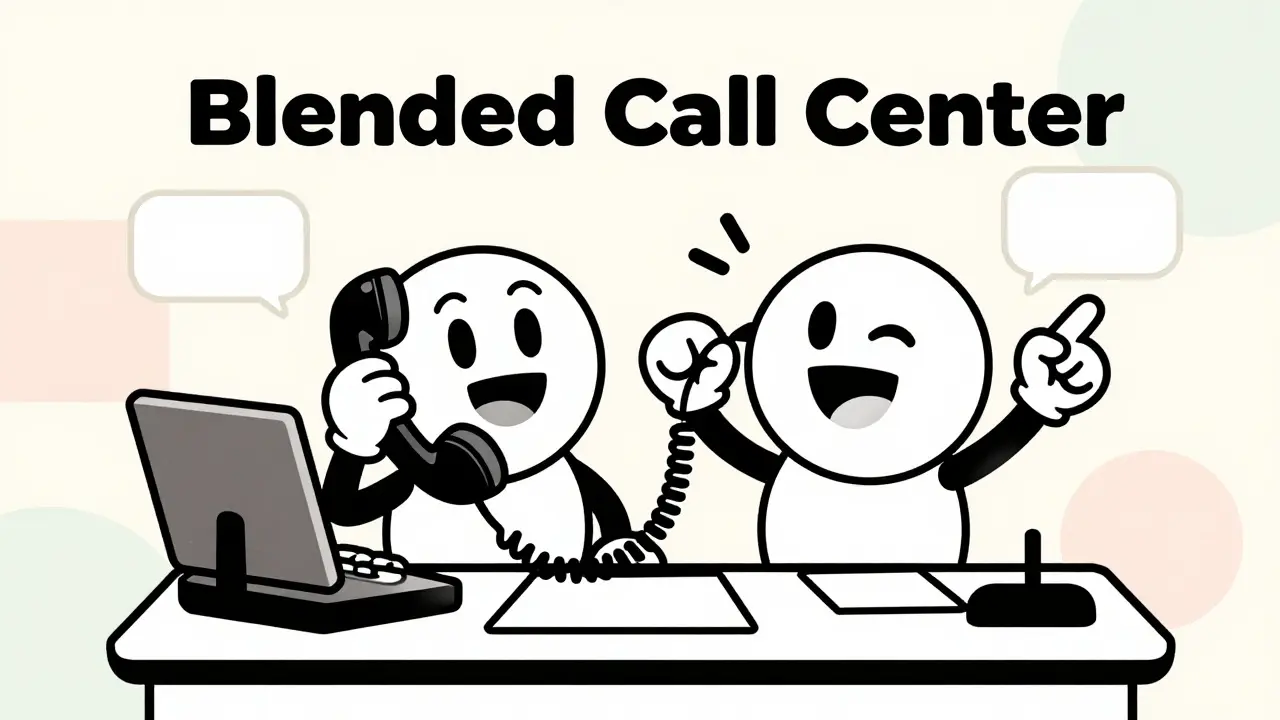

Imagine your customer service team sitting idle while your sales targets slip by. Or picture your sales reps waiting on hold because they can't answer a support question that might close a deal. This disconnect is exactly what a blended call center is designed to fix.
In a traditional setup, you have two separate silos: one team answers phones (inbound) and another makes them (outbound). A blended model breaks down those walls. It allows the same agents, using the same software, to switch dynamically between helping customers who call in and reaching out to prospects or existing clients. It’s not just about saving money on headcount; it’s about creating a fluid, responsive operation where every minute of agent time adds value.
What Is a Blended Call Center?
At its core, a blended call center combines the reactive nature of customer support with the proactive nature of sales or retention into a single operational unit. Instead of maintaining two distinct infrastructures, you use one unified platform. When the inbound queue is empty, the system automatically shifts agents to outbound campaigns. When a surge of incoming calls hits, the system pauses outbound dialing and prioritizes customer service.
This approach relies heavily on intelligent technology. You aren't just asking agents to multitask manually; you are using an Automatic Call Distributor (ACD) and a blended dialer to manage the flow. The ACD routes inbound calls to the best available agent based on skill or availability, while the outbound dialer feeds leads to agents only when they have capacity. This dynamic balancing act is what separates a true blended environment from a team that simply does both tasks but gets overwhelmed trying.
How Blended Call Centers Work: The Technology Stack
You can’t run a blended center effectively with basic phone lines. The magic happens through a specific stack of technologies working together in real-time.
- Automatic Call Distributor (ACD): This is the traffic cop for inbound calls. It ensures that when a customer calls, they reach the right person quickly. In a blended setup, the ACD must communicate constantly with the outbound system to know which agents are free.
- Outbound Dialers: These tools handle the proactive side. Predictive dialers are common here, as they can estimate agent availability and dial multiple numbers at once to ensure a live agent always has a connected prospect ready. Preview dialers allow agents to review customer data before making the call, which is useful for complex sales or high-touch retention efforts.
- Interactive Voice Response (IVR): IVR helps filter inbound calls. By resolving simple queries via menu options or deflecting them to chat/email, the IVR reduces the load on agents, freeing them up for outbound work during quiet periods.
- CRM Integration: This is non-negotiable. Whether an agent is answering a support ticket or following up on a lead, they need the full context of the customer’s history on their screen instantly. Seamless integration prevents agents from juggling multiple tabs or systems.
The key is the "blended logic" embedded in the software. It monitors queue depth and agent status continuously. If the inbound wait time exceeds a set threshold (say, 30 seconds), the system might throttle outbound dialing to bring more agents back into the inbound pool. This automation is what protects your service levels while maximizing utilization.
Key Benefits: Why Companies Are Switching to Blended Models
The shift toward blended operations isn't just a trend; it's a response to the need for efficiency and better customer experiences. Here is why organizations are making the change:
1. Improved Agent Utilization
In pure inbound centers, agents often face lulls between peak hours. In pure outbound centers, agents spend significant time listening to voicemails or busy signals. A blended model smooths these fluctuations. Agents stay engaged throughout the day, switching to outbound tasks when inbound demand drops. This reduces idle time and boosts overall productivity without adding stress.
3. Cost Efficiency
Maintaining two separate teams requires double the management overhead, duplicate software licenses, and potentially larger physical spaces. By consolidating into one blended workforce, you reduce operational costs. You also save on training expenses since cross-trained agents can handle a wider range of interactions.
3. Enhanced Customer Experience
Customers appreciate consistency. In a blended center, the agent who solves your technical issue today might be the one calling you next week to check on your satisfaction or offer a relevant upgrade. Because all interactions happen within the same system, the agent has a complete view of the relationship. This context-aware service builds trust and loyalty faster than disjointed touchpoints.
4. Agility in Staffing
Market conditions change. Maybe a product launch causes a spike in support calls, or a seasonal promotion drives outbound sales needs. A blended model allows you to pivot quickly. You don't need to hire temporary staff for short-term spikes; you can simply adjust the routing rules to shift your existing team's focus where it’s needed most.
Challenges and Risks of Blending Inbound and Outbound
While the benefits are clear, blending isn't a plug-and-play solution. It introduces complexity that can backfire if not managed carefully.
Agent Burnout and Stress
Switching between mindsets is mentally taxing. Moving from a helpful, empathetic support mode to a persuasive, goal-oriented sales mode requires cognitive flexibility. If agents are forced to switch too frequently, or if they feel pressured to hit outbound quotas while handling urgent inbound issues, burnout rates can skyrocket. Proper pacing and realistic expectations are crucial.
Complex Forecasting and WFM
Workforce Management (WFM) becomes significantly harder. You’re no longer forecasting just inbound volume or just outbound campaign duration. You need to predict how many agents will be occupied with inbound calls at any given moment to determine how many are available for outbound work. Accurate forecasting requires historical data on both sides and sophisticated algorithms to balance the load.
Quality Control Dilution
There’s a risk that quality suffers in one area to benefit the other. For example, agents might rush inbound calls to get back to their outbound lists, leading to lower First Contact Resolution (FCR) rates. Conversely, they might be too soft on outbound calls because they’re worried about upcoming inbound surges. Rigorous quality assurance (QA) processes must monitor both interaction types equally.
Setting Up Your Blended Call Center: A Step-by-Step Guide
If you’re ready to move away from siloed operations, follow this roadmap to ensure a smooth transition.
- Define Clear Goals and KPIs: Determine what success looks like. Are you aiming to reduce cost per call? Increase sales conversion? Improve CSAT scores? Set specific metrics for both inbound (e.g., Average Handle Time, Service Level) and outbound (e.g., Connect Rate, Conversion Rate).
- Choose the Right Platform: Select a cloud-based contact center solution that offers native blending capabilities. Look for features like predictive dialing, skill-based routing, and robust analytics. Ensure it integrates seamlessly with your CRM.
- Analyze Current Metrics: Before launching, review your current inbound and outbound performance. Understand your baseline AHT, FCR, and abandonment rates. This data will help you configure the blending thresholds correctly.
- Design Routing Logic: Decide on priority rules. Typically, high-priority inbound calls (like technical support or VIP customers) should always take precedence over outbound campaigns. Define when the system should pause outbound dialing based on inbound queue length.
- Hire and Train Blended Agents: Recruit individuals who possess both strong communication skills and resilience. Train them extensively on both product knowledge and sales techniques. Include stress-management strategies in your training to help them cope with context switching.
- Pilot and Optimize: Start with a small group of agents. Monitor their performance closely, gather feedback, and adjust the routing rules and staffing models as needed. Gradually scale up once the process is stable.
Best Practices for Managing a Blended Environment
To make your blended call center thrive, keep these best practices in mind:
- Use Skill-Based Routing: Not all agents are equal in every task. Route complex technical inquiries to senior support agents, while directing simpler outbound surveys to newer hires. This ensures efficiency and quality across the board.
- Implement Real-Time Monitoring: Supervisors need dashboards that show both inbound queue depths and outbound campaign progress. This visibility allows for immediate interventions, such as pausing a campaign if inbound volume spikes unexpectedly.
- Prioritize Compliance: Blended centers must adhere to strict regulations, especially regarding outbound calls (like TCPA in the US). Ensure your software includes compliance features like do-not-call list scrubbing and consent management.
- Focus on Agent Well-being: Provide tools for stress management, such as break reminders and wellness resources. Recognize and reward achievements in both inbound and outbound areas to maintain motivation.
- Leverage AI and Analytics: Use AI-driven insights to predict call volumes and optimize staffing schedules. Analyze conversation data to identify trends and improve scripts for both support and sales interactions.
| Feature | Pure Inbound | Pure Outbound | Blended Call Center |
|---|---|---|---|
| Primary Focus | Customer Support & Service | Sales, Leads & Collections | Dynamic Balance of Both |
| Agent Utilization | Variable (Idle during lulls) | High (But inefficient due to dead air) | Optimized (Smooths peaks and valleys) |
| Technology Complexity | Low to Medium | Medium | High (Requires advanced routing) |
| Cost Structure | Higher per-contact cost | Lower per-contact cost | Consolidated, efficient costs |
| Customer Experience | Reactive, consistent | Proactive, targeted | Unified, context-aware |
| Best For | Support-heavy businesses | Sales-driven organizations | Balanced growth & retention goals |
Future Trends in Blended Contact Centers
The concept of blending is evolving beyond just voice. As omnichannel communication becomes standard, the next generation of blended centers will mix voice with digital channels like chat, email, and social media. Imagine an agent finishing a support chat and immediately being assigned an outbound voice call to a high-value prospect. This "omni-blending" will require even more sophisticated AI to route interactions based on customer preference and agent skill, further enhancing efficiency and personalization.
Additionally, AI-powered assistants will play a larger role in reducing agent workload. Real-time transcription and sentiment analysis can guide agents during calls, suggesting responses for support issues or talking points for sales pitches. This support layer will make the cognitive switch between inbound and outbound modes easier, mitigating one of the biggest risks of the blended model.
What is the difference between a blended and a hybrid call center?
While often used interchangeably, there is a subtle distinction. A blended call center typically refers to the mixing of inbound and outbound *voice* calls within the same agent pool. A hybrid call center usually refers to a mix of *channels* (voice, email, chat, social) or a mix of *workforce models* (on-site agents combined with remote or outsourced agents). However, modern platforms often combine both concepts, offering omni-channel blending.
Is a blended call center right for my business?
A blended model is ideal if you have significant volumes of both inbound support and outbound sales/retention activities. If your business is 90% inbound and 10% outbound, the complexity of blending may outweigh the benefits. It works best when there is enough variability in call volume to justify shifting agents between tasks dynamically.
How do I prevent agent burnout in a blended environment?
Prevent burnout by setting realistic performance targets for both inbound and outbound tasks. Avoid forcing agents to switch contexts too frequently. Use technology to automate routine tasks and provide adequate breaks. Regularly monitor agent stress levels through surveys and performance metrics, and offer support resources like coaching and wellness programs.
What software features are essential for a blended call center?
Essential features include an Automatic Call Distributor (ACD) for inbound routing, a predictive or power dialer for outbound campaigns, Interactive Voice Response (IVR) for call filtering, seamless CRM integration for context, and robust analytics dashboards for monitoring both inbound and outbound KPIs in real-time.
Can I implement a blended call center with my current VoIP system?
It depends on your current provider. Many modern cloud VoIP and contact center platforms (like Five9, NICE, or Nextiva) offer built-in blending capabilities. If your current system lacks advanced routing logic or outbound dialing features, you may need to upgrade or integrate third-party dialer software to achieve true blending.







Michael Richards
20 Jun 2026 at 22:14This is absolute fluff for people who don't know what they're doing. You think blending inbound and outbound is just about "efficiency"? It's a recipe for disaster if you don't have elite talent. Most companies try this to cut costs, not because it makes sense operationally. Agents get whiplash switching from empathy mode to sales shark mode. If your CRM isn't perfect and your ACD logic is dumb, you'll lose customers on the inbound side while failing to close deals on the outbound side. Don't fall for the hype.