


Most people think of Bitcoin when they hear "blockchain," but that's just one piece of a much larger puzzle. If you've been following the crypto space, you know that environmental impact and scalability have become the two biggest hurdles for digital assets. Cardano is a third-generation layer 1 blockchain designed to solve these exact problems through academic research and a unique proof-of-stake mechanism. Launched in 2017, it has spent nearly a decade refining its architecture to balance security with sustainability, making it a standout choice for those who care about long-term viability rather than just short-term price spikes.
You might wonder why another blockchain matters when Ethereum dominates the smart contract space. The answer lies in how Cardano handles its core operations. Instead of relying on energy-hungry mining rigs like early Bitcoin networks, Cardano uses a protocol called Ouroboros. This isn't just a buzzword; it’s a mathematically proven system that ensures network security without burning through electricity. For investors and developers alike, this means a platform that can scale as adoption grows without hitting the same environmental ceilings that plagued earlier generations of crypto.
The Core Architecture: Why Two Layers Matter
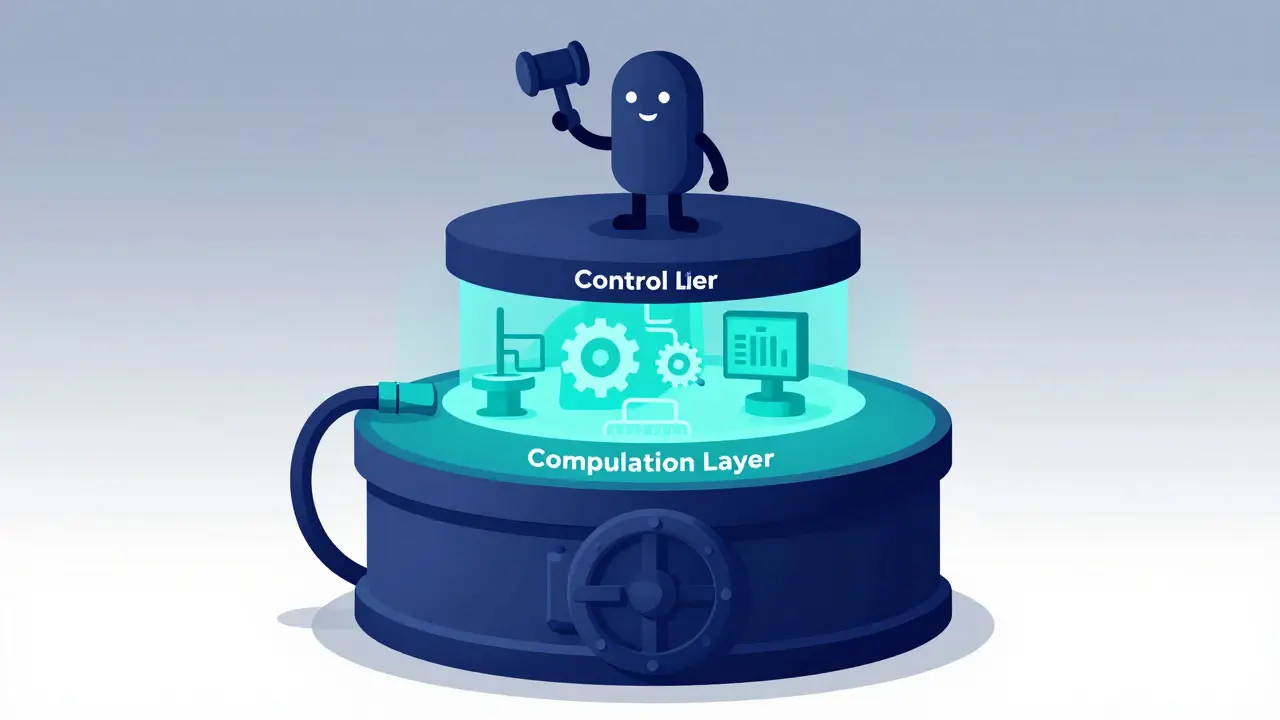
At its heart, Cardano operates as a computer operating system for the decentralized web. It doesn't just process payments; it provides the framework for everything else to run on top of it. To understand why this works so well, you need to look at its multi-layered structure. Unlike monolithic blockchains where every function competes for the same resources, Cardano splits its operations into distinct layers.
- Cardano Settlement Layer (CSL): This layer handles the basics-sending and receiving ADA transactions. Think of it as the banking system of the network. It focuses purely on moving value securely and quickly.
- Cardano Computation Layer (CCL): This is where the magic happens for developers. It powers smart contracts and decentralized applications (dApps). Because it's separate from the settlement layer, complex calculations here don't slow down simple money transfers.
- Cardano Control Layer: This acts as the governance backbone, managing the rules of the network and ensuring updates are implemented smoothly.
This separation is a game-changer for scalability. Imagine trying to upgrade your car's engine while driving at highway speeds; it's risky and disruptive. With Cardano, you can update the computation layer to support new apps without touching the settlement layer that keeps your funds safe. This architectural independence allows each part of the network to evolve at its own pace, reducing bottlenecks and improving overall performance.
Ouroboros: The Science Behind Sustainability
So, how does Cardano achieve such low energy consumption? The secret is the Ouroboros consensus mechanism, which is the first proof-of-stake algorithm developed through peer-reviewed academic research. In traditional proof-of-work systems, miners race to solve complex mathematical puzzles using massive amounts of computing power. The winner gets to add a new block to the chain and earns a reward. It’s effective, but incredibly wasteful.
Ouroboros flips this model. Instead of competing for computing power, participants stake their ADA tokens to validate transactions. Time is divided into "epochs" and "slots." During each slot, the network randomly selects a validator based on how much ADA they have staked. The more you stake, the higher your chance of being picked. But here’s the key: it’s not just about having the most money. The system uses cryptographic randomness to ensure fairness, preventing any single entity from dominating the network indefinitely.
This approach offers a few critical advantages:
- Energy Efficiency: Since there’s no need for heavy hardware crunching numbers, energy usage drops dramatically. This makes Cardano one of the most environmentally friendly major blockchains available today.
- Mathematical Security: Because Ouroboros was built on rigorous academic proofs, it guarantees the same level of security as proof-of-work systems. You don’t have to guess if the network is secure; the math backs it up.
- Decentralization: Thousands of independent nodes operate across the globe, managed by Stake Pool Operators (SPOs). This geographic diversity strengthens the network against failures or attacks.

How ADA Works: More Than Just Currency
ADA, named after Ada Lovelace-the 19th-century mathematician considered the first computer programmer-is the native asset of the Cardano ecosystem. But calling it just a "coin" undersells its utility. ADA serves four distinct functions within the network, each playing a vital role in keeping the system running.
| Function | Description | User Action Required |
|---|---|---|
| Digital Currency | Securely exchange value globally without intermediaries. | Hold in a wallet and send/receive. |
| Transaction Fees | Pays for network processing and prevents spam. | Maintain a small ADA balance in your wallet. |
| Staking Rewards | Earn passive income by helping secure the network. | Delegate ADA to a stake pool. |
| Governance Rights | Vote on future upgrades and treasury spending. | Participate in Project Catalyst voting. |
Let’s break down staking, since that’s what most users care about. When you delegate your ADA to a stake pool, you aren’t locking it away forever. You’re simply lending your stake to help validate blocks. In return, you earn rewards proportional to your contribution. It’s similar to putting money in a savings account, except you’re helping run the bank. You can do this with minimal technical knowledge using wallets like Daedalus, which downloads a full copy of the transaction history to ensure maximum security. Just remember: if you lose your seed phrase, you lose access to your funds, so keep it safe.
Smart Contracts and the EUTXO Model
Cardano didn’t stop at payments. Through upgrades like the Mary hard fork, it became a multi-asset ledger capable of running smart contracts. These are self-executing agreements that trigger actions when specific conditions are met. But Cardano approaches them differently than Ethereum.
Instead of an account-based model, Cardano uses the Extended Unspent Transaction Output (EUTXO) model. This builds on Bitcoin’s UTXO foundation but adds data fields to each entry. Why does this matter? It makes smart contracts more predictable. In many other systems, a bug in one contract can cascade and break others. With EUTXO, contracts reference specific ledger entries, isolating risks and ensuring that if one deal fails, it doesn’t take down the whole network.
This design also separates validation from execution. The blockchain validates that the rules were followed, but the actual side effects happen off-chain. This keeps the main chain lightweight and fast, while still allowing for complex dApps in DeFi, supply chain tracking, and gaming. It’s a subtle but powerful distinction that gives developers more flexibility without sacrificing stability.

Governance: Giving Power to the People
Who decides the future of Cardano? Not a single CEO or company. The answer is the community, through a system called Project Catalyst. This is Cardano’s on-chain voting and treasury system. ADA holders can propose projects, fund them, and vote on how the network evolves.
This decentralized governance model ensures that the platform remains responsive to user needs. Whether it’s funding a new bridge to another blockchain or upgrading the underlying code, the decision rests with those who hold the most at stake. It’s a radical shift from centralized tech companies, where roadmap changes are often opaque. Here, transparency is built into the protocol itself.
Frequently Asked Questions
Is Cardano better than Ethereum?
It depends on your priorities. Ethereum has a larger developer ecosystem and more established dApps. However, Cardano offers lower energy costs, a more rigorous academic approach to development, and a two-layer architecture that may offer better long-term scalability. If you value sustainability and structured growth, Cardano is a strong contender. If you want immediate access to a vast array of existing apps, Ethereum might be more convenient right now.
Do I need to run a node to stake ADA?
No. You can delegate your ADA to an existing stake pool operator (SPO) through your wallet. This requires no technical setup beyond choosing a reputable pool. Running your own node is optional and only necessary if you want to contribute directly to network infrastructure without delegating to others.
What is the minimum amount of ADA needed for staking?
There is no strict minimum set by the protocol, but practically, you need enough ADA to cover transaction fees for delegation and to maintain a sufficient balance to avoid your stake becoming dust. Most pools recommend holding at least a few hundred ADA to make the rewards meaningful relative to the effort of managing the wallet.
How does the EUTXO model improve security?
The EUTXO model treats each transaction output as a unique object. Smart contracts must explicitly reference these objects, which prevents unintended interactions between different contracts. This isolation reduces the risk of bugs spreading across the network, making the system more robust and easier to audit.
Can I use ADA for anything besides staking and paying fees?
Yes. As the ecosystem grows, ADA will be used to pay for services on dApps, interact with DeFi protocols, and participate in governance votes. Its role as a universal medium of exchange within the Cardano network is expanding beyond just basic transfers.







Write a comment