



Imagine buying a ticket to the lottery where you don't have to buy the machine, plug it in, or worry about your electric bill skyrocketing. That is essentially what cloud mining is. You rent computational power from a remote data center, and they handle the noisy fans, the heat, and the hardware maintenance. It sounds like the perfect solution for anyone wanting to mine Bitcoin without turning their garage into a server room. But here is the catch: while you skip the hardware headache, you often trade away a chunk of your profits to service fees and contract risks.
The Core Concept: What Are You Actually Buying?
At its heart, cloud mining is a service model. Instead of purchasing an ASIC miner (Application-Specific Integrated Circuit), which can cost anywhere from $2,000 to over $15,000 depending on the model, you buy a contract. This contract grants you a specific amount of hashrate, also known as hash power. Hasrate measures how many calculations your rented hardware can perform per second. In Bitcoin mining, this is critical because miners compete to solve complex cryptographic puzzles. The more hashes you can attempt per second, the higher your chance of solving the puzzle and earning the block reward.
You might see units like TH/s (terahashes per second) or PH/s (petahashes per second). To put that in perspective, modern contracts often start at 10 TH/s for Bitcoin. While that sounds impressive, remember that the entire Bitcoin network’s total hashrate hit 600 EH/s (exahashes per second) in late 2023. Your little slice of the pie needs to be big enough to matter, yet small enough to fit your budget. Providers like BitFuFu or NiceHash act as intermediaries, managing massive facilities filled with thousands of machines and selling slices of their total power to retail users.
Why People Choose Cloud Mining Over Hardware
The biggest draw is accessibility. Traditional mining requires technical know-how. You need to understand overclocking, cooling solutions, and firmware updates. If your rig goes down at 3 AM, you fix it. With cloud mining, the provider handles all that. You just log in to a dashboard. For beginners with limited capital-say, $100 to $500-this lowers the barrier to entry significantly. You avoid the upfront capital expenditure for hardware, which depreciates rapidly as newer, more efficient chips are released.
Another major factor is electricity. Home mining setups can rack up bills between $150 and $500 monthly. If you live in a region with high energy costs, such as areas where rates exceed $0.15/kWh, traditional mining might barely break even. Cloud providers operate in locations with cheap industrial electricity, often below $0.05/kWh. They pass some of these savings to you, though not all of them. By renting hash power, you effectively outsource the energy inefficiency problem to someone else who has scale advantages.
The Hidden Costs and Risks
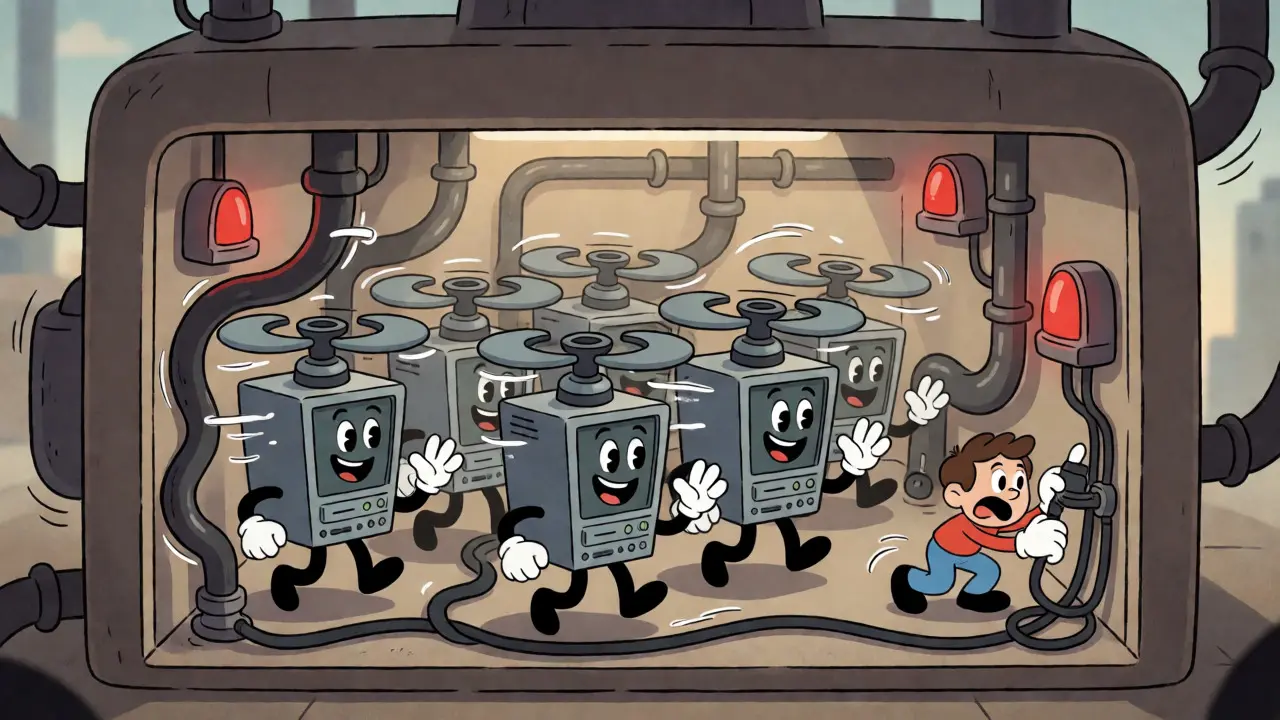
It isn’t all sunshine and passive income. Service fees eat into your margins. Providers typically take 10% to 25% of your mining revenue as a fee. This includes maintenance, electricity, and profit for the company. During bull markets, when cryptocurrency prices soar, these fees feel negligible. But during bear markets, when prices drop, those same fees can turn a profitable contract into a loss-maker almost overnight.
Contract limitations are another trap. Many contracts last one year. If the market crashes halfway through, you’re stuck paying fees on unprofitable operations unless you sell the contract back, often at a steep discount. There is also the risk of scams. The industry lacks strict regulation. The SEC’s enforcement action against HashOcean, which settled for $2.4 million, highlighted that some cloud mining contracts might qualify as unregistered securities. Always check if the provider has a transparent track record. A study by the Blockchain Council found that only 37% of surveyed cloud mining services passed rigorous transparency audits. That means nearly two-thirds failed basic trust checks.
| Feature | Cloud Mining | Traditional Mining |
|---|---|---|
| Upfront Cost | Low ($100 - $500) | High ($2,000 - $15,000+) |
| Technical Skill | Minimal | Advanced |
| Maintenance | Provider handles it | User handles it |
| Profit Margins | Lower (due to fees) | Higher (if managed well) |
| Risk Factor | Scam/Fee Risk | Hardware Failure/Energy Cost |
How to Calculate Real Profitability
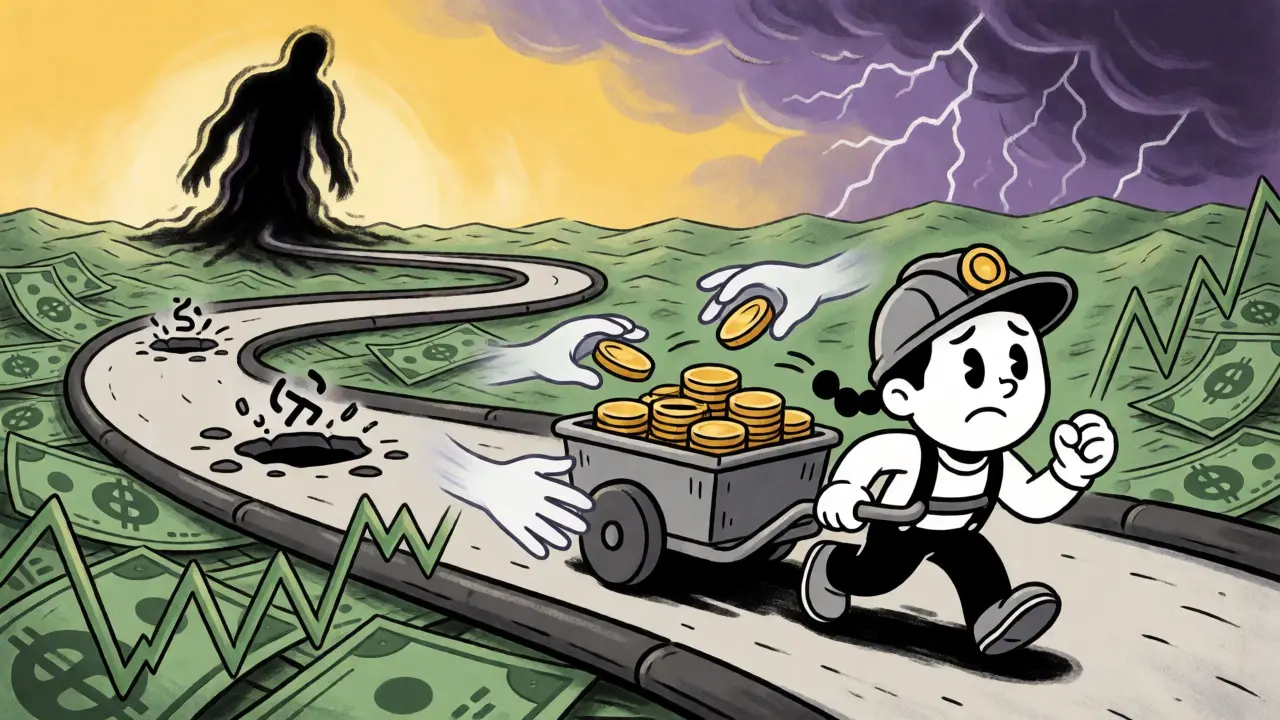
Don’t just look at the advertised daily earnings. You need to calculate your break-even point. Let’s say you buy a 100 TH/s contract for $100. At a Bitcoin price of $42,000, after deducting maintenance fees equivalent to $0.05/kWh, you might net around $0.85 per day. To recoup your $100 investment, you’d need 117 days of stable conditions. If the difficulty increases-which happens roughly every two weeks-or the price drops, that timeline stretches indefinitely.
Use online calculators provided by reputable sites. Input your contract size, duration, and current network difficulty. Then, stress-test it. What happens if Bitcoin drops 20%? What if network difficulty rises 10% next month? Dr. Alex de Vries, founder of Digiconomist, warned that hidden fees make profitability elusive for 85% of retail customers during average market conditions. He’s right. Most people underestimate how quickly difficulty adjustments erode returns.
Choosing a Reputable Provider
Not all platforms are created equal. Look for providers with long operating histories and transparent dashboards. BitFuFu, launched in 2020, has gained traction for its real-time hashrate monitoring and no-hidden-fee policy. Users on Trustpilot rate it 3.8/5, with praise for its user-friendly interface. However, read the negative reviews too. Some users complained about withdrawal delays and unexpected contract modifications during market downturns.
Check for regulatory compliance. Since 2024, the SEC clarified that cloud mining services handling customer crypto must register as money services businesses. Platforms that haven’t adapted to this guidance might pose legal risks. Also, consider hybrid models. Genesis Mining recently launched 'Hash Power Tokens,' allowing fractional ownership of physical rigs. This bridges the gap between pure rental and actual asset ownership, offering more transparency about what you’re paying for.
Who Should Avoid Cloud Mining?
If you want maximum control and highest potential returns, stick to hardware. If you live in a place with free or extremely cheap electricity, home mining beats cloud every time. Cloud mining fails when you expect guaranteed profits regardless of market conditions. It is a speculative tool, not a savings account. If you panic-sell your mined coins during dips, you’ll likely lose money after fees. Only enter cloud mining if you plan to hold the mined assets long-term and can tolerate periods of zero or negative ROI.
Geographic location matters less for cloud mining than it does for hardware, but tax implications still apply. In the US, mining income is taxable upon receipt. Keep detailed records of your contract purchases and payouts. Unlike hardware mining, where depreciation deductions might offset income, cloud mining expenses are harder to claim cleanly. Consult a tax professional familiar with crypto before signing up.
Is cloud mining profitable in 2026?
Profitability depends heavily on Bitcoin's price and network difficulty. As of recent trends, only about 28% of users achieve profitability over 12-month periods. It works best when bought during market bottoms and held through price increases. High service fees mean you need significant price appreciation to break even compared to owning your own hardware.
What happens if my cloud mining contract becomes unprofitable?
Most contracts continue running until expiration, meaning you pay fees even if you aren't earning much. Some modern providers, like BitFuFu, offer features to suspend contracts automatically during severe downturns. Otherwise, you may choose to sell the remaining contract value on secondary markets, often at a discount.
Do I need technical skills to start cloud mining?
No. The learning curve is rated very low, around 2 out of 10. You only need to create an account, complete KYC verification, and select a contract. The provider manages all hardware, software, and cooling issues remotely.
Are cloud mining companies regulated?
Regulation varies by country. In the USA, the SEC has taken steps to classify certain contracts as securities, requiring registration. Many offshore providers operate in gray areas. Always verify if a platform complies with local financial regulations before investing large sums.
Can I withdraw my mined coins anytime?
Yes, but minimum withdrawal thresholds apply. Some platforms charge withdrawal fees. Delays can occur during high network congestion or if the provider undergoes internal audits. Check the payout schedule-some pay daily, others weekly or monthly.









Jeff Falcon
4 Sep 2026 at 20:00Look, I totally get the appeal here because, honestly, who wants to deal with the noise of ASIC fans at 3 AM when you could just be sleeping soundly in a warm bed? It really is like renting a car instead of buying one, sure, you pay more over time, but you don't have to worry about the oil changes or the transmission blowing up on a highway trip. I've been thinking about this for months now, and the part that gets me is the electricity savings, especially since my utility rates are climbing higher every single month due to those new infrastructure taxes they keep adding. If I were to set up a rig in my garage, I'd need to install dedicated circuits, maybe even upgrade my panel, which costs thousands upfront, whereas cloud mining lets me dip my toes in with just $100. But then again, the fees are brutal, and if Bitcoin doesn't moon soon, I'm basically paying rent on a machine that might not even break even by the end of the year. It's a gamble, no doubt about it, but for someone like me who lacks the technical skills to fix firmware issues, it seems like the only viable option without hiring an IT guy for every minor glitch. Plus, the tax situation is simpler too, since I don't have to track depreciation schedules for hardware that becomes obsolete in six months. So yeah, I'm leaning towards trying a small contract just to see how the dashboard works and whether the withdrawal process is actually smooth or if they hold your coins hostage until you refer three friends.