



When you send Bitcoin or Ethereum, no bank approves it. No clerk verifies your ID. No middleman stands between you and the recipient. So how does the network know you own the money you’re trying to spend? The answer lies in something simple but powerful: cryptographic signatures. These aren’t just fancy math-they’re the digital equivalent of a handwritten signature that can’t be forged, copied, or denied. And they’re what make public blockchains work without trusted authorities.
What Exactly Is a Cryptographic Signature?
A cryptographic signature is a unique digital code generated using your private key. It proves two things: that you own the funds, and that you approved the transaction. It doesn’t reveal your private key. It doesn’t even look like your key. It’s just a mathematically linked proof that only your key could have created. This works because of asymmetric cryptography. Every user has a pair of keys: a private key (kept secret) and a public key (shared openly). The public key is derived from the private key using elliptic curve math. You can’t reverse-engineer the private key from the public key. That’s the foundation. When you sign a transaction, your private key combines with the transaction data to create a signature. Anyone can check that signature using your public key-and only your public key-to confirm it’s valid.The Four-Step Process Behind Every Transaction
Every time you send cryptocurrency, four things happen in sequence:- Hashing the transaction: The details-sender, receiver, amount, timestamp-are fed into a hash function (SHA-256 in Bitcoin). This turns the data into a fixed-length string. Even changing one digit completely changes the hash. This ensures data integrity.
- Signing with your private key: Your wallet uses your private key and the transaction hash to generate a signature using the Elliptic Curve Digital Signature Algorithm (ECDSA). This signature is a pair of numbers, (r, s), unique to that exact transaction.
- Broadcasting to the network: The transaction, along with your public key and signature, gets sent out to all nodes on the network.
- Verification by nodes: Each node takes your public key, the transaction hash, and the signature. It runs a mathematical check. If the signature matches, the transaction is valid. If it doesn’t, it’s rejected.
Why ECDSA? The Standard Behind Most Cryptocurrencies
Bitcoin, Ethereum, and over 90% of major blockchains use ECDSA. Why? Because it’s efficient and secure. ECDSA uses elliptic curves-mathematical shapes that allow strong security with small key sizes. Bitcoin’s secp256k1 curve, chosen by Satoshi Nakamoto in 2009, uses 256-bit keys to produce signatures around 72 bytes long. Compare that to RSA, which would need 3,072-bit keys for similar security and produce signatures over 384 bytes. On a blockchain where every byte costs money, efficiency matters. The secp256k1 curve has fixed parameters: a prime modulus p = 2^256 - 2^32 - 977 and a base point G defined in hexadecimal. These aren’t random. They were chosen for performance and resistance to known attacks. The algorithm has been tested for over a decade. Bitcoin has processed over 427 million transactions using ECDSA since 2009. Ethereum has processed over 1.2 billion. Not a single flaw in the algorithm itself has been found.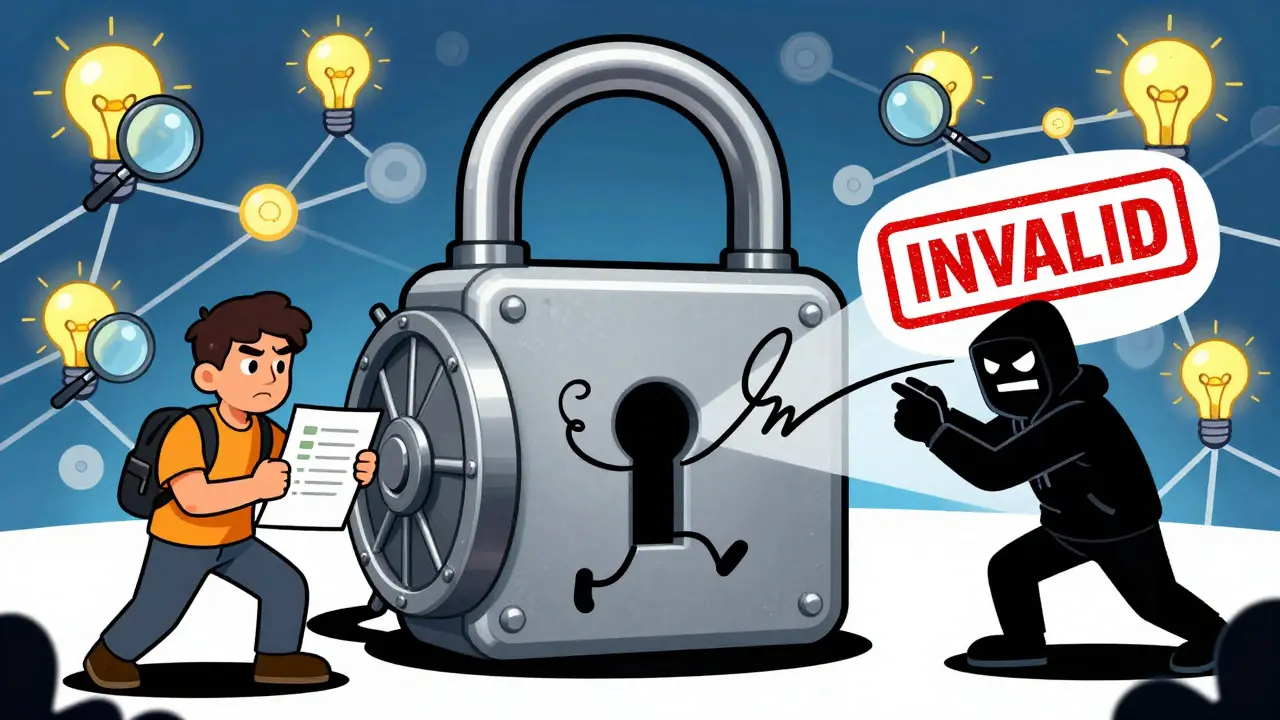
What Happens If You Change the Transaction?
One of the most important features of cryptographic signatures is tamper detection. Imagine you send 0.5 BTC to Alice. Your signature is tied to that exact transaction. If someone tries to change the amount to 0.6 BTC after you sign it, the hash changes. The signature no longer matches. The node verifies it, sees the mismatch, and rejects the transaction. This isn’t a bug-it’s by design. The signature locks the data in place. Any alteration breaks the link. This is why blockchain transactions are immutable. Not because they’re stored in a “chain,” but because each one is cryptographically sealed. You can’t rewrite history because the math won’t allow it.Weaknesses and Fixes: The Story of Transaction Malleability
ECDSA isn’t perfect. In Bitcoin’s early days, a flaw called transaction malleability let attackers tweak signature formats without invalidating them. This didn’t steal funds, but it broke wallet tracking and caused confusion. The fix came in 2017 with SegWit (Segregated Witness). SegWit moved the signature data out of the main transaction and into a separate “witness” field. This made it impossible to alter the signature without breaking the entire transaction structure. It also reduced fees and improved scalability. Another issue was poor random number generation. ECDSA requires a random number (k) for each signature. If the same k is used twice, your private key can be stolen. In 2013, a vulnerability in Android Bitcoin Wallets caused this exact problem because the random number generator was predictable. Thousands of wallets were compromised. The fix? Better entropy sources. Today, modern wallets use hardware-backed secure enclaves and cryptographically secure random number generators to prevent this.Schnorr Signatures: The Next Step
ECDSA is still dominant, but it’s not the end. Bitcoin’s Taproot upgrade in November 2021 introduced Schnorr signatures. Unlike ECDSA, Schnorr allows multiple signatures to be combined into one. If you need three people to approve a transaction (a 3-of-3 multisig), ECDSA creates three separate signatures-adding bulk. Schnorr combines them into a single signature, cutting transaction size by 25% and reducing fees. It also improves privacy. To the outside world, a multisig looks like a regular single-signature transaction. Ethereum is exploring similar upgrades. EIP-2537 proposes adding support for Ed25519, a signature scheme used by Solana and Monero. Ed25519 is faster and more resistant to side-channel attacks. But it’s still early. ECDSA remains the workhorse because it’s battle-tested. Changing it requires massive coordination. Taproot’s adoption took over a year. Ethereum’s upgrades are still in draft.
Legal Recognition and Real-World Trust
Cryptographic signatures aren’t just technical-they’re legal. In the U.S., the ESIGN Act of 2000 gives digital signatures the same weight as handwritten ones. The EU’s eIDAS Regulation (2014) does the same. Over 87 countries now recognize them as legally binding. J.P. Morgan’s JPM Coin and Ripple’s On-Demand Liquidity both rely on ECDSA-based signatures to settle institutional payments. Banks don’t trust blockchain because it’s new. They trust it because the math is proven.What You Need to Know as a User
You don’t need to understand elliptic curves to use cryptocurrency. But you do need to protect your private key. If someone gets it, they can sign transactions on your behalf. No password reset. No customer service. Just irreversible loss. Use a hardware wallet. Never share your recovery phrase. Avoid sketchy apps that ask for your private key. Modern wallets handle signatures automatically. Your job is to keep the key safe. The math does the rest.Future Outlook: Quantum Threats and Beyond
The biggest long-term threat isn’t hacking. It’s quantum computing. A powerful enough quantum computer could break ECDSA by solving the discrete logarithm problem in seconds. But we’re not there yet. NIST’s 2022 post-quantum cryptography finalists are still being tested. No blockchain has adopted a quantum-resistant signature scheme yet. Experts estimate ECDSA will remain secure until at least 2035. When the time comes, upgrades like Schnorr or lattice-based signatures will be rolled out. The system is designed to evolve. For now, cryptographic signatures remain the unshakable backbone of public blockchains. They’re simple, efficient, and have stood up to over a decade of real-world use. No bank. No government. Just math. And that’s what makes them revolutionary.Can someone steal my cryptocurrency if they see my public key?
No. Your public key is meant to be shared. It’s like your bank account number-you can give it out to receive payments. Without your private key, no one can spend your funds. The math ensures that even if someone knows your public key, they can’t reverse-engineer your private key.
Why can’t I just copy and paste someone else’s signature to spend their money?
Because each signature is tied to a specific transaction hash. If you copy a signature from one transaction and try to use it on another, the hash won’t match. The network checks that the signature corresponds to the exact transaction data. A copied signature is useless on a different transaction.
What happens if I lose my private key?
You permanently lose access to your funds. There is no recovery option. Unlike banks, blockchains have no customer support team. Your private key is the only way to prove ownership. Back it up securely-preferably offline on a hardware wallet or written on paper and stored safely.
Do all cryptocurrencies use ECDSA?
Most do-Bitcoin, Ethereum, Litecoin, and others. But some newer chains use alternatives. Solana and Monero use Ed25519. Cardano uses a different scheme based on BLS signatures. Still, ECDSA powers over 93% of all cryptocurrency value transfers as of 2023.
Is ECDSA safe from hacking?
The ECDSA algorithm itself has never been broken. All major thefts happened due to poor implementation: weak random number generators, stolen private keys, or phishing. The math is solid. The human side is the weak link. Use trusted wallets, avoid sketchy apps, and never expose your private key.









Nikhil Gavhane
8 Mar 2026 at 05:16This is one of the clearest explanations I've ever read about how crypto signatures actually work. I used to think it was magic or some kind of centralized system hiding behind the scenes. Turns out it's just elegant math. The part about how changing one digit flips the entire hash really clicked for me. I've sent a few transactions before but never understood why they couldn't be tampered with. Now I get it. The immutability isn't from blockchain structure - it's from the signature locking the data. That's powerful.