



You pick up your phone to call a client. The connection drops mid-sentence. Or worse, you hear that robotic stuttering that makes everyone sound like they're talking through a fan. If you run a business on VoIP or Unified Communications, this isn't just annoying-it's costing you money. Most IT managers assume their high-speed fiber line is enough. It’s not. The problem usually isn't the last mile to your office; it's the path your voice packets take across the open internet to reach your cloud provider.
This is where the debate between Direct Connect solutions and Public Internet paths gets heated. For years, the public internet was the only option for most companies. It was cheap, easy to set up, and "good enough." But as we move deeper into 2026, with AI-driven traffic and massive data loads, "good enough" often means dropped calls and poor user experience. Let's break down why routing your voice traffic through private cloud peering might be the upgrade your network actually needs, and when sticking with the public web still makes sense.
The Hidden Cost of Public Internet Routing
Think of the public internet like a busy highway during rush hour. You have a fast car (your VoIP system), but if there are accidents, construction, or too many trucks (data spikes) in the way, your arrival time becomes unpredictable. In networking terms, this unpredictability is called jitter. Voice traffic hates jitter. It needs a steady, rhythmic flow of packets. When packets arrive out of order or get delayed by congestion, your phone system tries to buffer them. Too much buffering causes delay (latency). Too little causes gaps in speech (packet loss).
A study by PacketFabric in 2023 highlighted a stark reality: public internet paths can see jitter spike to 15-50ms during business hours. Compare that to the consistent 1-2ms jitter found on dedicated connections, and the difference is night and day. Why does this happen? Because public routes are dynamic. Your packets might hop through three different ISPs in Chicago today and five in New York tomorrow, depending on who has the cheapest route at that second. You don't control that. Your VoIP quality depends on strangers making routing decisions for profit, not performance.
How Cloud Peering Changes the Game
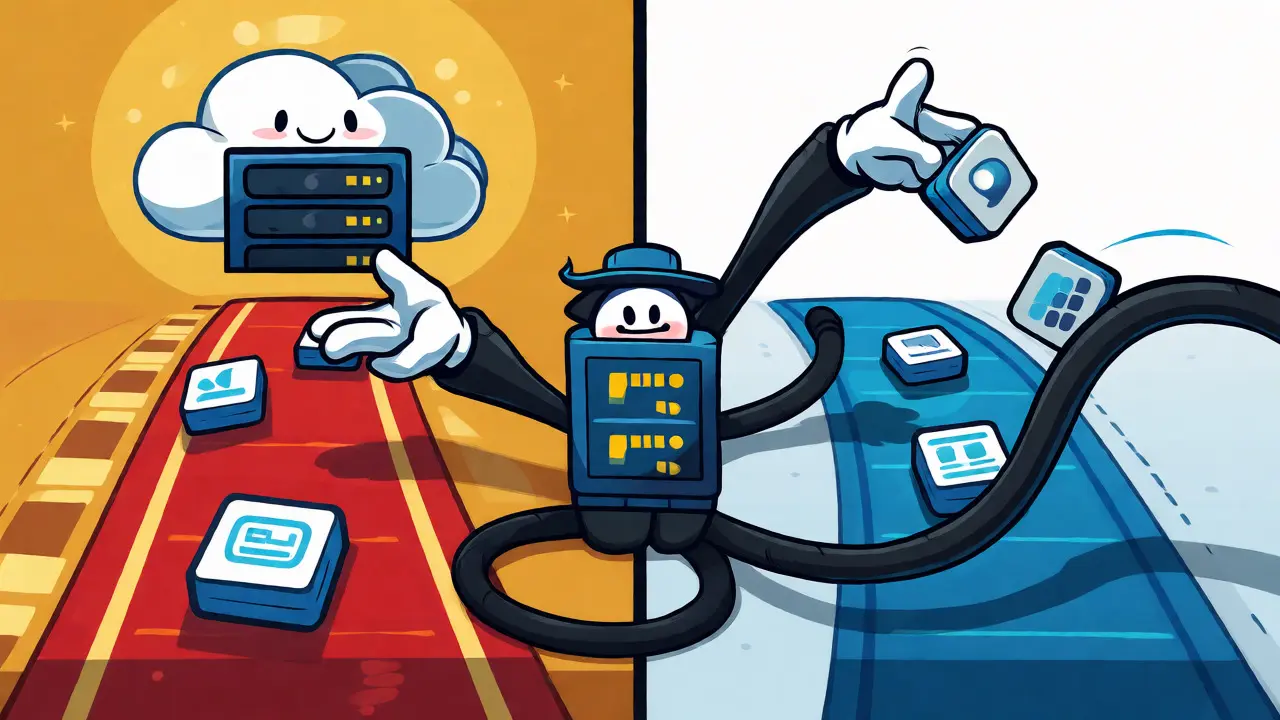
Cloud peering, often implemented via services like AWS Direct Connect, Azure ExpressRoute, or Google Cloud Interconnect, bypasses the public internet entirely. Imagine building a private toll road directly from your office to your cloud provider’s data center. No other cars. No traffic lights. Just a straight shot.
These services establish a physical or logical private connection between your on-premises infrastructure and your cloud environment. They use Border Gateway Protocol (BGP) to announce your networks directly to the cloud provider. This creates a deterministic path. You know exactly where your packets are going and how long it will take them to get there. According to CoreSite’s 2023 whitepaper, these direct connections reduce latency variability by 60% compared to public paths. That stability is gold for real-time communications.
| Metric | Public Internet Path | Direct Connect / Private Peering |
|---|---|---|
| Median Latency | 45-90 ms | 15-25 ms |
| Jitter | 15-50 ms (variable) | < 1-2 ms (consistent) |
| Packet Loss | 0.1-5% (during peaks) | < 0.01% |
| Security Exposure | High (public routing) | Low (physical/logical separation) |
| SLA Guarantee | None (best effort) | 99.95% - 99.99% |
When You Should Choose Direct Connect
Not every company needs a private pipe. If you’re a small startup with ten employees using Zoom for occasional meetings, the public internet is fine. But once you hit certain thresholds, the math changes. If you have more than 50 concurrent calls, or if your users are spread across multiple regions connecting to a single cloud hub, direct connectivity starts paying for itself in reduced support tickets and improved productivity.
Compliance is another major driver. Industries like healthcare and finance face strict regulations regarding data privacy. HIPAA guidelines updated in early 2023 explicitly recommend private network connections for healthcare communications. Why? Because keeping voice traffic off the public internet reduces the attack surface. A direct connection uses physical separation or encrypted VLANs, making man-in-the-middle attacks significantly harder. Lightpath Fiber noted in their 2023 analysis that direct fiber reduces exposure to these attacks by nearly 99.8% compared to public paths.
Consider Teladoc Health. They migrated their 15,000-user system to Google Cloud Interconnect. The result? Uptime jumped from 99.2% to 99.995%. For a telemedicine provider, those fractions of a percent represent thousands of successful patient consultations that didn’t drop due to network glitches.

The Downsides: Cost and Complexity
If direct connections are so great, why doesn’t everyone use them? Two words: cost and complexity. Setting up a direct link isn’t as simple as plugging in an Ethernet cable. It requires colocation. You need to physically connect your router to the cloud provider’s edge location, which means leasing space in a data center near one of their access points. AWS has over 130 locations globally, Google has 150+, but they aren’t everywhere.
The setup fees can range from $3,000 to $10,000, plus monthly port charges. AWS, for example, charges around $0.30 per port hour for a 1Gbps port, plus data transfer costs. While data egress fees have come down, they are still a factor. Then there’s the deployment timeline. Provisioning a dedicated circuit can take 30 to 90 days. Compare that to the few hours it takes to configure a VPN over the public internet, and you see the friction.
Technical expertise is also a barrier. Configuring BGP routing, setting up Multi-Exit Discriminators (MED), and ensuring Quality of Service (QoS) policies prioritize RTP traffic correctly requires skilled network engineers. Flexential’s 2023 survey found that teams needed 8-12 weeks of training to properly manage these connections. If you lack in-house talent, you’ll need to hire a managed service provider, adding another layer of cost.
Hybrid Strategies: The Best of Both Worlds
Most modern enterprises aren’t choosing one or the other exclusively. They’re building hybrid architectures. Here’s a common pattern: Use Direct Connect for critical applications-like core VoIP systems, ERP databases, and sensitive customer data. Route less critical traffic-like employee web browsing, software updates, and non-real-time video-over the public internet via a secure gateway.
This approach optimizes spend. You pay premium prices for the traffic that absolutely cannot fail, while leveraging the cheap, scalable nature of the public internet for everything else. Tools like Cisco ASR routers or Juniper MX series devices can handle this segmentation seamlessly. By marking VoIP packets with DSCP EF (Expedited Forwarding) tags, you ensure they get priority treatment on both private and public links.
Another emerging trend is multi-cloud connectivity. Many businesses use AWS for compute but rely on Microsoft Teams for communication. Managing direct connections to multiple providers can get messy. Solutions like Megaport allow you to create a private network fabric that connects to AWS, Azure, and Google Cloud simultaneously. This avoids vendor lock-in and simplifies management. As of late 2023, 62% of enterprises were planning hybrid direct connection strategies to avoid being tied to a single provider’s ecosystem.
Implementation Pitfalls to Avoid
Even with the right hardware, mistakes happen. The most common issue I’ve seen is MTU mismatch. If your internal network uses a standard MTU of 1500 bytes but the cloud provider expects a different size, large VoIP packets fragment. Fragmentation adds overhead and increases the chance of packet loss. Always verify MTU settings end-to-end before going live.
Another trap is ignoring failover configuration. What happens if your primary direct link goes down? If you haven’t configured a backup path over the public internet, your phones go silent. Proper BGP route propagation ensures that if the direct link fails, traffic automatically reroutes through the public internet within seconds. An October 2023 incident involving a healthcare provider showed what happens when you skip this step: 22 hours of downtime because the failover wasn’t tested.
Finally, don’t forget about security monitoring. Just because the traffic is private doesn’t mean it’s invincible. Ensure you have visibility into your direct links. Use NetFlow or sFlow data to monitor for anomalies. If a sudden spike in traffic hits your direct port, it could indicate a DDoS attempt or a misbehaving application flooding the pipe.
Key Takeaways
- Quality Matters: Direct connections offer 60% less latency variability and near-zero packet loss compared to public internet paths.
- Cost vs. Benefit: Direct Connect is worth it for organizations with >50 concurrent calls or strict compliance needs (HIPAA/PCI).
- Complexity Warning: Expect 30-90 day deployment times and significant configuration learning curves.
- Hybrid is Smart: Combine direct links for critical VoIP/data with public internet for general traffic to balance cost and performance.
- Test Failovers: Always configure and test automatic rerouting to public internet paths to prevent total outages.
Is Direct Connect always faster than the public internet?
Generally, yes, but "faster" refers to consistency rather than raw speed. Public internet can sometimes have lower initial latency if the route is short, but it suffers from high variability (jitter). Direct Connect provides predictable, low-latency paths essential for real-time apps like VoIP, whereas public internet performance fluctuates based on global congestion.
Can I use Direct Connect for all my internet traffic?
You can, but it’s rarely cost-effective. Direct Connect ports have fixed bandwidth limits (e.g., 1Gbps, 10Gbps). Routing all web browsing, streaming, and downloads through a paid private link can become expensive quickly. Most companies use split-tunneling: sending critical business apps and VoIP over Direct Connect, while letting general internet traffic exit via a local ISP.
What happens if my Direct Connect link fails?
Without proper configuration, your connection to the cloud stops. However, best practices involve configuring BGP failover so that if the direct link goes down, traffic automatically reroutes over a site-to-site VPN or public internet gateway. This ensures continuity, albeit with potentially higher latency, until the direct link is restored.
Do I need a specific router for Direct Connect?
Yes. Not all routers support the necessary features like BGP, VLAN tagging (802.1Q), and specific QoS policies required for optimal VoIP performance. Common enterprise-grade routers used include Cisco ASR 1000 series, Juniper MX series, and Palo Alto Networks firewalls. Check your provider’s compatibility list before purchasing.
Is Direct Connect more secure than a VPN over the internet?
It offers a different type of security. A VPN encrypts data over the public internet, protecting content but not hiding metadata or timing. Direct Connect keeps traffic off the public internet entirely, reducing exposure to sniffing and DDoS attacks. For maximum security, many enterprises combine both: using Direct Connect for isolation and IPsec/TLS encryption for data confidentiality.







Write a comment