

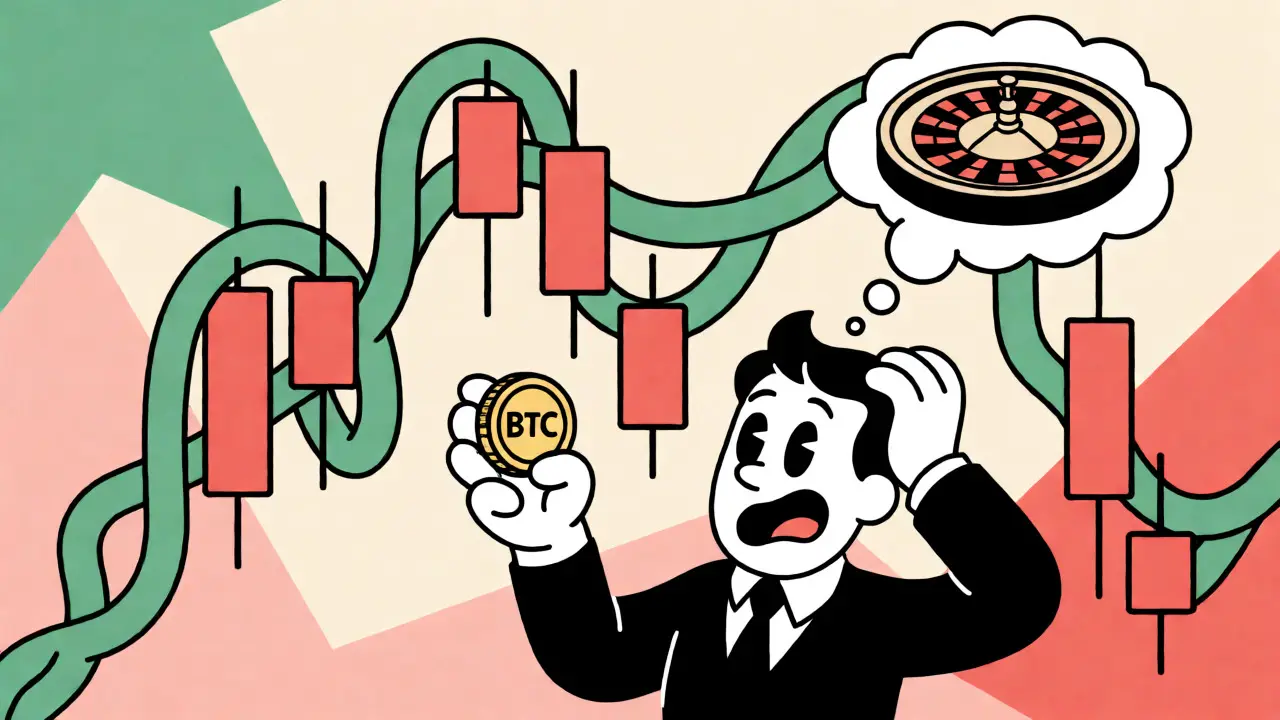

You’ve probably been there. You’re watching the charts, and Bitcoin has dropped for five straight days. Your gut screams that it has to bounce back tomorrow. It’s due, right? The universe owes you a green candle. So you double down, betting your savings on a reversal that never comes. This isn’t bad luck; it’s a glitch in your brain called the Gambler’s Fallacy. It is a cognitive bias where people mistakenly believe that if an independent event occurs more or less frequently than expected, future events will 'balance' it out. In the high-speed world of cryptocurrency, this mental trap costs traders billions annually.
The Monte Carlo Mistake in Digital Assets
The name "Monte Carlo Fallacy" comes from a famous incident in 1913 at a casino in Monaco. The roulette ball landed on black 26 times in a row. Players, convinced red was "due," bet millions on red and lost everything as the streak continued. Cryptocurrency markets don’t have roulette wheels, but they have price ticks, block confirmations, and algorithmic trades. These are often perceived as random sequences by retail investors, triggering the same primal urge to find patterns where none exist.
When you trade crypto, you are dealing with assets whose prices are influenced by a complex mix of global news, whale movements, and sentiment. While these aren't purely random like dice rolls, short-term fluctuations often appear random to the human eye. If you see ten red candles in a row on a 5-minute chart, your brain tries to impose order on chaos. You assume the probability of a green candle has increased simply because it hasn’t happened recently. Statistically, unless there is new information entering the market, the probability of the next tick being up or down remains largely unchanged by the previous ten ticks.
| Concept | Core Belief | Applies To | Risk Level |
|---|---|---|---|
| Gambler's Fallacy | Past independent events influence future probability (e.g., "It's due"). | Truly random or near-random short-term price action. | High - leads to chasing losses and over-betting. |
| Mean Reversion | Prices tend to return to their long-term average over time. | Correlated assets with historical volatility bands. | Moderate - requires statistical validation, not just intuition. |
Why Crypto Triggers Our Pattern-Seeking Brains
Human brains are evolutionarily wired to detect patterns. In the wild, noticing that rustling grass usually means a predator helped us survive. In finance, this trait becomes a liability. We look at a blockchain explorer or a trading dashboard and see faces in clouds. We convince ourselves that a specific sequence of transactions predicts the next move. This is particularly dangerous in crypto because the market operates 24/7. There is no closing bell to reset your emotional state. The dopamine hit from checking your phone every ten minutes reinforces the illusion that you are in control of a chaotic system.
Consider the concept of Statistical Independence. Two events are independent if the outcome of one does not affect the probability of the other. A coin flip is the classic example. If you flip heads ten times, the chance of tails on the eleventh flip is still exactly 50%. Crypto price movements on very short timeframes often mimic this independence. Yet, traders treat them as dependent, assuming a "correction" is mathematically inevitable after a spike. This misunderstanding leads to premature entries and exits, eroding capital through transaction fees and poor timing.
The Dopamine Loop and Illusion of Control
Beyond pure statistics, emotion plays a massive role. The Illusion of Control is another bias where you believe your skill influences random outcomes. You might think, "I analyzed the RSI indicator, so I know what's coming." But if the underlying asset movement is driven by a sudden regulatory announcement or a large liquidation cascade, your technical analysis might be irrelevant noise. The excitement of potential gains triggers dopamine release, which makes you want to repeat the action-betting again-even when the logic doesn't hold up.
This creates a feedback loop. You lose money, your brain tells you a win is "due" (Gambler's Fallacy), you increase your position size to recover quickly, and you lose more. This behavior is distinct from legitimate risk-taking. It’s not about having an edge; it’s about feeling entitled to a result based on past failures. In crypto gambling platforms or meme-coin speculation, this cycle accelerates. The speed of blockchain transactions means you can make dozens of these erroneous decisions in a single hour, compounding losses rapidly.

Distinguishing Randomness from Market Cycles
Not all patterns are illusions. Crypto markets do have cycles, driven by halving events, macroeconomic trends, and adoption curves. However, confusing a genuine trend with a random streak is where most beginners fail. How do you tell the difference? Look at volume and context. A random streak might show low volume and no external catalysts. A true trend usually accompanies increasing volume and narrative shifts.
If you rely solely on the idea that "it must go up because it went down," you are ignoring data. Instead, ask yourself: Is there fundamental news driving this change? Are whales accumulating? If the answer is no, you are likely falling into the trap of expecting randomness to self-correct immediately. Remember, the law of large numbers states that averages converge over many trials, not necessarily over the next few. Waiting for the "average" to correct in the short term is a recipe for disaster.
Practical Strategies to Outsmart Your Brain
So, how do you stop yourself from making Monte Carlo mistakes in your portfolio? First, acknowledge that your intuition is often wrong when it comes to probability. Here are three concrete steps to mitigate this bias:
- Use Fixed Position Sizing: Never increase your bet size just because you've lost several times in a row. Stick to a strict percentage of your capital per trade (e.g., 1-2%). This prevents the "doubling down" impulse that drains accounts.
- Track Your Decisions: Keep a journal. Write down why you entered a trade. If your reason was "it's been red for too long," flag it as a potential gambler's fallacy error. Over time, you'll see the cost of this bias clearly.
- Rely on Data, Not Gut Feel: Use backtesting tools. Check if the pattern you see actually has a statistical edge over thousands of past occurrences. If a strategy only works in your head, it won't work in the market.
By shifting focus from predicting individual outcomes to managing probabilities over time, you regain control. You stop fighting randomness and start working with it. This doesn't mean you'll win every trade, but you'll avoid the catastrophic losses that come from believing the universe owes you a payout.
Is the Gambler's Fallacy always wrong in crypto?
Mostly, yes, when applied to short-term, independent price ticks. However, crypto markets are not perfectly efficient. Sometimes, liquidity pools or automated market makers create temporary imbalances that do resolve. But distinguishing these structural inefficiencies from pure randomness requires rigorous data analysis, not just intuition that a price is "due" to move.
How is Gambler's Fallacy different from Mean Reversion?
Mean reversion is a statistical theory suggesting that extreme prices eventually return to the average, often supported by economic fundamentals. Gambler's Fallacy is a cognitive error where you assume independent events must balance out immediately. Mean reversion looks at long-term averages and correlations; Gambler's Fallacy looks at recent streaks and assumes immediate correction without logical basis.
Can AI trading bots suffer from Gambler's Fallacy?
No, AI bots do not have emotions or cognitive biases. They operate on code and defined parameters. However, if a bot is programmed with flawed logic that assumes past independent events predict future ones, it will execute trades based on that false premise. The bias lies in the programmer's model, not the machine itself.
Why is crypto more susceptible to this fallacy than stocks?
Crypto markets are more volatile, trade 24/7, and have higher retail participation compared to institutional-heavy stock markets. The constant availability of real-time data and the lack of circuit breakers allow rapid-fire decision-making, amplifying the psychological pressure to act on perceived patterns before they disappear.
What is the best way to test if I'm falling for this bias?
Review your last 10 losing trades. Did you enter them because you felt the price was "oversold" or "due" for a bounce without any supporting technical or fundamental signal? If so, you were likely reacting to the Gambler's Fallacy rather than executing a strategic plan.








Tamara Miller
31 Aug 2026 at 14:36Oh, please. This is just another one of those "read a book" posts that tries to explain basic statistics to people who clearly shouldn't be trading in the first place.
It's not a glitch in your brain; it's a lack of education. If you can't understand independent probability, maybe stick to savings accounts instead of gambling on volatile assets like Bitcoin.
I've seen this exact mistake cost beginners thousands of dollars, and they always blame the market instead of their own cognitive biases. It’s frustrating to watch people throw money away because they think the universe owes them something.
The article is fine, I guess, but it doesn't go deep enough into why retail investors are so prone to this. They don't read charts; they read vibes.
If you're doubling down after five red days, you aren't trading; you're praying.
And frankly, most of these people wouldn't survive a week in a traditional financial environment without blowing up their accounts immediately.