

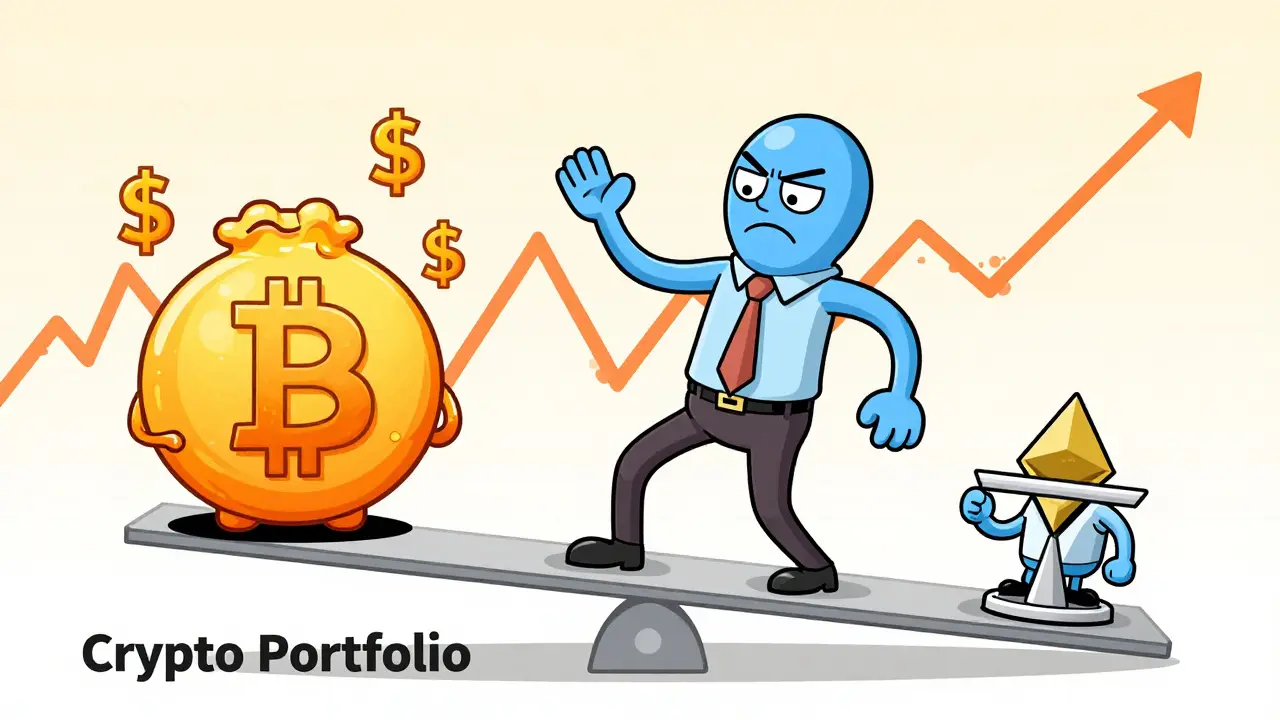

Most crypto investors know the feeling: you buy Bitcoin at $30K, it hits $70K, and suddenly your portfolio is 80% Bitcoin. You feel rich-until the next crash wipes out half your gains. That’s not luck. That’s poor risk management. Rebalancing isn’t about timing the market. It’s about taking profits when they’re there and buying more when things are cheap-without letting emotions drive your decisions.
Why Rebalancing Works in Crypto
Crypto doesn’t behave like stocks or bonds. Prices swing 20% in a day. One week, Ethereum leads. The next, Solana. A year later, a forgotten altcoin surges. If you hold everything without adjusting, your portfolio becomes a gamble on whatever happened to rise the most. Rebalancing fixes that.Studies show disciplined rebalancing adds 2-5% annually compared to just holding. Why? Because it forces you to sell high and buy low-automatically. When Bitcoin spikes, you sell some to lock in gains. When it drops 30%, you use that cash to buy more at a discount. It’s the opposite of what most people do: chase winners and panic-sell losers.
Backtests from 2019 to 2023 show that a portfolio with 60% Bitcoin and 40% Ethereum, rebalanced every time an asset drifted more than 15% from its target, outperformed a buy-and-hold version by 3.7% per year. That’s not magic. It’s math.
The Four Rules-Based Methods That Actually Work
Not all rebalancing is the same. Some methods are overkill. Others cost more than they earn. Here are the four proven approaches used by serious investors and institutional funds.
1. Threshold Rebalancing (Best for Most People)
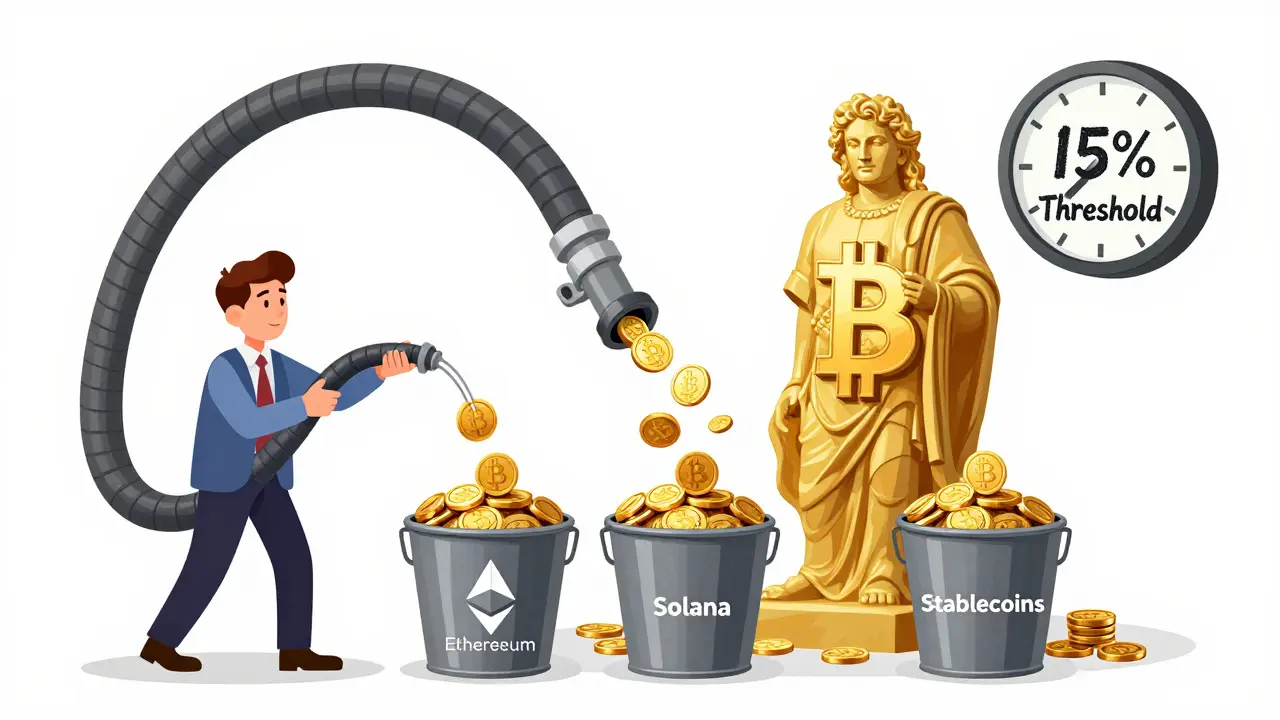
This is the sweet spot. You set a target allocation-say, 50% Bitcoin, 30% Ethereum, 20% Solana. Then you pick a tolerance band: 10% or 15%. If Bitcoin rises to 65% of your portfolio, you sell 15% of your Bitcoin holdings and buy the underweight assets. If it drops to 35%, you buy more Bitcoin.
Why 10-15%? Because lower thresholds (like 5%) trigger too many trades. Fees eat your profits. Higher ones (20%+) let risk grow too big. Shrimpy’s data from 2022 shows 15% gives the best balance: fewer trades, better returns, less stress.
Real example: A $20,000 portfolio with 50/50 BTC/ETH. Bitcoin jumps to $60K. Now it’s 72% of your portfolio. You sell $7,200 worth of Bitcoin and buy $7,200 of Ethereum. You locked in $7,200 in gains and bought more ETH at a lower price. No guesswork.
2. Time-Based Rebalancing (Simple, But Less Efficient)
Rebalance every month or quarter. No triggers. Just do it on the 1st of every month. Easy. But it’s not as smart. If Bitcoin crashes 40% in January and rebounds in February, you’re still selling it in March because it’s “too high.” That’s the downside.
Monthly rebalancing works fine for beginners. Weekly is too noisy-fees pile up. Quarterly is too slow. If you’re not watching the market daily, stick to monthly. But if you want to maximize returns, threshold-based is better.
3. Cash Flow Rebalancing (Tax-Friendly)
Instead of selling assets to rebalance, use new money you add to your portfolio to buy the underweight ones. You don’t trigger capital gains. That’s huge if you’re in the U.S. and subject to short-term capital gains tax (up to 37%).
Example: You add $5,000 to your portfolio in June. Your target is 50% BTC, but now it’s 65%. Instead of selling BTC, you use the $5,000 to buy ETH and SOL until your allocations are back in line. No taxes. No stress. Just smart money flow.
This method is ideal for people who regularly add to their portfolio-DCAers, salary savers, side-hustlers. It’s the quiet winner.
4. Risk-Based Rebalancing (For Advanced Users)
This one uses volatility as a guide. High-volatility coins get smaller allocations. Low-volatility ones get more. Token Metrics’ AI system, for example, caps risky altcoins at 5-8% and gives 15-20% to stable, lower-risk assets-even if they’re not trending.
It’s not about what’s hot. It’s about what’s safe. In 2021-2023, this method delivered 5.1% higher returns than equal-weight portfolios. But it requires tools. You can’t do this manually. It’s built into platforms like Token Metrics, which charge $99/month.
If you’re serious and have $50K+ in crypto, this is worth exploring. For most people? Stick with threshold-based.
What Tools to Use (And Which to Avoid)
You don’t need to do this by hand. But not all tools are equal.
- Binance Rebalancing Bot: Easy to use. Integrates with your spot wallet. Good for beginners. Limited customization. Only lets you set thresholds and frequency. No moving averages. 4.3/5 on Trustpilot.
- Coinrule: Lets you build complex rules-like “buy ETH if 50-day MA crosses above 200-day MA.” Great for trend-following. But API glitches happen during big price swings. 4.5/5. Worth it if you like automation.
- Altrady: Tracks portfolios across Binance, Coinbase, Kraken. Has rebalancing bots with 0.1% precision. Costs $29+/month. Steep learning curve, but powerful.
- Manual rebalancing: Free. You use CoinGecko Portfolio or Koinly to track values. Then you log into each exchange and trade. Takes 15-30 minutes. Good for small portfolios under $10K. Avoid if you trade frequently-taxes get messy.
Avoid tools that promise “AI magic” or auto-rebalance every hour. That’s not smart. That’s gambling with fees. Backtests show hourly rebalancing loses 2.8% a year to transaction costs.
How to Set Up Your Rebalancing System (Step by Step)
Here’s how to build your own system in 10 minutes:
- Decide your target allocation. Example: 50% BTC, 30% ETH, 15% SOL, 5% stablecoins. Don’t go over 10 assets. Complexity kills returns.
- Pick your threshold. Start with 15%. If you’re nervous, use 10%. Only adjust later after you’ve seen how it works.
- Choose your method. Cash flow? Threshold? Time-based? Pick one. Don’t mix unless you know what you’re doing.
- Set up your tool. Use Binance’s bot if you trade there. Use Coinrule if you want rules. Or do it manually with CoinGecko Portfolio.
- Turn it on and forget it. Check quarterly. Don’t tweak it every week. Consistency beats perfection.
Pro tip: Schedule rebalancing for 2-5 AM UTC. That’s when volume is low and slippage is minimal. Avoid weekends and major news events.
Pitfalls to Avoid
Even smart systems fail if you ignore these traps.
- Rebalancing into dead coins. In 2022, some bots kept buying Luna as it collapsed. Never rebalance into a project you don’t believe in. Add a fundamental filter: if a coin’s 30-day volume drops 50%, pause rebalancing into it.
- Too many trades. If you’re trading every 5% swing, you’re paying fees and taxes. That’s how you lose money. Stick to 10-15%.
- Ignoring taxes. Selling crypto triggers capital gains. In the U.S., if you held less than a year, you pay up to 37%. Use cash flow rebalancing to avoid this.
- Overfitting. You tweak your thresholds to match last year’s prices. That’s like driving by looking in the rearview mirror. Markets change. Keep it simple.

What Experts Say
Dr. Adam Grimes, former J.P. Morgan portfolio manager, calls rebalancing “the only free lunch in crypto.” He’s right. You’re not predicting the future. You’re just reacting to it in a disciplined way.
Morgan Stanley’s 2023 guide says rebalancing is “non-negotiable” for crypto allocations over 3% of your total portfolio. CoinShares says 83% of retail investors do best with 10-15% thresholds.
But here’s the warning: BitBull Capital’s CIO says over-optimized systems failed during the Terra/Luna crash. Automated bots bought more Luna as it crashed. That’s why you need a human in the loop. If something looks insane, pause it.
Final Rule: Rebalance to Stay in the Game
Crypto isn’t a get-rich-quick scheme. It’s a long-term game of risk control. The biggest threat isn’t a price drop. It’s losing your nerve-and your portfolio-because you didn’t manage your exposure.
Rebalancing doesn’t make you rich overnight. But it keeps you rich long-term. It turns volatility from your enemy into your advantage. It lets you sleep at night, knowing you’re not gambling-you’re managing.
Start simple. Use a 15% threshold. Rebalance monthly or when an asset moves too far. Use cash flow if you’re adding money regularly. Avoid overcomplicating it. The best system is the one you actually stick with.
Markets will keep swinging. Your strategy shouldn’t.
How often should I rebalance my crypto portfolio?
For most people, monthly or when any asset moves more than 10-15% from its target works best. Weekly rebalancing creates too many trades and eats profits through fees. Quarterly is too slow for crypto’s volatility. Start with monthly, then adjust based on your trading volume and tax situation.
Is rebalancing crypto profitable?
Yes, when done right. Studies show disciplined rebalancing adds 2-5% annual returns compared to buy-and-hold. The key is using a 10-15% threshold, not too-frequent trades, and avoiding selling into losing positions. It works because it forces you to sell high and buy low automatically.
Should I use an automated bot or do it manually?
If your portfolio is under $10,000 and you trade infrequently, manual rebalancing with a tracker like CoinGecko is fine. For $10K+, use a bot like Binance’s or Coinrule. They save time, reduce emotional mistakes, and execute trades faster. Just avoid bots that trade hourly-they lose money on fees.
Can rebalancing help me avoid taxes?
Yes, if you use cash flow rebalancing. Instead of selling overweight assets, you use new money you add to your portfolio to buy underweight ones. This avoids triggering capital gains taxes. It’s especially helpful if you’re in a high tax bracket or hold assets for less than a year.
What’s the best crypto allocation to rebalance?
There’s no universal answer, but a common starting point is 50% Bitcoin, 30% Ethereum, 15% top 5 altcoins, and 5% stablecoins. Keep it simple. Too many coins make rebalancing messy. Focus on assets with real volume and use cases. Avoid meme coins unless you’re comfortable losing that portion.
What happens if I don’t rebalance my crypto portfolio?
Your portfolio becomes unbalanced. One asset-like Bitcoin or Solana-can dominate and make up 80% of your holdings. If that asset crashes 50%, your entire portfolio crashes. Rebalancing keeps your risk in check. Without it, you’re not investing-you’re gambling on whatever happened to rise last.






Write a comment