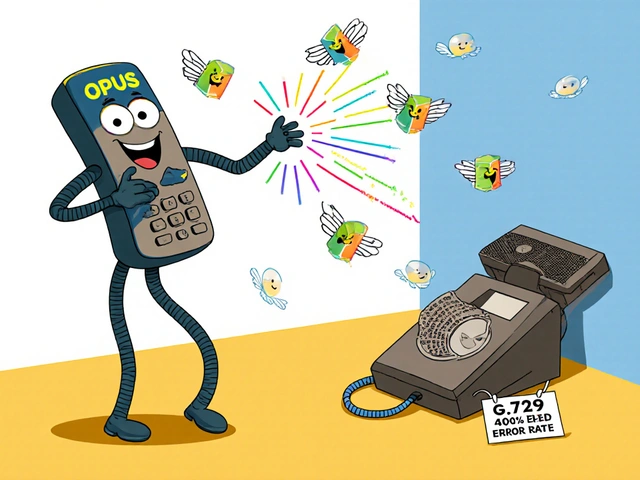
When you make a VoIP call, your voice gets turned into digital data using something called a G.711, a standard audio codec for uncompressed voice transmission in VoIP systems. Also known as PCM, it’s the go-to for crystal-clear calls but uses a lot of bandwidth. Right next to it sits G.729, a compressed audio codec designed to reduce bandwidth use while maintaining acceptable voice quality. Also known as CS-ACELP, it’s the quiet workhorse that lets you fit more calls on a slow internet connection. These two codecs are the most common in business VoIP systems, and choosing between them isn’t about which is "better"—it’s about what your network can handle and what your calls need.
Here’s the simple breakdown: G.711 sends voice data almost exactly as it’s picked up by the microphone. That means high quality—close to a landline—but it eats up 87 Kbps per call. If you’ve got a fast, stable connection and you’re making calls from a call center or boardroom, G.711 sounds natural and professional. But if you’re running a small office on shared internet, or your team works remotely with spotty Wi-Fi, that bandwidth adds up fast. That’s where G.729 steps in. It cuts the bandwidth to just 8 Kbps by compressing the audio, using clever math to keep the voice recognizable while dropping the parts humans don’t notice. The trade-off? A slightly robotic or tinny tone, especially in noisy environments. It’s not perfect, but it’s good enough for most daily calls—and it lets you run ten times as many calls on the same connection.
Real-world use matters more than specs. A company with 50 employees on G.711 needs about 4.35 Mbps just for voice. Switch to G.729, and that drops to 400 Kbps—same call volume, same staff, but now your video meetings and file uploads don’t choke. Many VoIP providers even let you set different codecs for internal calls (G.711 for HQ) and external ones (G.729 for international). And if your internet drops? G.729’s smaller packets are less likely to cause choppy audio. But don’t just pick one and forget it. Test both. Record a call with each, play it back on headphones, and ask your team which sounds less tiring after an hour. That’s the real test.
What you’ll find below are real setups, network tips, and comparisons from businesses that switched between G.711 and G.729—and what happened when they got it right (or wrong). From bandwidth calculators to codec conflicts in SIP trunks, these posts cut through the noise and show you exactly what works today.
Compare G.711 and G.729 codecs for VoIP bandwidth usage. Learn which one saves bandwidth, which one sounds better, and how to choose based on your network, call volume, and budget.