

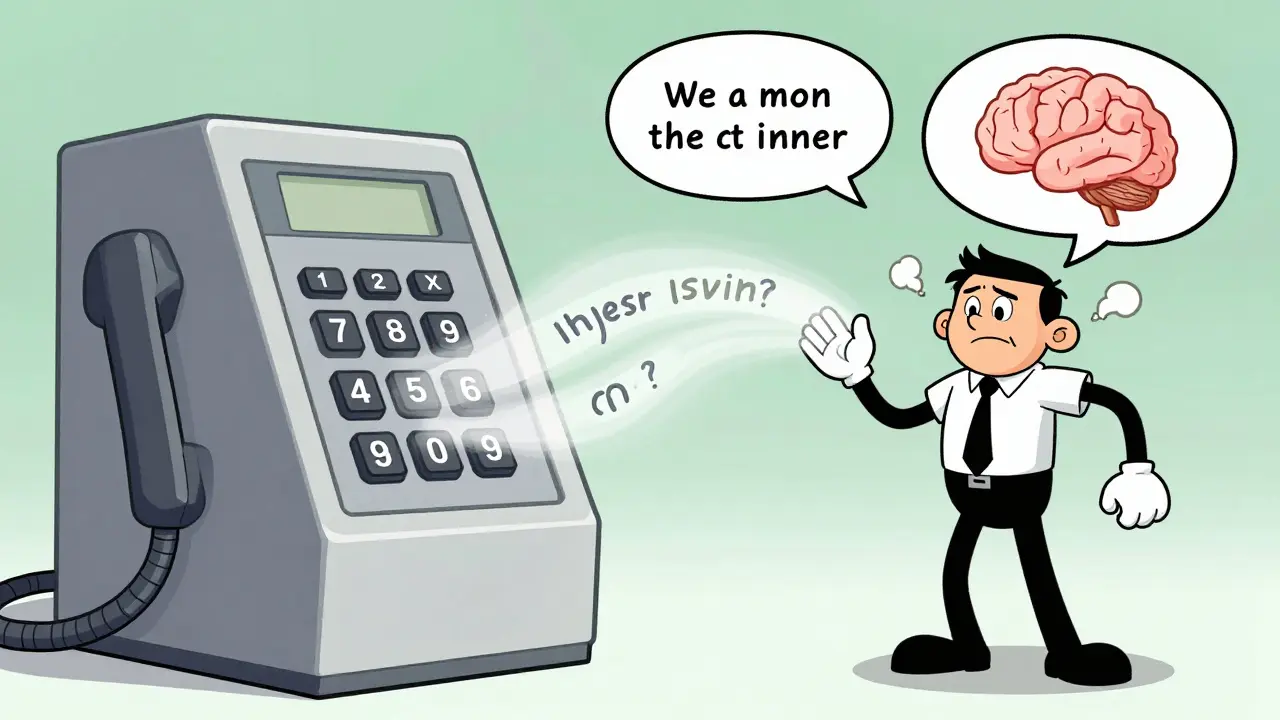

Think about the last time you called a customer service line. How many buttons did you press? How long did you wait before someone actually understood what you needed? Most people still deal with the same frustrating IVR menus they’ve lived with for decades: "Press 1 for billing, press 2 for support, press 3 to hear your options again." It’s exhausting. And it’s outdated.
Today, the best call centers don’t make you navigate menus. They listen. They understand. They respond like a human would - even before you finish speaking. That’s the power of advanced IVR powered by natural language processing (NLP) and artificial intelligence. No more guessing which number to press. Just say what you need, and the system gets it.
From Touch-Tone to Talk
Traditional IVR systems are rule-based. They work like a flowchart: if you press 1, go here; if you press 2, go there. They don’t learn. They don’t adapt. And they don’t understand context. If you say, "I can’t log in," but the system only accepts "I forgot my password," you’re stuck in a loop.
Advanced IVR changes all that. Instead of forcing you into predefined choices, it listens to your words - the way you say them, the emotion in your voice, the context behind them. A caller might say, "My account’s locked again," and the system doesn’t just hear words. It understands the frustration, the pattern ("again"), and the likely need: immediate access recovery. No menu. No waiting. Just action.
This isn’t science fiction. It’s happening right now in banks, hospitals, and retail companies across the U.S. And the results are clear: call handling time drops by 40%, first-call resolution jumps by 35%, and customer satisfaction scores rise.
The Tech Behind the Talk
There are four core technologies working together to make this possible:
- Automatic Speech Recognition (ASR) - This turns your voice into text. It’s not just about hearing words. It’s about filtering out background noise, recognizing different accents, and correcting mispronunciations. Modern ASR handles regional dialects, non-native speakers, and even mumbled sentences.
- Natural Language Processing (NLP) - This is the brain. It takes the text from ASR and figures out what you really mean. If you say, "I need to transfer money to John," NLP knows you’re asking for a payment, not asking for John’s phone number. It detects intent, not just keywords.
- Machine Learning (ML) - The system gets smarter over time. Every call it handles, whether successful or not, gets analyzed. If 80% of people who say "my bill is too high" actually want to set up a payment plan, the system learns to offer that option upfront.
- Text-to-Speech (TTS) - The system doesn’t just listen. It talks back. And today’s TTS sounds human. No robotic monotone. It uses generative AI to match tone, pace, and emotion. A frustrated caller hears a calm, reassuring voice. A curious shopper gets a friendly, helpful tone.
Put them all together, and you’ve got a system that doesn’t just answer questions - it anticipates them.
Real-World Use Cases
Let’s look at how this plays out in real industries:
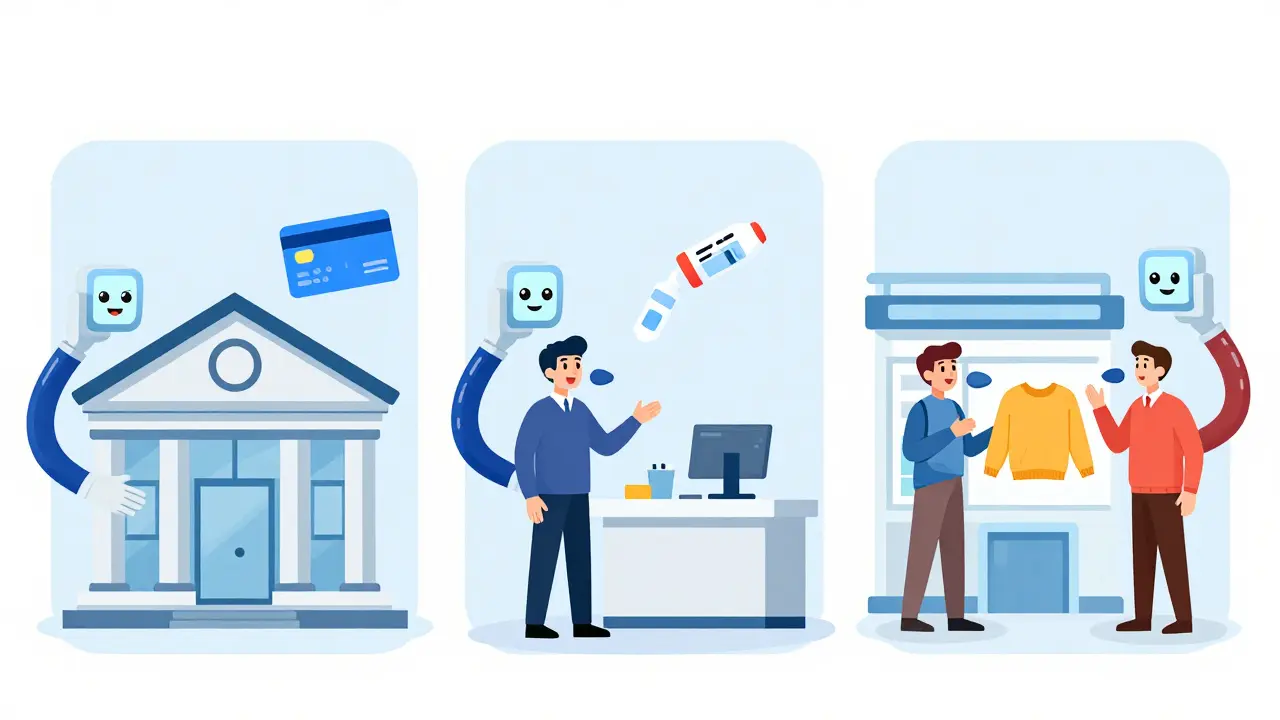
- Banking - A customer calls saying, "I think someone stole money from my account." The system doesn’t ask for their account number. It uses voice biometrics to authenticate them instantly, checks recent transactions, freezes the card if needed, and opens a fraud case - all without transferring to an agent.
- Healthcare - A patient calls to refill a prescription. The IVR pulls up their medical records, checks pharmacy availability, confirms insurance coverage, and schedules a pickup - all in under 90 seconds. No call center rep needed.
- Retail - A shopper says, "I ordered a blue sweater last week but got a green one." The system pulls the order, confirms the return, emails a prepaid label, and offers a 10% discount on their next purchase. It’s not just fixing a mistake - it’s turning a negative experience into loyalty.
These aren’t hypotheticals. Companies like Bank of America, Kaiser Permanente, and Walmart have cut their call center costs by over 30% while improving customer ratings. And they’re not replacing humans - they’re freeing them up. Agents now handle the complex issues: angry customers, billing disputes, technical troubleshooting. The routine stuff? Handled by AI.
Why This Matters for Your Business
If your call center still uses button-based IVR, you’re losing money - and customers.
Customers don’t just want fast service. They want understanding. They want to feel heard. Traditional IVR makes them repeat themselves. Advanced IVR gets it right the first time. That builds trust.
Here’s what you gain:
- Lower costs - Fewer agents needed for routine tasks. One AI system can handle 10,000 calls a day without overtime.
- Faster resolution - No menu diving. No transferring. Just direct answers.
- Better data - Every interaction is logged, analyzed, and used to improve. You see what customers are really asking for - not what you think they’re asking.
- Scalability - No hiring spikes during holidays. No training new staff. The system works 24/7, in multiple languages.
And the best part? It gets better with time. Every call teaches the system. A new phrase like "I’m being charged twice" gets added to its understanding. A regional accent becomes easier to recognize. A common complaint turns into a new automated solution.
What to Look For When Choosing a System
Not all AI IVR systems are equal. Here’s what actually matters:
- NLP depth - Does it understand context, not just keywords? Can it handle "I need help with my bill" versus "I want to pay my bill"? The difference is critical.
- Language support - Are you serving Spanish speakers? Mandarin? Tagalog? The system must handle multiple languages seamlessly - not just translate, but understand cultural phrasing.
- Integration - Does it connect to your CRM, ticketing system, and billing software? If it can’t pull customer history, it’s just a fancy answering machine.
- Learning capability - Can it auto-update its models? Or do you need to manually retrain it every month? The best systems learn in real time.
- Emotion detection - The next frontier. Systems that detect frustration, urgency, or confusion can adjust their tone, speed, or route the call to a human before the customer escalates.
Ask vendors for real data: "What’s your first-call resolution rate? How much did call time drop after deployment? Can you show me anonymized call logs?" If they can’t answer, walk away.
The Future Is Conversational
The next step? AI that doesn’t just respond - it anticipates.
Imagine a system that notices a customer says "I’ve called three times this month" and immediately says, "I see you’ve had trouble with your service. Let me fix this for you right now."
Or one that hears a customer’s voice tremble and says, "I know this is stressful. Let me connect you with someone who can help immediately."
This isn’t far off. Companies are already testing sentiment analysis in live calls. Voice tone, pause length, word choice - all signals that tell the AI how the caller is feeling. And it responds accordingly.
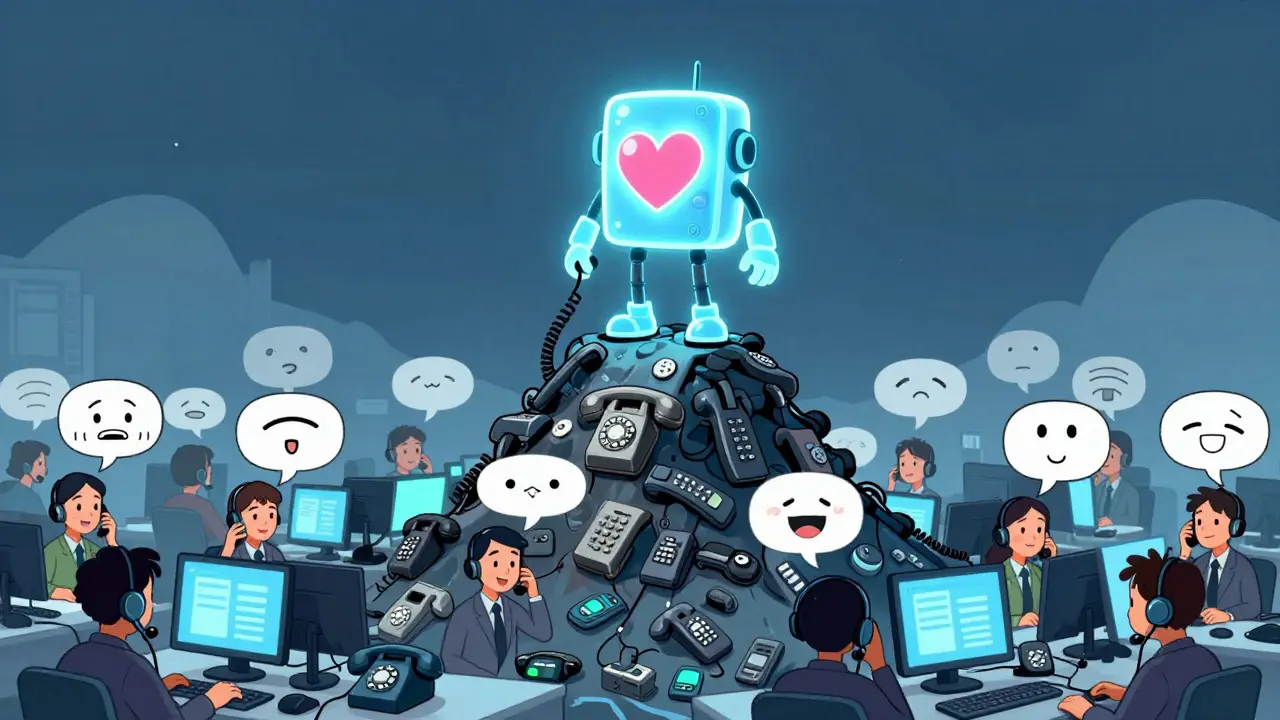
Advanced IVR isn’t about replacing humans. It’s about making them more effective. It’s about removing friction so customers feel respected, not rushed. It’s about turning a chore into a conversation.
The call centers that win in 2026 won’t be the ones with the most agents. They’ll be the ones with the smartest systems - the ones that listen like a friend, not a machine.
How is AI IVR different from traditional IVR?
Traditional IVR relies on pre-recorded menus and touch-tone input - you press numbers to navigate. AI IVR listens to your spoken words, understands your intent, and responds naturally. No menus. No pressing 1 or 2. Just talk, and the system acts. It learns from every interaction, gets smarter over time, and handles complex, ambiguous requests that traditional systems can’t.
Can AI IVR handle multiple languages?
Yes. Modern AI IVR systems use NLP models trained on diverse speech patterns across languages and dialects. They can switch between languages mid-conversation, recognize non-native accents, and adapt to regional phrasing. For example, a Spanish-speaking caller can ask in Spanish, then switch to English mid-sentence, and the system will follow along without confusion.
Does AI IVR replace human agents?
It doesn’t replace them - it empowers them. AI IVR handles routine tasks like balance checks, appointment scheduling, or password resets. This frees up human agents to deal with complex, emotional, or high-value issues. Studies show companies using AI IVR reduce agent workload by 40% while improving customer satisfaction.
How long does it take to implement an AI IVR system?
Most businesses see a working system in 6-12 weeks. The timeline depends on integration depth - connecting to your CRM, billing, and ticketing systems. Basic setups with pre-built models can go live in 4 weeks. More complex deployments, especially with custom industry vocabulary (like medical terms or financial codes), may take up to 6 months. The key is starting with high-volume, low-complexity use cases first.
Is AI IVR secure?
Yes - if built right. Leading systems use voice biometrics for authentication, encrypt all data in transit and at rest, and comply with PCI-DSS, HIPAA, and GDPR standards. They never store full voice recordings. Instead, they convert speech to text, extract intent, and discard raw audio. Always ask vendors for compliance certifications before deployment.
Can AI IVR understand slang or broken English?
Absolutely. Modern NLP models are trained on millions of real-world calls, including casual speech, typos, and non-standard grammar. A caller saying "I wanna check my balance" or "My card got declined, help?" is handled just as well as formal speech. The system focuses on intent, not grammar. It’s designed for how people actually talk - not how they’re supposed to.
Next Steps
If you’re still using button-based IVR, start small. Pick one high-volume, low-risk use case - like appointment scheduling or balance inquiries. Test an AI IVR solution for 30 days. Measure call volume, resolution rate, and customer feedback. If it cuts handling time by 25% and improves satisfaction, scale it. If not, look at your training data. Most failures come from poor sample sets - not bad tech.
The future of customer service isn’t about more staff. It’s about smarter systems. And the companies that get this right won’t just save money. They’ll build loyalty.





VIRENDER KAUL
20 Mar 2026 at 06:56Let me be clear-this isn’t innovation. It’s corporate theater wrapped in buzzwords. NLP? ASR? Please. You’re still feeding the machine canned responses disguised as ‘understanding.’ I’ve seen these systems fail spectacularly when a customer says ‘I’m mad’ instead of ‘I’m frustrated.’ The algorithm doesn’t grasp emotion-it parses keywords. And don’t get me started on ‘voice biometrics.’ I’ve had my voice cloned by scammers in Mumbai. You think a bank’s AI is secure? It’s a honeypot for identity theft. This isn’t progress. It’s risk multiplied by marketing.
And yes-I’ve audited these deployments. The ‘40% reduction in call time’? That’s because they’re dumping 60% of calls into a black box where no human ever intervenes. Customers hang up. No one tracks those. The KPIs are rigged. Stop selling snake oil as transformation.