



Most people use the terms blockchain and Distributed Ledger Technology interchangeably, but that is actually a mistake. Think of it like this: DLT is the broad category, and blockchain is just one specific type of DLT. It is the difference between saying "vehicle" and "electric sedan." While every blockchain is a distributed ledger, not every distributed ledger is a blockchain.
The real magic of this tech is that it kills the "middleman." For decades, we have relied on banks, government registries, and clearinghouses to tell us who owns what. We trust a central authority to keep the master book. DLT flips that script by letting everyone in a network hold a copy of the book. When a change happens, everyone updates their copy at once. No more waiting for a central admin to approve a transaction or worrying if a single database gets hacked and wipes out everything.
If you are trying to get a grip on how this actually works, you need to understand that we are moving from institutional trust (trusting a brand or a person) to algorithmic trust (trusting math and code). Here is a breakdown of how this technology functions and why it matters for the future of business.
The Core Pillars of Distributed Ledgers
To understand why DLT is a big deal, we have to look at the properties that make it different from a standard Excel sheet or a SQL database. A Distributed Ledger is a database that is consensually shared and synchronized across multiple sites, institutions, or geographies.
First, there is immutability. Once a transaction is written into the ledger and the network agrees it is valid, it is basically carved in stone. You cannot go back and "edit" a transaction from three weeks ago to hide a mistake or commit fraud. If you need to change something, you have to add a new transaction that corrects the old one, leaving a permanent audit trail.
Then we have provenance. This is a fancy way of saying "chain of custody." Because every single move is recorded, you can trace an asset-whether it is a Bitcoin or a shipment of organic coffee-all the way back to its origin. This eliminates the guesswork in supply chains and financial audits.
Finally, there is finality. In some payment systems, a transaction might be "pending" for days. In a well-tuned DLT system, once consensus is reached, the transaction is final. There is no "undo" button, which provides an incredible level of certainty for high-value trades.
How DLT Actually Works: The Step-by-Step Process
It is easy to get lost in the jargon, but the operational workflow is actually quite logical. It follows a strict sequence to ensure that no one is cheating the system.
- Initiation: A user starts a transaction (e.g., sending 1 BTC to a friend). This request is broadcast to all the computers in the network, which are called nodes.
- Validation: The nodes don't just take the request at face value. They check it against pre-defined rules. Do you actually have the funds? Is the digital signature valid? This prevents the "double-spend" problem, where someone tries to send the same digital coin to two different people at once.
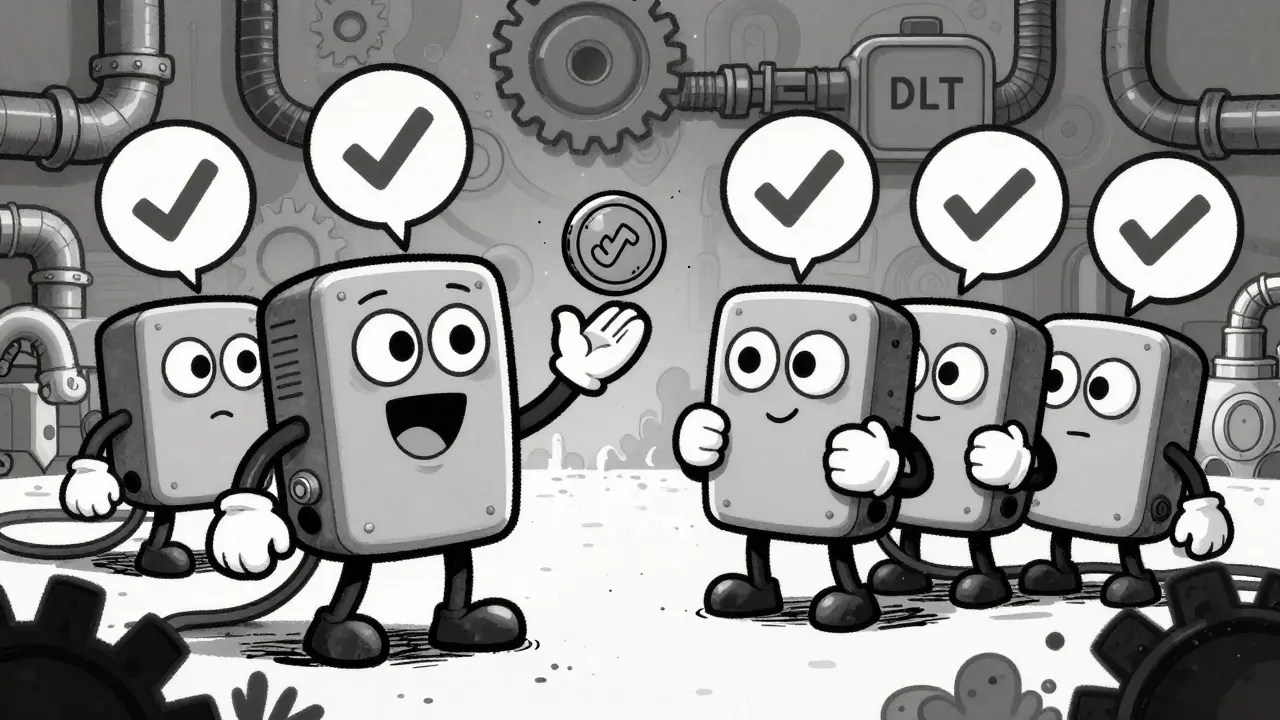
- Consensus: This is the hardest part. The nodes must agree on the order and validity of the transactions. They use a consensus mechanism-a set of mathematical rules-to reach a collective agreement without a boss telling them what to do.
- Cryptographic Sealing: Once agreed upon, the transaction is sealed using cryptography. This usually involves a "hash," which is a unique digital fingerprint that links the current record to the previous one.
- Updating the Ledger: Every node updates its local copy of the ledger simultaneously. The state of the network changes, and the transaction is now officially complete and permanent.
Comparing DLT Architectures: Blockchain, DAG, and Hashgraph
Not all distributed ledgers organize data the same way. Depending on the goal-whether it is absolute security or lightning-fast speed-different structures are used.
| Architecture | Data Structure | Main Strength | Example |
|---|---|---|---|
| Blockchain | Sequential Blocks | Maximum Immutability | Bitcoin, Ethereum |
| Directed Acyclic Graph (DAG) | Web-like Graph | High Scalability / No Fees | IOTA, Nano |
| Hashgraph | Gossip about Gossip | Fair Ordering / Speed | Hedera |
Blockchain is the most famous. It bundles transactions into blocks and chains them chronologically. It is incredibly secure but can be slow because every block must be finished before the next one starts.
On the other hand, Directed Acyclic Graph (DAG) ignores the "block" concept entirely. Instead, transactions are linked directly to previous ones in a web. This allows for parallel processing, meaning you can handle thousands of transactions per second without the bottlenecks associated with traditional blocks.
The Engines of Trust: Understanding Consensus Mechanisms
Since there is no central server, the network needs a way to decide who is telling the truth. This is where consensus mechanisms come in. They are the "voting systems" of the digital world.
Proof-of-Work (PoW) is the original method used by Bitcoin. It requires miners to solve a complex math puzzle using massive computing power. It is incredibly secure because attacking the network would require an impossible amount of electricity, but it is a nightmare for the environment.
Proof-of-Stake (PoS), used by Ethereum, is the modern alternative. Instead of burning electricity, validators lock up (or "stake") their own coins as collateral. If they validate a fake transaction, they lose their money. It is thousands of times more energy-efficient than PoW.
For private or corporate use, you often see Proof-of-Authority (PoA). In this setup, only a few pre-approved entities (like a group of banks) are allowed to validate transactions. It is much faster and more controlled, but it sacrifices some of the decentralization that makes public blockchains special.
Then there are more exotic methods like Practical Byzantine Fault Tolerance (PBFT), which relies on nodes voting and exchanging messages until a super-majority agrees. This is common in frameworks like Hyperledger, where the goal is enterprise efficiency rather than total anonymity.
DLT vs. Traditional Centralized Databases
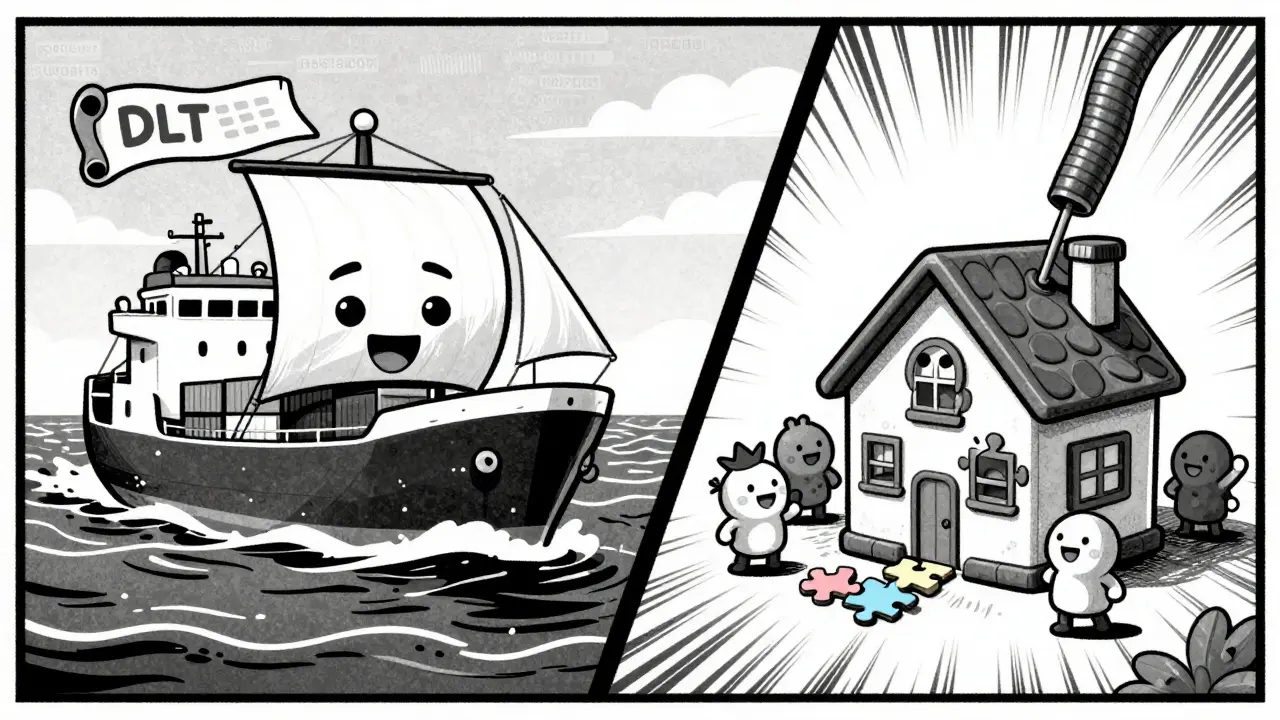
You might be wondering, "Why not just use a regular database?" The answer comes down to where the power lives. In a traditional system, you have a central administrator. If that administrator is corrupt, decides to change a record, or gets hit by a cyberattack, the whole system is compromised. You are trusting the organization's internal policies and audits.
In a DLT system, the security is built into the math. To change a record, an attacker would have to take over more than half of the nodes in the network simultaneously. For a global network with thousands of computers, that is practically impossible. This shift from "trusting the bank" to "trusting the network" is what allows for peer-to-peer value transfer without any one person having the power to stop it or steal it.
Real-World Applications Beyond Cryptocurrency
While coins and tokens get all the headlines, DLT is doing some heavy lifting in the background of many industries.
- Trade Finance: Traditionally, shipping a container across the ocean involves mountains of paperwork (Bills of Lading, Customs forms). DLT digitizes these documents, allowing buyers, sellers, and customs agents to see the same real-time status, cutting weeks off the processing time.
- Identity Management: Instead of having your data stored on 50 different company servers, you could hold your own identity on a distributed ledger and grant temporary access to whoever needs to verify your age or credentials.
- Healthcare: Imagine a world where your medical history isn't trapped in one hospital's legacy system. A DLT-based record would let you carry your data securely, giving any authorized doctor instant access to your history regardless of where you are in the world.
- Real Estate: Tokenizing property on a ledger allows for fractional ownership. Instead of needing $100k for a down payment, a hundred people could own 1% of a commercial building, with the ledger handling the dividends and ownership transfers automatically.
Is every blockchain a distributed ledger?
Yes. Blockchain is a specific sub-type of Distributed Ledger Technology. While all blockchains distribute their data across a network, not all DLTs use a chain of blocks (for example, DAGs use a graph structure instead).
Can data on a distributed ledger ever be deleted?
Generally, no. The core property of DLT is immutability. Once the network reaches consensus and records a transaction, it cannot be deleted or altered. Any corrections must be made via a new transaction, which creates a transparent history of the change.
What is the difference between PoW and PoS?
Proof-of-Work (PoW) requires computational power and electricity to secure the network (mining). Proof-of-Stake (PoS) requires participants to lock up currency as collateral to validate transactions. PoS is significantly more energy-efficient and faster than PoW.
Why is DLT more secure than a central database?
Central databases have a single point of failure; if the central server is hacked, all data is at risk. DLT distributes the data across many nodes, meaning an attacker would need to compromise a majority of the network simultaneously to alter the records.
What is a DAG and how does it differ from blockchain?
A Directed Acyclic Graph (DAG) is a DLT structure where transactions are linked to multiple previous transactions rather than being grouped into sequential blocks. This removes the bottleneck of block times, allowing for faster transactions and often zero fees.






Eric Etienne
8 Apr 2026 at 07:17Pretty basic stuff here. Everyone and their dog knows the difference between a DAG and a blockchain by now, so this is basically like explaining that a square is a rectangle. The whole 'algorithmic trust' thing is a bit overblown too, because you're still trusting the people who wrote the code, just in a different way.
Honestly, most of these 'real-world applications' are just corporate buzzwords to get VC funding for things a simple SQL database could handle in half the time with zero lag.