



Imagine you find a $20 bill on the sidewalk. You smile, maybe buy a nice lunch, and feel a light sense of gratitude. Now imagine you drop that same $20 bill down a storm drain. That sting? It’s sharp. It lingers. Psychologists have found that the pain of losing $20 is roughly twice as powerful as the pleasure of gaining it. This isn’t just a quirky personality trait; it is a hardwired feature of human psychology called loss aversion, defined as the tendency for losses to loom larger than equivalent gains in our decision-making processes.
If you trade stocks, options, or crypto, this bias is likely costing you money right now. It keeps you holding onto losers too long, selling winners too early, and missing out on strategic opportunities because the fear of being wrong feels physically worse than the excitement of being right. Understanding why your brain reacts this way is the first step toward fixing it.
The Science Behind the Sting
To understand loss aversion, we have to look back to 1979. Two researchers, Daniel Kahneman and Amos Tversky, introduced a concept that shook economics to its core: Prospect Theory. They argued that humans don't make decisions based on final wealth (as traditional economic models suggested), but rather on changes relative to a reference point-usually what we currently own.
According to their research, the curve of value is steeper for losses than for gains. If you are offered a gamble with a 50% chance to win $100 and a 50% chance to lose $100, most people will decline. To get someone to take that risk, the potential gain usually needs to be about $200 to balance the psychological weight of the $100 loss. This ratio-often cited between 1.5:1 and 2:1-is the hallmark of loss aversion.
This isn't just theoretical math. It happens in your head. When you face a potential loss, your brain doesn't just calculate numbers. It triggers an emotional response that overrides logic. This is why 'rational' investors often act irrationally when markets turn red.
Why Did We Evolve to Fear Losses?
You might wonder why such a flawed system evolved. After all, if we were neutral about gains and losses, we’d probably be richer. The answer lies in survival.
For our ancestors living on the edge of starvation, losing a day's worth of food could mean death. Gaining an extra day's food, however, rarely meant an extra day of life unless it could be stored perfectly. The asymmetry was brutal: losses were fatal; gains were merely convenient. Over millennia, natural selection favored individuals who treated threats as more urgent than opportunities. Those who panicked at the sight of a lost resource survived to reproduce. Those who casually shrugged off losses didn't.
This evolutionary baggage is still with us. Today, losing money doesn't kill us, but our brains process financial loss with the same urgency as physical threat. This explains why checking your portfolio during a market crash can cause genuine physiological stress-elevated heart rate, dilated pupils, and increased activity in the amygdala, the brain's fear center.
How Loss Aversion Sabotages Traders
In the world of trading, loss aversion manifests in specific, predictable patterns that erode profits over time. Recognizing these behaviors is crucial for any serious investor.
- The Disposition Effect: This is the tendency to sell winning positions too early to lock in a small gain (to avoid the fear of it turning into a loss) while holding onto losing positions too long, hoping they will break even. You want to avoid the pain of realizing a loss, so you hold the bag. Meanwhile, you cut off your winners before they can run.
- Myopic Loss Aversion: When you check your account every day, you see short-term volatility. Because losses hurt more than gains please, frequent monitoring makes you feel worse about the investment experience. This leads to pulling money out of the market during normal dips, missing the long-term recovery.
- Risk-Seeking Behavior in Loss Domains: Paradoxically, when people are facing losses, they become riskier. If you are down significantly on a trade, you might double down or move your stop-loss further away, gambling that the price will revert. This is not strategy; it is desperation driven by the desire to avoid the finality of a realized loss.
These behaviors create a skewed P&L statement. You have many small wins and few large ones, but one or two massive losses that wipe out months of progress. The math simply doesn't work in your favor.
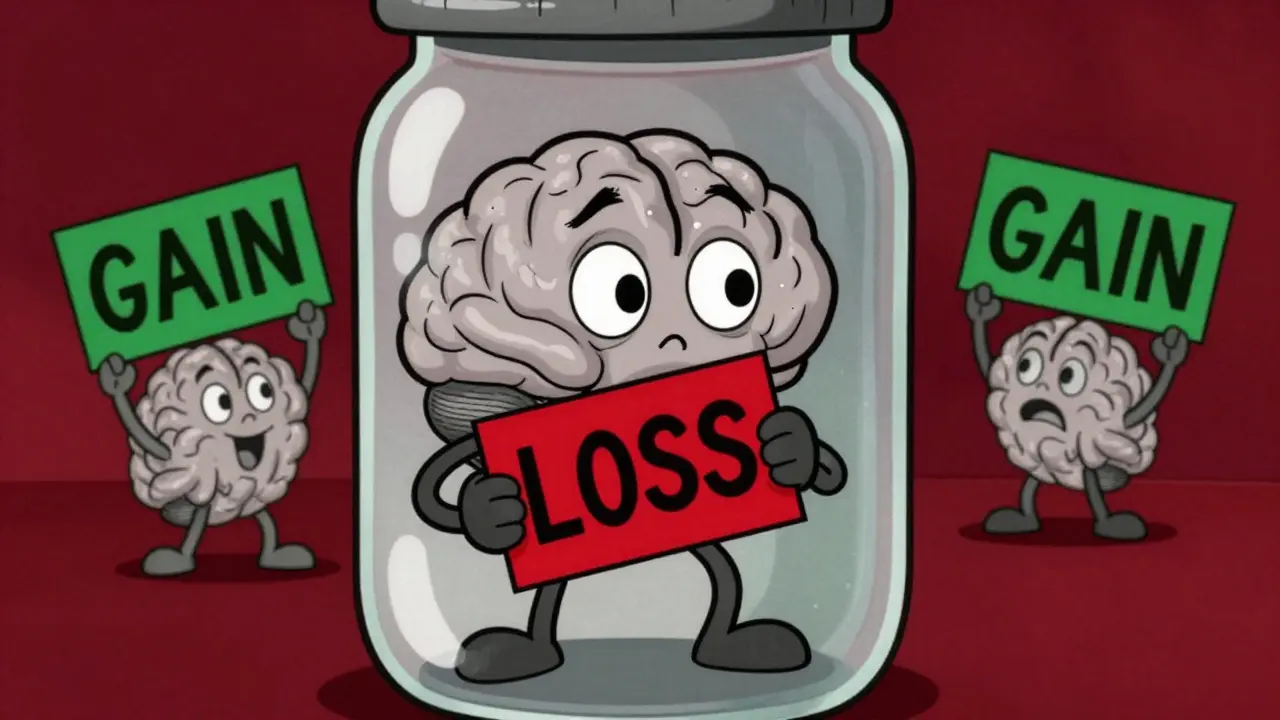
The Neuroscience of Pain vs. Pleasure
Modern neuroimaging studies confirm that loss aversion is rooted in biology, not just mindset. Research shows that processing losses activates the striatum and the amygdala more intensely than processing equivalent gains.
Furthermore, the autonomic nervous system reacts differently. Studies measuring pupil diameter and heart rate show that the magnitude of increase is consistently higher following losses, even for small amounts where behavioral loss aversion might not be obvious. There is also increased activation in midfrontal cortical networks within 200 to 400 milliseconds of observing a negative outcome. This suggests that the brain registers loss almost instantly as a high-priority alert.
This neural pathway is stable. It’s not a temporary mood swing; it’s a structural part of how we evaluate risk. For traders, this means that willpower alone is often insufficient to overcome loss aversion. You need systems that bypass the emotional brain entirely.
| Scenario | Rational Action | Loss-Averse Reaction | Result |
|---|---|---|---|
| Stock up 10% | Let profit run or take partial profit based on plan | Sell immediately to secure the win | Capped upside, missed trend continuation |
| Stock down 5% | Cut loss at predefined stop-loss | Hold hoping for recovery | Potential for deep drawdown |
| New opportunity arises | Allocate capital if criteria met | Wait for 'perfect' entry to avoid risk | Missed entry, FOMO later |
| Market volatility increases | Rebalance portfolio | Panic sell or freeze | Lock in losses, exit market timing error |
Mitigating Loss Aversion: Practical Strategies
You cannot rewire your evolution overnight, but you can build structures that protect you from your own psychology. Here are actionable steps to reduce the impact of loss aversion in your trading.
- Automate Your Exits: Use hard stop-loss orders. By letting the broker execute the sale automatically, you remove the emotional decision from the equation. You don't have to 'feel' the loss; the system handles it. This prevents the disposition effect where you hold losers too long.
- Reduce Monitoring Frequency: If you are a long-term investor, checking your portfolio daily induces myopic loss aversion. Switch to weekly or monthly reviews. Less data points mean less emotional noise. Focus on the macro trend, not the micro fluctuation.
- Reframe 'Losses' as 'Costs': Change your language. A stop-loss isn't a failure; it's the cost of doing business, like paying rent for an office. Entrepreneurs accept overhead costs without feeling personally attacked. Treat trading losses as operational expenses required to capture larger gains.
- Use Position Sizing: Loss aversion spikes when the amount at stake feels significant. By sizing positions smaller, the absolute dollar loss is reduced, making the psychological pain more manageable. If a loss doesn't keep you up at night, your bias won't hijack your judgment.
- Focus on Process, Not Outcome: Judge your trades by whether you followed your plan, not by whether you made money on that specific day. A well-executed trade that results in a small loss is a success. A reckless trade that hits a home run is a failure. This shifts your reward system from outcome-based to behavior-based.
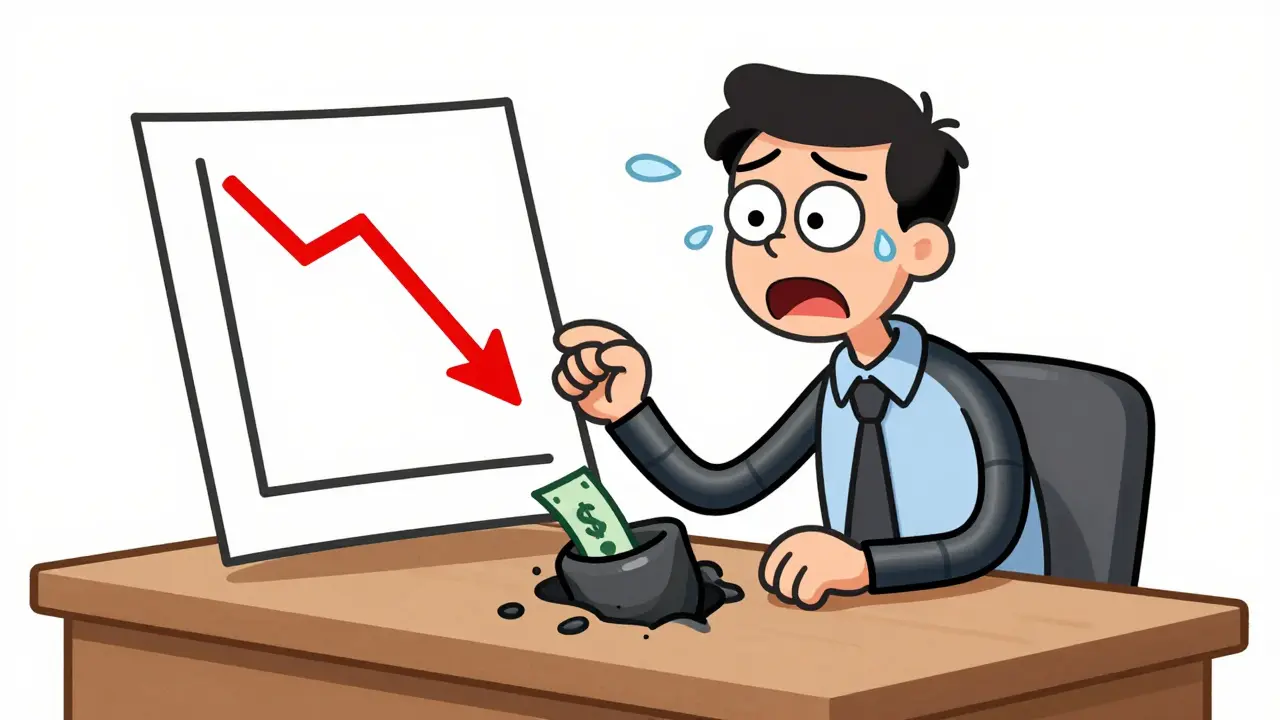
Beyond Money: Status Quo and Endowment Effects
Loss aversion doesn't just apply to cash. It connects closely to the endowment effect, which describes how we value things more highly simply because we own them. In trading, this makes it incredibly difficult to sell a stock you've held for years, even if the thesis has changed. You view the stock not as an asset, but as part of your identity or wealth base. Letting go feels like amputation.
Similarly, status quo bias keeps investors in low-yield savings accounts or outdated portfolios because changing requires action, and action carries the risk of loss. Doing nothing feels safe, even though inflation is silently eroding purchasing power. Recognizing these related biases helps you identify when hesitation is actually disguised loss aversion.
Conclusion: Mastering the Bias
Loss aversion is not a bug in the human system; it's a feature designed for survival. But in modern financial markets, survival instincts can lead to destruction. The goal isn't to eliminate fear-that's impossible. The goal is to acknowledge it, respect it, and build rules that operate independently of it. When you stop trying to avoid every loss, you start allowing yourself to win big.
What is the difference between loss aversion and risk aversion?
Risk aversion is a preference for a certain outcome over a gamble with equal or higher expected value. It is a general attitude toward uncertainty. Loss aversion is specifically about the asymmetry between losses and gains. You can be risk-neutral regarding gains but highly loss-averse. For example, you might happily take a 50/50 bet to win $100, but refuse a 50/50 bet to lose $100, even if the other side of the coin offers a huge gain.
Can loss aversion be completely eliminated?
No, it is a fundamental part of human neurobiology and evolutionary history. However, it can be significantly mitigated through education, experience, and strict procedural frameworks like automated stop-losses and position sizing. Professional traders don't lack fear; they have systems that function despite it.
How does loss aversion affect long-term investing?
It often leads to under-diversification and excessive caution. Investors may stay in cash or low-risk assets to avoid the pain of market downturns, resulting in lower returns over decades. It also causes panic selling during corrections, locking in losses and missing the subsequent bull market recovery. Myopic loss aversion is particularly damaging here, as frequent checking amplifies the perceived pain of volatility.
Is loss aversion different for professional traders?
Research suggests that experienced traders and professionals exhibit reduced loss aversion compared to novices. Through repeated exposure and training, they learn to frame losses as data points rather than personal failures. However, even experts are not immune, especially during periods of extreme stress or unprecedented market conditions. Discipline remains key for all levels.
What role does the amygdala play in loss aversion?
The amygdala is the brain's fear center. Neuroimaging studies show that it becomes highly active when processing potential or actual losses. This activation triggers the fight-or-flight response, releasing stress hormones like cortisol. In trading, this can lead to impulsive decisions, such as panic selling or freezing up, overriding the prefrontal cortex which handles logical reasoning and long-term planning.







Henry Kelley
4 May 2026 at 09:04man this article hits different cause i just watched my portfolio drop 15% last week and felt like my chest was actually tightening. it is wild how the brain treats a paper loss like a tiger chasing you down the street. i used to think i was just bad at math but now i realize its just biology fighting me. the part about reframing losses as costs of doing business really stuck with me though. i need to start treating my stop losses like paying for coffee instead of failing a test. thanks for breaking this down so clearly without making me feel stupid for holding onto losers.