



When someone dies owning Bitcoin, their funds don’t just vanish - but they might as well if no one knows how to access them. Unlike bank accounts or stocks, Bitcoin can’t be recovered by calling customer service or resetting a password. It lives on a blockchain, locked behind a private key. If that key isn’t passed on properly, the Bitcoin is gone forever. And it’s not a rare scenario. Experts estimate that Bitcoin holdings worth tens of billions of dollars could be lost because owners never planned for what happens after they die.
Why Bitcoin Inheritance Is Different
Most assets you own - your house, your car, your savings - have a system built in to transfer them after death. Banks, title offices, and brokerage firms handle the paperwork. Bitcoin has none of that. The only thing that proves you own Bitcoin is a private key. That key is usually a 12- or 24-word seed phrase. Write it down wrong, lose the paper, forget the password to your hardware wallet - and your heirs won’t be able to touch a single satoshi, no matter what your will says.This isn’t theoretical. There are real cases where families found out a loved one owned Bitcoin, but couldn’t access it. One man died suddenly, leaving behind a hardware wallet. His wife knew the device existed but didn’t know the PIN. She tried every combination she could think of - and the wallet locked permanently after five failed attempts. That’s it. Over $2 million vanished because no one knew how to unlock it.
Basic Approach: Hardware Wallet + Written Instructions
The simplest way to pass on Bitcoin is with a hardware wallet like a Ledger or Trezor. These devices store your private key offline, so hackers can’t reach it. To inherit it, your heirs need three things: the physical device, the PIN to unlock it, and the seed phrase.But here’s the problem: if you give them the seed phrase and they lose the device, they can restore it on any other wallet. If you only give them the device and PIN, and the device breaks, they’re stuck. That’s why experts agree: the seed phrase is the real key. Write it down clearly. Store it somewhere safe. Tell your heirs where to find it.
Don’t store it on your computer. Don’t take a photo of it. Don’t email it. Paper can tear. USB drives can fail. A better option is a metal seed phrase backup like Cryptosteel. It survives fire, water, and years of storage. Engrave the words. Put it in a safe. Or better yet - split it.
Split Storage: Redundancy Is Your Friend
Relying on one copy of your seed phrase is risky. What if the safe burns down? What if your sibling who has the backup changes their mind? The smartest approach is to split your seed phrase into parts and store them in separate places.For example:
- One copy in a fireproof safe at home
- One copy in a bank safety deposit box
- One copy with a trusted family member who doesn’t live with you
Each copy should be complete. No need to cut the phrase into fragments - that just makes it harder to use. Full copies, in different locations. That way, if one fails, the others still work. And if someone tries to steal one copy, they still can’t access the funds without the others.
Advanced: Multisignature Wallets for Smoother Transfers
If you want to make inheritance easier for your heirs - especially if they’re not tech-savvy - a multisig wallet is the best option. A 2-of-3 multisig wallet means three keys are created. Any two of them can spend the Bitcoin.Here’s how it works for inheritance:
- You hold one key
- Your spouse or child holds another
- A trusted service like Unchained Capital, Casa, or Swan Bitcoin holds the third
When you die, your heirs contact the service. They submit a death certificate and proof of identity. The service verifies everything, then releases their key. Your family uses their own key + the service’s key to unlock the funds. No need to guess PINs, no risk of losing a device. The service handles the technical steps.
This setup also adds security. Even if someone steals your key, they can’t spend the Bitcoin without the second signature. And if your device is lost, your heirs still have two other ways to access the funds.
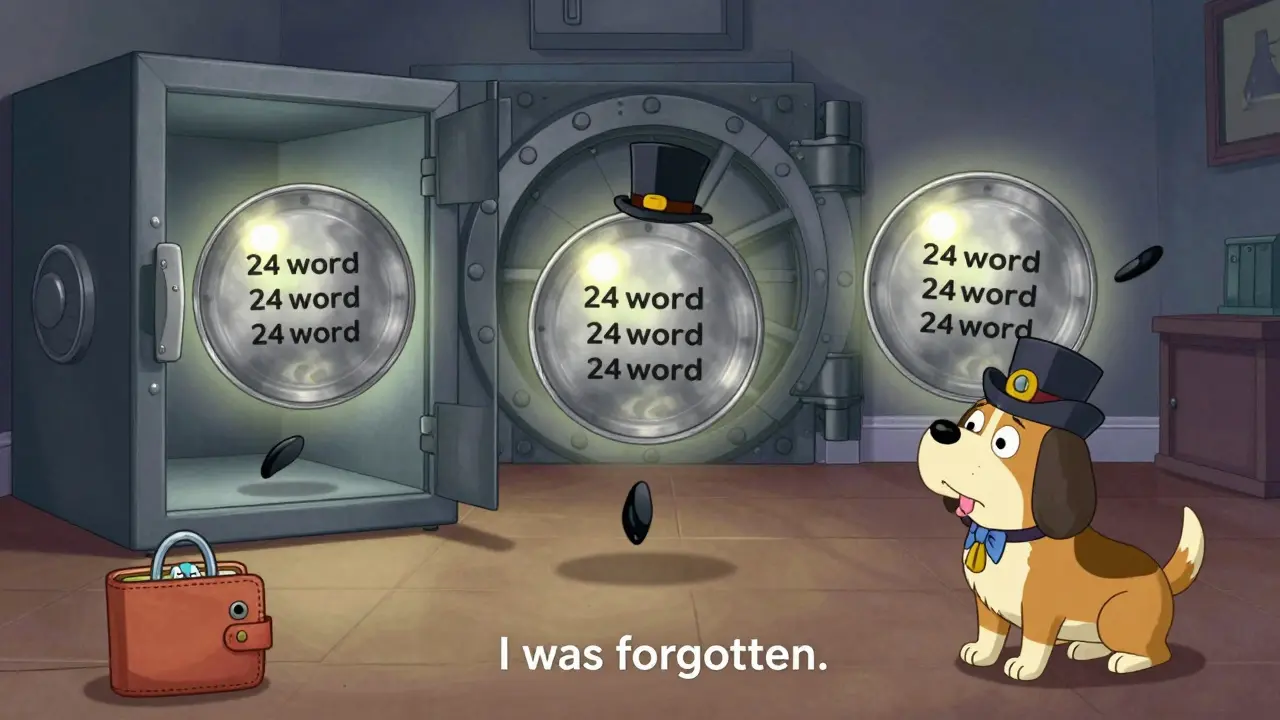
Guardian Networks: Trust Your Circle
Another option is a guardian network, used by services like Vault12. Instead of relying on a company, you pick five people you trust - maybe your sibling, your lawyer, a close friend, your accountant, and your child. Each of them gets an encrypted share of your seed phrase.When you die, at least three of them must come together to reconstruct the key. None of them can access the funds on their own. This removes reliance on third-party companies - but it requires you to find five people who are willing, able, and trustworthy enough to handle this responsibility. It’s a personal solution, not a technical one.
Timelocked Inheritance: Automate, But With Caution
Some people set up a "dead man’s switch" - a smart contract that automatically sends Bitcoin to a designated address if you don’t check in for six months. It sounds convenient. But it’s dangerous.What if you’re in a coma? What if you’re traveling for a year? What if your phone dies and you forget to reset the timer? The blockchain doesn’t care. It just executes the code. And once it does, there’s no undo. Several cases have ended with families losing access because the system thought the owner was dead - but they weren’t.
Unless you’re absolutely certain you won’t be away from your wallet for more than six months, avoid this method. It’s too rigid for real life.
Legal Documents: What to Include (and What Not to)
Your will matters. But never put your seed phrase or private key in your will. Wills become public records after death. If a thief finds out you had $5 million in Bitcoin, they’ll come looking.Instead, write something like:
"I own cryptocurrency assets. My executor is authorized to contact [service name] or retrieve materials stored at [location] to facilitate distribution to my beneficiaries. My heirs are entitled to [percentage] of my digital asset holdings."
Don’t say "I have 12.5 BTC" - that tells thieves how much to look for. Say "a significant portion" or "my digital assets". Let your executor handle the details.
Also, don’t name your lawyer as the trustee for your Bitcoin. Most attorneys don’t know how to handle cryptocurrency. They’ll get confused. They’ll make mistakes. You’re better off naming a trusted family member who’s tech-savvy - or using a service that guides them through the process.
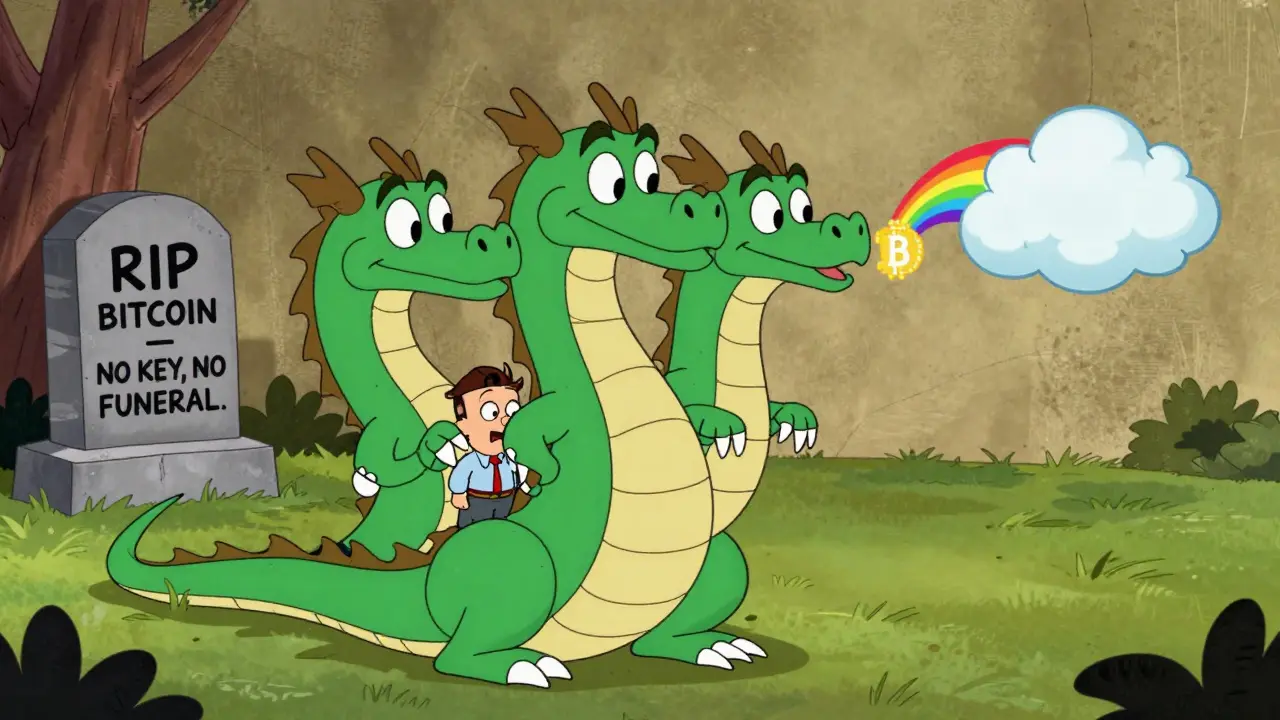
Combining Methods for Maximum Security
The most reliable inheritance plan doesn’t rely on one method. It uses layers.Here’s what a solid setup looks like:
- 80% of your Bitcoin in a 2-of-3 multisig wallet with a professional service like Swan Bitcoin
- 10% in a hardware wallet stored in a safety deposit box
- 10% in a simple paper wallet with the seed phrase given to your spouse
This way, if one system fails, the others still work. If the service goes under, your spouse still has access. If the hardware wallet breaks, the multisig still functions. You’re not putting all your eggs in one basket.
What Happens If You Do Nothing?
If you don’t plan, your Bitcoin likely dies with you. And that’s not just your loss - it’s a loss for your family. Imagine your child inheriting a house, a car, and a bank account - but not knowing you had $300,000 in Bitcoin locked away. They might never find out. Or worse, they find out years later - after the wallet was wiped by a failed PIN attempt.Bitcoin inheritance isn’t about being rich. It’s about responsibility. If you own it, someone else might need it. And they deserve a chance to use it.
Start Now - Before It’s Too Late
You don’t need to be an expert to plan this. Here’s what to do today:- Find out how much Bitcoin you own
- Write down your seed phrase on metal or fireproof paper
- Store at least two copies in separate locations
- Tell one trusted person where to find them
- Update your will to reference your digital assets without revealing keys
- Consider a multisig service if you have more than $10,000 in Bitcoin
You don’t need to fix everything tomorrow. But if you do one thing today - write down your seed phrase and tell someone where it is - you’ve already done more than 90% of Bitcoin owners.
What happens if I lose my Bitcoin private key?
If you lose your private key or seed phrase and no one else has a copy, the Bitcoin is permanently inaccessible. There is no recovery option, no customer service, and no reset button. Blockchain technology doesn’t allow for reversals. That’s why planning ahead is critical.
Can I leave Bitcoin in my will?
Yes, but never include the actual private key or seed phrase in your will. Wills are public documents after death. Anyone can read them - including criminals. Instead, mention that you own digital assets and direct your executor to contact a trusted service or retrieve materials from a secure location.
Is a hardware wallet enough for inheritance?
A hardware wallet alone is not enough. Heirs need the device, the PIN, and the seed phrase. If they don’t have all three, they can’t access the funds. The seed phrase is the most important part - it works on any wallet. Store it separately from the device and make sure someone you trust knows where to find it.
What’s the safest way to store a seed phrase?
The safest way is to engrave it onto a metal plate, like Cryptosteel, and store it in multiple secure locations - such as a home safe, a bank safety deposit box, and with a trusted family member. Avoid digital storage entirely. Paper can rot, USB drives can fail, and photos can be hacked.
Should I use a third-party service for Bitcoin inheritance?
Using a service like Unchained Capital, Casa, or Swan Bitcoin can simplify inheritance for non-technical heirs. These services hold one key in a multisig setup and only release it after verifying your death. This reduces the burden on your family. But make sure you understand their fees, terms, and how long they’ve been operating before trusting them with your assets.








Bob Buthune
24 Mar 2026 at 11:58Man, I just read this and I’m sitting here with my hands shaking. I didn’t even think about this until my uncle passed last year and we found his Ledger in a drawer with a sticky note that said ‘wallet 1’ - no PIN, no phrase, just that. I cried. Not because of the money - though it was like $400K - but because he was so careful with everything else. His garden, his vintage watches, his vinyl collection… but Bitcoin? He thought it was ‘too techy’ to explain. I’ve since engraved my own seed on three Cryptosteel plates. One in my safe, one with my sister in Vancouver, one buried in a waterproof tube in my backyard. Yeah, I know, sounds crazy. But if I die tomorrow, I want my kid to be able to buy a damn house. 🛠️💧🔒