

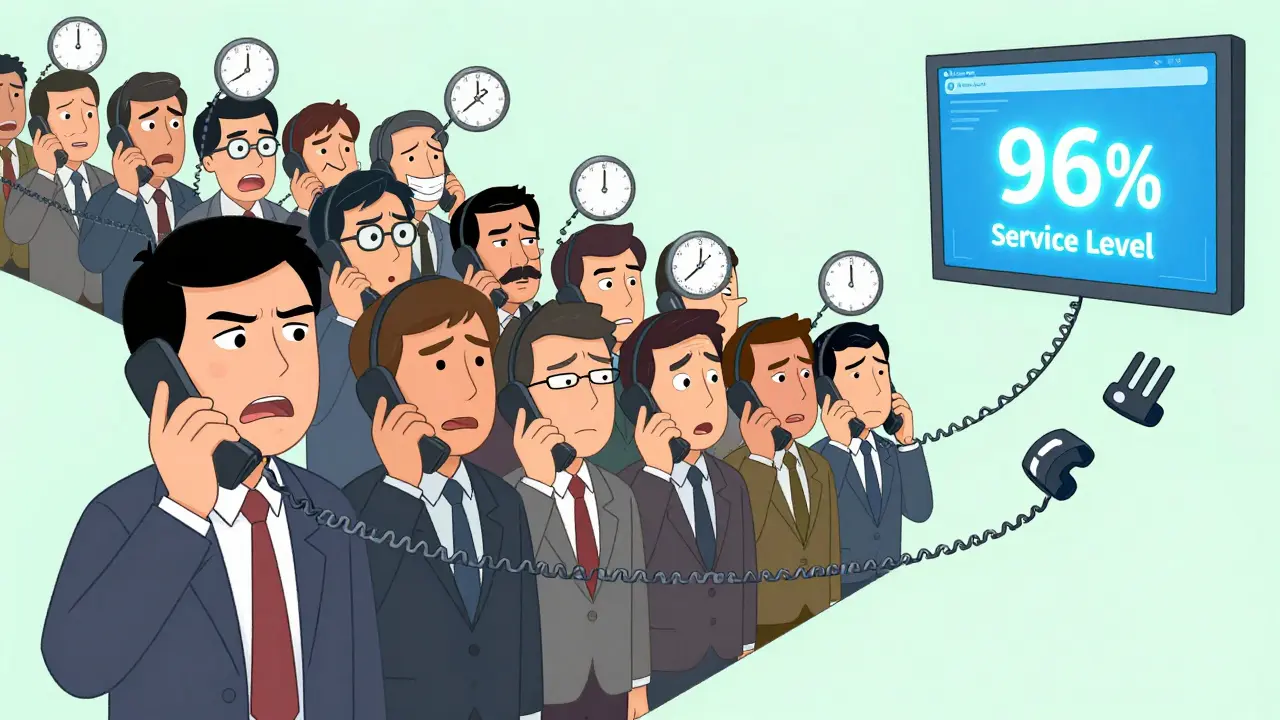

When a customer calls your business, they don’t care about your VoIP provider’s uptime or the number of servers you have. They care about one thing: how long they wait. If they’re stuck in a queue for more than a minute, they hang up. And if it happens often, they stop calling altogether. That’s why queue service level isn’t just a metric-it’s a survival tool for any VoIP-powered call center.
What Exactly Is Queue Service Level?
Queue service level (SL) measures the percentage of calls answered within a set time limit. For example, if your SLA says "80% of calls answered in 30 seconds," then out of every 100 calls, at least 80 must be picked up by an agent within half a minute. Simple, right? But here’s the catch: it’s not just about the calls that get answered. It’s also about the ones that get abandoned. Most VoIP systems automatically subtract abandoned calls from your service level percentage. So if 100 calls come in, 98 get answered within 30 seconds, but 2 were dropped before anyone picked up? Your service level isn’t 98%. It’s 96%. That’s because those two abandoned calls count as failures. This adjustment makes the metric real. It reflects what customers actually experienced-not just what you think happened.Why 60 Seconds Is the Default (And Why You Should Change It)
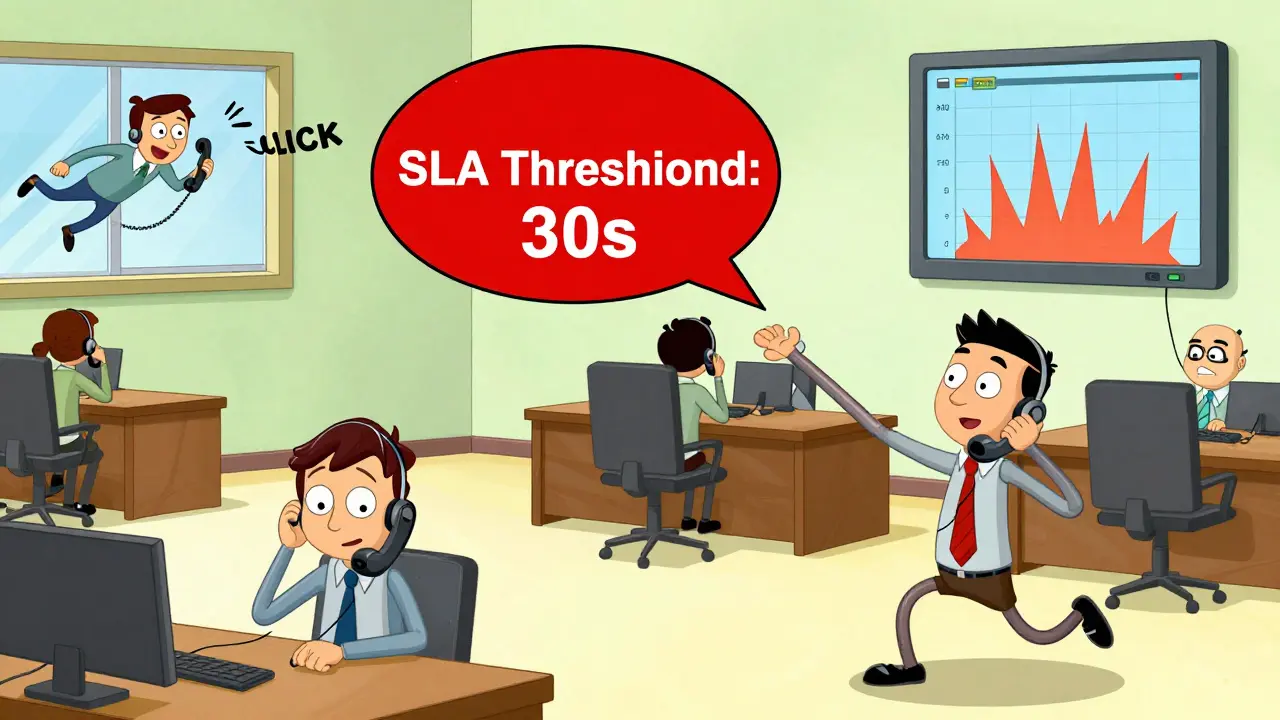
Many VoIP platforms set the default SLA threshold at 60 seconds. That’s not because it’s ideal-it’s because it’s safe. It gives agents time to breathe, systems time to route calls, and managers time to react. But if your customers expect instant service, 60 seconds is too long. A 2025 survey of 1,200 U.S. call center customers found that 73% expect to be connected within 20 seconds. Only 12% said they’d tolerate more than 45 seconds. If your SLA still says 60, you’re already behind. The right SLA target depends on your business. A hospital hotline? 15 seconds. A retail support line during Black Friday? 25 seconds. A B2B billing department? Maybe 60 is fine. But don’t just copy your competitor’s number. Look at your own data. What’s your current abandon rate? What’s your average handle time? Use that to set a baseline, then push slightly beyond it.How VoIP Systems Track and Report Service Level
Modern VoIP platforms like SpectrumVoIP, RingCentral, and 8x8 give you real-time dashboards that show service level as a live percentage. These dashboards pull data from three key sources:- Number of calls answered within your SLA time
- Total number of calls handled
- Number of abandoned calls
Setting Realistic SLA Targets: The Balance Between Customer Expectation and Staffing Costs
You can set your SLA target at 10 seconds. But if you only have 3 agents on duty during peak hours, you’ll fail. Constantly. And when you fail, you pay. Many VoIP providers include service credits in their SLA. If you don’t hit your target, customers get money back. That’s not a bonus-it’s a penalty. And if you’re offering SLAs to your own clients (like a B2B call center serving other businesses), you’re on the hook too. The trick is to find the sweet spot. Too aggressive? You burn out staff, hire too many people, and bleed cash. Too lenient? You lose customers, damage your brand, and watch churn rise. Start with this rule: your SLA should be 10% faster than your current best performance. If your average answer time is 45 seconds and your abandon rate is 5%, aim for 40 seconds. Then track it for 30 days. If you hit it 90% of the time, raise it again. If you’re barely scraping by, lower it. This isn’t guesswork-it’s iterative optimization.What Happens When You Miss Your SLA?
Missing SLA targets isn’t just bad for customer experience-it’s bad for business. Here’s what typically follows:- Service credits paid to customers (often 10-25% of monthly fees)
- Internal performance reviews that lead to staff retraining or layoffs
- Loss of client trust, especially if SLAs are part of your contract
- Increased abandon rates, which hurt your overall metrics and make future SLAs harder to hit
How to Improve Your Service Level (Without Hiring More People)
You don’t always need more agents to improve SLA. Sometimes, you just need better processes.- Use skill-based routing. Don’t send all calls to the first available agent. Route billing questions to billing experts. That cuts handle time and increases first-call resolution.
- Implement callback options. If a caller’s wait time exceeds 2 minutes, offer a callback. They’re less likely to abandon if they know they’ll be called back within 10 minutes.
- Optimize IVR menus. Too many options? 70% of callers give up before reaching an agent. Simplify. Two choices max.
- Monitor seasonal trends. Holiday spikes? Schedule extra staff in advance. Don’t wait until the queue hits 50 calls deep.
- Train agents on speed without sacrificing quality. A 30-second call that solves the problem is better than a 90-second call that doesn’t.
SLA Isn’t Just About Calls-It’s About Trust
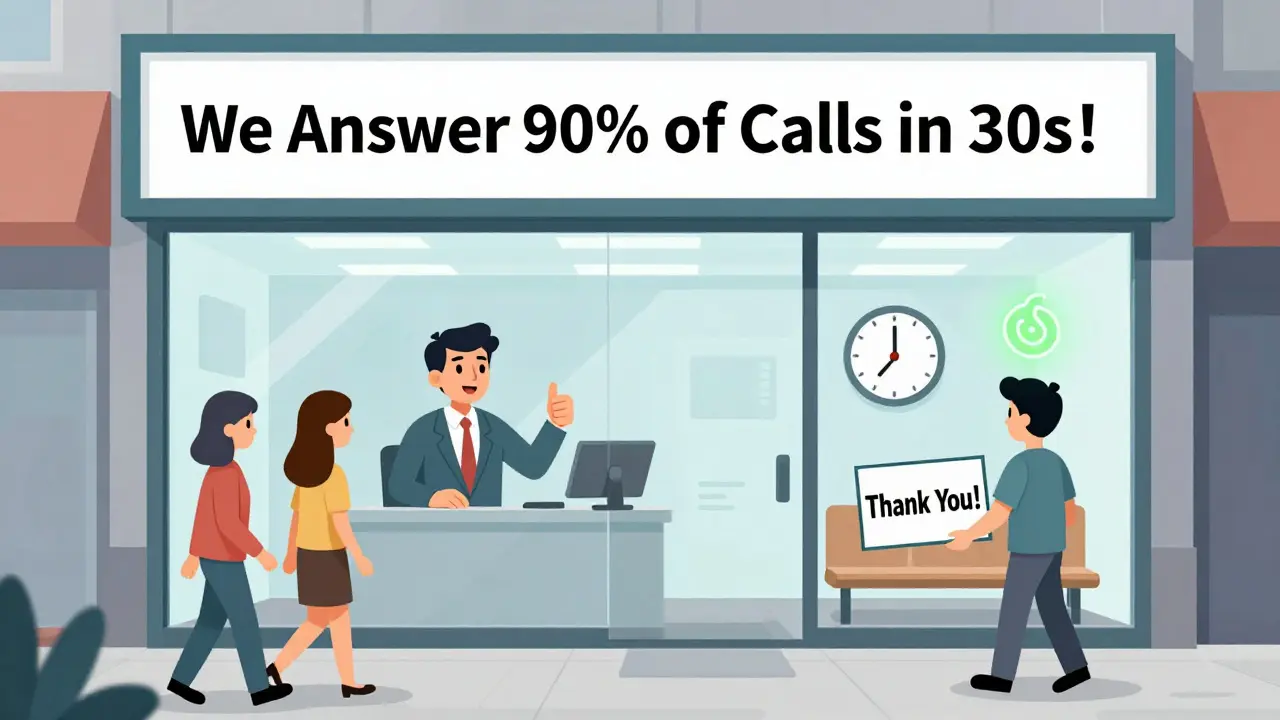
Your SLA is more than a technical metric. It’s a promise. When you say “we answer 90% of calls in 30 seconds,” you’re telling customers: “We value your time.” If you break that promise, they don’t just leave-they tell others. The best call centers don’t just track SLA-they publish it. They display it on their website. They mention it in onboarding emails. They use it as a benchmark for internal goals. That’s because transparency builds trust. And trust turns customers into advocates.Final Checklist: Are You Setting SLAs Right?
Use this quick checklist to audit your current SLA setup:- Is your SLA time based on real customer data, not industry defaults?
- Are abandoned calls being subtracted from your SLA percentage?
- Do you get real-time alerts when calls exceed your SLA threshold?
- Are SLA targets reviewed monthly and adjusted based on performance?
- Do your agents know what SLA you’re targeting-and why it matters?
- Is your SLA clearly documented in client contracts (if applicable)?
What’s the difference between SLA and service level?
Service level is the metric: the percentage of calls answered within a set time. SLA (Service Level Agreement) is the contract that defines what that percentage and time should be. Think of service level as the score, and SLA as the goal you’re trying to hit.
Can I set different SLAs for different times of day?
Yes, and you should. Most VoIP platforms allow time-based SLA rules. For example, 20 seconds during 9 AM-5 PM, 60 seconds overnight. This matches real demand patterns and prevents overstaffing during low-traffic hours.
Why does my service level drop even when no calls are abandoned?
Because the calculation is based on handled calls only. If your system has a high volume of calls that are never answered (e.g., due to system errors or routing failures), those calls aren’t counted as “handled,” so they’re excluded from the denominator. This can make your percentage look higher than it is. Always check total call volume alongside service level.
Do I need an SLA if I’m not a VoIP provider?
If you’re running a call center-even internally-you still need one. SLAs aren’t just for vendors. They’re for accountability. Without a clear target, you can’t measure performance, train staff, or prove you’re delivering value. Internal SLAs keep teams aligned and focused.
What’s a good abandon rate to aim for?
Under 5% is excellent. 5-8% is acceptable for most industries. Above 8% means your service level is too slow or your staffing is too low. If your abandon rate is high, fix the queue first-not the agent training.






Rubina Jadhav
19 Feb 2026 at 08:43I work in a small call center in Hyderabad, and this hit home. We used to aim for 60 seconds because it felt manageable. Then we tracked abandon rates for a week and realized 1 in 4 callers hung up before 30 seconds. We switched to 25 seconds. Staff were stressed at first, but with skill-based routing and a cleaner IVR, we hit 92% in 3 weeks. No extra hires. Just smarter routing. Simple changes, huge difference.