

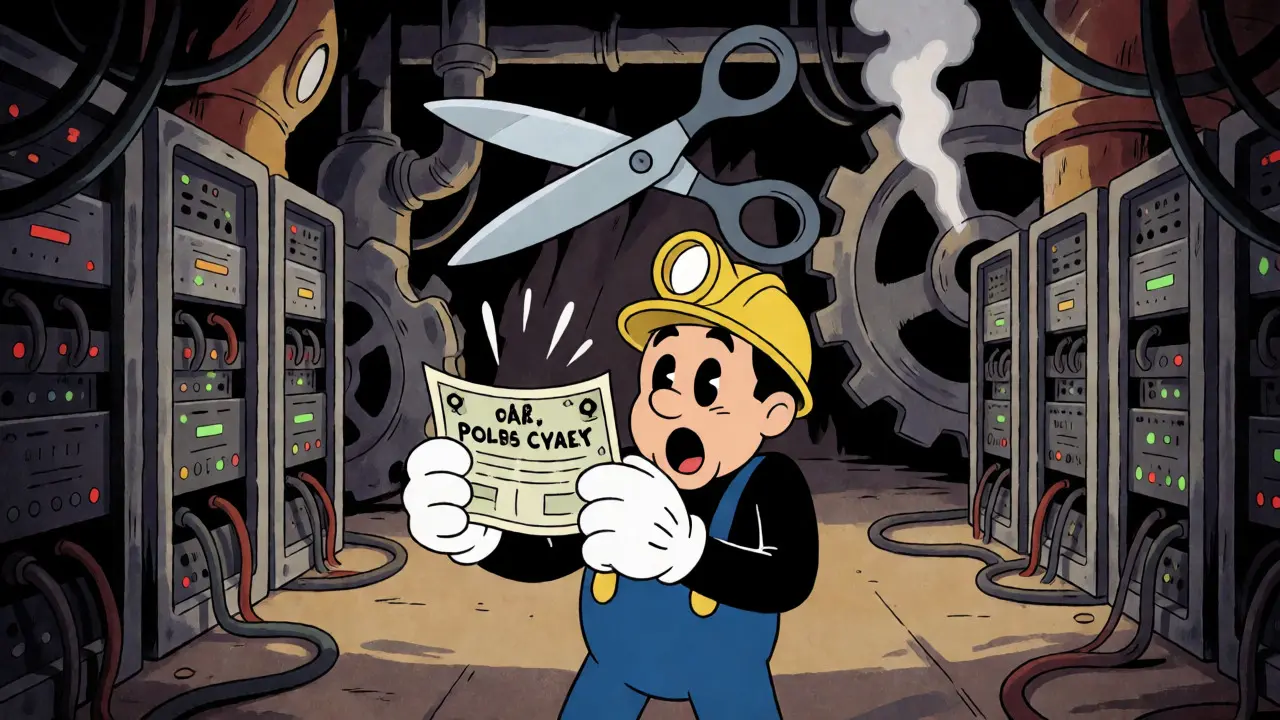

Imagine your paycheck gets cut in half overnight, but your rent and electricity bills stay exactly the same. That’s the reality for Bitcoin miners after a halving event. In April 2024, the fourth major halving reduced the reward for mining a new block from 6.25 BTC to 3.125 BTC. This protocol-driven mechanism is designed to cap Bitcoin’s supply at 21 million coins, making it deflationary by nature. But while the code changes instantly, the economic impact ripples through the industry for years.
You might wonder how miners survive when their primary income source drops so sharply. The answer lies in a gradual shift from relying on newly minted coins (the block subsidy) to earning money from user payments (transaction fees). This transition isn't just a minor adjustment; it's a fundamental restructuring of mining economics. If you're an investor, a miner, or just curious about how Bitcoin stays secure, understanding this revenue mix is crucial. Let's break down what actually happens to mining profits when the subsidy shrinks and why fees are becoming the lifeline of the network.
The Immediate Shock: Halving Your Income Without Cutting Costs
When the Bitcoin halving occurs, every miner on the network sees their block reward drop by 50% simultaneously. It’s not a gradual fade; it’s a cliff edge. Before the April 2024 event, a successful block earned 6.25 BTC. If Bitcoin was trading at $40,000, that block was worth $250,000. After the halving, that same block yielded only 3.125 BTC, or $125,000 at the same price. That’s a sudden $125,000 loss per block, repeated roughly every ten minutes across the network.
Here’s the kicker: operational costs don’t drop. Electricity rates, hardware depreciation, and facility maintenance remain constant. For many miners, especially those with older equipment or higher energy costs, this immediate reduction pushes them below the break-even line. Data from post-halving periods shows that BTC-denominated hashprice-the amount of Bitcoin earned per unit of computing power-often halves as well. In 2024, this metric dropped from approximately 0.0008 to 0.0004 BTC per petahash per day. This means that even if you’re running efficient machines, you’re earning significantly less Bitcoin for the same amount of work.
Why Transaction Fees Are Becoming the New Kingmaker
If the block subsidy is shrinking, where does the rest of the revenue come from? Enter transaction fees. These are the tips users pay to get their transactions processed faster. When the network is congested, fees spike, providing a lucrative boost to miners who can prioritize these high-paying transactions. Historically, fees were a small slice of the pie. But as subsidies decline with each halving cycle, fees must fill the gap.
Consider the long-term trajectory. By the time we reach the final halvings in the year 2140, the block subsidy will be negligible. At that point, transaction fees will likely constitute nearly 100% of miner revenue. We’re already seeing this trend accelerate. Miners are now optimizing their operations to capture more fee-rich blocks rather than just relying on the fixed subsidy. This shift forces miners to become better market participants, analyzing mempool congestion and fee markets to maximize earnings. It’s no longer enough to just plug in a machine; you need to understand the flow of capital on-chain.
The Difficulty Adjustment: A Natural Safety Valve
So, what happens when too many miners go bankrupt because they can’t cover their bills? The Bitcoin difficulty adjustment kicks in. Every two weeks, the network recalibrates how hard it is to find a new block. If inefficient miners shut down their rigs, the total hashrate (computing power) securing the network drops. The protocol responds by lowering the difficulty, making it easier for the remaining miners to find blocks.
This mechanism acts as a natural safety valve. After the 2024 halving, difficulty dropped by about 8% as weaker operations exited the market. This allowed surviving miners to earn more per unit of compute, offsetting some of the revenue loss from the halving. However, this relief is temporary. As soon as prices rise or efficiency improves, new hardware joins the network, pushing difficulty back up. It’s a continuous tug-of-war between miner survival and network security.
| Halving Event | Date | Block Reward (BTC) | Total Supply Cap Progress |
|---|---|---|---|
| Initial Launch | 2009 | 50 BTC | ~0% |
| First Halving | 2012 | 25 BTC | ~12% |
| Second Halving | 2016 | 12.5 BTC | ~25% |
| Third Halving | 2020 | 6.25 BTC | ~50% |
| Fourth Halving | April 2024 | 3.125 BTC | ~75% |
| Fifth Halving (Projected) | ~2028 | 1.5625 BTC | ~87% |
Operational Survival: Efficiency and Energy Costs
Surviving a halving isn’t just about waiting for the price to go up; it’s about cutting costs. The cost to mine one Bitcoin varies wildly depending on location and hardware. Estimates suggest it costs between $10,000 and $15,000 to mine a coin under optimal conditions, but this figure can double for less efficient operations. The single biggest variable? Electricity.
Miners in regions with subsidized or renewable energy sources have a massive advantage. If you’re paying $0.06 per kilowatt-hour, you’re in a much stronger position than someone paying $0.12. Post-2024, the threshold for profitability tightened. Only operators with the latest ASIC hardware-machines specifically designed for SHA-256 hashing-and low energy costs could maintain healthy margins. Older generation rigs became obsolete almost overnight, forcing owners to either upgrade, sell, or scrap them.
This pressure drives consolidation. Large firms with access to capital buy out struggling smaller players. They leverage economies of scale to negotiate better power contracts and deploy newer tech faster. Meanwhile, overleveraged miners who borrowed heavily to expand before the halving often face default risks. If their cash reserves run dry during the post-halving dip, lenders step in, leading to mergers and acquisitions that concentrate mining power among fewer, larger entities.

The Price Paradox: Why USD Revenue Might Stay Flat
Here’s a counterintuitive point: while Bitcoin-denominated revenue drops, USD-denominated revenue doesn’t always follow suit. Why? Because Bitcoin’s price often appreciates around halving events due to anticipated supply shocks. During the 2024 cycle, while BTC hashprice fell, USD hashprice remained relatively flat at around $45 per petahash per day. This stability suggests that market price appreciation can partially offset the mechanical reduction in rewards.
However, relying on price speculation is risky. Miners need predictable cash flows to pay monthly bills. If the price stagnates while costs remain high, margins vanish. Successful miners hedge this risk by selling portions of their mined Bitcoin immediately to cover operational expenses, rather than holding everything in hopes of a future bull run. This discipline helps them weather the volatility without facing liquidity crises.
Long-Term Sustainability: Can Fees Secure the Network?
The big question hanging over Bitcoin’s future is whether transaction fees alone can incentivize miners once the subsidy disappears entirely. Currently, fees account for a small percentage of total miner revenue. For the network to remain secure without substantial subsidies, either transaction volume must increase dramatically, or the value of Bitcoin must rise enough to make small fees worthwhile.
Technological upgrades like the Lightning Network aim to reduce on-chain congestion, which could lower fees. But ironically, lower fees might hurt miner revenue unless volume explodes. It’s a delicate balance. If fees become too low, miners might stop securing the network, leading to potential centralization or security vulnerabilities. Conversely, if fees are too high, users might migrate to cheaper alternatives. The ecosystem needs to evolve to ensure that fee-based incentives remain robust enough to replace the fading block subsidy.
What happens to miners immediately after a halving?
Immediately after a halving, miners see their block reward cut by 50%. Since operational costs like electricity and hardware depreciation remain unchanged, profit margins shrink drastically. Many inefficient miners may shut down operations if they cannot cover their costs with the reduced income.
How do transaction fees help miners after a halving?
Transaction fees serve as a critical secondary revenue stream. As block subsidies decrease, miners rely more heavily on fees paid by users to prioritize transactions. High network congestion leads to higher fees, which can compensate for the lower block reward, helping miners maintain profitability.
Does the Bitcoin price always rise after a halving?
Historically, Bitcoin’s price has tended to appreciate in the months following a halving due to reduced supply issuance. However, this is not guaranteed. Market conditions, macroeconomic factors, and regulatory news also play significant roles in determining price movements.
What is the difficulty adjustment and how does it help miners?
The difficulty adjustment is a protocol feature that recalibrates mining difficulty every two weeks. If unprofitable miners leave the network, difficulty decreases, making it easier for remaining miners to find blocks. This helps stabilize revenue for surviving operators by compensating for the reduced block reward.
Will Bitcoin mining stop when the block reward reaches zero?
No, mining will continue as long as transaction fees provide sufficient incentive. Eventually, fees will become the sole source of miner revenue. The network’s security depends on whether these fees remain attractive enough for miners to invest in hardware and energy.






Write a comment