

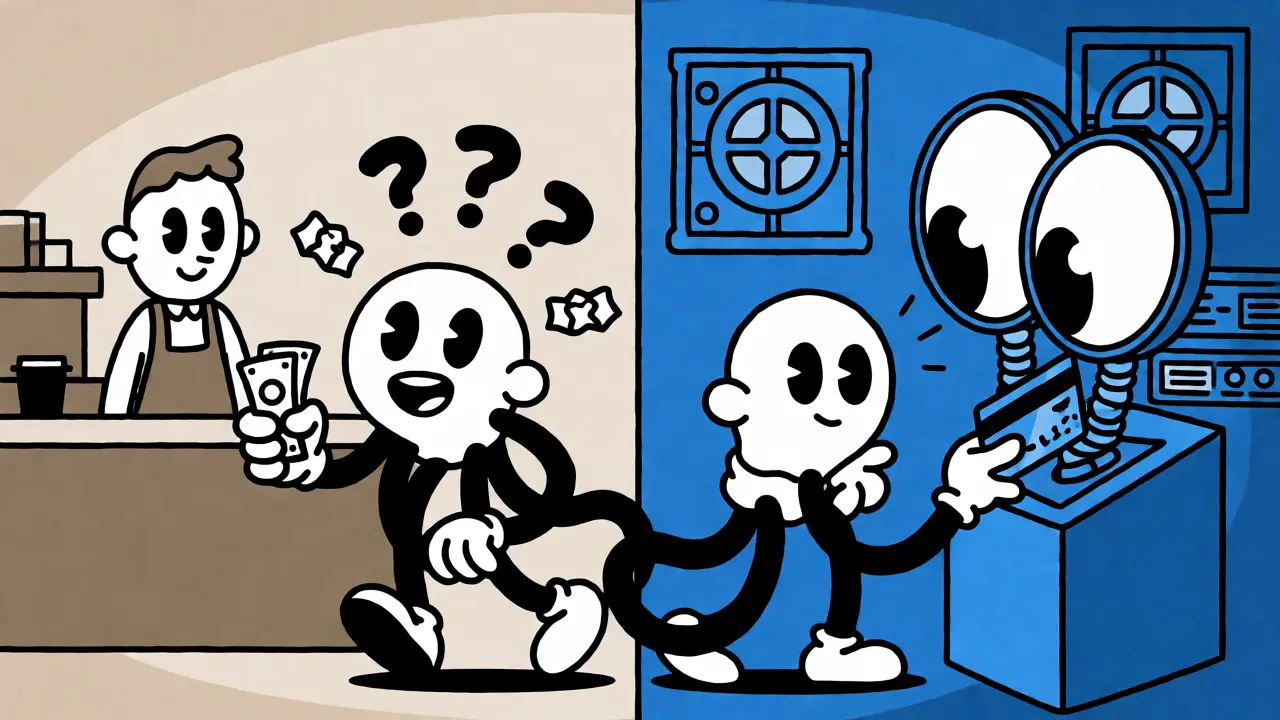

Imagine you pay for a coffee with cash. The barista doesn't know your name, your bank balance, or where you spent money yesterday. Now imagine paying that same coffee with a credit card. Every transaction is logged, linked to your identity, and visible to the merchant, the bank, and potentially data brokers. This is the fundamental tension in cryptocurrency today. While Bitcoin and Ethereum promise decentralization, their public ledgers create a permanent, transparent record of every move you make. If you want true financial privacy, you need specific crypto privacy tools.
But here is the catch: using these tools isn't just a technical challenge; it's a legal minefield. In 2025 and 2026, we've seen major shifts. The U.S. government has prosecuted founders of mixing services, and the EU has tightened rules on anonymity-enhancing assets. So, how do you actually use privacy tools without becoming a target? And what is the difference between a mixer, CoinJoin, and a privacy coin? Let's break down the technology, the risks, and the law.
The Core Problem: Why Public Ledgers Aren't Private
Most people think "anonymous" means "private." In crypto, they are different things. Bitcoin is pseudonymous. You don't use your name, but you use an address. Once that address is linked to your identity-say, by withdrawing from a KYC-compliant exchange like Coinbase or Binance-your entire history becomes visible. Blockchain analytics firms like Chainalysis can trace funds through dozens of hops. They look at timing, amounts, and interaction patterns. If you send 0.5 BTC to a known entity, then immediately receive 0.49 BTC back, that's a strong signal. To break this link, you need to obscure the relationship between sender and receiver. That is the job of privacy protocols.
CoinJoin: Breaking the Link Without Trusting a Middleman
CoinJoin is a collaborative technique for Bitcoin transactions where multiple users combine their inputs into a single transaction to obscure which input funded which output. Unlike traditional banking, there is no central authority holding your money. Instead, software coordinates a group of strangers to sign one big transaction together.
Here is how it works practically. Imagine three users: Alice wants to send 1 BTC to Bob. Carol wants to send 1 BTC to Dave. Eve wants to send 1 BTC to Frank. Normally, these would be three separate transactions. With CoinJoin, all three users contribute their inputs (the source of funds) and outputs (the destinations) into one large transaction. On the blockchain, it looks like a chaotic jumble of inputs and outputs. An observer sees ten inputs and ten outputs but cannot easily determine that Alice's input paid for Bob's output. It could have been Carol's or Eve's. This ambiguity creates an "anonymity set." The larger the set, the harder it is to trace.
However, CoinJoin has weaknesses. First, equal-value outputs are crucial. If Alice sends 1.01 BTC and everyone else sends exactly 1.00 BTC, she stands out. Second, metadata matters. If all participants connect to the same server IP address simultaneously, network-level surveillance can cluster them. Third, the coordinator-the piece of software that organizes the round-is a point of failure. Wasabi Wallet uses a centralized coordinator called WabiSabi. JoinMarket, by contrast, uses a peer-to-peer maker-taker model, which is more resilient but requires more technical skill to operate.
Mixers and Tumblers: The Custodial Risk
Before CoinJoin became popular, "mixers" or "tumblers" were the go-to solution. These are often custodial services. You send your coins to a service provider, they pool them with thousands of other users' coins, and then send equivalent amounts to new addresses you provide. The provider knows who sent what and when, but the blockchain only shows the pooled activity.
The biggest issue with custodial mixers is trust. You are handing over control of your private keys. The operator could steal your funds, freeze them, or shut down overnight. More importantly, they hold data that could be subpoenaed. If the FBI asks for records, the mixer hands them over. This was a key factor in the prosecution of Blender.io and Sinbad.io. Even if the code is open-source, the operational reality involves human intervention and logging.
Smart-contract mixers like Tornado Cash attempted to solve the custody problem. Tornado Cash is an Ethereum protocol that uses zero-knowledge proofs to allow users to deposit fixed denominations and withdraw them later without revealing the original deposit. Users didn't trust a person; they trusted code. But as recent legal battles showed, trusting code doesn't exempt you from laws regarding money transmission and sanctions.

The Legal Landscape: From Sanctions to Prison Sentences
If you thought privacy was purely a tech issue, the last few years proved otherwise. The legal environment for crypto privacy tools has hardened significantly.
| Entity/Service | Action Taken | Key Allegation | Current Status (Nov 2026) |
|---|---|---|---|
| Blender.io | OFAC Sanction (May 2022) | Laundering North Korean stolen funds | Operators indicted; service ceased operations |
| Tornado Cash | OFAC Sanction (Aug 2022); Conviction (Aug 2025) | Facilitating $7B+ in laundering; unlicensed money transmitter | Co-founder Roman Storm convicted; contracts delisted Mar 2025 |
| Samourai Wallet | DOJ Charges (Apr 2024); Guilty Pleas (Aug 2025) | $2B+ in unlawful transactions; $237M illegal proceeds | Founders sentenced to prison (Nov 2025) |
| Sinbad.io | OFAC Sanction (Nov 2023) | DPRK cyber-theft laundering | Russian nationals indicted (Jan 2025) |
The case against Tornado Cash was pivotal. Initially, the US Treasury sanctioned the smart contracts themselves, arguing they were property involved in laundering. However, in November 2024, the Fifth Circuit Court ruled in Van Loon v. Department of the Treasury that immutable smart contracts are not "property" under the International Emergency Economic Powers Act. This forced the Treasury to remove the sanctions in March 2025. Yet, the criminal conviction of co-founder Roman Storm in August 2025 for operating an unlicensed money-transmitting business showed that developers are not immune. They can be held liable for the conduct of the service, not just the code.
Similarly, Samourai Wallet founders Keonne Rodriguez and William Lonergan Hill pleaded guilty in 2025. Their sentence-five and four years respectively-signals that even non-custodial, partially decentralized tools can face severe penalties if they knowingly facilitate criminal proceeds. The DOJ focused on their marketing, fees, and awareness of customer behavior, not just the cryptographic nature of Whirlpool.
EU and UK Regulations: The Compliance Squeeze
Across the Atlantic, the regulatory approach is different but equally restrictive. The European Union’s Markets in Crypto-Assets (MiCA) framework and the Anti-Money Laundering Regulation (AMLA) are reshaping the market. AMLA, finalized recently, prohibits Crypto-Asset Service Providers (CASPs) from maintaining anonymous accounts or wallets that enable significant obfuscation. This effectively bans many privacy-focused features from being offered by regulated exchanges within the EU.
In the UK, the Financial Conduct Authority (FCA) supervises crypto businesses under Money Laundering Regulations. The FCA explicitly lists mixers, tumblers, privacy coins, and zero-knowledge proofs as indicators requiring enhanced scrutiny. If you try to withdraw funds from a UK-regulated exchange after using a mixer, you may face delays, requests for proof of source, or outright rejection. The burden of proof shifts to you to demonstrate that your funds are clean.

Practical Risks: It's Not Just About the Law
Even if you stay within legal bounds, technical pitfalls can ruin your privacy. A 2025 ESORICS study found that post-mix anonymity sets often shrink by 10% to 50% due to user behavior errors. Here are the most common mistakes:
- Address Reuse: Sending mixed coins back to an address used previously links your new balance to your old identity.
- Timing Correlations: Withdrawing from an exchange and immediately entering a CoinJoin round creates a temporal link. Investigators love timing patterns.
- Distinctive Amounts: If you mix 0.483721 BTC, that unique amount might reappear elsewhere, breaking the anonymity set.
- Input Consolidation: Merging small, unmixed dust inputs before mixing reveals your wallet structure.
- Endpoint Leaks: Running a node or wallet on a VPS with a static IP can expose your participation in rounds.
Furthermore, low adoption is a risk. As of late 2026, detectable privacy protocols account for less than 1% of Bitcoin transactions. A small anonymity set means fewer plausible matches for your transaction, making statistical analysis easier for adversaries.
How to Use Privacy Tools Safely
If you decide to use these tools, treat it as a high-stakes operation. Do not rely on default settings blindly.
- Choose Audited Software: Stick to established projects like Wasabi, JoinMarket, or Ashigaru. Avoid random GitHub repositories.
- Separate Identities: Use distinct wallets for KYC activities and private spending. Never merge mixed and unmixed coins in the same wallet unless necessary.
- Understand Fees: Know the coordination fee, mining fee, and any maker fees. High fees during congestion can force you to rush, leading to mistakes.
- Check Jurisdictional Rules: Before moving funds, verify current sanctions lists and exchange policies. What was allowed in 2024 might be blocked in 2026.
- Document Sources: Keep records of your income sources. If an exchange freezes your funds, you need to prove the origin quickly.
Remember, no tool provides perfect anonymity. CoinJoin makes tracing harder; it does not make transactions invisible. Metadata, network traffic, and off-chain actions still leave footprints. The goal is to raise the cost of surveillance, not to achieve invisibility.
Frequently Asked Questions
Is using Tornado Cash illegal in the US?
The smart contracts themselves were delisted from OFAC sanctions in March 2025 following a court ruling. However, interacting with the protocol can still trigger compliance checks at exchanges. Furthermore, operating the service resulted in criminal convictions for its founders, so individual users should consult legal counsel regarding their specific situation, especially if handling large sums.
What is the difference between a mixer and CoinJoin?
Mixers are typically custodial services where you send funds to a third party who pools and redistributes them. CoinJoin is a non-custodial protocol where users collaborate directly to create a single transaction, keeping control of their private keys throughout the process.
Why did the EU ban anonymous crypto accounts?
The EU Anti-Money Laundering Regulation aims to prevent illicit finance by ensuring transparency. Anonymous accounts and privacy-enhancing technologies make it difficult for regulators to trace the flow of funds, increasing the risk of money laundering and terrorist financing.
Does using CoinJoin guarantee my transactions are untraceable?
No. CoinJoin improves privacy by creating ambiguity about which input funded which output, but it does not hide the existence of the transaction. Timing, amounts, and subsequent spending patterns can still reveal information to sophisticated blockchain analysts.
Are privacy coins like Monero affected by these regulations?
Yes. Many regulated exchanges in the EU and UK have delisted privacy coins like Monero and Zcash because their native privacy features conflict with anti-money laundering requirements for transparency and traceability.






Write a comment