


You are sitting in a conference room, trying to hear your colleague across the ocean. The audio cuts out, then bursts back in with a robotic stutter. You blame the internet speed, but often, the culprit is how your VoIP codec handles data rates. Specifically, whether it uses Constant Bitrate (CBR) or Variable Bitrate (VBR). This isn't just a technical footnote; it’s the difference between a smooth call and a frustrating one.
Most people assume faster is better, but in voice over IP, predictability often beats raw efficiency. If you run a small business or manage a network, understanding when to lock the bitrate and when to let it float can save you money on bandwidth bills while keeping your customers happy. Let’s break down exactly how these two modes work, why major platforms like Zoom stick to one, and when you should actually switch to the other.
The Core Difference: Predictability vs. Efficiency
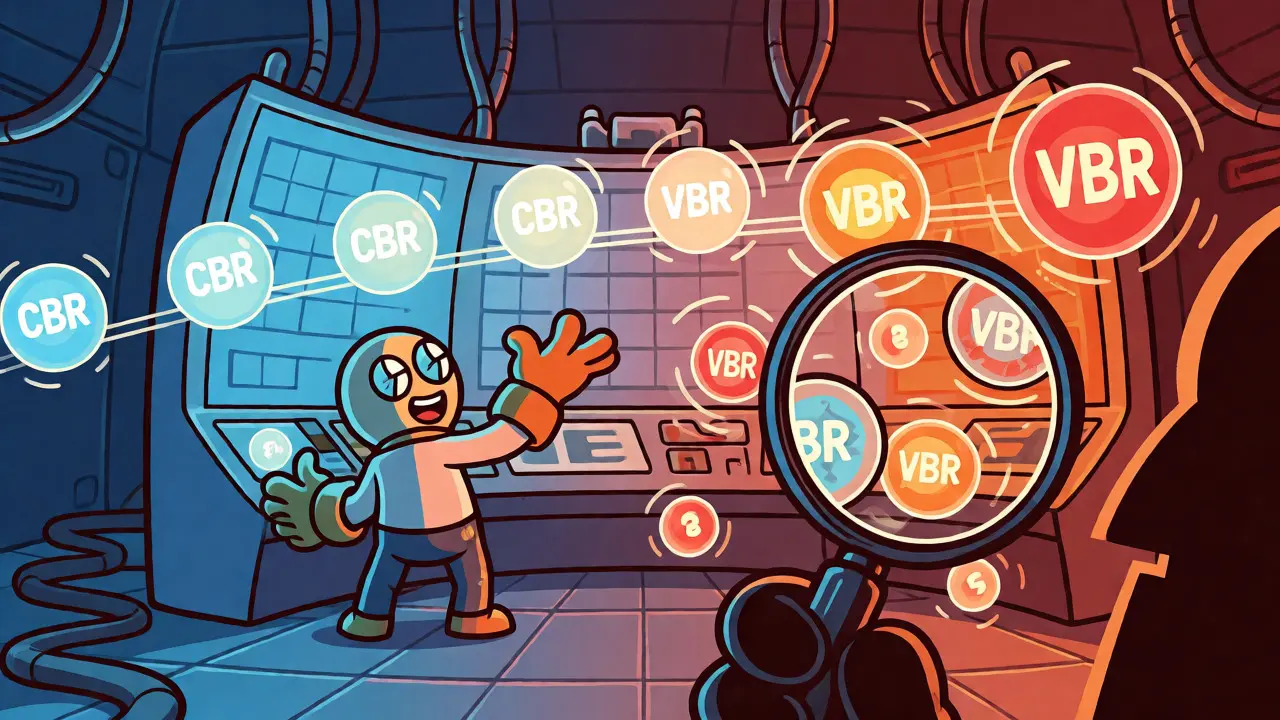
Think of Constant Bitrate as a faucet running at a fixed speed. No matter if you are speaking loudly, whispering, or staying silent, the amount of water (data) flowing per second stays roughly the same. In contrast, Variable Bitrate acts like a smart valve. It opens up wide when you speak complex sentences and closes almost completely during pauses.
Why does this matter? Voice traffic is bursty. We don’t talk continuously. There are gaps, breaths, and silences. CBR ignores this reality. It sends data packets even when nobody is saying anything, wasting bandwidth. VBR exploits these gaps. By suppressing silence and reducing data output during quiet moments, VBR can cut bandwidth usage by nearly 50% compared to CBR. That sounds great for your budget, right?
But here is the catch: networks hate surprises. When a VBR stream suddenly spikes from low activity to high complexity speech, it creates a burst of data. If your network buffer is small, those bursts can cause jitter or packet loss. CBR, being steady, allows network engineers to reserve exact amounts of bandwidth ahead of time. It’s less efficient, but much easier to manage.
How CBR Works in Real-Time Communications
In a CBR system, the encoder maintains a near-fixed target rate. For example, the classic G.711 codec always outputs 64 kbps, regardless of what you say. Even modern codecs configured for CBR will pad their packets with dummy data or adjust quantization slightly to keep the average rate stable within a tight window.
This stability is why giants like Zoom, Microsoft Teams, and Discord default to CBR or constrained-CBR modes. They prioritize a consistent user experience over saving a few kilobytes. If you are streaming live video or making real-time calls, you want the data flow to be boring. Boring means predictable. Predictable means your router doesn’t have to guess how much capacity to allocate every millisecond.
However, CBR has a downside. During complex speech segments-like when someone speaks quickly with background noise-the encoder might not have enough bits to encode the audio accurately because it’s locked into a fixed rate. This leads to compression artifacts, where voices sound muffled or metallic. To combat this, you need to set a higher baseline bitrate, which defeats the purpose of saving bandwidth.
When VBR Saves Your Bandwidth Budget
VBR systems shine when bandwidth is scarce or expensive. Think about mobile users on 3G or 4G networks, or remote offices connected via satellite links. Here, every bit counts. Codecs like Opus and Speex are designed for VBR. They analyze each frame of audio. If the frame contains silence, they send almost nothing. If it contains complex consonants, they send more data.
A study on VoIP resource estimation showed that enabling silence suppression and treating flows as VBR sources yields about 50% bandwidth savings. This allows service providers to multiplex more calls onto the same physical line without degrading quality significantly. For businesses with thousands of concurrent calls, this reduction translates directly into lower infrastructure costs.
Beyond cost, VBR often provides better audio quality for the same average bitrate. Because the encoder saves bits during easy parts of the conversation, it can spend them on difficult parts. This results in clearer highs and lows during active speech. Audiophiles and podcasters prefer VBR for recorded content for this reason, and the logic applies to VoIP too, provided the network can handle the variability.

The Security Angle: Why Spies Love VBR
Here is something most tech blogs miss: metadata leakage. Even if your voice traffic is encrypted, the size of the packets tells a story. With VBR, packet sizes vary wildly based on speech patterns. An eavesdropper analyzing traffic flow can infer when people are talking, how fast they are speaking, and even identify specific words or phrases based on the unique "fingerprint" of packet lengths.
CBR masks this behavior. Since packet sizes remain constant, an observer sees a uniform stream of data. They know a call is happening, but they can’t easily tell who is speaking or what is being said. For sensitive communications, such as legal consultations or executive board meetings, this privacy benefit often outweighs the bandwidth inefficiency. Wire, the secure messaging app, explicitly notes that using CBR mitigates traffic analysis risks, even though it incurs a 20-30% higher bitrate overhead compared to VBR.
Hybrid Modes: The Middle Ground
You don’t always have to choose extremes. Many modern implementations use Constrained CBR or Peak VBR. These hybrid approaches allow slight fluctuations around a target rate but cap the maximum instantaneous bitrate. This gives you some of the efficiency of VBR without the wild swings that crash buffers.
For instance, Microsoft Media Foundation documentation describes how constrained streams maintain a small buffer window. The rate varies, but only within strict limits. This is ideal for interactive applications where you need decent quality but can’t afford the risk of sudden congestion. It’s a compromise that many enterprise-grade VoIP systems adopt internally, balancing the needs of the network hardware with the expectations of the end-user.
Decision Guide: Which One Should You Pick?
Choosing between CBR and VBR depends on your specific constraints. Use this quick checklist to decide:
- Choose CBR if: You are using legacy PBX systems, require strict QoS policies, operate in a highly congested network where jitter is critical, or need maximum security against traffic analysis.
- Choose VBR if: You are on a limited-bandwidth connection (mobile, satellite), want to maximize audio quality for a given average bitrate, or are recording/storing calls where file size matters more than real-time transmission stability.
- Consider Hybrid if: You are building a custom application and want to balance quality and stability, using codecs like Opus with capped bitrates.
| Feature | Constant Bitrate (CBR) | Variable Bitrate (VBR) |
|---|---|---|
| Bandwidth Usage | Higher (wastes bandwidth on silence) | Lower (up to 50% savings with silence suppression) |
| Network Predictability | High (easy to plan and reserve) | Low (bursts can cause jitter/congestion) |
| Audio Quality | Consistent, but may degrade on complex sounds | Generally better for equivalent average bitrate |
| Security/Privacy | Stronger (harder to analyze traffic patterns) | Weaker (packet sizes reveal speech dynamics) |
| Best Use Case | Enterprise conferencing, strict QoS environments | Mobile VoIP, bandwidth-constrained WANs |
Implementation Tips for Network Engineers
If you are configuring a VoIP gateway or SIP trunk, start with CBR for your primary trunks. It simplifies troubleshooting. If you notice excessive bandwidth consumption on secondary lines or mobile clients, test switching to VBR with aggressive silence suppression. Monitor your jitter buffer settings closely. VBR requires larger buffers to absorb the natural variations in packet arrival times.
Also, remember that codec compatibility matters. Not all endpoints handle VBR gracefully. Some older IP phones might glitch when receiving variable-sized packets. Always test with your specific hardware mix before rolling out changes company-wide. Modern standards like WebRTC handle VBR well, but legacy TDM-to-IP gateways often prefer the rigid structure of CBR.
Does VBR always provide better audio quality than CBR?
Not always. While VBR generally offers better quality for the same average bitrate by allocating more bits to complex sounds, poor implementation or network instability can negate this advantage. If the network drops packets due to VBR bursts, the perceived quality will drop below that of a stable CBR stream.
Why do apps like Zoom use CBR instead of VBR?
Apps like Zoom prioritize consistency and low latency over bandwidth savings. CBR ensures that the data rate is predictable, which helps prevent jitter and buffering issues across diverse and unreliable consumer internet connections. It also simplifies the adaptive bitrate algorithms used to maintain call stability.
Can I mix CBR and VBR calls on the same network?
Yes, but it requires careful QoS configuration. You must ensure that the total peak bandwidth of all VBR calls plus the fixed bandwidth of CBR calls does not exceed your link capacity. Mixing them can complicate traffic shaping rules, so it’s best to segregate them into different VLANs or priority queues if possible.
Is silence suppression the same thing as VBR?
They are related but distinct. Silence suppression stops sending packets entirely during silence, which is a form of extreme VBR. VBR adjusts the bitrate dynamically throughout the call, including during active speech. Most VBR implementations include silence suppression as part of their strategy to reduce overall bandwidth.
Which codec is best for VBR in VoIP?
Opus is widely considered the best modern codec for VBR in VoIP. It supports a wide range of bitrates and sample rates, adapts quickly to network conditions, and includes robust silence detection. Speex is another good option for older systems, specifically designed for source-controlled VBR.





Write a comment