



Choosing the right technical foundation for your digital asset project can feel like standing at a fork in the road with no signposts. On one side sits ERC-721, the original standard that defined what it means to own something unique on the blockchain. On the other is ERC-1155, the newer, multi-token powerhouse designed to handle complex inventories with surgical precision. By June 2026, the debate isn't just about which standard is "better"-it’s about which one actually fits the specific job you need done. Are you launching a single rare piece of art, or are you building an entire virtual economy? The answer changes everything regarding your development time, user experience, and ongoing costs.
We often treat these standards as interchangeable synonyms for "NFT," but they operate on fundamentally different architectural principles. Understanding the gap between them prevents costly mistakes later on. If you pick the wrong one, you might find yourself paying exorbitant gas fees during minting events or struggling to support basic features like semi-fungible tickets. Let’s break down exactly how these two protocols work under the hood so you can make a decision based on hard data rather than hype.
The Original Pioneer: How ERC-721 Works
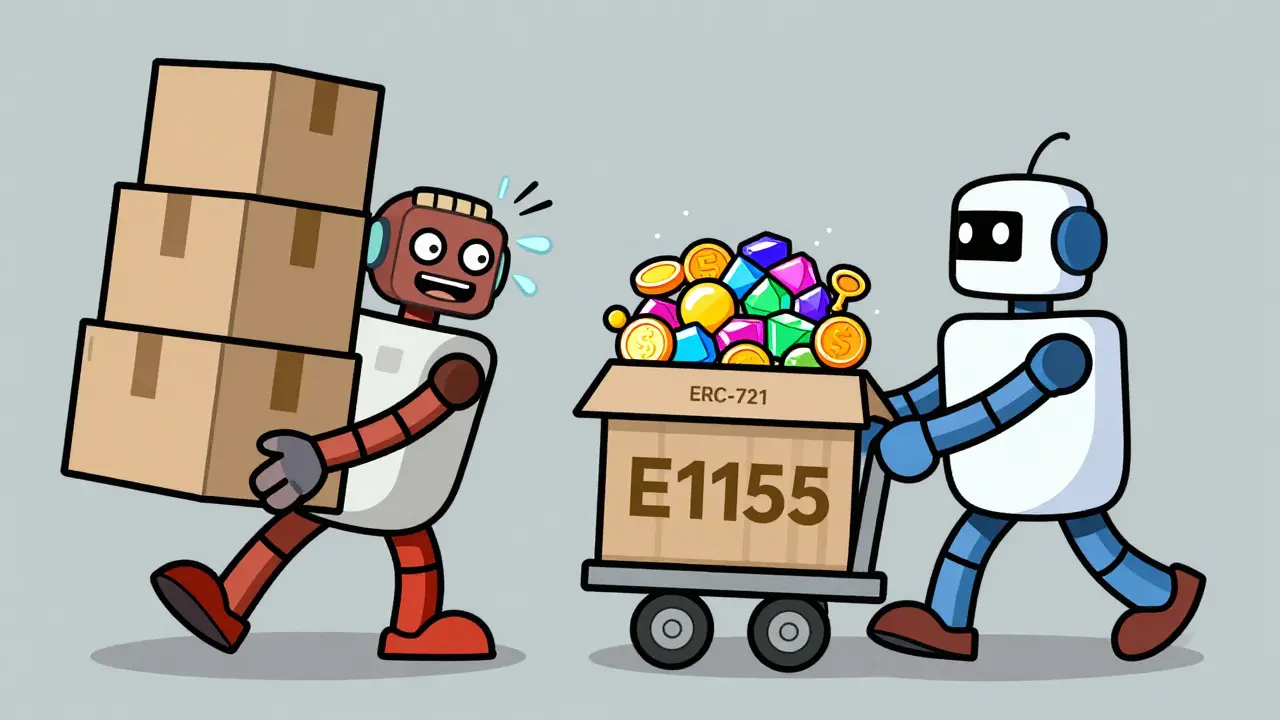
ERC-721 emerged as the first true standard for non-fungible tokens on Ethereum. Its design philosophy is simple: every token ID represents a completely unique asset that cannot be exchanged on a one-to-one basis with another token. When you deploy an ERC-721 contract, you are essentially creating a ledger where each entry maps a specific Token ID to a single owner address. There is no concept of "supply" in the traditional sense; if you mint ten tokens, the network sees ten distinct items, not ten units of the same thing.
This strict uniqueness makes ERC-721 the gold standard for high-value, one-of-a-kind digital collectibles. Think of Bored Ape Yacht Club or CryptoPunks. Each item has its own metadata URI, pointing to unique attributes like fur color or background style. Because the architecture is straightforward-one contract per collection-it became the default choice for early NFT marketplaces. Wallets like MetaMask and platforms like OpenSea built their initial infrastructure around this model because it was easy to query: check the balance, get the owner, transfer the asset.
However, this simplicity comes with structural limitations. Since each token is treated individually, transferring multiple items requires multiple transactions. If a user wants to send five different NFTs from your collection to another wallet, they must execute five separate calls. This increases friction for users and inflates transaction costs, especially when Ethereum network congestion spikes. For simple art drops, this overhead is manageable. For complex systems, it becomes a bottleneck.
The Multi-Token Powerhouse: Inside ERC-1155
ERC-1155 was introduced to solve the inefficiencies inherent in earlier standards. Unlike ERC-721, which focuses solely on non-fungible assets, ERC-1155 is a multi-token standard. A single deployed smart contract can manage any combination of fungible (like currency), non-fungible (like unique swords), and semi-fungible (like event tickets) tokens simultaneously. This unification drastically reduces deployment complexity. Instead of deploying three separate contracts for your game’s currency, consumables, and rare equipment, you deploy one.
The magic of ERC-1155 lies in its handling of token IDs and supply. In this standard, a Token ID defines the *type* of asset, while the balance determines the quantity. If the supply of Token ID #1 is set to 1, it behaves exactly like an ERC-721 NFT-unique and indivisible. If the supply is 1,000,000, it acts like an ERC-20 utility token. This flexibility allows developers to create intricate economies without juggling multiple codebases. Platforms like Enjin have leveraged this capability to manage massive inventories of in-game items efficiently.
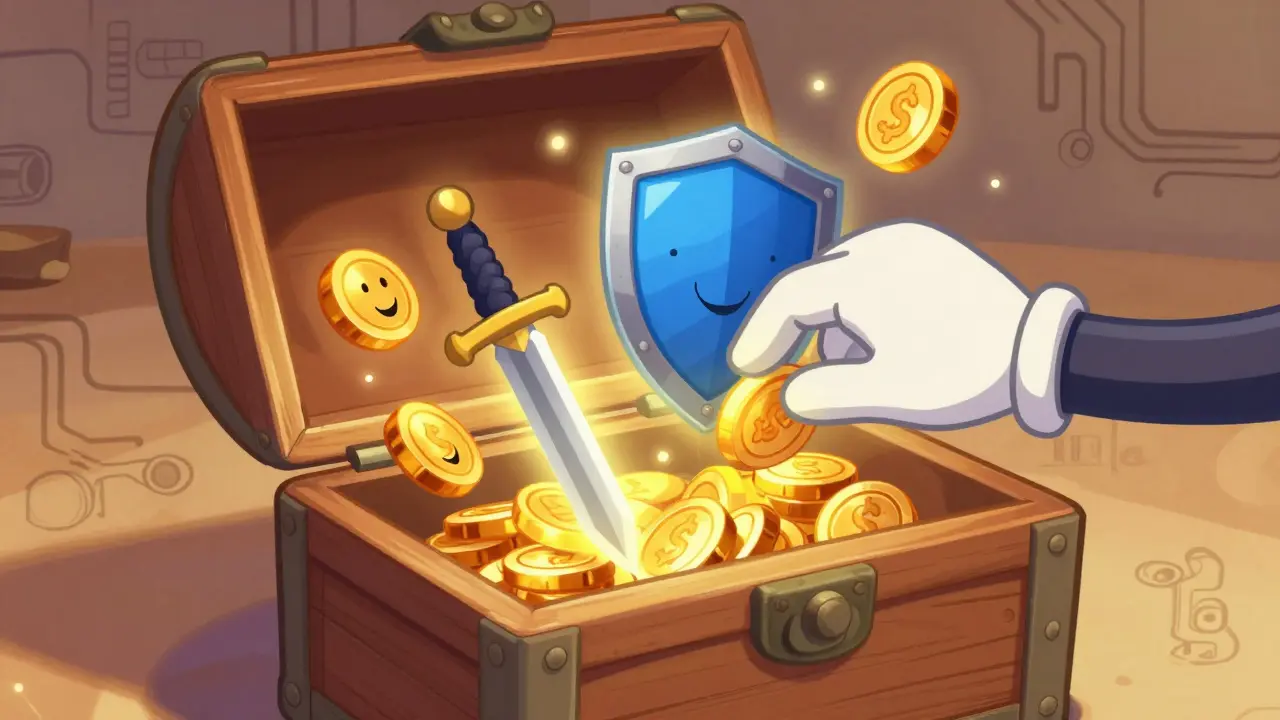
Furthermore, ERC-1155 introduces batch operations. You can transfer dozens of different token types in a single transaction. Imagine buying a starter pack in a game that includes a sword, a shield, and 100 gold coins. With ERC-1155, that entire bundle moves in one atomic operation. This not only improves user experience by reducing confirmation times but also slashes gas costs significantly compared to executing individual transfers for each item.
Gas Efficiency and Scalability Comparison
When we talk about scalability in Web3, we are usually talking about gas efficiency. Gas is the fuel that powers transactions on the Ethereum Virtual Machine (EVM). Every operation-from storing data to executing logic-consumes gas. Here is where the architectural differences between the two standards translate into real-world financial implications for both developers and end-users.
| Feature | ERC-721 | ERC-1155 |
|---|---|---|
| Token Types Supported | Non-fungible only | Fungible, Non-fungible, Semi-fungible |
| Contract Architecture | One contract per collection | Single contract for all assets |
| Batch Transfers | Not supported (individual calls) | Natively supported |
| Metadata Storage | Per-token URI (higher storage cost) | Base URI + Token ID pattern (lower cost) |
| Gas Cost for Bulk Ops | High (linear increase with volume) | Low (amortized across batch) |
| Ecosystem Maturity | Universal support | Growing, strong in gaming |
Consider a scenario where you are minting 1,000 identical items. With ERC-721, even though the items are visually identical, the protocol treats them as unique entities. You would need to store metadata references for each of the 1,000 tokens, leading to higher storage costs on-chain or off-chain indexing requirements. With ERC-1155, you define one Token ID for that item type and set the supply to 1,000. The metadata is linked to the base URI, meaning you pay for storage once, not a thousand times. This optimization becomes critical as projects scale.
During high-volume events, such as a public mint, ERC-1155’s ability to process batch approvals and transfers reduces the load on the network. Users spend less ETH on fees, which lowers the barrier to entry. While exact gas prices fluctuate daily based on network congestion, the relative difference remains consistent: ERC-1155 is structurally cheaper for operations involving more than one asset.
Metadata Handling and Flexibility
Metadata is the soul of an NFT. It contains the name, description, image link, and attributes that give the token its value. How these two standards handle metadata reveals much about their intended use cases.
In ERC-721, the standard typically relies on a `tokenURI` function that returns a unique URL for each Token ID. This works beautifully for generative art where every pixel differs. However, storing thousands of unique URIs can bloat the contract state or require expensive updates if the underlying IPFS hash changes. Changing metadata for a single ERC-721 token often requires updating the mapping for that specific ID.
ERC-1155 takes a different approach using a `uri` function that returns a base URI. The client (wallet or marketplace) then appends the Token ID to this base string to fetch the specific metadata. For example, if the base URI is `https://api.game.com/item/{id}.json`, requesting metadata for Token ID 5 automatically resolves to `https://api.game.com/item/5.json`. This pattern-based system is incredibly efficient. It allows developers to update the base endpoint without touching individual token records. It also supports dynamic metadata, enabling traits to change over time-a feature essential for living games or evolving digital twins.
Security and Transfer Safety
Security is paramount when dealing with valuable digital assets. Both standards have evolved to include safety mechanisms, but their approaches differ due to their complexity.
ERC-721 introduced the `safeTransferFrom` function, which checks if the recipient is a smart contract capable of receiving tokens. If the recipient doesn’t implement the correct interface, the transfer reverts, preventing tokens from being sent to dead ends. This was a crucial improvement over earlier, less secure practices.
ERC-1155 builds upon this by implementing a standardized hook called `onERC1155Received`. Any contract wishing to accept ERC-1155 tokens must explicitly declare support via this hook. This creates a robust handshake protocol between sender and receiver. Additionally, ERC-1155 simplifies approval management. Instead of approving individual tokens, users can approve an operator to manage all their assets of a certain type within a single call. While this centralizes trust in the operator, it reduces the attack surface associated with managing hundreds of granular approvals, which is a common vector for phishing attacks in complex wallets.
Which Standard Fits Your Project?
So, which one should you choose? The decision hinges on your project’s scope and asset diversity. There is no universal winner, only the right tool for the job.
Choose ERC-721 if:
- You are creating unique, one-of-a-kind artworks or collectibles.
- Your primary goal is maximum compatibility with existing NFT marketplaces and galleries.
- You prefer a simpler development workflow with abundant tutorials and libraries.
- Your inventory size is small, and bulk transfers are not a core feature.
Choose ERC-1155 if:
- You are building a blockchain game, metaverse platform, or complex marketplace.
- You need to manage multiple asset types (currency, items, cards) in one ecosystem.
- Gas efficiency and low transaction costs are critical for your user base.
- You plan to issue semi-fungible assets like concert tickets or redeemable vouchers.
- You anticipate large-scale minting or frequent trading volumes.
In 2026, the trend is clear. While ERC-721 remains the king of pure digital art, ERC-1155 is rapidly becoming the backbone of interactive Web3 applications. As tooling matures and more wallets natively support multi-token displays, the friction around adopting ERC-1155 continues to drop. If you are looking to build a scalable, economically viable product, the flexibility of ERC-1155 likely offers a stronger long-term foundation.
Can I convert an ERC-721 NFT to ERC-1155?
You cannot directly "convert" the standard itself because they are different smart contract architectures. However, you can create a bridging mechanism where burning an ERC-721 token mints a corresponding ERC-1155 token in a new contract. This requires careful planning and additional development resources to ensure security and parity of value.
Do all wallets support ERC-1155?
Most major wallets like MetaMask, Trust Wallet, and Coinbase Wallet support ERC-1155, but the display quality varies. Some older or simpler wallets may show the raw token ID instead of the image or name. Always test your dApp with your target audience's preferred wallets to ensure a smooth experience.
What are semi-fungible tokens?
Semi-fungible tokens are assets that are interchangeable up to a point, after which they become unique. A classic example is a concert ticket. Before the event, all VIP tickets are identical and can be traded freely. After the event, each ticket becomes a unique souvenir with a timestamp or signature, making it non-fungible. Only ERC-1155 supports this natively.
Is ERC-1155 safer than ERC-721?
Both standards are secure when implemented correctly. ERC-1155 includes stricter receive hooks (`onERC1155Received`) which can prevent accidental loss of tokens to incompatible contracts. However, its complexity means there is more code to audit. Security depends heavily on the quality of the smart contract development and auditing process, not just the standard itself.
Which standard is better for gaming?
ERC-1155 is overwhelmingly the better choice for gaming. Games require managing diverse inventories (weapons, armor, currency) and frequent transactions. ERC-1155’s batch operations reduce gas costs and improve latency, while its multi-token capability allows all game assets to live in a single contract, simplifying backend integration.



Francis Laquerre
11 Jun 2026 at 15:53It is absolutely fascinating to see how the architecture of these standards dictates the entire user experience, isn't it? The way ERC-1155 handles batch operations feels like a revelation for anyone who has ever tried to move a whole inventory without losing their mind or their wallet balance. I remember trying to transfer five different items in an older game and watching my gas fees skyrocket into the stratosphere while the transaction just sat there pending. It was a nightmare scenario that really highlighted why we needed something more efficient. Now, looking at this comparison, it’s clear that for any project with even a hint of complexity, sticking to ERC-721 is almost like choosing to drive a horse carriage when you could have a sports car. The multi-token capability is not just a feature; it is a fundamental shift in how we think about digital ownership. We are moving away from isolated assets toward interconnected ecosystems where every item interacts with every other item seamlessly. This evolution is crucial for the next generation of applications that rely on real-time interactions rather than static collectibles.