

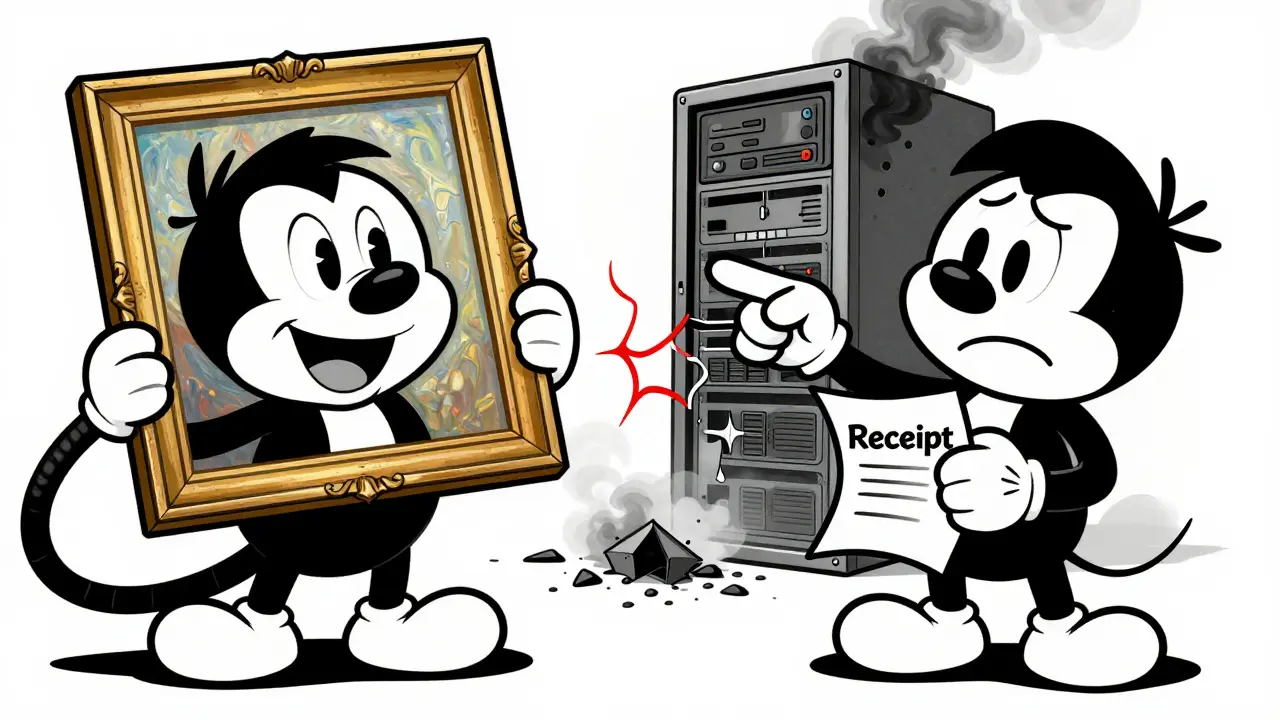

Imagine buying a rare painting. In the traditional art world, you get the canvas, the frame, and the certificate of authenticity all rolled into one physical object. You hang it on your wall, and it stays there. Now imagine buying that same painting digitally, but instead of owning the file itself, you own a receipt that points to a cloud server where the image lives. If that server shuts down or the link breaks, your "painting" disappears, leaving you with just a receipt for nothing.
This is the fundamental difference between Traditional NFTs-mostly built on Ethereum-and Bitcoin Ordinals. While both are marketed as digital collectibles, they operate on completely different technical philosophies. One relies on smart contracts and external storage; the other embeds data directly into the Bitcoin blockchain itself. As we move through 2026, understanding these differences isn't just about tech specs-it's about knowing what you're actually holding in your digital wallet.
The Core Technical Divide: On-Chain vs Off-Chain
To understand why Ordinals feel different from the NFTs you might have minted on OpenSea years ago, you have to look at where the data lives. This is the single biggest technical distinction.
Traditional NFTs, typically following standards like ERC-721 or ERC-1155 on Ethereum, act more like pointers. When you mint an NFT, the blockchain records a unique token ID and metadata. That metadata usually contains a Uniform Resource Identifier (URI)-essentially a web address-that links to the actual image, video, or audio file. These files are stored off-chain, often on decentralized networks like IPFS (InterPlanetary File System) or centralized servers run by the creator. The blockchain proves you own the token, but the content itself exists outside the chain.
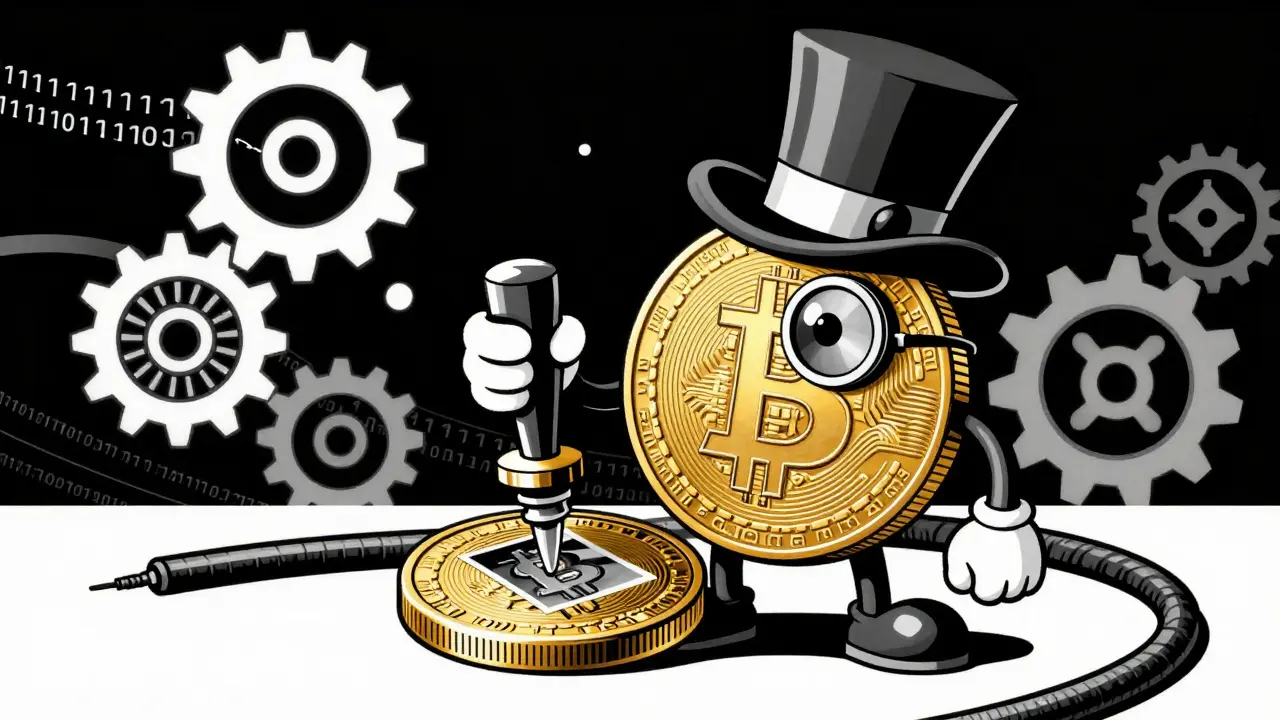
Bitcoin Ordinals, introduced by developer Casey Rodarmor in January 2023, take a radically different approach. They utilize a concept called "inscription." Instead of pointing to a file elsewhere, the entire file-whether it's a JPEG, a text document, or even a short video-is embedded directly into the witness data field of a Bitcoin transaction. Thanks to the Taproot upgrade in 2021, which allowed for larger witness data payloads (up to nearly 4 megabytes per transaction), this became possible without changing Bitcoin's core consensus rules. The satoshi (the smallest unit of Bitcoin) becomes the carrier, and the data travels with it forever.
This means if you hold an Ordinal, you aren't holding a link to an image. You are holding the image itself, permanently etched into the Bitcoin ledger. For collectors worried about "link rot"-where external servers go offline and NFT images turn into broken placeholders-Ordinals offer a level of permanence that traditional NFTs struggle to match.
Architecture: Smart Contracts vs Satoshis
The way these assets are created and managed reveals another layer of complexity. Traditional NFTs live inside smart contracts. A smart contract is a self-executing program on the blockchain that defines the rules of the token. It handles minting, transfers, royalties, and sometimes complex logic like staking rewards or gaming mechanics. Because Ethereum is a Turing-complete platform, developers can build intricate ecosystems around these tokens.
Ordinals do not use smart contracts in the traditional sense. Bitcoin is not designed for complex programmable logic in its base layer. Instead, Ordinals rely on "ordinal theory," which assigns a unique serial number to every satoshi based on the order it was mined. There are roughly 2.1 quadrillion satoshis in existence (21 million BTC x 100 million sats). An indexer software tracks these numbers and identifies which satoshi carries which inscription. When you transfer an Ordinal, you are simply sending that specific satoshi to another wallet address. The logic is handled by client-side tools and indexers, not by code running on the blockchain itself.
This architectural choice has trade-offs. Ethereum NFTs benefit from composability-they can interact with decentralized finance (DeFi) protocols, be used as collateral, or trigger automated actions. Ordinals are static artifacts. They are immutable and secure, but they lack the programmable flexibility of their Ethereum counterparts. You cannot easily write a royalty mechanism into an Ordinal that automatically pays the creator upon resale, because there is no contract to enforce it.
Market Dynamics and Valuation in 2026
When it comes to money and market behavior, the two ecosystems have diverged significantly. By mid-2026, the traditional NFT market has matured into a multi-billion dollar industry. Research firms like Grand View Project estimate the global NFT market size reached approximately $35.7 billion in 2024, with projections climbing toward $211.7 billion by 2030. Trading volumes remain robust, with Q1 2024 seeing $3.9 billion in activity alone. Ownership has expanded globally, reaching about 4% of the population.
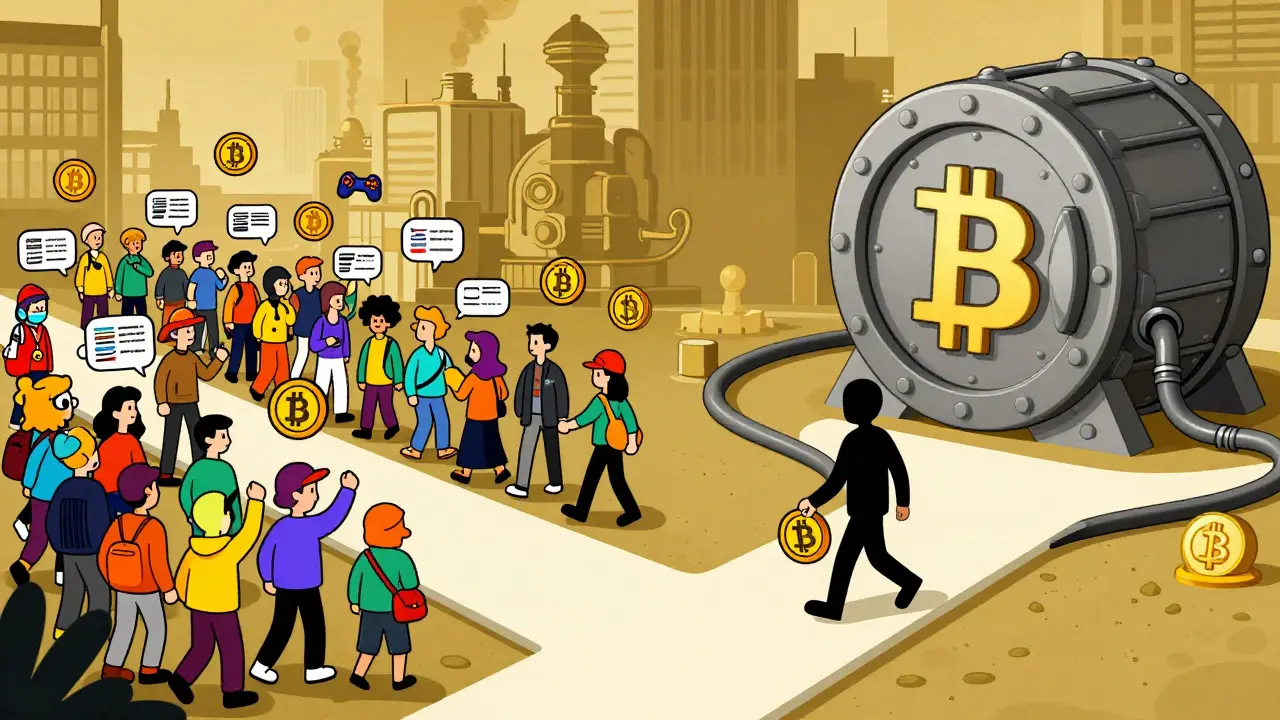
Ordinals, however, occupy a smaller, more niche segment of this landscape. They are deeply tied to Bitcoin's culture and price action. Collectors of Ordinals often view them as "digital gold" artifacts-assets that share the scarcity and security profile of Bitcoin itself. While comprehensive global market forecasts for Ordinals specifically are still emerging, their value is driven heavily by cultural cachet within the Bitcoin community and the perceived security of storing assets on the most secure network in history.
The liquidity differs too. Ethereum NFTs trade on a vast array of marketplaces with deep integration into wallets like MetaMask and Phantom. Ordinals require wallets that support Taproot and ordinal indexing, such as Xverse or Unisat, though major players like Trust Wallet and Phantom have added support. The barrier to entry for buying an Ordinal is slightly higher technically, but the appeal lies in the alignment with Bitcoin maximalism-the belief that Bitcoin should be the primary store of value and, increasingly, a medium for permanent data storage.
Security and Permanence Risks
Every system has vulnerabilities, and both models face distinct risks. For traditional NFTs, the primary threat is not the blockchain itself, but the infrastructure surrounding it. If the IPFS pinning service fails, or if the centralized server hosting the metadata goes bankrupt, the asset loses its visual component. We've seen this happen repeatedly with early NFT projects where the "art" vanished, leaving owners with empty frames. Additionally, smart contracts can contain bugs. Exploits in NFT contracts have led to frozen funds or unauthorized transfers in the past.
Ordinals inherit the security of the Bitcoin network, which has operated without downtime since 2009 and is secured by massive proof-of-work mining power. Once an inscription is confirmed and buried under subsequent blocks, it is virtually impossible to alter or delete. However, Ordinals introduce a different set of concerns. Because the data is stored on-chain, it contributes to the growth of the blockchain size. Critics argue that filling Bitcoin blocks with memes and art increases the hardware requirements for running full nodes, potentially centralizing validation power among those who can afford large storage arrays. Furthermore, because there are no smart contracts, recovering a stolen Ordinal is nearly impossible; if you send it to the wrong address, it is gone forever, with no customer service or pause button to save you.
| Feature | Bitcoin Ordinals | Traditional NFTs (Ethereum) |
|---|---|---|
| Data Storage | Fully on-chain (in witness data) | Off-chain (IPFS/Servers), pointer on-chain |
| Underlying Tech | Ordinal Theory + Inscriptions | Smart Contracts (ERC-721/1155) |
| Programmability | Low (Static artifacts) | High (Royalties, DeFi, Gaming) |
| Permanence Risk | Low (Tied to Bitcoin node health) | Medium (Dependent on external storage) |
| Network Security | Proof-of-Work (Bitcoin) | Proof-of-Stake (Ethereum) |
| Cost Driver | Block space competition (fees) | Gas fees during mint/transfer |
User Experience and Accessibility
If you are a creator or a collector, the day-to-day experience varies. Minting a traditional NFT on Ethereum has become quite user-friendly. Platforms allow you to upload media, set prices, and click "mint." The smart contract handles the heavy lifting. For advanced users, writing custom Solidity code offers endless possibilities for interactive art or utility-based tokens.
Minting an Ordinal is more technical. You need a Bitcoin wallet that supports Taproot and ordinals. You must understand concepts like UTXOs (Unspent Transaction Outputs) and fee estimation. While services exist to simplify this, the process feels closer to crafting a raw transaction than clicking a button on a website. This friction filters out casual users, resulting in a community that is often more technically literate but smaller in scale.
However, viewing and displaying Ordinals has improved. Major exchanges and galleries now support rendering inscriptions directly from the blockchain. For the average buyer, the difference is subtle: one connects an Ethereum wallet to a marketplace, the other connects a Bitcoin-compatible wallet to an ordinal explorer. Both lead to ownership, but the journey gets you there differently.
Which Should You Choose?
Your choice depends on what you value most in a digital asset. If you prioritize utility, interoperability with DeFi, and access to a broad ecosystem of games and applications, traditional Ethereum NFTs remain the standard. They are the engines of the metaverse and digital identity sectors.
If you prioritize absolute permanence, censorship resistance, and alignment with Bitcoin's monetary policy, Ordinals are the superior choice. They are ideal for collectors who want their digital art to survive as long as Bitcoin itself, without relying on third-party servers or complex code that could break. In 2026, the market supports both paths, recognizing that digital ownership is not a one-size-fits-all proposition.
Are Ordinals considered NFTs?
Yes, broadly speaking. While they differ technically from Ethereum-based NFTs, Ordinals function as non-fungible tokens on the Bitcoin network. They represent unique, indivisible digital assets that can be collected and traded, fulfilling the core definition of an NFT.
Can I lose my Ordinal if Bitcoin crashes?
No. The value of the Bitcoin currency does not affect the existence of the Ordinal. Even if Bitcoin's price drops to zero, the inscription remains permanently recorded on the blockchain. However, the market value of the Ordinal would likely decrease alongside Bitcoin.
Why are Ordinals criticized by some Bitcoin purists?
Critics argue that using Bitcoin block space for art and memes congests the network, raising transaction fees for everyday payments. They believe Bitcoin should remain strictly a peer-to-peer electronic cash system, and that storing large files undermines its efficiency and scalability.
Do Ordinals support royalties for creators?
Not natively. Unlike Ethereum smart contracts which can enforce royalty payments automatically, Bitcoin transactions do not have this capability. Royalties in the Ordinals space are largely voluntary or enforced through social norms and marketplace policies, rather than code.
Which wallet should I use for Ordinals?
You need a wallet that supports Taproot and ordinal indexing. Popular choices include Xverse, Unisat, and Apple Wallet (with specific plugins). Major multi-chain wallets like Trust Wallet and Phantom also offer Ordinals support, making them convenient for users holding both Bitcoin and Ethereum assets.




Joe Walters
28 Jun 2026 at 05:19omg another article explaining basic tech to people who clearly dont get it lol. like seriously? ordinals are just btc maximalists trying to make their boring chain relevant again by shoving memes into the witness data. its so pretentious to think your jpeg is 'permanent' when the whole network is bloated with garbage. i mean, sure, its on-chain, but at what cost? we are literally paying fees to store cat pictures instead of actual transactions. typical ethereum haters acting like they discovered fire because they can mint a token without a smart contract. please.