



Imagine trying to store a high-resolution video file directly inside a Bitcoin transaction. You’d pay an astronomical fee, wait hours for confirmation, and still struggle with network congestion. This is the core dilemma facing developers building cryptocurrency applications that need to handle more than just simple money transfers. As of mid-2026, the industry has moved past the binary debate of "on-chain versus off-chain." Instead, successful projects rely on hybrid architectures that strategically split data based on cost, speed, and security requirements.
The way you choose to store data defines your application’s scalability, user experience, and long-term viability. Whether you are building a decentralized finance (DeFi) protocol, a non-fungible token (NFT) marketplace, or a digital identity system, understanding the trade-offs between storing data directly on the ledger versus keeping it in external systems is critical. Let’s break down how these models work, why pure on-chain storage is rarely practical for large datasets, and how modern tools like IPFS and Arweave are reshaping the landscape.
Understanding On-Chain Data Storage
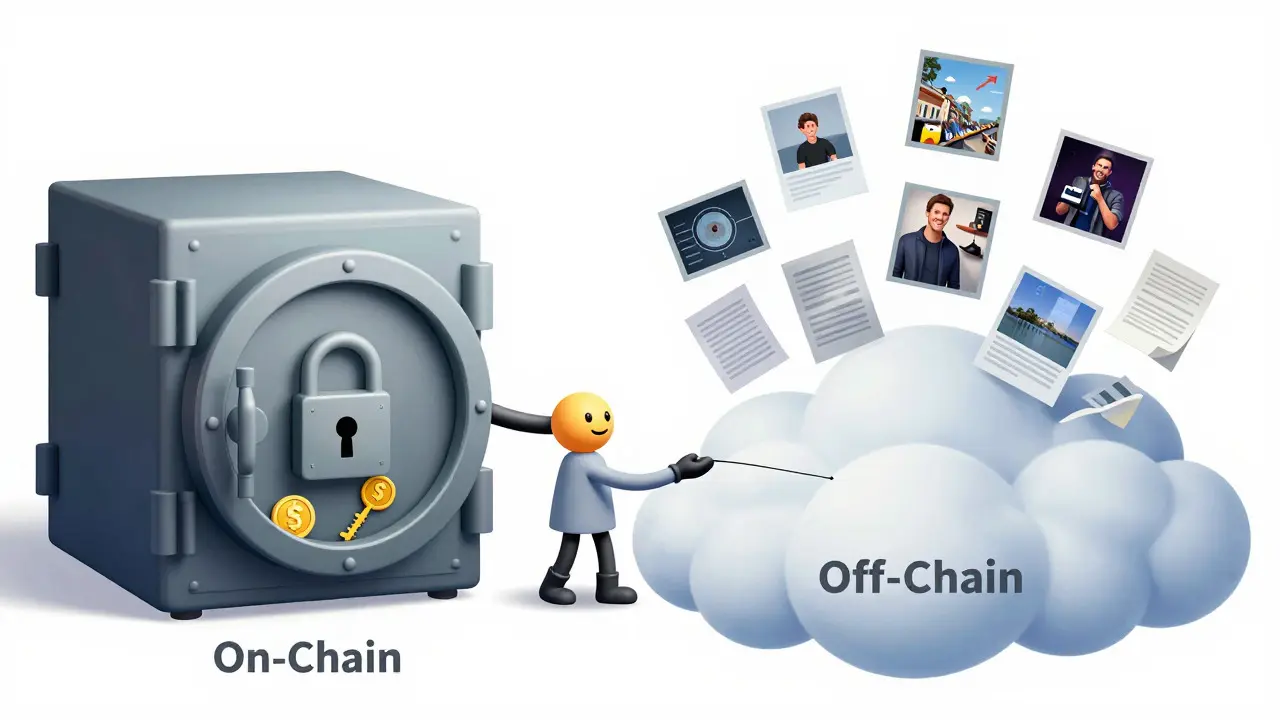
On-chain data storage means writing information directly into the blockchain blocks, where every full node in the network stores and verifies it as part of the canonical state. When you send Bitcoin or Ether, the transaction details-who sent what to whom-are recorded on-chain forever. This model offers maximum transparency and immutability because altering this data would require controlling a majority of the network’s hash power or stake, which is computationally prohibitive.
However, this security comes at a steep price. In platforms like Ethereum, each 256-bit storage slot written by a smart contract costs significant gas fees. Under Ethereum’s rules, initializing a new storage slot can cost around 20,000 gas units, multiplied by the current gas price. During periods of high network activity, storing even a small amount of text on-chain can become prohibitively expensive for end-users. Furthermore, because every node must replicate this data, on-chain storage limits the overall size of the blockchain, making it unsuitable for gigabytes of multimedia or complex databases.
For cryptocurrency applications, on-chain storage is best reserved for high-value, integrity-critical data. This includes:
- Token balances and ownership records
- Smart contract code and logic
- Cryptographic hashes of larger files
- Access control policies and metadata pointers
By keeping only these essential elements on-chain, developers ensure that the core trust layer of their application remains decentralized and tamper-proof without clogging the network.
The Case for Off-Chain Data Storage
Off-chain data storage involves keeping the bulk of application data outside the blockchain while anchoring it to the chain through cryptographic links, such as hashes or content identifiers. This approach separates the verification layer from the storage layer. The blockchain acts as a notary, proving that a specific piece of data existed at a certain time, while the actual data resides in more efficient systems.
There are three main categories of off-chain storage used in Web3 today:
- Centralized Databases: Traditional SQL or NoSQL databases hosted on cloud services. These offer fast retrieval and easy management but reintroduce centralization risks. If the server goes down, the data becomes inaccessible.
- Decentralized File Systems: Networks like IPFS (InterPlanetary File System) allow users to store and retrieve files using content addressing rather than location addressing. However, IPFS alone does not guarantee persistence; files can be garbage-collected unless they are pinned by a service or node.
- Permanent Storage Blockchains: Solutions like Arweave use a unique "blockweave" structure and an endowment pool model. Users pay once upfront, and the economic incentives ensure data is stored permanently. Similarly, Filecoin operates as a decentralized storage marketplace where miners compete to store data in exchange for tokens.
Off-chain storage is significantly cheaper and faster for large datasets. A 2025 study on blockchain performance noted that off-chain models could be up to 5.39% faster for storing data compared to on-chain methods, though retrieval speeds varied depending on the infrastructure. For applications handling images, videos, or extensive user logs, off-chain storage is not just an option-it’s a necessity.
Comparing Performance, Cost, and Security
| Feature | On-Chain Storage | Off-Chain Storage |
|---|---|---|
| Cost | High (gas fees per byte) | Low (flat rates or negligible) |
| Scalability | Limited by block size/gas limits | High (unlimited by blockchain constraints) |
| Data Integrity | Immutable and cryptographically verified by all nodes | Dependent on external infrastructure reliability |
| Privacy | Publicly visible (unless encrypted) | Can be restricted or encrypted |
| Retrieval Speed | Slower due to consensus overhead | Faster via direct HTTP/IPFS access |
The choice between these models often hinges on the specific needs of your application. For example, in DeFi protocols, financial state like loan positions and interest rates must remain on-chain to ensure deterministic execution and prevent fraud. However, historical analytics, order books, and frontend assets are typically stored off-chain to reduce latency and costs.
Security trade-offs are also crucial. While on-chain data is inherently secure against censorship, off-chain data relies on the robustness of its hosting environment. If an NFT’s image is stored on a centralized server that shuts down, the link breaks, and the asset appears empty despite the token existing on-chain. To mitigate this, developers increasingly use content-addressed systems like IPFS combined with pinning services or permanent storage solutions like Arweave to ensure long-term availability.
Hybrid Architectures: The Industry Standard
By 2026, the most robust cryptocurrency applications adopt a hybrid approach. This model leverages the strengths of both worlds: the trustlessness of on-chain verification and the efficiency of off-chain storage. Here’s how this typically works in practice:
First, the developer uploads large files-such as NFT artwork, medical records, or legal documents-to a decentralized storage network. This generates a unique content identifier (CID) or hash. Second, the smart contract stores only this hash on-chain. Because hashes are short strings, the gas cost is minimal. Third, when a user wants to view the data, the application fetches the hash from the blockchain, uses it to locate the file on the off-chain network, and verifies that the downloaded file matches the on-chain hash.
This pattern ensures that if someone tries to alter the off-chain data, the hash will no longer match the one recorded on the blockchain, immediately flagging the tampering. It provides a balance between cost-efficiency and data integrity. For instance, many NFT collections now store their metadata and images on Arweave or IPFS, with the token contract pointing to these resources. This prevents the "broken link" issue common in earlier generations of NFTs that relied on fragile centralized URLs.

Implementation Challenges and Best Practices
Implementing a hybrid storage system introduces complexity. Developers must manage the lifecycle of off-chain data, ensuring that pins are maintained or storage deals are renewed. Common pitfalls include mismatched hashes due to encoding changes or relying on unpinned IPFS content that disappears over time.
To avoid these issues, follow these best practices:
- Use Content Addressing: Always store CIDs or hashes instead of traditional URLs. This decouples the data from any specific server location.
- Verify Persistence: If using IPFS, integrate with reliable pinning services or consider migrating to permanent storage solutions like Arweave for critical assets.
- Optimize On-Chain Payloads: Store only the absolute minimum required for verification. Use Merkle trees to prove membership of large datasets without storing them entirely on-chain.
- Plan for Upgrades: Smart contracts are immutable, so design storage schemas that can evolve. Using proxy patterns allows you to update the off-chain integration logic without redeploying the entire contract.
Additionally, regulatory considerations often drive the choice toward off-chain storage. In sectors like healthcare or finance, data privacy laws may require the ability to erase personal information-a feat impossible with true on-chain immutability. By storing sensitive data off-chain in encrypted formats and keeping only access keys or proofs on-chain, developers can comply with regulations while maintaining blockchain benefits.
Future Trends in Blockchain Storage
As we move further into 2026, the line between on-chain and off-chain continues to blur thanks to advancements in Layer 2 scaling solutions and data availability layers. Rollups bundle thousands of transactions off-chain and post compressed data back to the mainnet, effectively creating a new tier of semi-on-chain storage that is cheaper and faster than Layer 1 but more secure than purely off-chain databases.
Research into sharding and pruning techniques is also expanding the capacity of base-layer blockchains, allowing them to handle slightly larger payloads without sacrificing decentralization. Meanwhile, economic models for permanent storage are maturing, with networks competing to offer better longevity guarantees and lower costs. For developers, the key takeaway is flexibility: build your architecture to adapt to these evolving storage options, prioritizing modularity so you can switch underlying storage providers without disrupting your application.
What is the biggest disadvantage of on-chain storage?
The primary disadvantages are high cost and limited scalability. Storing data on-chain requires paying gas fees for every byte, which can become extremely expensive during network congestion. Additionally, since every node must replicate the data, the blockchain’s total size grows, leading to slower synchronization and higher hardware requirements for validators.
Is off-chain storage less secure than on-chain?
It depends on the implementation. Centralized off-chain storage carries single points of failure and censorship risks. However, decentralized off-chain networks like IPFS, Filecoin, and Arweave provide strong security guarantees. When combined with on-chain hash verification, off-chain storage can be nearly as trustworthy as on-chain storage for data integrity purposes.
Which storage model is best for NFTs?
A hybrid model is best. Store the token ID, ownership, and royalty information on-chain. Store the actual media files (images, videos) off-chain using a persistent solution like Arweave or pinned IPFS. Record the CID of the media on-chain. This avoids high gas costs while preventing the asset from disappearing if a central server fails.
How do I ensure off-chain data remains available?
Relying solely on standard IPFS is risky because files can be garbage-collected. To ensure availability, use a pinning service that pays for storage nodes to keep your files alive, or use a permanent storage blockchain like Arweave where a one-time payment funds future storage indefinitely. Regularly audit your off-chain links to verify accessibility.
Can I delete data stored on-chain?
No, on-chain data is immutable. Once written to the blockchain, it cannot be deleted or altered. This is a feature for transparency but a bug for privacy compliance (like GDPR). If you need deletable data, store it off-chain and only keep a reference or hash on-chain.






Write a comment