



Switching phone providers is easy-until you try to move your toll-free number. If you’ve ever had an 800, 888, or 855 number tied to your brand, you know it’s more than just a phone line. It’s your customer hotline, your ad tagline, your trust signal. Losing it during a provider switch isn’t an option. But porting a toll-free number isn’t like moving a local number. It’s slower, trickier, and full of hidden roadblocks that can leave you without service for weeks.
Why Toll-Free Porting Is Different
Local number porting? You call your new provider, give them your account info, and in 5 to 7 days, your number moves. Simple. Toll-free porting? It’s a multi-step, multi-party process managed by the Toll-Free Number Portability system under the North American Numbering Plan Administration (NANPA). The key difference? Local numbers are handled by regional carriers. Toll-free numbers are controlled by Responsible Organizations (RespOrgs)-companies like Somos Inc. that manage routing in the Service Management System (SMS/800) database.When you port a toll-free number, you’re not just changing carriers. You’re changing who controls the routing instructions for that number. If the RespOrg info is wrong, your calls don’t go anywhere. Not some calls. All calls. That’s why 37% of porting failures happen because of incorrect RespOrg codes, according to Somos Inc.’s 2024 technical bulletin.
What You Need to Get Started
You can’t just say, “I want to move my 800 number.” You need hard documents. And they have to be perfect.- Letter of Authorization (LOA): This isn’t a form you fill out online. It must include the full legal name of the account owner, the physical service address (PO boxes are rejected), and the exact toll-free numbers you’re porting. No typos. No abbreviations.
- Recent phone bill: Must be dated within the last 30 days and clearly show the toll-free number and your account name. Screenshots from your provider’s portal won’t cut it unless they’re official invoices.
- Service Order Code (SOC) and Product Code (PC): These are technical identifiers your current provider uses to describe your service. If your new provider doesn’t match them exactly, your request gets stuck. 68% of delays come from mismatched SOCs, according to Voipcom’s 2024 guide.
One business in Wisconsin lost three weeks because their LOA used “Inc.” instead of “Incorporated.” The new provider’s system flagged it as invalid. They had to resubmit with a notarized version. Don’t let that be you.
How Long Does It Really Take?
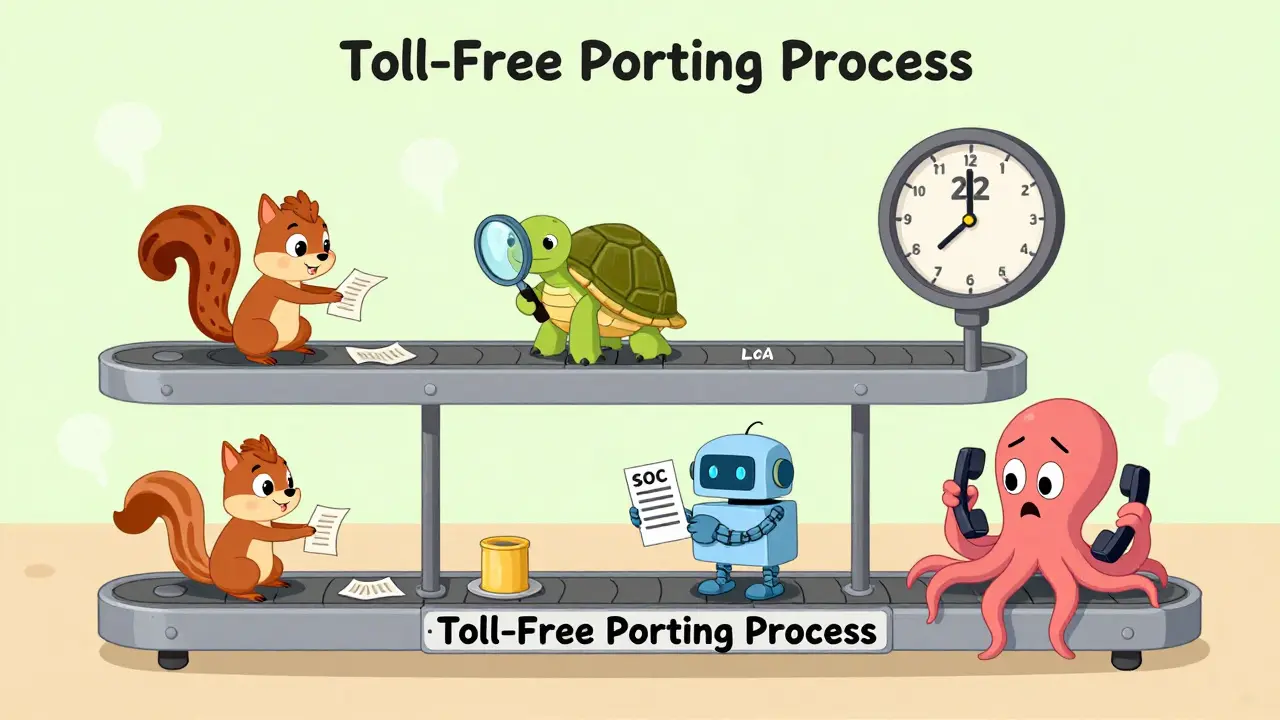
Most providers promise “5 to 10 business days.” That’s the regulatory minimum. Reality? It’s longer.According to Outreach’s 2024 data, toll-free porting takes an average of 22 business days. That’s nearly twice as long as local number porting. Why? Because:
- There are more parties involved: gaining carrier, losing carrier, RespOrg, NPAC
- Each step requires manual verification
- There’s a mandatory 48-hour notification window before activation
And 22% of complex cases take up to 8 weeks. Why? If your number was originally assigned through a reseller, or if it’s tied to multiple accounts, or if your current provider has outdated records, you’re in for a marathon. One Reddit user reported a 42-day porting process because of a single typo in the RespOrg code.
Common Mistakes That Kill Your Port Request
Based on thousands of failed porting attempts tracked by TelecomReseller.com and G2 Crowd, here are the top three reasons your request gets rejected:- Address mismatch (32%): Your LOA says 123 Main St., but your provider’s system has 123 Main Street. Even a missing apartment number can trigger rejection.
- Expired billing docs (28%): Your bill is 31 days old? It’s invalid. No exceptions.
- Authorized user mismatch (24%): If the person signing the LOA isn’t the legal account owner, it’s denied. Corporate accounts with multiple signers? You’ll need a board resolution or power of attorney.
And don’t forget the “number not found” error. It happens in 21% of cases. Usually, it means your new provider can’t verify the number is actually owned by your current carrier. Double-check that your account is active and the number hasn’t been suspended or canceled.
What You Should Do Before You Start
Don’t rush into this. Prepare like you’re preparing for a legal transfer.- Check your contract: Look for early termination fees. Some providers charge hundreds to cancel before the term ends.
- Confirm eligibility: Some promotional toll-free numbers (like those from free trials or bundled deals) can’t be ported. Ask your current provider.
- Don’t cancel your old service: 89% of service outages happen because people cancel their old plan before the port completes. Keep paying until you get confirmation your number is live with the new provider.
- Designate one point of contact: At both your old and new provider. One person who knows the status, handles documents, and follows up. Global Call Forwarding found this cuts porting time by 32%.

Which Providers Are Best for Porting?
Not all providers handle toll-free porting the same way. Based on user reviews from Capterra, Trustpilot, and G2 Crowd:- RingCentral: 4.1/5 stars. Praised for detailed checklists, clear timelines, and proactive communication.
- Nextiva: 4.0/5 stars. Strong documentation support and responsive account managers.
- Vonage: 3.4/5 stars. Complaints about inconsistent RespOrg coordination and slow responses.
- 8x8: 3.8/5 stars. Reliable but requires more manual input from the customer.
Don’t just pick the cheapest plan. Pick the provider with the best porting track record. Ask them for their porting success rate and average timeline before you sign up.
What’s Changing in 2025 and Beyond
The system is getting better-slowly. The FCC’s 2024 Modernization Initiative pushed carriers to adopt electronic LOAs. As of Q2 2024, 73% of major providers use them, cutting processing time by 15%. In 2025, NANPA plans to roll out automated RespOrg verification. That could drop average porting time from 22 to 14 business days.Long-term, companies like AT&T and Verizon are testing blockchain-based number ownership verification. If it works, it could make fraud nearly impossible and cut verification steps dramatically. But don’t expect that before 2026.
Industry experts warn: stricter security rules may extend the minimum porting timeline from 10 to 15 days by 2027. So while the system is improving, it’s also becoming more rigid.
Final Advice: Plan Ahead, Double-Check Everything
Porting your toll-free number isn’t a technical task. It’s a project. Treat it like one.Start at least 30 days before you want to switch. Gather every document. Verify every name, address, and code. Call your current provider and ask: “Is this number active? Is the RespOrg correct? Is the account owner listed exactly as it appears on my LOA?”
If you’re a small business owner doing this alone, consider hiring a telecom consultant. A $300 service that gets your port through in 10 days instead of 40 is worth it. Your customers are calling that number. Don’t let a typo break your connection.
Remember: your toll-free number isn’t just a number. It’s your brand’s voice. Protect it. Plan for it. Don’t assume it’ll be easy.
Can I port a toll-free number that’s part of a bundle or promotion?
Not always. Some promotional toll-free numbers, especially those tied to free trials, discounted packages, or bundled services, are locked and non-portable. Check your contract or call your current provider and ask if the number is eligible for porting. If it’s not, you may need to keep the old service until the contract ends or pay a fee to unlock it.
What happens if my call gets dropped during porting?
During the 48-hour window before the port completes, your number may ring through to both your old and new provider. After activation, calls should route only to the new provider. If calls drop or go to voicemail after the port date, contact your new provider immediately. Most often, the issue is a misconfigured RespOrg or incomplete SMS/800 database update. Your new provider must fix it-they’re responsible for ensuring service continuity after the port.
Can I port multiple toll-free numbers at once?
Yes, but each number must be listed individually on the Letter of Authorization. You can submit one LOA for multiple numbers, but each must have its own Service Order Code and be verified separately. Grouping them doesn’t speed things up. In fact, if one number has an issue, it can delay the entire batch. For large portfolios, consider porting in batches of 5-10 numbers to isolate problems faster.
Do I need to notify my customers about the port?
No, you don’t have to. The port happens silently on the network side. Customers will still reach you at the same number. However, if your port takes longer than expected and you’re worried about missed calls, it’s smart to send a brief email or update your website with a note like, “We’re upgrading our phone system-your number remains the same.” Most customers won’t notice unless something goes wrong.
What if my current provider won’t give me my billing statement?
By FCC rules, your current provider must provide you with a copy of your bill or account details upon request. If they refuse, file a complaint with the FCC at fcc.gov/complaints. In the meantime, you can submit a notarized affidavit stating you are the authorized account holder, along with any other proof of ownership (like past invoices or portal screenshots). Some new providers accept this as a backup if you explain the situation.









Daniel Kennedy
15 Dec 2025 at 23:32Been through this nightmare twice. First time, I used a cheap VoIP provider and lost 18 days because their tech didn’t know what an SOC was. Second time, I went with RingCentral-sent them my docs, they handled everything, called my old provider for me, and got the number moved in 12 days. Don’t even think about saving $20/month if it means your customers can’t reach you. This isn’t Netflix. Your 800 number is your storefront.
Also, never use a PO box. I had a client try it. Got rejected. Had to notarize a letter just to prove they actually had a physical office. Ridiculous, but true.