

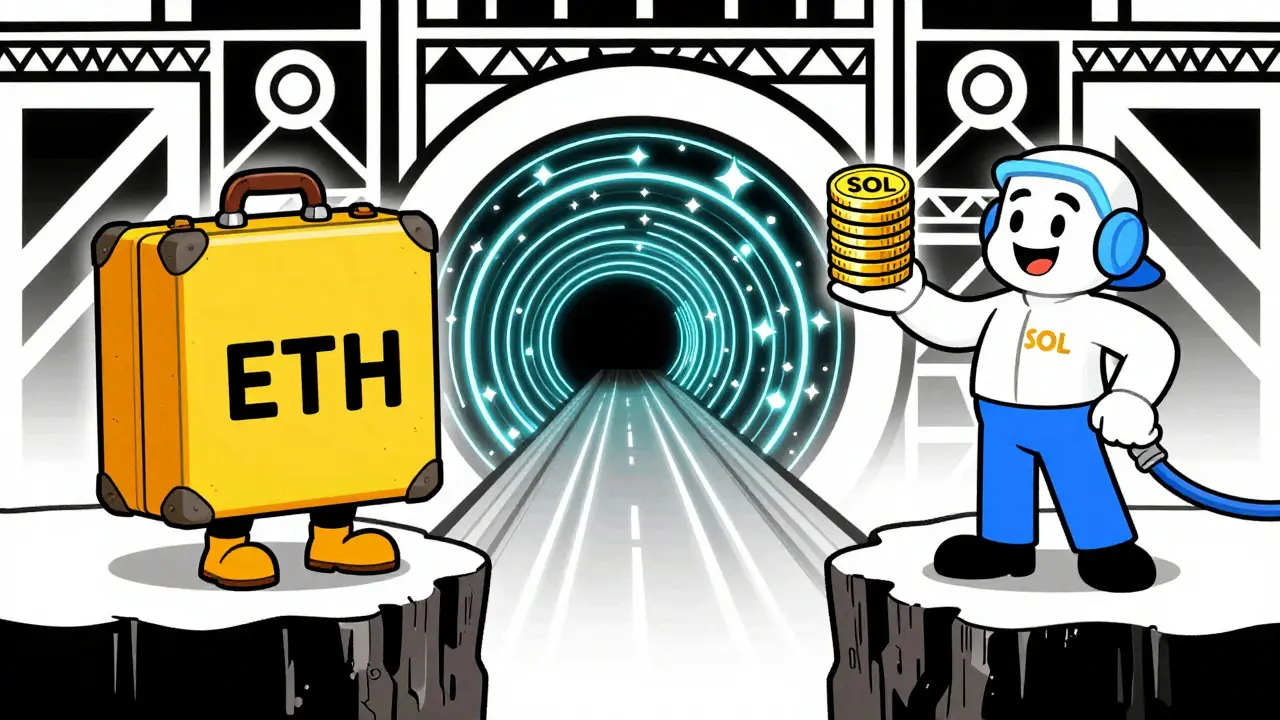

Imagine you have a heavy suitcase full of cash sitting in New York, but you need to spend it in London today. You don't want to fly there with the bag-it’s risky and slow. So, you lock the cash in a secure vault in New York, get a receipt, and hand that receipt over to a trusted agent who gives you local pounds in London. When you’re done, you return the pounds, burn the receipt, and unlock your cash in New York.
This is exactly how Wormhole Bridge is a generic cross-chain message-passing protocol that connects blockchains like Ethereum and Solana by locking assets on one chain and minting wrapped versions on another. It was originally launched in October 2020 by Solana Labs and Certus One to solve a massive problem in cryptocurrency: different blockchains couldn't talk to each other. Ethereum was the king of decentralized finance (DeFi), but it was slow and expensive. Solana was fast and cheap, but it lacked liquidity. Wormhole built the highway between them.
How Wormhole Actually Works
You might think bridges are just simple swap buttons, but under the hood, they are complex systems of trust and verification. Wormhole isn't just a token bridge; it's a messaging layer. Think of it as the internet's TCP/IP protocol, but for blockchains. It allows arbitrary data to move between chains, not just money.
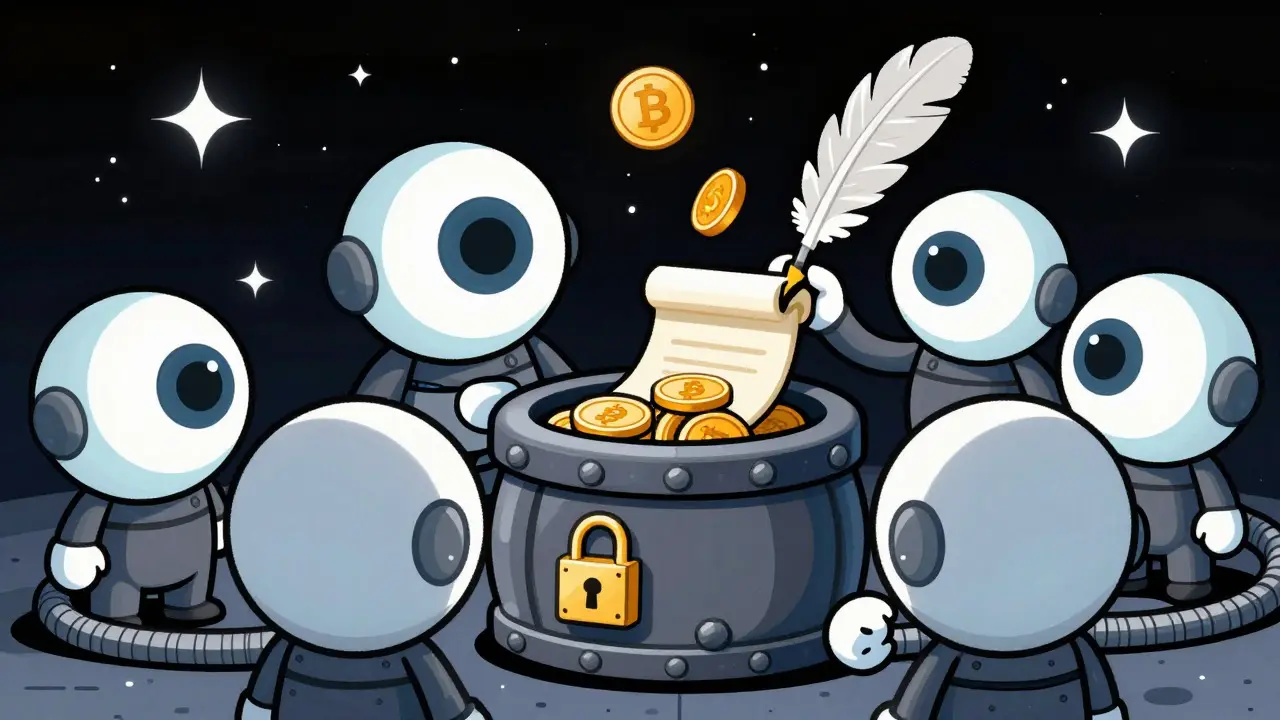
The core mechanism relies on a group called Guardians are cross-chain oracle nodes operated by major validators and ecosystem stakeholders that observe events on source chains and sign messages to attest to asset locks or burns. These guardians watch the blockchain activity. When you send tokens from Ethereum to Solana, here is what happens step-by-step:
- Lock: You connect your wallets and initiate the transfer. The smart contract on Ethereum locks your original tokens (like ETH or USDC) in escrow.
- Observe: The Guardians see this lock event. They verify it happened correctly.
- Sign: A quorum of Guardians signs a message confirming the lock.
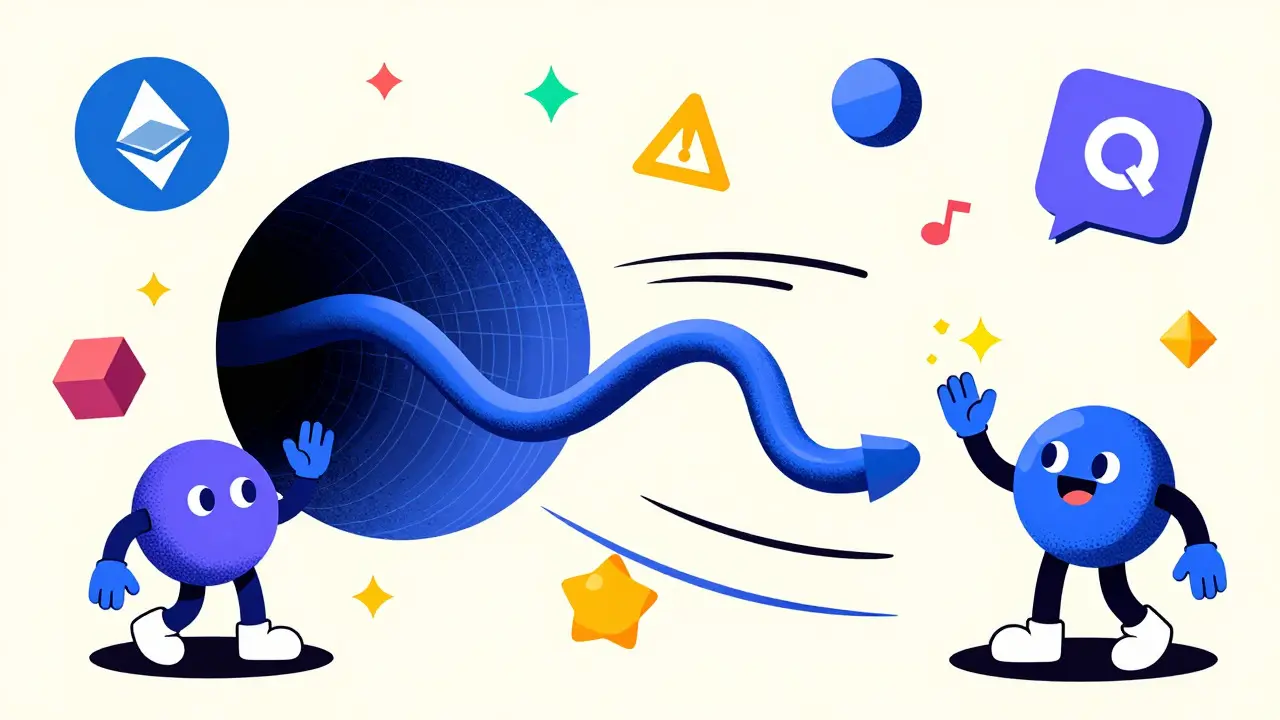
- Mint: This signed message is sent to Solana. The Solana program verifies the signatures and mints an equivalent amount of "wrapped" tokens (like WeETH or wUSDC) into your Solana wallet.
To reverse the process, you burn the wrapped tokens on Solana. The Guardians verify the burn, and the original tokens are released from escrow on Ethereum. This 1:1 collateralization model ensures that every wrapped token has real backing-assuming the system works perfectly.
The $325 Million Lesson in Security
If you've been in crypto since early 2022, you remember the shockwave. On February 2, 2022, Wormhole suffered one of the largest hacks in DeFi history. An attacker stole roughly $325 million worth of wrapped Ether (WeETH). How did this happen if the Guardians were watching?
The flaw wasn't in the concept of bridging; it was in the code implementation on the Solana side. At the time, Solana introduced a new feature allowing user-submitted "signature sets." The Wormhole program failed to strictly validate which accounts were providing these signatures. Specifically, it missed a check for a critical system variable (sysvar).
An attacker exploited this by passing a fake account in place of the expected system variable. The Guardians' signatures were technically valid, but they were being verified against the wrong context. The attacker essentially tricked the bridge into thinking legitimate Guardians had approved a transaction that never actually locked any ETH on Ethereum. The result? The attacker minted 120,000 units of WeETH out of thin air and bridged most of it back to Ethereum to sell for real ETH.
This incident changed everything. It proved that in cross-chain protocols, the weakest link isn't always the math-it's the specific implementation details on each unique blockchain runtime. As security firm Halborn noted later, the root cause was a failure to verify guardian accounts and sysvar addresses rigorously.
Beyond Tokens: NFTs and General Messaging
While most people use Wormhole for moving stablecoins or ETH, its architecture supports more than just fungible tokens. Because it is a generic message-passing protocol, it can carry any data.
This capability enabled the NFT Bridge is a component of Wormhole that allows ERC-721 NFTs from Ethereum and SPL NFTs on Solana to be moved between chains through a similar lock-and-mint mechanism. Artists and collectors could move their digital art between ecosystems without losing ownership proof. The metadata travels with the token, ensuring the image and traits remain intact across chains.
Furthermore, developers use Wormhole for complex DeFi strategies. For example, a trader might want to borrow against their Ethereum holdings but execute trades on Solana due to lower fees. Wormhole enables this seamless liquidity sharing. By mid-2026, Wormhole supported at least seven major chains including Ethereum, Solana, Binance Smart Chain, Polygon, Avalanche, Oasis, and Terra (historically), making it a central hub for multi-chain applications.
Is Wormhole Safe Today?
After the 2022 hack, the team didn't disappear. They rebuilt. The protocol underwent extensive audits and architectural changes. Here is how the current landscape looks for users in 2026:
- Stricter Validation: The Solana programs now enforce strict checks on all account addresses involved in signature verification. The "fake sysvar" exploit path has been closed.
- Defense in Depth: Modern implementations require multiple layers of validation. It's no longer enough for signatures to match; the context of those signatures must also be verified against trusted configuration parameters.
- Formal Verification: Many parts of the codebase have undergone formal verification, a mathematical method to prove that code behaves exactly as intended under all possible conditions.
However, "safe" in crypto doesn't mean "risk-free." Cross-chain bridges remain high-value targets because they hold hundreds of millions of dollars in collateral. If you are using Wormhole, you are trusting the Guardians and the code. Always ensure you are using the official interface to avoid phishing scams, which remain a common threat separate from protocol hacks.
Comparing Wormhole to Other Bridges
Not all bridges are created equal. Some are simple lock-and-mint tools, while others are sophisticated message-passing networks. Understanding the differences helps you choose the right tool for your needs.
| Protocol | Primary Mechanism | Key Strengths | Risks/Considerations |
|---|---|---|---|
| Wormhole | Guardian-signed messages (Generic) | Supports arbitrary data, NFTs, and many chains; High throughput | Relies on Guardian set integrity; Past major exploit |
| LayerZero | Ultra Light Nodes (ULNs) | End-to-end connectivity; Highly customizable security levels | Complex setup for developers; Oracle dependency |
| Hyperlane | Permissionless Message Passing | Open-source; Developer-friendly; No single point of failure | Newer ecosystem; Smaller TVL compared to incumbents |
| Synapse Protocol | Liquidity Network + Lock/Mint | Fast swaps; Good UX for simple token transfers | Less focus on general messaging; Higher reliance on AMM pools |
Wormhole stands out because it was one of the first to offer true general-purpose messaging. While LayerZero focuses heavily on ultra-light nodes for efficiency, Wormhole's Guardian model provides a familiar, albeit centralized-ish, trust anchor. For moving large amounts of value between Ethereum and Solana specifically, Wormhole remains a top choice due to its deep liquidity integration and established track record post-recovery.
Practical Guide: Bridging Assets Safely
If you are ready to move assets, follow these steps to minimize risk. This applies to Wormhole and most other bridges.
- Verify the URL: Phishing sites look identical to the real bridge. Bookmark the official site (
wormhole.com) before you start. Never click links from social media DMs. - Prepare Both Wallets: Ensure you have native gas tokens on both chains. You need ETH for Ethereum fees and SOL for Solana fees. If you run out of SOL after bridging, your funds will be stuck until someone sends you a little dust.
- Start Small: If you haven't used the bridge recently, do a test transaction with a small amount ($10-$50). Wait for it to complete successfully before moving larger sums.
- Check the Token Standard: On Ethereum, you're sending ERC-20 tokens. On Solana, you'll receive SPL tokens. Make sure your Solana wallet (like Phantom or Solflare) recognizes the specific mint address of the wrapped token.
- Monitor Confirmations: Bridging isn't instant. It takes time for Guardians to sign. Don't panic if it says "pending." Check the transaction status on the explorer provided by the bridge interface.
The Future of Interoperability
By 2026, the narrative around bridges has shifted from "will it work?" to "how secure is it?" The industry has learned hard lessons from Wormhole's 2022 hack. We are seeing a trend toward more decentralized validator sets and formal verification becoming a standard requirement, not a luxury.
Wormhole continues to evolve. The team behind it views the protocol as long-term infrastructure. With ongoing updates to its Guardian network and tighter security constraints, it remains a critical piece of the multi-chain puzzle. As blockchains become more specialized-some for speed, some for privacy, some for storage-the need for a reliable postal service like Wormhole only grows.
Whether you are a DeFi trader seeking arbitrage opportunities or an NFT collector expanding their portfolio, understanding how these bridges work empowers you to navigate the fragmented crypto landscape with confidence. Just remember: in crypto, trust is good, but verifying the code is better.
What happened in the Wormhole hack in 2022?
In February 2022, an attacker exploited a vulnerability in Wormhole's Solana program. The bug allowed the attacker to bypass guardian signature verification by injecting a fake system variable (sysvar). This enabled the unauthorized minting of approximately 120,000 wrapped Ether (WeETH) worth about $325 million, which was then bridged back to Ethereum and sold.
Is Wormhole Bridge safe to use in 2026?
Yes, Wormhole is considered safe for use in 2026 following significant security upgrades. The protocol implemented stricter account validation, closed the sysvar vulnerability, and adopted defense-in-depth strategies. However, as with any DeFi protocol, users should always verify URLs and start with small test transactions.
How does Wormhole differ from LayerZero?
Wormhole uses a committee of Guardians to sign and verify messages, acting as a trusted relay. LayerZero uses Ultra Light Nodes (ULNs) which rely on oracles and relayers but aim for a more decentralized verification model. Wormhole is often preferred for its simplicity and deep integration with Solana, while LayerZero offers highly customizable security configurations for developers.
Can I bridge NFTs using Wormhole?
Yes, Wormhole supports NFT bridging. It allows ERC-721 NFTs from Ethereum to be converted into SPL NFTs on Solana and vice versa. The process involves locking the NFT on the source chain and minting a corresponding version on the destination chain, preserving metadata and ownership.
What are Wrapped Assets?
Wrapped assets are tokens on one blockchain that represent an asset locked on another blockchain. For example, WeETH on Solana is backed 1:1 by ETH locked in a smart contract on Ethereum. They allow assets from one ecosystem to be used in another, enabling cross-chain liquidity and trading.



Quintin Franzese
30 Jul 2026 at 06:44So let me get this straight, we lock our life savings in a digital vault run by a group of 'Guardians' who are basically just validators with extra steps?
The article tries so hard to make the $325M hack sound like a minor software glitch rather than a catastrophic failure of trust. It’s funny how they pivot to 'formal verification' now that people actually care about not getting rug-pulled into next week. I suppose calling it a 'messaging layer' makes it sound less like a giant target for hackers and more like essential infrastructure. Sure, Jan.