

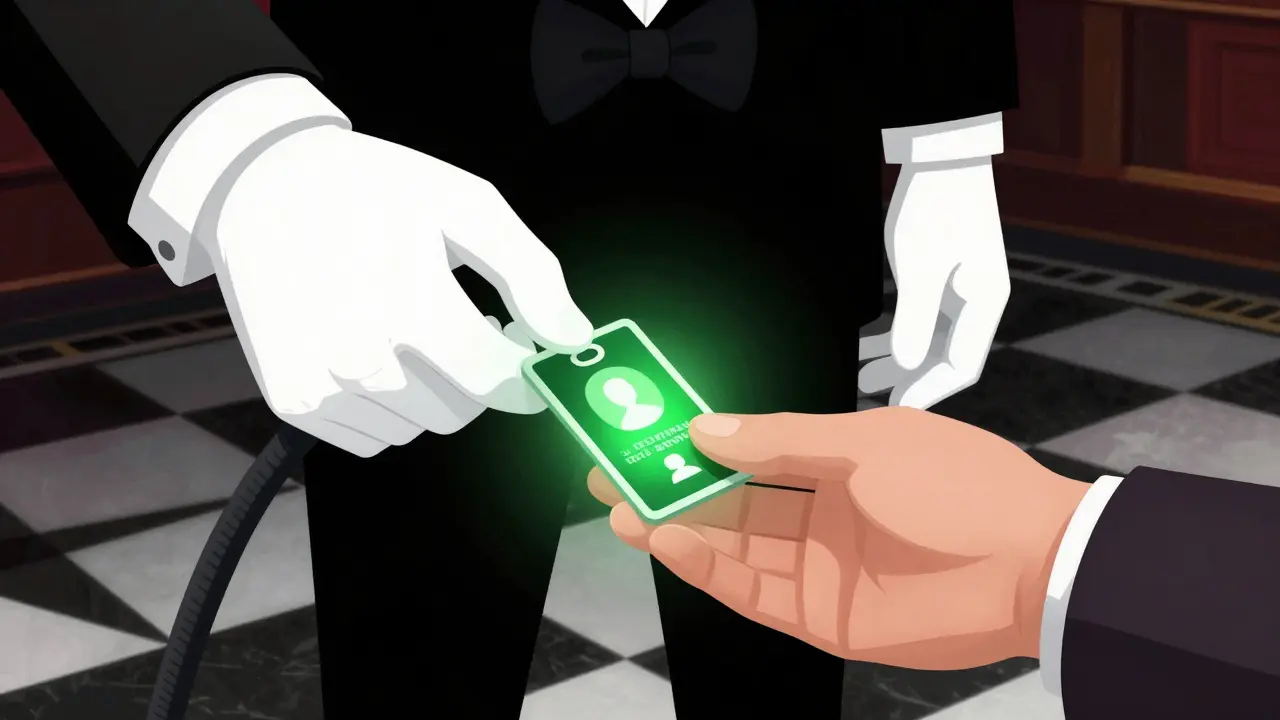

Imagine you need to prove to a bouncer that you are over 21 years old. The standard way is to hand over your driver’s license. The bouncer checks the date of birth, sees you qualify, and hands it back. But in doing so, they also saw your name, address, and maybe even your dog’s name if it’s on there. You gave away more information than necessary just to get through the door.
Now imagine a different scenario. You show a special digital token that simply flashes green if you are over 21 and red if you are not. The bouncer sees green. They know you are legal. They do not know your name, where you live, or exactly how old you are-only that you meet the requirement. This is the core promise of zero-knowledge proofs, often abbreviated as ZKPs. It is a method of verifying truth without exposing the underlying data.
This technology is moving from theoretical math into the real world, reshaping how we handle privacy in finance, identity, and supply chains. If you have heard terms like zk-SNARKs or shielded transactions, you are looking at zero-knowledge proofs in action. Here is how they work, why they matter, and what you need to know before relying on them.
The Core Concept: Proving Knowledge, Not Facts
To understand zero-knowledge proofs, you have to shift your thinking about what "proof" means. In traditional systems, proof usually involves showing evidence. To prove you own a house, you show the deed. To prove you know a password, you type it in. The verifier sees the secret directly.
In a zero-knowledge system, the prover (you) convinces the verifier (the system) that a statement is true without revealing the secret itself. For this to work securely, the protocol must satisfy three strict conditions:
- Completeness: If the statement is true and both parties follow the rules, the verifier will be convinced. You won’t be locked out of your account if you actually know the password.
- Soundness: If the statement is false, no cheating prover can convince the verifier except with a negligible probability. You cannot fake being over 21 if you are 19.
- Zero-Knowledge: The verifier learns nothing beyond the fact that the statement is true. They don’t learn your exact age, just that it meets the threshold.
These properties ensure that privacy and integrity are not trade-offs. You get one without sacrificing the other.
How Do Zero-Knowledge Proofs Actually Work?
The math behind ZKPs is complex, involving abstract algebra and complexity theory. However, the logic can be understood through a simple analogy known as the "Ali Baba Cave."
Imagine a circular cave with a magic door in the middle that only opens if you speak a secret word. There are two paths, A and B, leading to the door. Alice wants to prove to Bob that she knows the secret word without telling him what it is.
- Alice enters the cave and randomly chooses either path A or path B.
- Bob stands outside and shouts which path he wants Alice to exit from.
- If Alice knows the secret word, she can open the door and come out whichever path Bob asks for.
- If she doesn’t know the word, she has a 50% chance of guessing right. If she guessed wrong, she is stuck.
If they repeat this process 20 times, the probability that Alice is faking it drops to less than one in a million. Bob is convinced she knows the secret, but he never heard the word. This is an interactive zero-knowledge proof because it requires back-and-forth communication.
In modern computing, we mostly use non-interactive zero-knowledge proofs (NIZKs). These allow the prover to generate a single piece of data-a proof-that anyone can verify instantly without needing to ask questions. This is crucial for blockchains, where thousands of nodes need to verify transactions quickly without talking to each other repeatedly.

Types of Zero-Knowledge Systems: SNARKs vs. STARKs
Not all zero-knowledge proofs are created equal. Two dominant families dominate the current landscape: zk-SNARKs and zk-STARKs. Understanding the difference helps you choose the right tool for security and scalability needs.
| Feature | zk-SNARKs | zk-STARKs |
|---|---|---|
| Full Name | Succinct Non-Interactive Arguments of Knowledge | Scalable Transparent Arguments of Knowledge |
| Proof Size | Very small (kilobytes) | Larger (megabytes) |
| Verification Speed | Fast | Moderate |
| Trusted Setup | Required (initial ceremony needed) | Not required (transparent) |
| Quantum Resistance | No (relies on elliptic curves) | Yes (relies on hash functions) |
| Best Use Case | Blockchain scaling, mobile wallets | High-security archives, future-proofing |
zk-SNARKs are the most common type today, used by projects like Zcash. Their proofs are tiny and fast to verify, making them ideal for blockchains with limited storage. However, they require a "trusted setup." This is a one-time event where random numbers are generated. If those numbers are leaked or saved maliciously, someone could create fake proofs. Projects mitigate this with multi-party ceremonies where many people contribute randomness, ensuring no single person holds the full key.
zk-STARKs eliminate the trusted setup entirely, making them "transparent." They rely on hash functions, which are believed to be secure even against quantum computers. The downside is larger proof sizes, which can strain network bandwidth. As hardware improves and compression techniques advance, STARKs are becoming more viable for mainstream applications.
Real-World Applications Beyond Cryptocurrency
While ZKPs gained fame through Bitcoin alternatives, their utility extends far beyond digital cash. Here is how industries are applying this technology to solve privacy and compliance headaches.
1. Privacy-Preserving Identity
Currently, accessing services often requires handing over excessive personal data. With ZKPs, you can prove you are a citizen of a specific country, that your credit score exceeds a certain number, or that you are not on a sanctions list-all without revealing your actual ID number or financial history. Projects like Aleo are building smart contract platforms where data remains private by default, allowing developers to build apps that respect user confidentiality while still functioning on public ledgers.
2. Supply Chain Transparency
Companies face pressure to prove ethical sourcing and sustainability without giving competitors access to their proprietary supply chain data. Circularise uses ZKPs to allow suppliers to prove that products meet specific criteria, such as containing less than a certain percentage of restricted substances. The buyer verifies the compliance claim without seeing the full bill of materials or supplier contracts. This separates proof of compliance from disclosure of trade secrets.
3. Blockchain Scalability (ZK-Rollups)
Blockchains like Ethereum are slow and expensive when congested. ZK-rollups bundle hundreds of transactions off-chain, compute the result, and then submit a single zero-knowledge proof to the main blockchain. The main chain verifies the proof, trusting that all bundled transactions were valid. This increases throughput significantly while maintaining the security of the base layer. It is a primary reason why Layer 2 solutions are growing rapidly.
4. Secure Voting and Auditing
Traditional electronic voting raises fears of tampering. ZKPs can enable systems where voters prove they are eligible to vote and that their ballot was counted correctly, without revealing who they voted for. Similarly, companies can prove their financial audits are accurate without exposing sensitive customer transaction details to regulators.
Challenges and Limitations
Despite the hype, zero-knowledge proofs are not a magic bullet. Implementing them comes with significant hurdles that developers and businesses must navigate.
Computational Cost: Generating a ZKP is computationally intensive. It requires substantial CPU power and memory. While verification is cheap, creating the proof can take seconds or even minutes for complex computations. This latency makes ZKPs unsuitable for high-frequency trading or real-time gaming where milliseconds matter. Offloading proof generation to specialized hardware or centralized provers is a common workaround, but it introduces centralization risks.
Circuit Design Complexity: Writing code for a ZKP is different from writing standard software. Developers must translate logic into arithmetic constraints, a process called circuit design. Bugs in these circuits can lead to catastrophic failures, such as allowing invalid transactions or leaking private data. Auditing ZKP circuits requires specialized expertise that is currently in short supply.
Trust Assumptions: As mentioned with SNARKs, the initial setup phase is a critical vulnerability. If the ceremony is compromised, the entire system’s integrity is at risk. Even with transparent STARKs, users must trust the underlying mathematical assumptions and the implementation libraries. Cryptographic attacks evolve, and today’s secure hash function might be broken tomorrow.
The Future of Privacy Technology
We are likely entering an era where zero-knowledge proofs become invisible infrastructure. Just as HTTPS encryption protects web browsing without users thinking about it, ZKPs may soon protect identity and data transactions seamlessly. The trend is moving toward easier developer tools that abstract away the complex math, allowing regular programmers to integrate privacy features without becoming cryptographers.
Regulators are also beginning to recognize ZKPs as a solution to the tension between transparency and privacy. GDPR and similar laws demand data minimization-collecting only what is necessary. ZKPs enforce this principle technically rather than just legally. As adoption grows, expect to see standardized protocols for cross-border identity verification and compliant financial reporting.
For now, the technology is mature enough for serious applications but still requires careful engineering. If you are considering implementing ZKPs, start with clear use cases where privacy is non-negotiable. Evaluate whether the computational overhead fits your performance requirements. And always prioritize audited, well-established libraries over custom implementations.
What is the simplest example of a zero-knowledge proof?
The classic example is proving you know a combination to a safe without revealing the numbers. You enter a room with a safe, lock yourself in, and open the safe using the combination. An observer sees you enter and exit with the safe open, confirming you knew the code, but never sees the digits themselves. In digital terms, this is achieved through cryptographic challenges and responses.
Are zero-knowledge proofs completely unbreakable?
No cryptographic system is completely unbreakable. ZKPs rely on mathematical hardness assumptions, such as the difficulty of factoring large numbers or solving discrete logarithms. If new algorithms or quantum computers break these assumptions, the security could be compromised. Additionally, implementation bugs in software can create vulnerabilities even if the underlying math is sound.
Why do some ZKPs require a trusted setup?
Systems like zk-SNARKs need a set of random parameters to generate proofs efficiently. If these parameters are generated poorly or if the random seeds are kept secret by a malicious actor, that actor could forge valid-looking proofs for false statements. A trusted setup ceremony involves multiple participants destroying their parts of the seed, ensuring no single entity can compromise the system.
Can zero-knowledge proofs be used for passwords?
Yes. Instead of sending your password to a server, you can use a ZKP to prove you know the password associated with an account. The server verifies the proof without ever storing or receiving the actual password. This prevents database breaches from exposing user credentials, as hackers would only find hashed commitments that cannot be reversed to reveal the original password.
What is the difference between ZKPs and encryption?
Encryption hides data so only authorized parties can read it. Zero-knowledge proofs allow computation or verification on data without revealing it at all. Encryption protects confidentiality during transmission or storage. ZKPs enable privacy during processing and validation. They are often used together: encrypt the data, then use a ZKP to prove something about the encrypted data without decrypting it.


Write a comment