



Imagine you just minted your first NFT. You signed the transaction with your wallet, paid the gas fee, and celebrated. But did you realize that a piece of your digital identity-your public key, your transaction history, maybe even metadata from the image file itself-is now etched into a global ledger forever? For years, the crypto world sold decentralization as the ultimate shield against surveillance. Now, regulators are looking at those same immutable ledgers and seeing something else entirely: a massive repository of personal data that is nearly impossible to delete.
If you operate a Web3 project, run a decentralized exchange, or simply care about how your digital footprint is handled, this tension is no longer theoretical. It is the defining challenge of modern crypto compliance. The European Union’s General Data Protection Regulation (GDPR) demands that users have control over their information, including the right to be forgotten. Blockchain technology, by design, refuses to forget anything. Bridging this gap requires more than just reading the law; it demands a fundamental rethink of how we build and interact with Web3 applications.
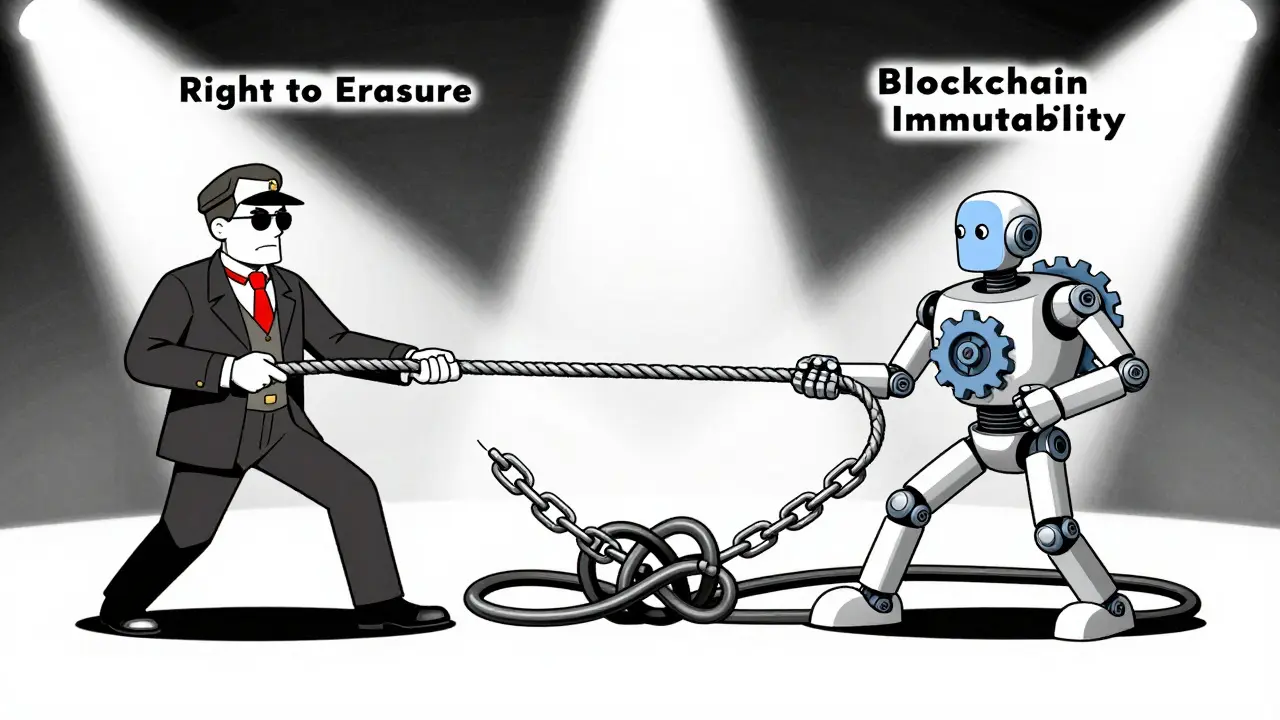
The Core Conflict: Immutability vs. The Right to Erasure
At the heart of the issue is a structural clash. GDPR is the EU's comprehensive data protection framework that grants individuals rights like rectification and erasure. Article 17 of GDPR gives people the "right to erasure," often called the right to be forgotten. If a user asks for their data to be deleted, a company must comply within 30 days.
Now apply that to Bitcoin or Ethereum. Once a transaction is confirmed, it is replicated across thousands of nodes worldwide. No single entity controls the network. No central server can simply hit "delete." This immutability is a feature for security, but a bug for compliance. The European Data Protection Board (EDPB) made this clear in its Guidelines 02/2025, updated in July 2026. They state that if personal data is stored on-chain, controllers must find ways to respect these rights, even if it means complex technical workarounds.
Why does this matter to you? Because if your dApp logs user emails, IP addresses, or even identifiable wallet behaviors directly on the chain, you are likely violating GDPR principles of storage limitation and data minimization. The risk isn't just a fine; it's the loss of trust. Users are waking up to the fact that "privacy" in crypto often just means pseudonymity, not anonymity.
Is Your Wallet Address Personal Data?
This is the most common question I hear from developers. "My wallet address is just a string of random characters. How is that personal data?" The short answer: because it can be linked back to you.
Under GDPR, personal data includes any information relating to an identified or identifiable natural person. The EDPB and national authorities like France’s CNIL have clarified that public keys and wallet addresses qualify as personal data if there is a realistic possibility of linking them to an individual.
Think about it. Most users connect their wallets via services like MetaMask or Phantom. Many also link these wallets to social media profiles, Discord accounts, or centralized exchanges that require KYC (Know Your Customer) verification. Analytics firms like Chainalysis or Glassnode already map billions of dollars in transactions to real-world entities. If a hacker or a curious regulator can combine your on-chain activity with off-chain data points, your "anonymous" address becomes a detailed profile of your financial life.
This means that treating wallet addresses as non-personal data is a dangerous gamble. In the eyes of the law, they are identifiers. And if you process them, you are subject to strict rules about consent, purpose limitation, and security.
Who Is Responsible? Controllers, Processors, and DAOs
In traditional software, identifying who is responsible for data privacy is easy. The company hosting the database is the controller. In Web3, lines blur. Who is the controller when a smart contract executes automatically based on code written by an anonymous developer, validated by miners or validators, and used by millions of users?
The EDPB guidelines attempt to untangle this web:
- dApp Operators: If you run a frontend interface for a DeFi protocol or an NFT marketplace, you are likely the data controller. You determine why and how data is processed. You bear the primary legal responsibility.
- Smart Contract Deployers: Depending on the level of control they retain post-deployment, they may also be considered controllers or joint controllers.
- Node Operators and Validators: These participants store and replicate data. In some interpretations, especially for permissioned chains, they might be seen as joint controllers because they actively participate in maintaining the record.
- DAOs: Decentralized Autonomous Organizations present a unique challenge. If a DAO governs a protocol, is the token holder base the controller? Regulators are skeptical. They tend to look for natural or legal persons who exercise decisive influence. If no one is clearly accountable, the entire group could face scrutiny, or regulators may pierce the veil to target core development teams.
For practical purposes, assume that if you benefit from the service, you have obligations. Don't hide behind decentralization as an excuse to ignore compliance. Conduct a Data Protection Impact Assessment (DPIA) early. Map out every data flow. Identify where personal data enters your system and where it ends up.
Designing for Privacy: Off-Chain Storage and Cryptographic Proofs
So, how do you build compliant Web3 apps? The consensus among experts-from Slaughter and May to OMFIF-is clear: keep personal data off-chain.
This doesn't mean abandoning blockchain. It means using it for what it does best: securing transactions and verifying integrity without storing sensitive details. Here is how top-tier projects approach this:
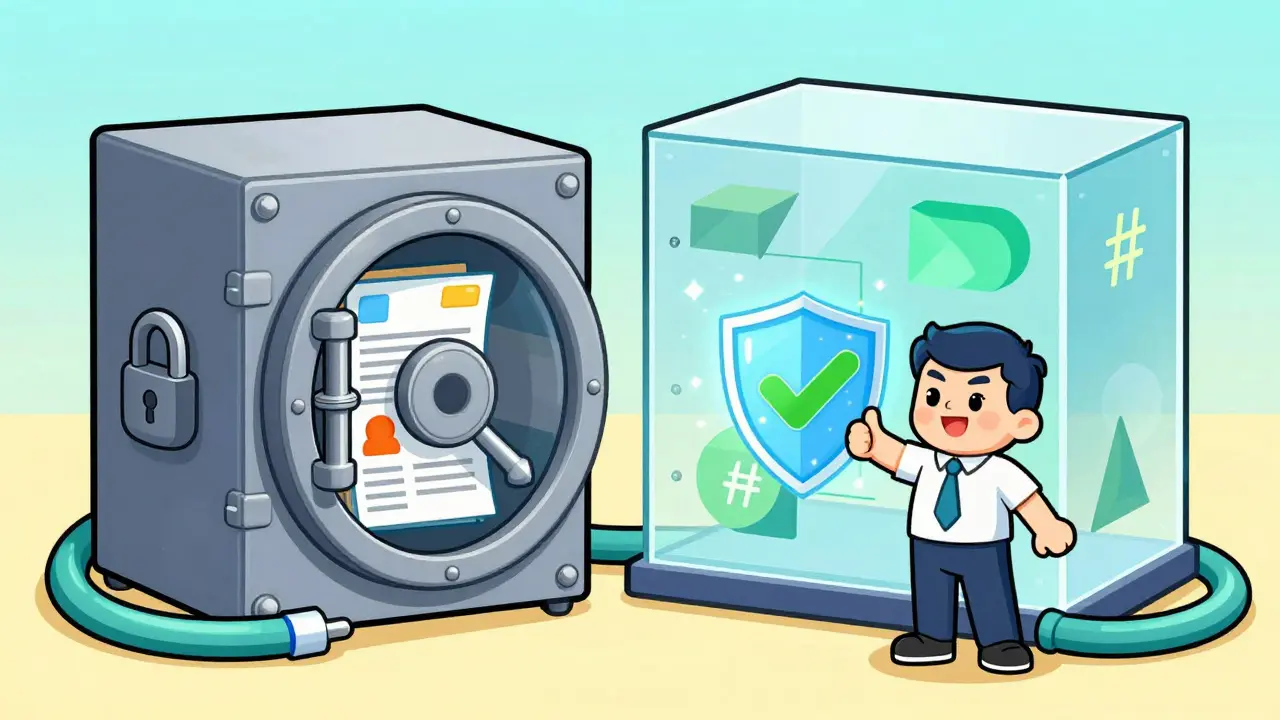
- Store Hashes, Not Data: Instead of putting a user's email or ID document on the blockchain, store a cryptographic hash of that data. A hash is a fixed-length string derived from the input. You can verify that the original data matches the hash without ever revealing the content. If a user requests deletion, you delete the original data off-chain. The hash remains, but it is useless without the source material.
- Use Zero-Knowledge Proofs (ZKPs): ZKPs allow you to prove a statement is true without revealing the underlying data. For example, you can prove a user is over 18 without disclosing their birthdate. Or prove they have sufficient funds without showing their balance. Technologies like zk-SNARKs and zk-STARKs are becoming standard tools for privacy-preserving Web3.
- Pseudonymization and Encryption: If you must store data on-chain, encrypt it. Use strong encryption standards and manage keys securely off-chain. Even better, use salted hashes to prevent rainbow table attacks. Remember, pseudonymization alone is not enough if re-identification is feasible. Combine it with robust access controls.
- Off-Chain Databases for Metadata: Store rich metadata-like NFT descriptions, user profiles, or transaction notes-in conventional databases controlled by the dApp operator. Link to these records via URIs or IPFS hashes on-chain. This allows you to update or delete the metadata as required by GDPR.
This hybrid architecture satisfies both worlds. The blockchain provides transparency and tamper-resistance for critical operations. The off-chain systems provide flexibility and compliance for personal data.
| Strategy | GDPR Alignment | Complexity | Best Use Case |
|---|---|---|---|
| Plain-text On-Chain | Very Low | Low | Avoid entirely for personal data |
| Encrypted On-Chain | Medium | High | Sensitive data requiring on-chain verification |
| Hash Pointers to Off-Chain | High | Medium | NFT metadata, identity documents |
| Zero-Knowledge Proofs | Very High | Very High | Age verification, credit scoring, private voting |
User Consent in Web3: Beyond the Checkbox
Consent is another pillar of GDPR. It must be freely given, specific, informed, and unambiguous. In Web3, this translates to how you design your wallet interactions and dApp interfaces.
Simply asking a user to sign a transaction is not enough. That signature confirms the transfer of assets or execution of code, not necessarily consent to data processing under GDPR. You need explicit, separate mechanisms for data-related permissions.
Here’s what effective consent looks like in practice:
- Clear Disclosure: Before a user connects their wallet, explain exactly what data will be collected, where it will be stored (on-chain vs. off-chain), and for how long. Use plain language, not legalese.
- Granular Options: Allow users to opt-in to optional data collection. For example, if you offer analytics to improve UX, make it toggleable. Do not bundle essential service terms with marketing consents.
- Easy Withdrawal: Provide a straightforward way for users to withdraw consent. If they do, you must stop processing their data and delete it if possible. This reinforces the need for off-chain storage for consent-based data.
- Wallet Signature Prompts: Customize the messages in signature requests. Instead of generic "Approve Transaction," specify "Approve Data Sharing with Partner X." This ensures users understand the implications of their actions.
Remember, consent is fragile. If a power imbalance exists-for instance, if denying consent blocks access to a basic service-it may not be considered "freely given." Relying on other legal bases like legitimate interest or contract performance is often safer for core functionalities, provided you document your reasoning thoroughly.
Practical Steps for Web3 Teams
If you are building or managing a crypto project, here is your action plan for staying compliant in 2026 and beyond:
- Audit Your Data Flows: Map every piece of data your application handles. Identify which elements are personal data. Trace where they go. Are they logged on-chain? Sent to third-party APIs? Stored in cloud buckets?
- Implement Privacy by Design: Integrate privacy considerations from day one. Choose architectures that minimize on-chain personal data. Use libraries and frameworks that support encryption and pseudonymization out of the box.
- Update Your Legal Documents: Revise your privacy policy to reflect Web3 realities. Explain blockchain limitations honestly. Disclose how you handle erasure requests in an immutable environment.
- Train Your Team: Developers, designers, and marketers all play a role in data privacy. Ensure everyone understands GDPR basics and the specific risks of blockchain technology.
- Monitor Regulatory Updates: The landscape is evolving fast. Keep an eye on new guidance from the EDPB, national authorities, and emerging laws like the EU’s MiCA (Markets in Crypto-Assets) regulation, which intersects with data privacy in areas like stablecoin issuance and exchange operations.
Compliance is not a one-time task. It is an ongoing process of adaptation. As technology advances-with rollups, layer-2 solutions, and advanced cryptography-the possibilities for balancing privacy and transparency will expand. Stay curious, stay cautious, and always prioritize the user’s right to control their own data.
Does GDPR apply to decentralized blockchains like Bitcoin?
Yes, GDPR applies to any processing of personal data of individuals in the EU, regardless of the technology used. However, applying GDPR to permissionless networks like Bitcoin is challenging because there is no single controller. The EDPB guidelines suggest that entities interacting with the blockchain (like exchanges or wallet providers) are responsible for their own processing activities.
Can I delete personal data from a public blockchain?
Technically, no. Once data is written to a public blockchain, it cannot be erased. To comply with GDPR’s right to erasure, you should avoid storing personal data on-chain in the first place. Instead, store only cryptographic hashes or references, keeping the actual personal data in off-chain databases where it can be deleted upon request.
Are wallet addresses considered personal data under GDPR?
Yes, if they can be linked to an identifiable individual. Since many wallets are associated with KYC identities, social media profiles, or exchange accounts, regulators treat them as personal data. You must protect them with appropriate security measures and obtain valid consent for processing.
What is the role of a DAO in GDPR compliance?
DAOs face significant challenges in defining a data controller. Regulators typically look for natural or legal persons who exercise control over data processing. If a DAO operates a service involving personal data, its core team or governing entity may be held responsible. Clear governance structures and designated compliance officers are recommended.
How can zero-knowledge proofs help with GDPR compliance?
Zero-knowledge proofs allow you to verify information without revealing the underlying data. For example, proving age eligibility without sharing a birthdate. This aligns perfectly with GDPR’s principle of data minimization, as no personal data needs to be stored or transmitted, reducing privacy risks significantly.









Edward Nigma
16 Jul 2026 at 20:52Look, I get the hype around privacy tech but this whole GDPR thing is just a bureaucratic nightmare designed to kill innovation. You cant have it both ways. You want immutability? Then you accept that data stays there forever. The regulators are trying to square a circle and failing miserably because they dont understand how distributed systems actually work at a fundamental level. It is ridiculous to expect node operators who are spread across the globe to act like a centralized database admin for some EU law.