



Imagine your customer support team is a factory assembly line. Every minute an agent spends on the phone or typing in a chat window is a unit of production. If that line slows down, costs skyrocket. If it speeds up too much, quality crashes. This is where Average Handle Time, commonly known as AHT, becomes the heartbeat of your operation.
AHT isn't just a number on a dashboard; it is the primary metric used to measure how efficiently agents handle customer interactions. In the world of VoIP call centers, where every second counts and bandwidth is optimized for real-time communication, understanding AHT is non-negotiable. It tells you if your staffing levels are right, if your technology is working, and if your customers are getting resolved without being rushed off the hook.
What Exactly Is Average Handle Time?
At its core, AHT measures the total time an agent spends handling a single customer interaction from start to finish. It’s not just about talking. Many managers make the mistake of thinking AHT equals talk time. That’s a costly error.
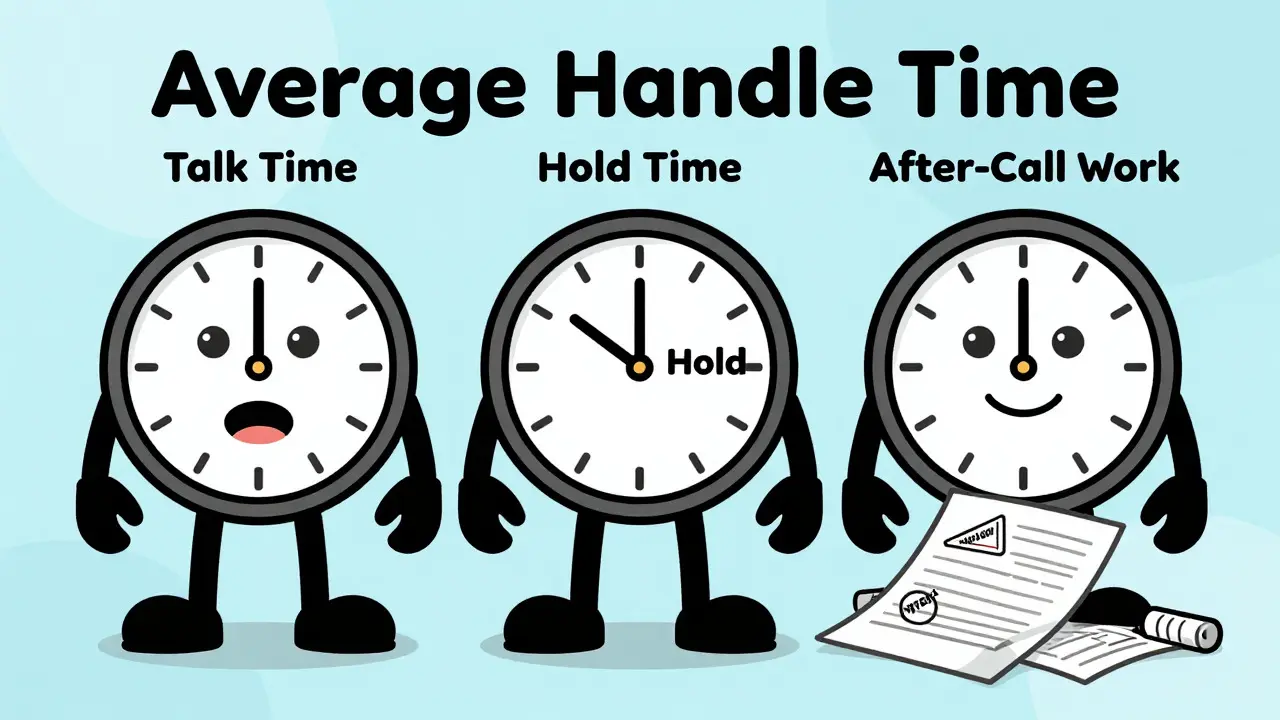
The standard industry formula for calculating AHT includes three distinct components:
- Talk Time: The actual duration the agent is speaking with the customer.
- Hold Time: Any time the customer is placed on hold while the agent looks up information or consults a colleague.
- After-Call Work (ACW): Also called wrap-up time, this is the administrative work done after the call ends, such as logging notes in the CRM, sending follow-up emails, or categorizing the ticket.
To calculate the average for a team or shift, you add up the total talk time, total hold time, and total after-call work for all interactions, then divide by the total number of contacts handled. For example, if an agent handles ten calls with a combined talk time of 60 minutes, 10 minutes on hold, and 15 minutes of wrap-up, their AHT is (60 + 10 + 15) / 10 = 8.5 minutes per call.
This formula remains consistent across major platforms like Genesys, NICE, and Salesforce. However, how these systems track "hold" versus "consult" can vary slightly, so it’s crucial to check your specific platform settings to ensure accuracy.
Why AHT Matters More Than You Think
You might wonder why we obsess over seconds and minutes. The answer lies in cost and capacity. AHT directly dictates how many customers your current headcount can serve. If your AHT drops by even one minute, you can significantly increase your daily volume without hiring a single new person.
Consider the math: An eight-hour shift allows for 480 minutes of work. If your AHT is 10 minutes, an agent can theoretically handle 48 calls. If you reduce AHT to 8 minutes through better training or tools, that same agent can handle 60 calls. That’s a 25% boost in productivity from the same workforce.
Beyond pure efficiency, AHT is a critical input for Workforce Management (WFM) software. These tools use historical AHT data to forecast future staffing needs. If your AHT data is inflated because agents aren’t logging wrap-up time correctly, your forecasts will be wrong, leading to understaffing during peak hours and frustrated customers waiting on hold.
Industry Benchmarks: What Is a "Good" AHT?
There is no universal "perfect" AHT. A complex technical support call for enterprise software will naturally take longer than a simple password reset for a retail account. However, recent data from 2025 and 2026 provides clear benchmarks to help you gauge performance.
| Channel Type | Routine Issues | Complex/Escalated Issues |
|---|---|---|
| Voice Calls | 4-7 minutes | 20-30 minutes |
| Live Chat | 8-12 minutes | 15-25 minutes |
| Email Support | 4-6 minutes active time | Varies widely |
| Social Media DMs | 5-9 minutes | 10+ minutes |
For general voice inquiries, an AHT between 4 and 7 minutes is considered healthy in most industries. If your AHT consistently exceeds 8 minutes for routine tasks, you likely have inefficiencies in your knowledge base or routing. Conversely, if your AHT is suspiciously low-say, under 3 minutes-you risk sacrificing quality for speed, leading to higher repeat contact rates.
It’s also important to note that blended AHT across all channels has stabilized around 7.4 to 7.6 minutes in 2026. This slight increase from previous years reflects a trend where AI deflects simple queries, leaving human agents to handle more complex, nuanced problems that inherently take longer to resolve.
The Trap of Obsessing Over AHT
Here is the dangerous part: When management makes AHT the *only* metric that matters, things go wrong fast. Agents feel pressured to rush customers, skip necessary verification steps, or even drop calls early to meet their targets. We’ve seen stories from call center workers who admit to transferring customers unnecessarily just to end their own clock faster.
This is why AHT must never stand alone. It needs to be balanced with two other critical KPIs:
- First Call Resolution (FCR): Did the customer’s issue get solved on the first try? If AHT is low but FCR is poor, you’re just creating more work for tomorrow.
- Customer Satisfaction (CSAT): Did the customer feel heard and helped? High AHT with high CSAT often means agents are doing thorough, empathetic work. Low AHT with low CSAT means you’re burning bridges.
A study cited by Microsoft found that companies focusing purely on CX improvements actually saw their AHT drop naturally. Why? Because resolving issues effectively reduces transfers and callbacks, which are major drivers of long handle times. So, don’t punish length; reward resolution.
How to Lower AHT Without Hurting Quality
If your AHT is too high, you don’t need to yell at agents to talk faster. You need to remove friction. Here are practical, proven strategies to optimize handle time:
1. Implement Intelligent Routing
Using IVR (Interactive Voice Response) and skill-based routing ensures customers reach the right agent the first time. Misrouted calls add significant time as agents transfer issues back and forth. Modern AI-driven routing can analyze caller intent and direct them to specialists, cutting down on unnecessary handoffs.
2. Streamline After-Call Work
Wrap-up time is often the biggest hidden killer of efficiency. If agents spend 3 minutes manually typing notes, that’s 3 minutes they aren’t helping customers. Use macros, templates, and integrated CRM fields that auto-populate data. Some platforms allow agents to perform ACW while still technically "on call" for certain types of interactions, further boosting availability.
3. Invest in Agent Assist Tools
AI-powered Agent Assist tools can listen to live calls and suggest relevant articles, scripts, or next-best actions in real-time. Case studies show these tools can reduce AHT by 15-30% by eliminating the time agents spend searching for answers. Instead of digging through a wiki, the answer pops up on their screen.
4. Improve Knowledge Base Accessibility
If your internal knowledge base is hard to search or outdated, agents will waste time calling supervisors or guessing. Ensure your KB is mobile-friendly, searchable, and updated regularly. Quick access to accurate information is the fastest way to cut talk and hold times.

Measuring AHT in an Omnichannel World
Today, customers don’t just call. They chat, email, and message via WhatsApp or SMS. Each channel has different dynamics. Chat AHT is often higher than voice because agents handle multiple conversations simultaneously (concurrency). Email AHT is measured differently, often tracking active agent time rather than total elapsed time since receipt.
When analyzing AHT, segment your data by channel and queue. Comparing voice AHT to chat AHT directly is misleading. Instead, look at trends within each channel. Are voice calls getting longer? Is chat concurrency dropping? Drill down into specific queues to identify bottlenecks. For instance, if billing-related calls have a much higher AHT than general inquiries, you may need specialized training or better self-service options for billing topics.
Conclusion: Balance Is Key
Average Handle Time is a powerful lens into your contact center’s health, but it’s only one piece of the puzzle. Use it to identify inefficiencies, forecast staffing, and measure the impact of new technologies like AI and automation. But always pair it with First Call Resolution and Customer Satisfaction scores. The goal isn’t the shortest call; it’s the most efficient, satisfying resolution. By balancing speed with quality, you build a support operation that saves money and keeps customers loyal.
What is the ideal AHT for a call center?
There is no single ideal AHT, as it varies by industry and complexity. However, for general voice inquiries, a benchmark of 4-7 minutes is considered good in 2026. Complex technical support may range from 20-30 minutes. The key is to balance AHT with First Call Resolution (FCR) and Customer Satisfaction (CSAT).
How do you calculate Average Handle Time?
The formula is: (Total Talk Time + Total Hold Time + Total After-Call Work) divided by the Total Number of Interactions. This gives you the average duration of a single customer interaction from start to finish.
Does AHT include hold time?
Yes, standard AHT calculations include hold time. This is because the agent is occupied and unavailable for other tasks while the customer is on hold, making it part of the total handling effort.
Is a lower AHT always better?
Not necessarily. Extremely low AHT can indicate that agents are rushing customers, skipping steps, or failing to resolve issues properly, which leads to higher repeat contact rates. AHT should be optimized alongside quality metrics like CSAT and FCR.
How can AI reduce AHT?
AI tools like Agent Assist can reduce AHT by providing real-time suggestions, automating note-taking, and surfacing relevant knowledge base articles instantly. This reduces the time agents spend searching for information and performing administrative tasks.







Write a comment