



Backtesting crypto strategies isn’t just a step in the process-it’s the difference between losing money and finding something that actually works. Too many traders jump into live trading after running a quick test on TradingView and wonder why their 20% monthly return strategy crashes in real time. The truth? Most of those failures come from bad data, hidden biases, and overconfidence in numbers that never faced real market chaos.
What Data Should You Use?
Not all crypto data is created equal. If you’re using daily OHLCV (Open, High, Low, Close, Volume) candles from a free API, you’re already working with a distorted picture. That’s fine for swing trading, but if you’re testing a scalping strategy that opens and closes positions within minutes, you need tick data-real trade-by-trade records with timestamps down to the millisecond. Professional funds use order book snapshots (Level 2 or 3 data) to simulate how orders fill. Why? Because a $50,000 buy order doesn’t just snap up one coin at $60,000. It eats through 12 different price levels, and each one adds slippage. CryptoCompare’s 2024 study found that ignoring this can overstate performance by 0.15% to 0.45% per trade. Multiply that by hundreds of trades, and suddenly your backtest looks like a lottery win-when it’s really just luck. Data sources vary wildly. CoinGecko, Kaiko, and CryptoCompare all claim to offer accurate data, but during the March 2022 crash, they differed by 8-15% on Bitcoin volume. That’s not noise-that’s a red flag. For serious backtesting, you need at least three data providers. Cross-check them. If one says Bitcoin traded 12,000 BTC in a 10-minute window and the others say 9,500, you don’t trust any of them until you figure out why.The Hidden Biases That Kill Strategies
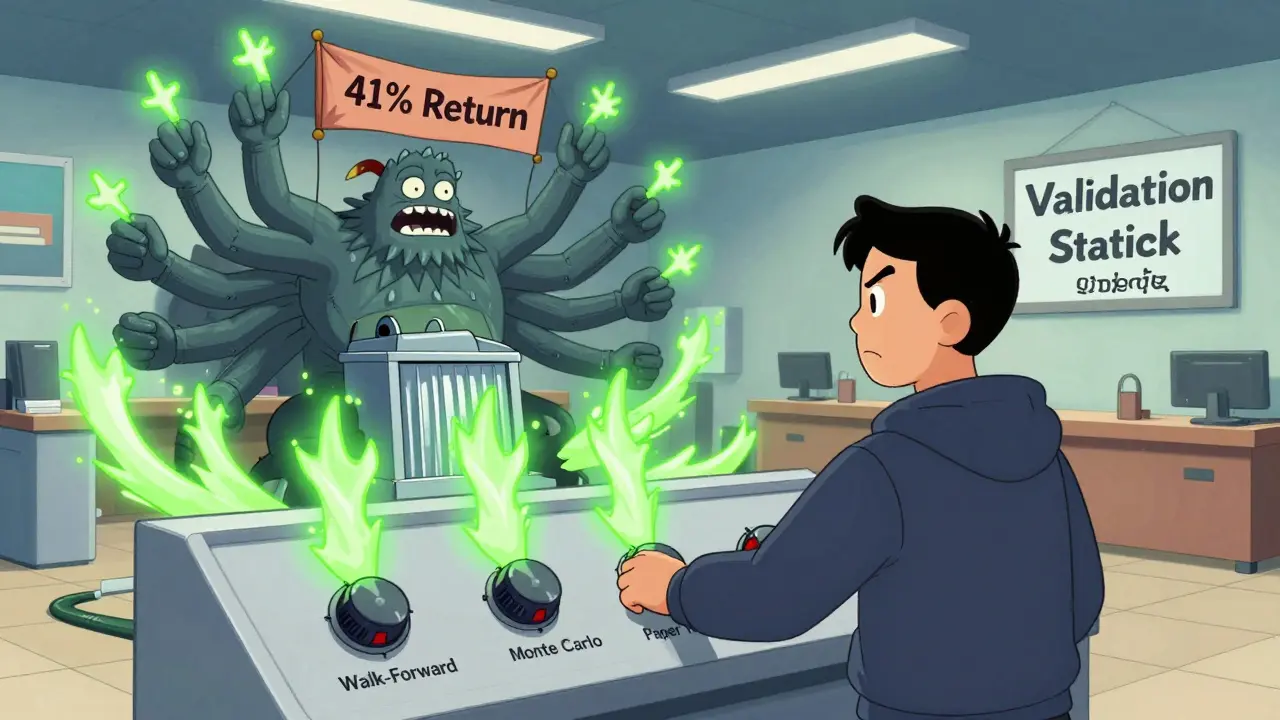
The biggest lie in backtesting isn’t a coding error-it’s survivorship bias. Most platforms only include coins that are still trading today. That means your strategy looks amazing because it never had to handle Bitcoin Cash, Ethereum Classic, or any of the 1,200+ tokens that died in 2021 and 2022. Coinbase’s research showed this alone inflates returns by 17-22% annually. Imagine testing a strategy that bought the top 5 coins by market cap in 2020. If you only include coins still alive today, you’re excluding Terra, FTX Token, and others that collapsed. Your backtest says you made 300%. Reality? You lost everything on one token. Then there’s overfitting. This happens when you tweak your strategy until it fits past data perfectly. You change the moving average from 20 to 23 days. You add a volume filter. You adjust the stop-loss to 3.7%. Suddenly, your strategy hits 41% annual returns from 2019 to 2024. Sounds perfect. But when you run it in 2025? It fails. Why? Because you didn’t test it on data it hadn’t seen. You trained it to memorize the past, not adapt to the future. Dr. David Aronchick, former head of Google’s AI team, says quants typically test 15-20 variations before finding a “winning” one. That’s not strategy development-that’s data mining. The Crypto Council for Innovation’s 2025 standards now require testing across at least three distinct market regimes: the 2020 crash, the 2021 bull run, and the 2022 bear market. If your strategy only works in a bull market, it’s not a strategy. It’s a coincidence.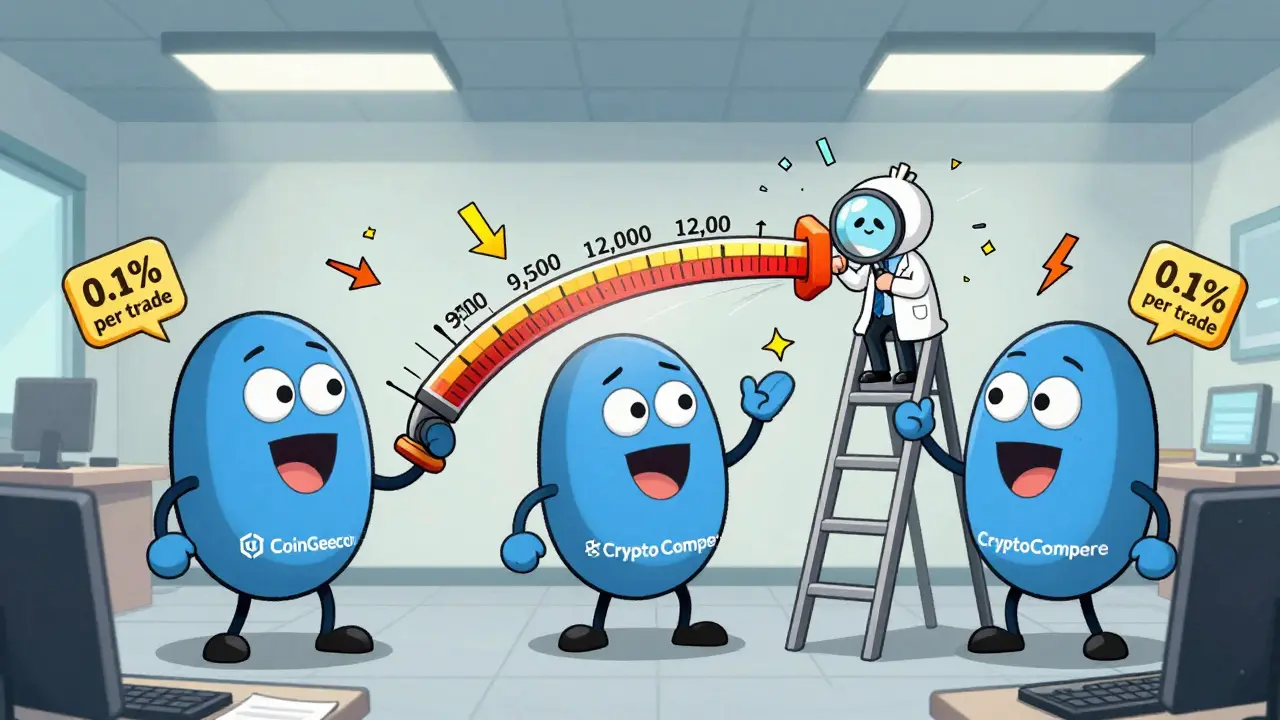
Execution Matters More Than You Think
You can have perfect data and no bias, but if your backtester assumes instant fills at the exact candle close, you’re setting yourself up for failure. Crypto markets don’t work like stocks. There are no closing bells. Orders fill continuously, 24/7, across dozens of exchanges with different rules. Binance and Coinbase calculate candlesticks differently. Binance includes every trade in a minute. Coinbase only includes trades above a certain size. If your strategy uses “close” prices without knowing how they’re made, you’re trading on fiction. Slippage and fees are often ignored. A trader on Reddit (u/CryptoQuant99) backtested a strategy that made 15% monthly returns. When they went live, it lost money immediately. Why? They didn’t account for Binance’s API rate limits. During volatility, their bot hit the 1,200-request-per-minute cap and missed 60% of its entries. That’s not a flaw in the logic-it’s a flaw in the simulation. Realistic backtesting includes:- Exchange fees (Binance spot fees range from 0.02% to 0.1% depending on VIP tier)
- Latency (retail API connections add 50-200ms delay)
- Slippage (0.05%-0.30% per trade on major exchanges)
- 24/7 market hours (no overnight gaps like in stocks)
- Delisted coins and forks (Bitcoin Cash split in August 2017 must be handled separately)
Tool Comparison: What Works Today
There’s no one-size-fits-all tool. Your choice depends on skill, budget, and strategy type.- TradingView (Pine Script): Easy to use, 12.7 million traders rely on it. But it doesn’t model slippage or order book depth. Great for beginners, useless for high-frequency.
- Backtrader (Python): Powerful, open-source, flexible. Requires serious coding. GitHub surveys say you need 80-120 hours of Python practice to use it well. Handles custom data, but integration with exchanges is messy-217 open issues as of April 2025.
- QuantConnect: Institutional-grade. Data back to Bitcoin’s first block. Cloud-powered. Costs $199/month. Best for complex strategies with multi-exchange logic.
- Freqtrade: Built for crypto. Supports hyperparameter tuning and AI optimization. Only works with 18 exchanges, though. A user on GitHub reported a 22% return boost after tuning take-profit levels.
- DolphinDB: Blazing fast. Processes 1 billion data points in 18.7 seconds. Used by quant funds. Its plugin supports tick, minute, and daily data. 68% of crypto quants cite data complexity as their biggest hurdle-and DolphinDB solves it.
Validation: How to Know It’s Real
A backtest that looks good on paper is meaningless. Validation is the only thing that separates luck from a real edge. Start with walk-forward analysis. Split your data into chunks. Test on 2019-2021. Then optimize parameters. Then test on 2022-2023. Then 2024. If your strategy holds up across all segments, it’s not overfit. If it falls apart after the first test, scrap it. Use Monte Carlo simulations. Run your strategy 10,000 times with random order fills, slippage, and fee variations. If 80% of the runs lose money, your edge isn’t real. Paper trade for at least 30 days before going live. Platforms like Cryptohopper now let you simulate trades against live markets without risking capital. If your strategy can’t survive 30 days of real-time slippage and latency, it won’t survive 30 minutes with real money.The Bigger Picture
The crypto backtesting market hit $287 million in 2024 and is growing at 35% per year. Why? Because institutions are in. Pantera Capital, Two Sigma, and Fidelity now have teams dedicated to backtesting. The SEC’s April 2025 guidance requires registered advisors to document their methodology. The Crypto Council for Innovation’s new standards are pushing for transparency. But here’s the catch: crypto markets change fast. A strategy that worked in 2023 might fail in 2026 because of a new regulatory rule, a shift in miner behavior, or a change in how exchanges handle order routing. Dr. Gary Gensler warned in March 2025 that regulatory evolution could invalidate historical assumptions. That’s why the best backtesters don’t just rely on past data-they build systems that adapt. The future isn’t about finding one perfect strategy. It’s about building a pipeline: test → validate → paper trade → deploy → monitor → iterate. Every month. Every quarter. Because in crypto, yesterday’s edge is tomorrow’s liability.Can I backtest crypto strategies with free data?
Yes, but with major limitations. Free data from CoinGecko or CryptoCompare is usable for daily or weekly strategies, but it’s often delayed by 12-48 hours and lacks tick-level detail. For scalping, arbitrage, or market-making strategies, free data will mislead you. Slippage, fees, and order book depth aren’t modeled, so your results will look better than reality. Use free data to learn the basics, but invest in professional sources like Kaiko or Coinbase Institutional if you’re serious.
What’s the most common mistake in crypto backtesting?
Ignoring slippage and fees. Most traders assume they’ll buy at the exact price shown on the chart. In reality, large orders move the market. A $10,000 buy order on a low-liquidity pair might fill at 2-3% worse than expected. Add in exchange fees and latency, and you’re eating away 5-7% of your potential profit before you even open a trade. This alone causes 57% of backtesting failures, according to CryptoQuant forum analysis.
Do I need to code to backtest crypto strategies?
Not necessarily. TradingView lets you build simple strategies with Pine Script in a few hours. But if you want to test complex logic-like combining on-chain metrics with price action, or simulating multi-exchange arbitrage-you’ll need to code. Tools like Backtrader, Freqtrade, and QuantConnect require Python knowledge. The learning curve is steep, but the control is worth it. For most people, start with TradingView, then move to Freqtrade once you’re ready to go deeper.
How long should I backtest a strategy?
At least three years, covering different market conditions: a bull run, a crash, and a sideways market. The 2020 crash, 2021 bull run, and 2022 bear market are the minimum benchmarks. If your strategy only works in bull markets, it’s not robust. Professional funds now require testing across these three regimes before deploying capital. Anything less is gambling.
Is backtesting worth it for retail traders?
Absolutely-if done right. Retail traders who backtest properly reduce strategy failure rates by 43%, according to TokenMetrics. The key is avoiding the traps: don’t overfit, don’t ignore slippage, and don’t rely on survivorship bias. Start simple. Test one idea. Validate it across market cycles. Paper trade it. If it survives, then go live. Backtesting doesn’t guarantee profits, but it removes the guesswork. And in crypto, that’s half the battle.







Sumit SM
23 Mar 2026 at 19:24Look, I’ve spent 12 hours straight on this, and I’ve come to one conclusion: backtesting isn’t about data-it’s about humility. You think you’ve cracked the code? You haven’t. You’ve just memorized a ghost. The market doesn’t care about your 41% annual returns. It doesn’t even know your name. It’s a living, breathing, chaotic entity that laughs at backtests that don’t account for slippage, latency, or the fact that someone on Binance just dumped 500 BTC right before your bot tried to enter. And yet-here we are-trading like we’re gods. We’re not. We’re just people with Excel sheets and delusions. So stop optimizing. Start observing. The market will tell you everything-if you’re quiet enough to listen.