

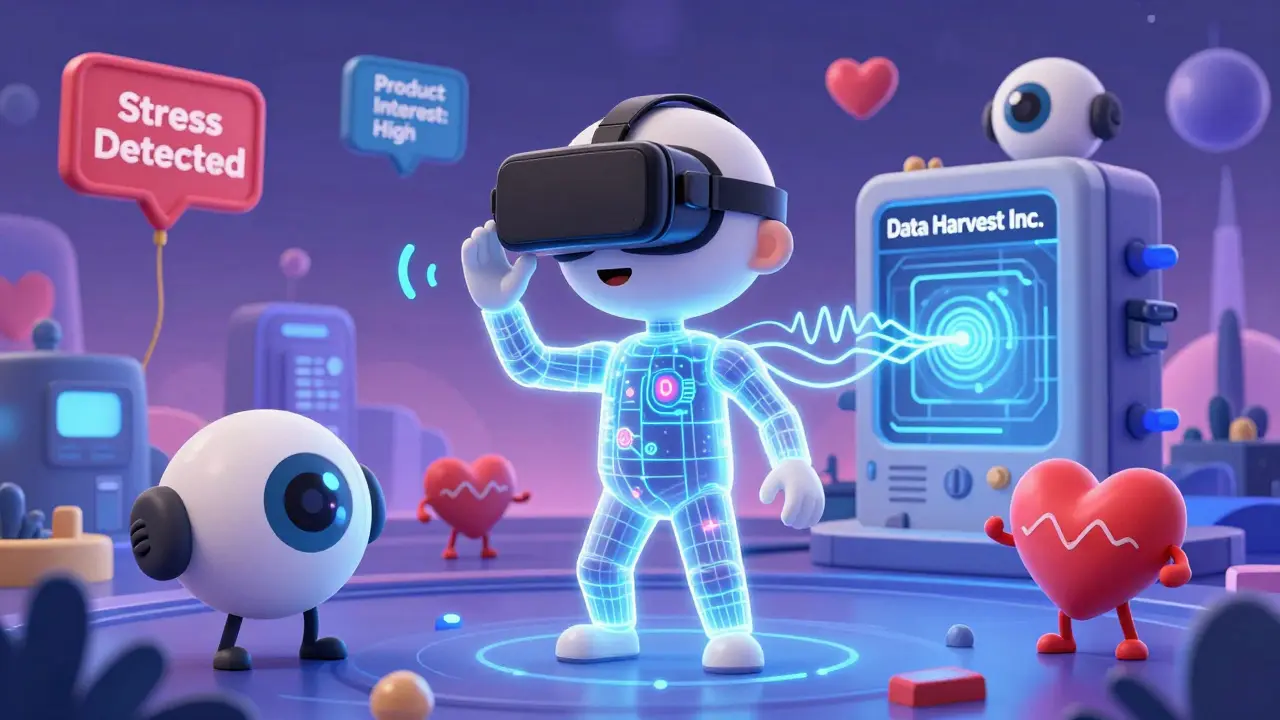

When you put on a VR headset and step into the metaverse, you're not just entering a game or a social space-you're walking into a surveillance system that knows more about you than your smartphone ever could. Your avatar isn't just a digital lookalike. It's a living sensor network, collecting your heartbeat, your eye movements, the way you shift your weight when you're nervous, even the subtle tone changes in your voice when you're upset. This isn't science fiction. This is what's happening right now in 2026.
What Your Avatar Reveals About You
Your avatar is built from data you give up willingly: height, weight, skin tone, hair color. But once you're inside, the system starts collecting far more. Cameras in your headset track your facial muscles as you smile, frown, or raise an eyebrow. Microphones capture not just what you say, but how you say it-pitch, rhythm, hesitation. Motion sensors record how you stand, how fast you walk, whether you lean forward when you're interested or pull back when you're uncomfortable.
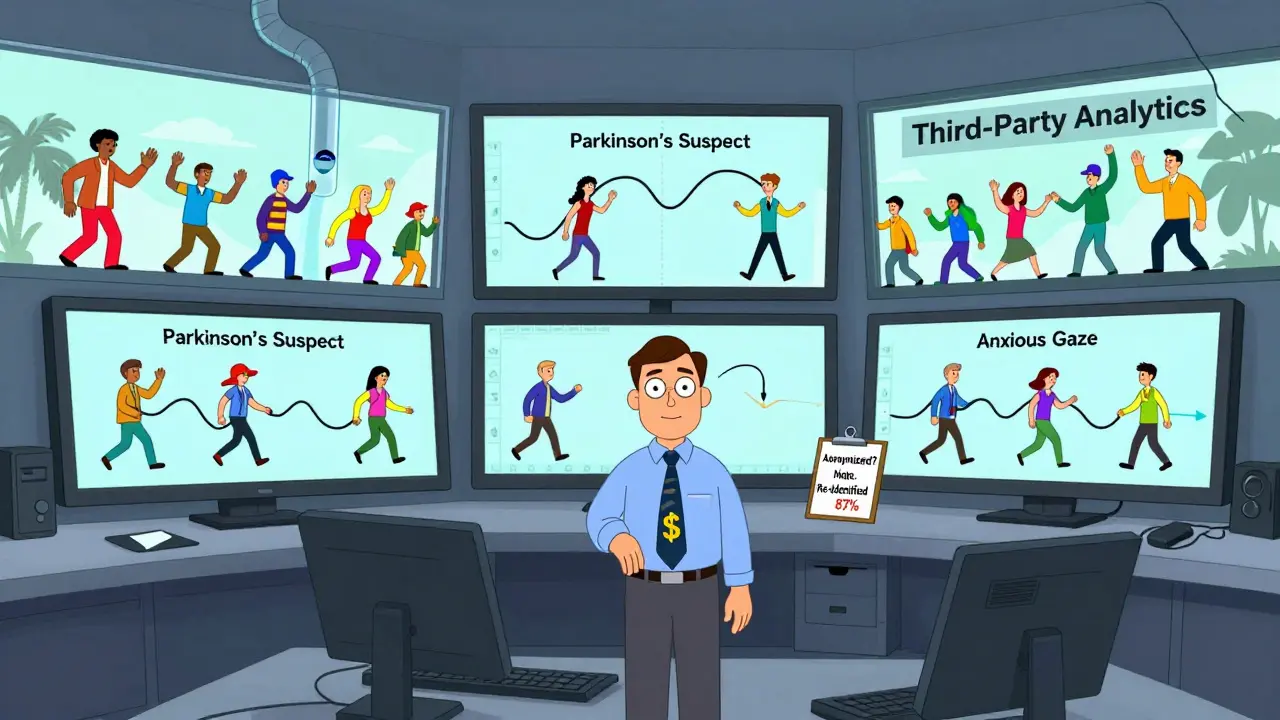
This isn't just for realism. It's for profit. Companies use this data to build psychological profiles that go far beyond your likes and clicks. If your gaze lingers on a virtual product for more than 3 seconds, you're flagged as interested. If your voice trembles during a virtual meeting, you might be tagged as "high stress"-a signal to advertisers offering relaxation apps or therapy services. Your movement patterns can even hint at medical conditions: a slight limp, unsteady hand gestures, or irregular breathing could be flagged as potential signs of Parkinson’s, anxiety, or chronic fatigue.
Biometric Data Isn't Just Personal-It's Unique
Unlike a password or an email, your biometrics are permanently tied to you. Your gait, your iris pattern, the way your lips move when you speak-these are biological fingerprints. In the metaverse, they're being recorded, stored, and sometimes sold. One major platform, as reported in late 2025, began sharing anonymized movement data with third-party analytics firms. The catch? "Anonymized" meant removing names, not the unique way someone walks or blinks. Researchers later proved they could re-identify 87% of users using just their motion signatures.
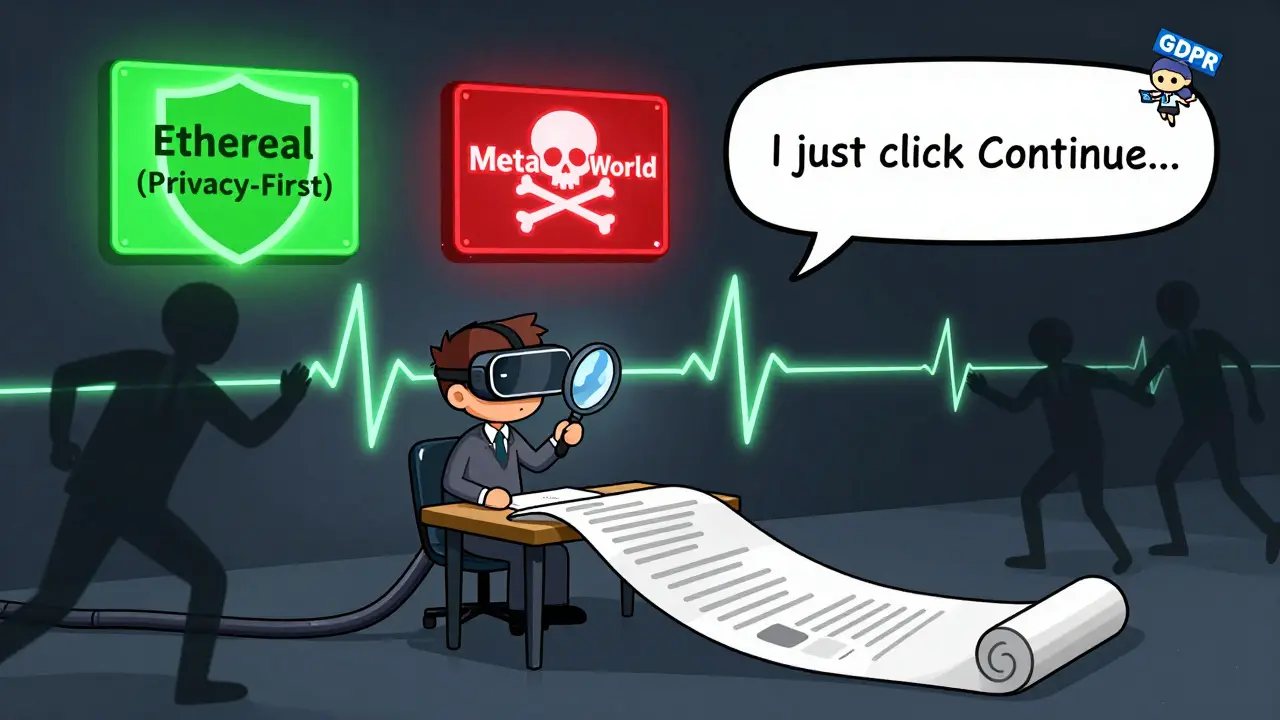
Under the GDPR, this kind of data is classified as "special category personal data." That means strict rules apply: you must give explicit consent, and the platform must prove it's necessary. But most users don’t read the fine print. The consent pop-up says, "Allow motion tracking to enhance your experience." It doesn’t say, "We will store your facial micro-expressions for 5 years and sell patterns to insurance companies."
Why Movement Data Is More Dangerous Than You Think
Think about how you move in real life. You don’t realize it, but your body reveals things: a slight tremor when you’re nervous, a stiff shoulder from an old injury, the way you avoid eye contact if you’ve been traumatized. In the metaverse, these cues are captured in real time, analyzed by AI, and turned into behavioral scores.
One study from Stanford’s Virtual Human Interaction Lab in early 2026 showed that metaverse platforms could predict depression with 78% accuracy based solely on posture, blink rate, and vocal tone. Another found that users who moved slowly in social spaces were more likely to be targeted for ads promoting antidepressants or meditation apps.
And it gets worse. If you’re wearing a haptic suit, your body’s physiological responses-sweating, heart rate spikes, muscle tension-are also recorded. This data can be used to determine your emotional state during a virtual job interview, a therapy session, or even a date. Imagine being denied a promotion because your avatar showed signs of stress during a virtual meeting. Or being charged higher insurance rates because your movement patterns matched those of people with heart conditions.
How Companies Are Using Your Voice
Your voice in the metaverse isn’t just audio. It’s a biometric key. Voiceprints are being built from every word you say, every laugh, every sigh. Companies use these to recognize you across platforms-even if you change your avatar name or appearance. Some platforms now use voice analysis to detect lies, stress, or even political leanings based on word choice and tone.
One platform, launched in late 2025, began offering "emotional tone analysis" as a premium feature for businesses. Employers could pay to see how "engaged" or "confident" a candidate sounded during a virtual interview. No one told users their voice was being analyzed for emotional health. When a whistleblower leaked the internal documentation, it sparked a class-action lawsuit in the EU.
Under GDPR, voice data that reveals health conditions, political opinions, or emotional states requires explicit consent. But consent forms in the metaverse are buried under layers of flashy graphics and gamified onboarding. You click "Continue" to enter a virtual concert, and you’ve unknowingly agreed to let them record your vocal stress patterns for the next 10 years.
What You Can Do to Protect Yourself
Here’s the truth: you can’t fully opt out. If you want to use the metaverse, you’ll have to share some data. But you can control how much.
- Check privacy settings every month. Most platforms reset preferences after updates. Don’t assume your settings stay the same.
- Disable biometric tracking. Look for options like "Disable facial tracking," "Turn off voice analysis," or "Limit motion data collection." If you can’t find them, don’t use the platform.
- Use pseudonyms. Never link your real name, email, or social media to your metaverse account. Treat it like a burner phone.
- Use a separate device. If possible, use a dedicated VR headset for the metaverse-not your personal laptop or phone. This limits data cross-contamination.
- Read the privacy policy. Yes, it’s long. But look for keywords: "biometric," "behavioral," "emotion detection," "third-party sharing," "data retention period." If they don’t clearly say "we don’t store this," assume they do.
The Future of Metaverse Privacy
Regulators are waking up. The European Union is drafting new rules specifically for virtual environments, requiring platforms to get separate, layered consent for each type of data collected. The U.S. Federal Trade Commission has launched investigations into three major metaverse companies for deceptive privacy practices.
Some startups are building privacy-first platforms. One, called Ethereal, uses on-device processing-meaning your facial movements and voice data never leave your headset. Another, NexusSafe, lets users encrypt their biometric data with a private key only they control. These aren’t gimmicks-they’re working prototypes.
The real shift won’t come from laws alone. It’ll come from users demanding better. When enough people stop using platforms that exploit their movement and voice, companies will have to change. Right now, the metaverse is a gold rush. But privacy isn’t optional. It’s the foundation of trust. And without trust, the metaverse won’t last.
What Happens If You Do Nothing?
If you keep clicking "Accept" without reading, your digital self will become a living archive of your most private moments. Your emotional reactions, your physical limitations, your unspoken fears-all stored, analyzed, and sold. In 2026, your metaverse profile could affect your job prospects, your insurance premiums, even your eligibility for loans.
There’s no undo button. Once your biometric data is in the system, it’s nearly impossible to erase. Even if you delete your account, many platforms keep anonymized copies for "research." And anonymized doesn’t mean untraceable.
Is metaverse privacy covered by GDPR?
Yes, if you’re in the European Union or if the platform processes data from EU residents. GDPR applies to any company handling personal data of EU citizens, regardless of where the company is based. This includes biometric data, movement patterns, and voice analysis collected in virtual environments. Platforms must get explicit consent and can’t store sensitive data without a legal basis.
Can metaverse companies sell my biometric data?
Technically, they can’t sell it directly under GDPR if it’s classified as special category data-but they can share it with third parties for analysis, advertising, or research. Many platforms disguise this as "data partnerships" or "analytics services." Always check the privacy policy for phrases like "data sharing with advertising partners" or "behavioral insights providers."
Do I need to worry if I don’t use a headset?
Yes. Many metaverse platforms now work on smartphones and desktops using motion sensors, webcams, and microphones. Even if you’re just navigating a 2D version of a virtual world, your face, voice, and movement can still be tracked. The level of data collected is lower, but it’s still there.
Can I delete my biometric data from the metaverse?
It’s possible, but difficult. Under GDPR, you have the right to request deletion. But many platforms store biometric data separately from your account, making it hard to locate. Some require you to submit a formal request, wait 30 days, and prove your identity. Even then, they may keep anonymized versions for "system improvement."
Are there any metaverse platforms that prioritize privacy?
Yes, but they’re rare. Platforms like Ethereal and NexusSafe use on-device processing and encryption to keep your data private. They don’t sell analytics or share your movement patterns. They’re smaller, less flashy, and often require subscriptions-but they’re the only ones you can trust if privacy matters to you.
Privacy in the metaverse isn’t about hiding. It’s about control. You’re not just building an avatar-you’re building a digital twin that can be used against you. The technology is here. The question is: who gets to decide what happens to it?





Gabby Love
19 Feb 2026 at 02:24I’ve been using VR for work meetings for over a year now, and I had no idea how much my micro-expressions were being logged. Last week I noticed an ad for ‘calm breathing apps’ pop up right after I had a stressful call. Turns out my voice cracked once when I was tired, and boom - I’m flagged as ‘high anxiety.’ No one warned me. I’ve since disabled facial and voice tracking. Not worth the creep factor.
Also, if you’re on a desktop version, check your webcam permissions. Even without a headset, some platforms use your camera to track head movement and blink rate. It’s wild how much they can infer from a 2D avatar.