



By January 2026, the DeFi world had lost over $77.1 billion to smart contract exploits and rug pulls since 2023. That’s not a typo. It’s not a hypothetical. It’s real money-money real people lost because they trusted code that wasn’t secure, or teams that vanished overnight. If you’re still using DeFi protocols without understanding these risks, you’re playing Russian roulette with your crypto.
Smart Contract Exploits: The Code That Broke the System
Smart contracts are supposed to be trustless. They run automatically, no middlemen, no human error. Except when they’re full of bugs. The most common flaw? Logic bugs. They make up 26% of all DeFi hacks, according to Halborn’s 2025 report. These aren’t typos. They’re design mistakes-like letting anyone withdraw funds after a certain condition, even if they didn’t deposit anything. Attackers find them by running fuzzing bots that test every possible input until something breaks. One of the worst examples happened in January 2026 with Truebit. Their contract had an integer overflow bug. It had been there since launch-nearly five years. No one caught it. Then, on January 8, attackers used it to mint infinite TRU tokens and drained $26 million in ETH. Within hours, the token price hit zero. Users who had staked their life savings watched their balances vanish. Reentrancy attacks are another favorite. In July 2025, GMX V1 lost $40 million because its withdrawal function called itself repeatedly before updating balances. The attacker withdrew, called withdraw again, withdrew again-like a loop that never ends. The contract didn’t check if the withdrawal had already been processed. Simple. Deadly. Then there’s oracle manipulation. Oracles feed real-world data-like the price of ETH-to DeFi protocols. If the oracle is wrong, the whole system goes off the rails. In February 2025, Cetus Protocol lost $223 million because attackers used a flash loan to temporarily spike the price of a token on a small exchange. The protocol’s oracle took that fake price as real, let users borrow against it, and then the price crashed. The attackers walked away with millions. Ethereum and Solana are the top targets. Together, they account for 47% of all DeFi exploits. Why? Because they’re the most used. More users = more money locked = bigger payoff for hackers.Rug Pulls: When the Team Disappears
A rug pull isn’t a hack. It’s theft with consent. You deposit your ETH into a DeFi protocol. You see the TVL (Total Value Locked) climb. You see the yield. You think, “This is legit.” Then, one day, the website goes dark. The Discord server vanishes. The devs delete their Twitter. The liquidity pool gets drained. Your tokens are now worthless. Rug pulls made up 12.8% of all crypto exploits in 2025. And they’re getting smarter. Some teams create fake audits. Others use fake partnerships. A few even run real code for months-building trust-before pulling the plug. One project in late 2025 had a working DEX, real users, and weekly updates. Then, overnight, the team moved all funds to a wallet with no public history. No warning. No refund. Just gone. The worst part? Many rug pulls happen in projects with less than $1 million in TVL. Attackers know small teams don’t have security budgets. They know users assume “small = new and risky,” but still invest anyway. That’s the trap.Why Audits Don’t Work Anymore
You’ve heard it before: “Get your contract audited.” Sounds solid. But here’s the truth: 38% of all exploits happened outside the scope of audits. That means even if a firm says your contract is “secure,” it might still be vulnerable. Audits are snapshots. They check code at one point in time. But DeFi evolves. New attack vectors emerge weekly. A contract audited in 2023 might be broken by a technique invented in 2025. Halborn found that 34% of attacks targeted unaudited contracts. But the real problem isn’t just the lack of audits-it’s the false sense of safety they create. People assume, “It’s audited, so it’s safe.” That’s not true. It just means someone looked at it once. And audits don’t catch everything. They miss edge cases. They don’t simulate real-world attacks. They don’t test how the contract behaves under extreme market stress. That’s why firms like AINvest now recommend formal verification and adversarial simulations-methods that mathematically prove correctness or force the contract to be attacked in controlled environments.
Who’s Behind the Attacks?
It’s not just random hackers. North Korean state-backed groups are responsible for 52% of all crypto exploit gains in 2025, according to Hacken. These aren’t lone coders. They’re organized teams with military-grade resources, targeting DeFi because it’s fast, global, and poorly regulated. They use AI to scan thousands of contracts for vulnerabilities. They automate exploits. They launder funds through Tornado Cash and decentralized exchanges. They move money in under 15 minutes-like the $1.5 billion Bybit hack in February 2025. Even more worrying: legacy protocols are being hunted. Projects from 2020-2022-like Yearn, Ribbon Finance, and Rari Capital-are being re-targeted. Why? Because they’re old. Their code hasn’t been updated. Their teams are gone. And attackers know it.How to Protect Yourself
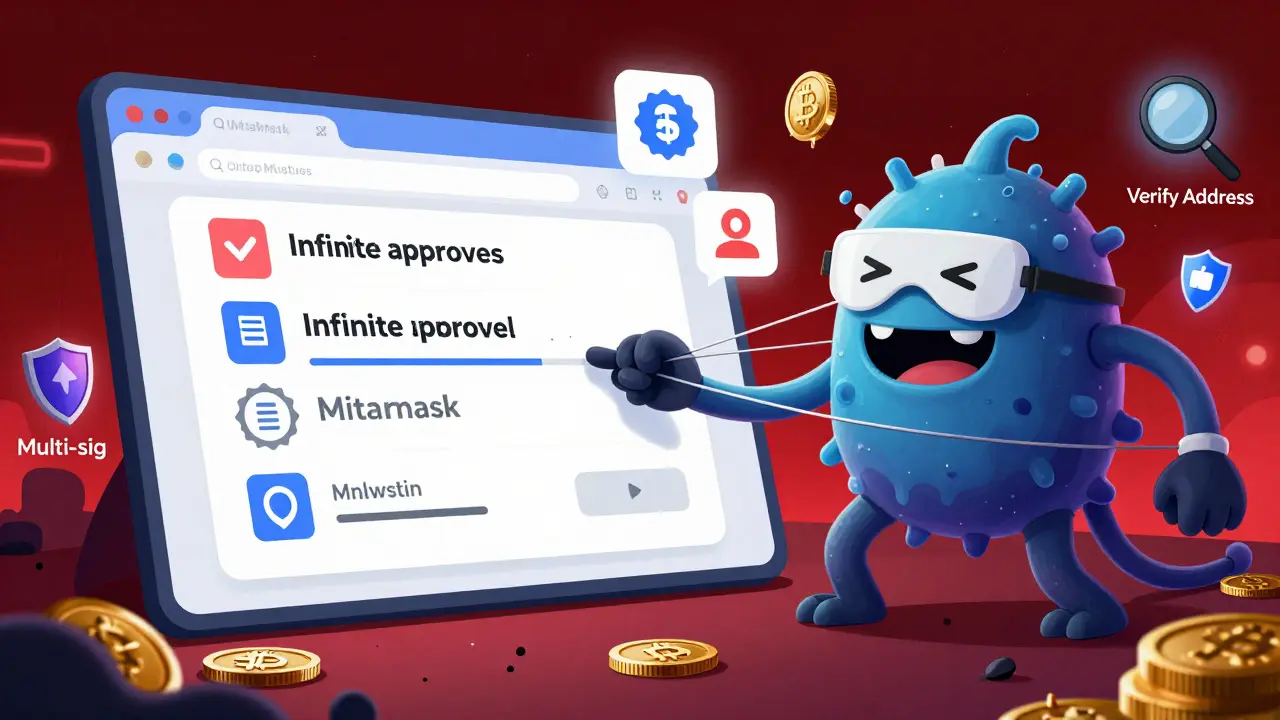
You can’t eliminate risk. But you can reduce it dramatically.- Never give infinite token approvals. Many users approve unlimited access to their tokens so they can trade easily. That’s like giving someone your bank PIN and saying, “Take whatever you want.” Use tools like Etherscan to revoke approvals you don’t need.
- Check the contract address. Always verify you’re interacting with the official contract. Scammers clone websites with tiny URL changes. One user lost $18,000 because they clicked a fake “stake” button on a phishing site that looked identical to the real one.
- Avoid old, low-TVL projects. If a protocol has been around for more than a year and has less than $5 million locked, treat it like a gamble. The risk isn’t worth the reward.
- Use multi-sig wallets for large stakes. If you’re managing a portfolio over $10,000, use a wallet that requires 2 or 3 signatures to move funds. That stops one compromised key from draining everything.
- Don’t trust yield alone. If a protocol promises 100% APY, it’s either a scam or about to collapse. Real DeFi yields rarely exceed 15-20% sustainably.
Off-Chain Risks Are Just as Dangerous
Here’s something most people ignore: 80.5% of 2024 losses came from off-chain attacks-not smart contract bugs. Phishing. Malware. Fake customer support. Compromised browser extensions. HX Technology documented cases where users lost funds because their browser was infected with a keylogger. Others were tricked into signing malicious transactions by fake “security alerts” that looked like MetaMask pop-ups. One user thought they were approving a swap. They were actually approving a transfer of their entire wallet balance to a hacker’s address. DeFi isn’t just about code. It’s about trust. And trust is broken by humans-not just hackers.What’s Next?
The DeFi security crisis isn’t slowing down. In fact, it’s accelerating. As more users enter DeFi, the attack surface grows. As AI tools become cheaper, more hackers can find and exploit vulnerabilities faster than ever. The only way forward is a shift in mindset. You can’t rely on audits. You can’t rely on “popular” projects. You can’t rely on the team being “honest.” You have to assume every contract is vulnerable. Every team could disappear. Every interface could be fake. If you’re still in DeFi, treat every transaction like a bank transfer you can’t undo. Double-check. Verify. Question. And if something looks too good to be true? It is.What’s the difference between a smart contract exploit and a rug pull?
A smart contract exploit is when a hacker finds a bug in the code-like a logic flaw or reentrancy-and uses it to steal funds. A rug pull is when the team behind the project intentionally drains the liquidity and disappears. One is a technical attack; the other is fraud.
Are audited DeFi projects safe?
No. Audits are helpful, but they’re not foolproof. 38% of exploits in 2025 happened outside the scope of audits. Even audited contracts can have undiscovered bugs, especially if they’re old or complex. An audit is a snapshot, not a guarantee.
How can I check if a DeFi contract is legitimate?
Verify the contract address on Etherscan or Solana Explorer. Look for a verified source code. Check if it’s been audited by a reputable firm (like Halborn or CertiK). Look at the transaction history-has the team moved funds unexpectedly? Is the liquidity locked? Avoid contracts with no public ownership or anonymous teams.
Can I recover funds lost to a rug pull or exploit?
Almost never. Blockchain transactions are irreversible. Once funds are moved to a hacker’s wallet, they’re gone unless law enforcement tracks them down-which rarely happens with cross-chain or mixer-obscured transfers. Prevention is the only real defense.
Why are older DeFi protocols being targeted now?
Because they’re sitting ducks. Many were built during the 2020-2022 boom with minimal security. Teams moved on. Code wasn’t updated. Attackers now use AI tools to scan these legacy contracts for forgotten bugs. Projects like Yearn and Rari Capital have been hit multiple times in 2025-2026 for this exact reason.
What’s the biggest mistake new DeFi users make?
Giving unlimited token approvals. Many users approve a contract to spend their entire token balance so they can trade easily. That’s like giving someone your credit card with no spending limit. Always set approvals to the exact amount you need, and revoke them when you’re done.
DeFi is powerful. But power without responsibility is dangerous. If you don’t understand the risks, you’re not investing-you’re gambling. And in this game, the house always wins.







Donald Sullivan
18 Jan 2026 at 12:58Bro, I saw a guy lose $80k on a rug pull last week because he trusted a Discord mod who said 'just approve this one time.' No audit, no due diligence, just FOMO. You think you're smart until your wallet's empty and the team's on a beach in Bali with your ETH. DeFi isn't investing-it's a casino where the dice are loaded and the dealers are anonymous.