

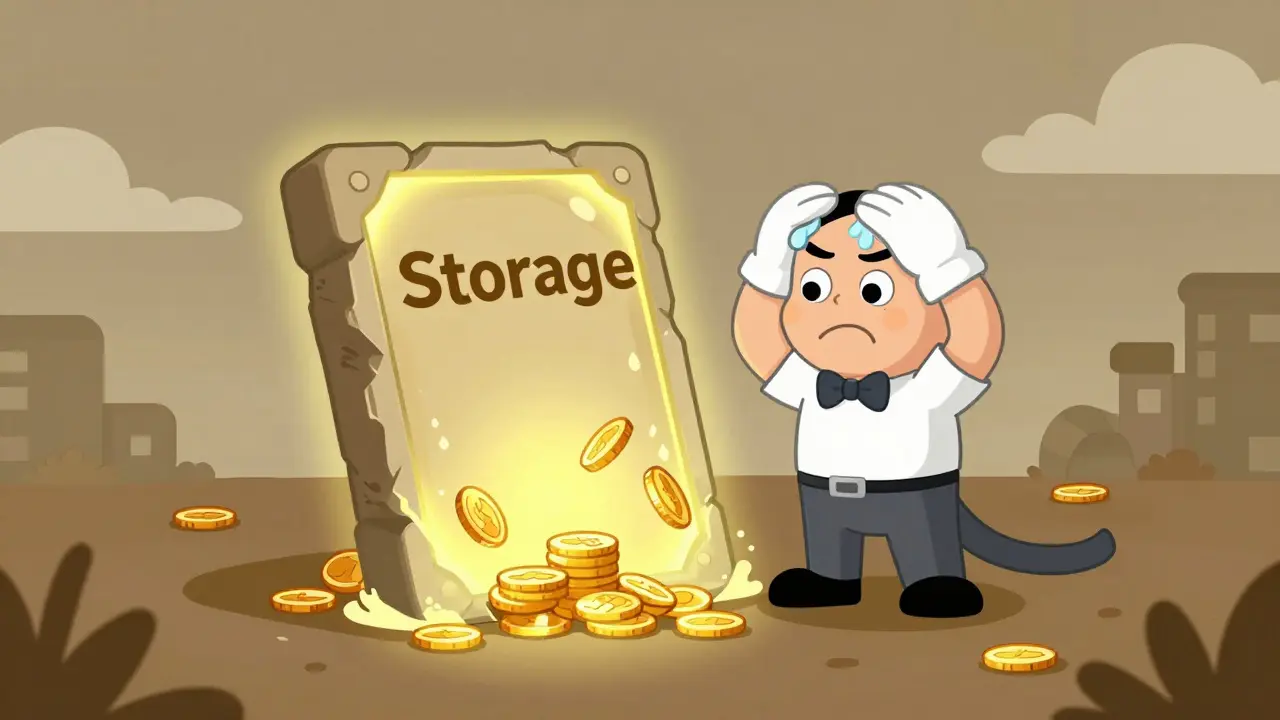

Every time you deploy a smart contract on Ethereum, you are paying for every single operation your code performs. If your code is inefficient, you aren't just wasting developer time; you are burning money for every user who interacts with your protocol. The difference between a profitable decentralized exchange and a bleeding-edge experiment often comes down to how well you manage three specific areas of the Ethereum Virtual Machine (EVM): storage, the persistent on-chain state that retains values across transactions, memory, a transient workspace cleared after each function call, and calldata, a read-only area holding external function arguments. Understanding these data locations isn't optional for professional developers-it's the foundation of cost-effective smart contracts.
The High Cost of Storage: Why Less Is More
Storage is the most expensive resource in the EVM. When you declare a state variable in your Solidity contract, it lives in storage. This data persists forever unless explicitly deleted, and every byte occupies space in the Merkle Patricia Trie that every full node must store and verify. Writing to storage costs significantly more gas than reading from it, and initializing a new slot costs even more than updating an existing one.
The golden rule here is simple: minimize storage writes. If you can calculate a value in memory or derive it from other on-chain data, do not store it. For example, instead of storing a user's total balance as a separate variable that updates every time they deposit or withdraw, consider calculating it dynamically if the underlying token balances are already on-chain. Every unnecessary `SSTORE` opcode (the instruction for writing to storage) adds up quickly, especially in high-frequency applications like NFT mints or automated market makers.
To further reduce costs, you must master storage packing, the technique of fitting multiple smaller variables into a single 32-byte storage slot. The EVM organizes storage in 32-byte slots. If you define two `uint8` variables separately, they will occupy two different slots, costing you double the gas for reads and writes. By grouping them together in a struct, the compiler packs them into one slot. This doesn't save much gas per transaction, but over millions of interactions, the savings are substantial. Always arrange your struct fields so that small types sit next to each other, avoiding large types like `address` or `uint256` that break the packing sequence.
Memory: The Temporary Workspace
Memory is cheaper than storage but still carries a cost. It exists only for the duration of a function execution. Once the function returns, memory is wiped clean. This makes it ideal for temporary calculations, loops, and intermediate data structures. However, many developers make the mistake of treating memory as free. Allocating large dynamic arrays in memory requires copying data, which consumes gas proportional to the size of the array.
A critical optimization pattern involves caching storage reads into memory. Suppose you have a loop that iterates through an array of users, and inside that loop, you need to check a global configuration setting stored in storage. If you read that setting directly from storage inside the loop, you pay the high `SLOAD` cost for every iteration. Instead, read the value once before the loop starts and assign it to a local memory variable. Subsequent accesses within the loop will use the cheap `MLOAD` opcode. This simple change can cut gas usage by hundreds of units in tight loops.
Be cautious with dynamic arrays in memory. If you pass a large array from storage to memory, the entire array is copied. If you only need to process a few elements, avoid copying the whole structure. Consider using indices or pointers where possible, though Solidity’s type system often forces explicit copies. In such cases, evaluating whether the operation truly needs to happen on-chain might be the best optimization of all.
Calldata: The Overlooked Efficiency Hack
If there is one change you can make today that will yield immediate, significant gas savings, it is replacing `memory` with calldata, a non-modifiable, non-persistent data location for external function parameters in external functions. When a user calls an external function, their input data arrives in calldata. If you declare your function parameters as `memory`, the Solidity compiler automatically copies that data from calldata into memory. For small integers, this copy is negligible. For large dynamic arrays or strings, this copy is expensive.
By declaring the parameter as `calldata`, you tell the compiler to read directly from the input without copying. This saves gas because no allocation occurs. The catch? You cannot modify the data. If your function needs to sort, append, or alter the array, you must use `memory`. But if you are merely iterating through the data to perform checks or calculations, `calldata` is always the superior choice. This is particularly relevant for batch operations, such as processing multiple token transfers or updating several user profiles in a single transaction.
Consider a function that accepts an array of addresses to whitelist. If the function only checks if an address is valid and then emits an event, there is no need to mutate the array. Declaring the parameter as `calldata` avoids the overhead of allocating memory for the array structure and copying each element. This pattern is widely adopted in modern DeFi protocols to keep transaction fees low for users executing complex multi-step actions.

Constants and Immutables: Bypassing Storage Entirely
Not all data needs to live in storage, memory, or calldata. For values that never change after deployment, use `immutable` variables. For values known at compile time, use `constant`. These keywords instruct the compiler to embed the values directly into the bytecode rather than storing them in state variables. Reading an immutable or constant value costs virtually zero gas compared to a storage read, because the value is already present in the contract’s code.
Use `constant` for mathematical constants, fixed fee rates, or hardcoded addresses that will never change. Use `immutable` for values determined during contract construction, such as the owner’s address or the initial supply of a token. By moving these values out of storage, you reduce the contract’s initial deployment cost and eliminate ongoing read costs. This is a low-effort, high-reward optimization that every developer should implement during the design phase.
| Data Location | Persistence | Mutability | Primary Use Case | Relative Gas Cost |
|---|---|---|---|---|
| Storage | Persistent (on-chain) | Mutable | State variables, long-term data | Very High |
| Memory | Transient (per function) | Mutable | Temporary calculations, local variables | Medium |
| Calldata | Transient (per call) | Read-only | External function inputs | Low |
| Constant/Immutable | Embedded in bytecode | Read-only | Fixed configuration values | Negligible |
Data Structures: Mappings vs. Arrays
Your choice of data structure deeply impacts gas usage. Mappings (`mapping`) are generally more efficient than arrays for lookups and updates because they provide O(1) access time without resizing overhead. When you add an element to a dynamic array, the entire array may need to be copied to a new memory location if it exceeds its current capacity. Mappings, however, allow sparse storage. You can update a single key without touching unrelated entries.
However, mappings have limitations. They cannot be iterated over efficiently, and you cannot delete individual keys without knowing their hash. If your application requires ordered iteration or frequent deletion of arbitrary elements, arrays might be necessary despite the higher cost. In such cases, consider using fixed-size arrays if the maximum number of elements is known at compile time. Fixed-size arrays avoid the dynamic resizing penalty and offer more predictable gas costs.

Practical Implementation Checklist
To apply these concepts effectively, follow this checklist when reviewing your Solidity code:
- Audit State Variables: Identify every state variable. Ask yourself if it truly needs to persist on-chain. Can it be derived or moved off-chain?
- Pack Storage Slots: Group small integer types and booleans into structs to ensure they fit within 32-byte slots. Avoid placing large types between small ones.
- Cache Storage Reads: Before any loop or repeated access, copy frequently used storage variables into memory locals.
- Use Calldata for Inputs: Change all external function parameters that are not modified from `memory` to `calldata`, especially for arrays and structs.
- Leverage Immutables: Convert constructor-set values that never change to `immutable` variables.
- Delete Unused Data: Explicitly set storage variables to zero or use `delete` when data is no longer needed to reclaim gas refunds and reduce state bloat.
Balancing Optimization and Readability
While gas optimization is crucial, it should never compromise security or maintainability. Over-aggressive "gas golfing"-such as using bitwise operations to replace intuitive arithmetic or packing unrelated fields into single slots-can introduce bugs and make audits difficult. Focus on high-impact optimizations first: minimizing storage writes, using calldata, and caching reads. These changes provide significant savings with minimal risk. Reserve micro-optimizations for hot paths that are executed thousands of times per block, and always document non-obvious patterns to help future developers understand your intent.
What is the difference between memory and calldata in Solidity?
Memory is a mutable, transient workspace that exists only during a function call and requires gas to allocate and copy data into. Calldata is a read-only, transient area that holds external function arguments. Calldata is cheaper because it avoids the copy operation required when data moves from external input into memory. You should use calldata for external function parameters that you do not intend to modify.
How does storage packing save gas?
The EVM stores data in 32-byte slots. If you declare multiple small variables (like uint8 or bool) separately, each may occupy its own slot, wasting space. Storage packing allows you to group these small variables into a single struct so they share one 32-byte slot. This reduces the number of SLOAD and SSTORE operations, lowering gas costs for both reads and writes.
When should I use immutable variables instead of storage?
Use immutable variables for values that are set during contract construction and never change afterward, such as the owner's address or initial token supply. Unlike storage variables, immutables are embedded directly into the bytecode. Reading an immutable value costs almost no gas, whereas reading a storage variable incurs a significant SLOAD cost.
Why is caching storage reads into memory important?
Reading from storage (SLOAD) is expensive. If your function accesses the same storage variable multiple times, such as inside a loop, you pay the high storage read cost repeatedly. By copying the value into a memory variable once before the loop, subsequent accesses use the much cheaper memory read (MLOAD) opcode, resulting in significant gas savings.
Can I use calldata for internal functions?
No, calldata is only available for parameters of external functions. Internal functions operate entirely within the contract's context and typically use memory or storage for their parameters. If you need to pass data from an external function to an internal function, you may need to copy the calldata into memory first if the internal function expects a mutable reference.









Nathaniel Petrovick
1 Jun 2026 at 07:13hey man this is super helpful thanks for breaking it down so clearly