

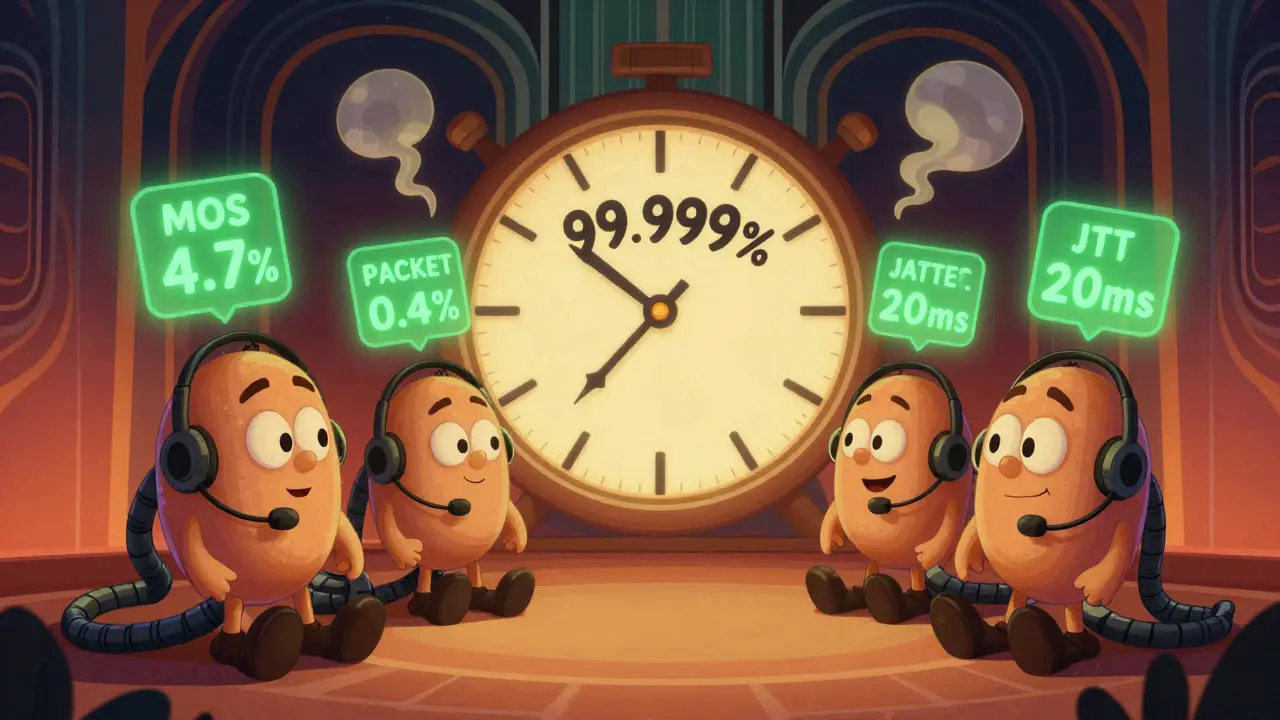

When your customers call you, do they hear a clear voice-or do they get dropped mid-sentence? In today’s world, VoIP KPI benchmarks aren’t just technical details; they’re the difference between keeping a client and losing them to a competitor. Every industry has different expectations for voice quality, speed, and reliability. What’s acceptable for a retail call center might be unacceptable for a hospital or a stock trading desk. Understanding these differences isn’t optional-it’s essential.
What Exactly Are VoIP KPIs?
VoIP KPIs are measurable metrics that tell you how well your voice calls are performing over the internet. Unlike old landline systems where quality was mostly about signal strength, VoIP depends on network conditions like delay, jitter, and packet loss. These aren’t abstract numbers-they directly affect how people experience your service.
Here are the core metrics every business should track:
- Mean Opinion Score (MOS): A 1-to-5 scale for voice quality. Anything below 3.6 is considered poor for business use.
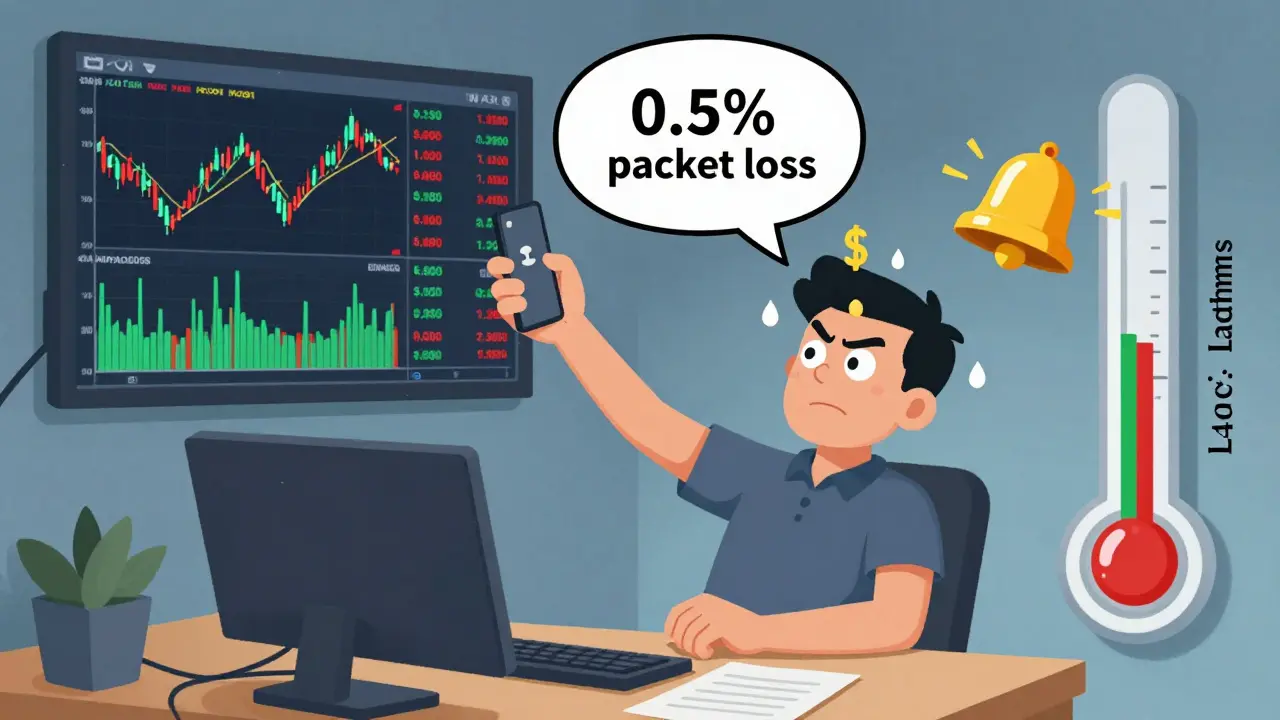
- Packet loss: Lost data packets. Above 1% causes noticeable audio dropouts. Financial firms demand under 0.5%.
- Jitter: Variability in packet arrival time. Over 30ms makes voices sound choppy.
- Latency: Delay between speaking and hearing. Under 150ms is excellent. Over 400ms breaks conversation flow.
- Call drop rate: How often calls end unexpectedly. Above 0.5% is a red flag.
- Connection success rate: Percentage of calls that complete successfully. Below 90% means trouble.
These aren’t theoretical. Real companies are spending millions to hit these targets.
How Industries Compare: The Numbers That Matter
Not all industries operate the same way. A bank can’t afford a 200ms delay during a trade. A hospital can’t let a telehealth call drop mid-diagnosis. Here’s how top industries stack up:
| Industry | MOS (Min) | Packet Loss (Max) | Jitter (Max) | Latency (Max) | Call Drop Rate (Max) | First Call Resolution |
|---|---|---|---|---|---|---|
| Telecommunications | 4.7 | 0.4% | 20ms | 120ms | 0.3% | 78% |
| Financial Services | 4.6 | 0.5% | 25ms | 140ms | 0.4% | 83% |
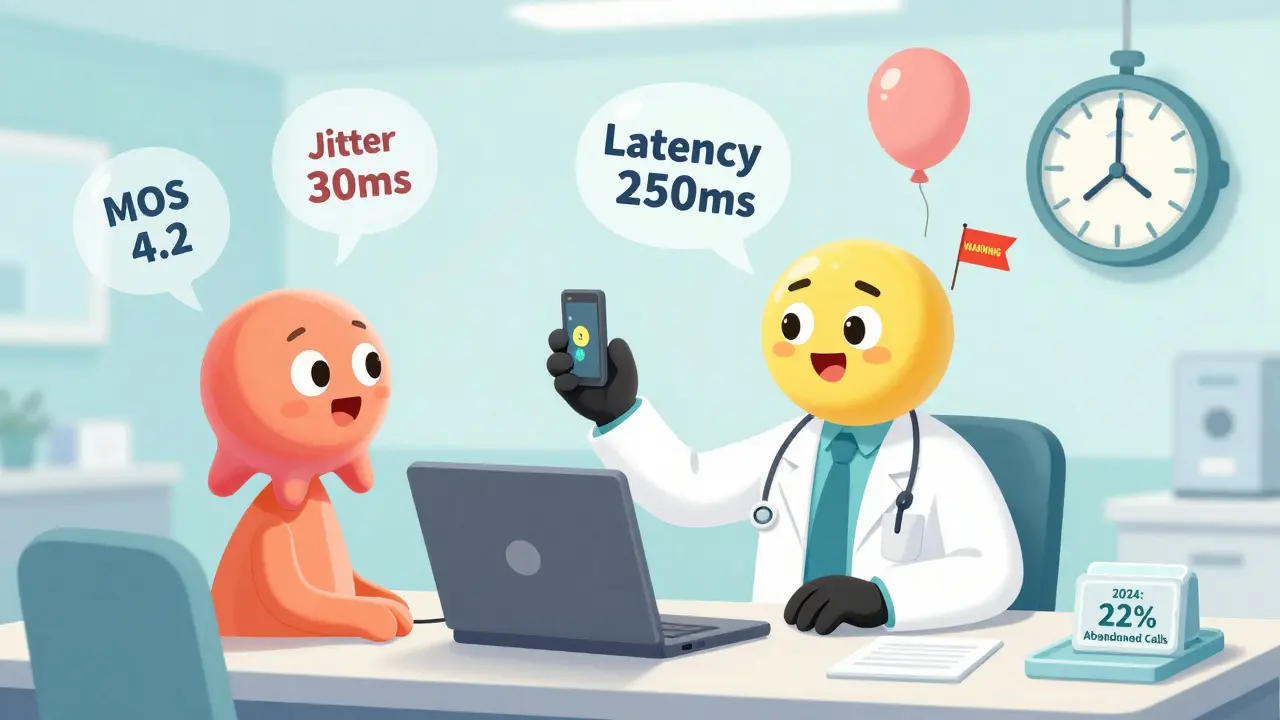
| Healthcare | 4.2 | 0.8% | 30ms | 250ms | 0.7% | 69% |
| Retail | 4.3 | 1.0% | 30ms | 200ms | 0.6% | 74% |
| Business/IT Services | 4.5 | 0.6% | 28ms | 160ms | 0.5% | 81% |
Notice the pattern? Financial services and telecom lead in performance. Why? Because their revenue depends on flawless communication. A single dropped call during a trade can cost thousands. Retailers tolerate slightly higher delays because customers are more forgiving-but not when it affects customer satisfaction scores.
Healthcare is an outlier. They accept higher latency (up to 250ms) because many calls aren’t real-time critical. But that’s changing. Telehealth is growing fast, and hospitals that ignored this in 2023 saw a 22% spike in abandoned calls during virtual consultations in early 2024.
What’s Behind the Numbers?
Why do some industries hit these targets while others struggle? It comes down to investment and consequences.
Telecom companies have been doing this for decades. They’re required by regulators like the FCC and BEREC to meet strict uptime standards-99.999% availability. That means less than 5 minutes of downtime per year. They’ve spent billions on redundant networks, dedicated VoIP infrastructure, and real-time monitoring tools. Their KPIs aren’t optional; they’re legally mandated.
Financial services follow closely. JPMorgan Chase reduced jitter from 40ms to 25ms in 2023. It cost $2.3 million in upgrades. But customer satisfaction scores jumped 18 points. That’s not just better calls-it’s better trust, better retention, better brand reputation.
Retailers, on the other hand, often use off-the-shelf VoIP systems. They prioritize cost over perfection. But here’s the catch: customers notice. One Best Buy network manager said implementing MOS monitoring cut customer complaints by 32% in just one quarter. Suddenly, “good enough” isn’t good anymore.
Hidden Problems Nobody Talks About
Most companies focus on the big numbers. But the real pain points are subtler.
One-way audio. Silent calls. These are the nightmare scenarios. Dr. Elena Rodriguez from Cisco says they’re among the most common issues she’s seen. It’s not a full call drop-it’s a call that seems connected but has no sound. Customers think they’re talking. You think they’re on hold. It’s frustrating, confusing, and damaging.
Another hidden issue? Inconsistent measurements. A Verizon enterprise customer reported a 27ms discrepancy between Cisco and Avaya systems in 2023. How can you fix what you can’t measure accurately? Many companies use multiple vendors with different tools-and get conflicting reports. That’s why standardized algorithms like the new ITU-T G.1011.1 (released April 2024) are so important. They finally give everyone the same way to calculate MOS.
And then there’s the human factor. A Reddit thread from May 2024 showed 68% of network engineers struggled to meet financial services’ 0.5% packet loss threshold during peak hours. It’s not a lack of will-it’s a lack of infrastructure. Legacy networks weren’t built for this.
How to Start Benchmarking Your VoIP
If you’re not measuring your VoIP performance yet, here’s how to begin:
- Identify your industry’s standard. Don’t copy telecom if you’re in retail. Match your goals to your business needs.
- Choose one metric to start with. MOS or packet loss are the easiest to track. Use tools that measure media quality, not just signaling.
- Run a 30-day baseline. Don’t set targets until you know your current performance.
- Integrate with your CRM. Link call quality data to customer feedback. If a call has high jitter and the customer leaves a bad review-there’s your proof.
- Train your team. Network engineers need CCNA Voice or equivalent. If your team doesn’t understand SIP, jitter, or QoS, they can’t fix it.
Implementation time varies. Retailers can get basic monitoring up in 3-4 months. Telecom providers take 6-9 months. The key isn’t speed-it’s accuracy.
The Future of VoIP KPIs
VoIP isn’t staying the same. The next big shift is AI-driven prediction. By 2026, Gartner predicts 45% of large companies will use AI to forecast call quality issues before they happen. That’s not science fiction-it’s already happening in pilot programs at Fortune 500 firms.
Another change? The rise of hybrid work. Cisco’s 2024 report says 68% of voice traffic now starts from home offices. That means your KPIs must account for consumer-grade internet, Wi-Fi interference, and mobile handoffs. The upcoming ETSI TS 103 559 standard (due in 2025) is the first to address this.
And don’t forget the bigger picture. Voice, video, and chat are merging into unified platforms. Your KPIs can’t just look at voice anymore. You need to track how video quality affects customer satisfaction. How chat response time ties into call volume. The old siloed approach is over.
Final Takeaway
VoIP KPI benchmarks aren’t about looking good on paper. They’re about keeping customers happy, reducing churn, and protecting revenue. If your call center has a 74% first-call resolution rate but your competitors hit 81%, you’re losing sales. If your latency is 200ms but your industry standard is 150ms, you’re making calls feel slow and unreliable.
Don’t wait for a customer to complain. Don’t wait for a regulatory audit. Start measuring. Start comparing. Start improving.
The numbers don’t lie. And in business, the ones who measure first, win first.
What’s the minimum acceptable MOS score for business VoIP?
The minimum acceptable Mean Opinion Score (MOS) for business VoIP is 3.6, according to ETSI guidelines. Anything below this is considered poor quality and can lead to customer dissatisfaction. Most high-performing industries aim for 4.2 or higher.
Why do financial services have stricter packet loss limits than retail?
Financial services handle time-sensitive transactions where even a brief audio dropout can cause miscommunication, lost trades, or compliance violations. A 0.5% packet loss threshold ensures near-perfect clarity during critical calls. Retail, while still important, allows slightly higher loss because customer interactions are less time-critical and more forgiving.
Can I use consumer-grade internet for VoIP in my business?
It’s risky. Consumer internet lacks Quality of Service (QoS) controls, leading to unpredictable jitter and packet loss. While small businesses might get by temporarily, any growth or reliance on voice communication will expose weaknesses. Enterprise-grade connections with dedicated bandwidth and QoS prioritization are strongly recommended.
How often should I review my VoIP KPIs?
Review KPIs monthly for operational changes and quarterly for strategic adjustments. If you’re upgrading systems, expanding to new locations, or adding remote workers, review immediately. Trends in MOS, jitter, or call drop rates often appear before customers complain.
What tools should I use to monitor VoIP KPIs?
Use tools that measure media quality, not just signaling. Cisco, Avaya, and Genesys offer enterprise platforms. Open-source tools like Wireshark are powerful but require expertise. Emerging AI tools from Retell AI and Sprinklr provide predictive insights. Match the tool to your industry’s standards and your team’s skill level.
Is 99.999% uptime really necessary for my business?
It depends. Telecom and financial services need this level-it’s often legally required. For most other businesses, 99.9% uptime (about 43 minutes of downtime per year) is sufficient. Going beyond 99.9% requires expensive redundancy and may not deliver proportional ROI unless your business depends on real-time voice.









Rocky Wyatt
7 Feb 2026 at 22:05Let me tell you something straight - if your VoIP is hitting below 4.0 MOS and you’re in anything but retail, you’re already losing money. I’ve seen it too many times. Companies think ‘it’s just a little choppy’ until a client hangs up mid-contract negotiation because the voice cracked like a broken walkie-talkie. No one’s gonna blame the network - they blame YOU. And trust me, in finance, one dropped call during a trade? That’s not a glitch. That’s a lawsuit waiting to happen. You want to keep clients? Stop treating VoIP like a free add-on and start treating it like your damn oxygen.