

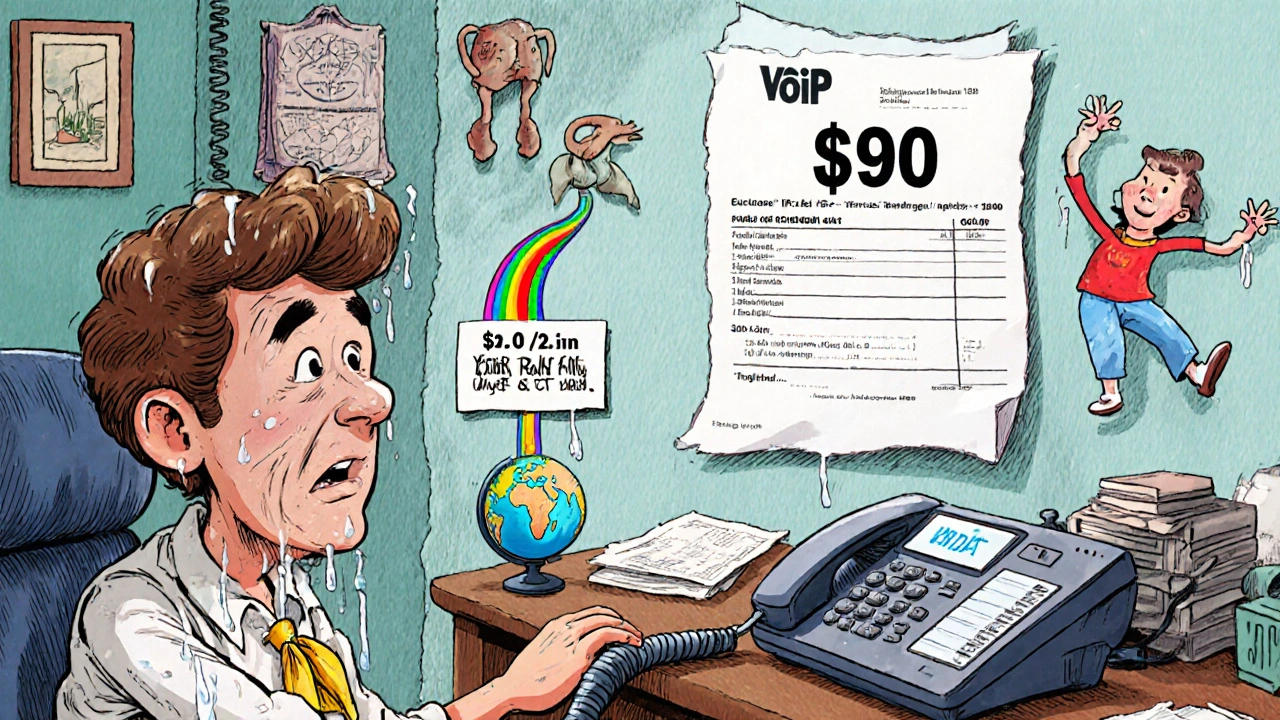

Think about the last time you called someone overseas. How much did it cost? If you’re still using a landline, you might’ve paid $1.50 a minute-or more-to talk to family in Mexico, a client in India, or a supplier in Germany. That’s $90 for an hour-long chat. Now imagine doing the same call for under $1. Now imagine it’s crystal clear, you can video chat while you talk, and your phone number works no matter where you are. That’s not science fiction. That’s VoIP-and it’s already replacing landlines for international calls.
VoIP Isn’t Just Cheaper, It’s Built for the Modern World
Landlines were designed for one thing: making local calls over copper wires. International calls? They were an expensive afterthought. Every mile of cable, every undersea fiber-optic link, every international carrier agreement added cost. Those costs got passed directly to you-per minute, per country, per time of day. It’s a system built on physical infrastructure, and it’s outdated. VoIP flips that. Instead of wires, it uses your internet. Voice gets turned into digital packets, sent over the same network that streams Netflix and loads websites. No extra infrastructure. No middlemen charging tolls. Just data moving efficiently across global networks. That’s why a 60-minute call from the U.S. to India costs about $3 on VoIP. On a landline? $45 to $90. That’s a 93% drop in cost. For businesses making dozens of international calls a day, that’s not savings-it’s a financial revolution.What You Get Beyond the Price Tag
Cost is the headline, but VoIP’s real power is in what it can do that landlines simply can’t.- Virtual numbers in 150+ countries: Need a local number in London, Tokyo, or São Paulo? VoIP gives you one. Customers call you as if you’re down the street-even if you’re working from your kitchen in Chicago.
- Call forwarding across devices: Answer a call from your office phone, then pick it up on your phone while walking to lunch. No switching numbers. No missed calls.
- Voicemail to email: Get your voicemails as audio files or even transcribed text. No more listening to garbled messages while stuck in traffic.
- Integrated video and messaging: Start with a voice call, then hit “video” mid-conversation. Add a screen share. Send a file. All in one tool. Landlines? You’d need three separate systems-and pay extra for each.
These aren’t gimmicks. They’re tools that keep global teams connected without juggling apps, numbers, or expensive add-ons. Businesses using VoIP report 70% faster decision-making because communication flows without friction.
Reliability: The Big Misconception
People still say, “But landlines work during power outages.” That’s true. But it’s not the full story. Most home landlines get power from the phone line itself, so they work even if your electricity goes out. But enterprise VoIP? That’s a different beast. Companies like Vonage, RingCentral, and Nextiva run their systems across multiple data centers in different countries. If one server goes down, traffic reroutes automatically. Their uptime is 99.999%-that’s less than 5 minutes of downtime per year. Yes, your home VoIP system needs power and internet. If your router dies or your internet goes out, you’re offline. But here’s the fix: use a backup mobile hotspot or a battery-powered router. Most businesses now pair VoIP with a cheap mobile plan for emergencies. It’s not perfect, but it’s cheaper and more flexible than maintaining a landline just for emergencies.
Quality: Clearer Than Ever
Early VoIP calls were choppy. That’s history. Modern codecs like Opus and G.729 compress voice without losing quality. With a stable 1.5Mbps connection, VoIP delivers HD voice that scores 4.3 to 4.5 on the Mean Opinion Score (MOS)-higher than landlines, which average 3.8 to 4.0. That means your voice sounds more natural. Less robotic. Less like you’re talking through a tin can. And with AI-powered routing tools like Vonage’s Global Smart Routing, calls now pick the fastest, most stable path across the internet-cutting drop rates by 42% in tests.Who’s Still Using Landlines for International Calls?
Not many. Among Fortune 500 companies, 92% have moved at least part of their international calling to VoIP. The rest? They’re clinging to legacy systems because they haven’t updated their infrastructure in 20 years. Landline providers like AT&T, Verizon, and BT Global have seen international calling revenue drop by 34% since 2018. Why? Because customers are leaving. They’re switching to VoIP because it’s cheaper, smarter, and more scalable. Even individual users are catching on. On Reddit, users share stories like: “I pay $0.02 per minute to call my parents in the Philippines. My old landline charged $1.20. I saved $400 last year.” That’s not rare. It’s normal.The One Real Weakness (and How to Fix It)
The biggest concern with VoIP? Emergency calls. If you dial 911 or 112 from a VoIP phone, the system may not know your location. That’s a real issue-especially for travelers or remote workers. But it’s fixable. Most VoIP providers now offer E911 services for a small monthly fee. You register your physical address. When you call emergency services, your location is sent automatically. It’s not 100% perfect (some international VoIP calls still fail E911), but it’s far better than it was five years ago. For extra safety, keep a basic mobile phone with a local SIM card just for emergencies. It costs $10 a month. It’s cheap insurance.
Switching Is Easier Than You Think
You don’t need an IT department to switch. Most VoIP providers offer plug-and-play IP phones or free apps for your smartphone and computer. Setup takes 2-4 weeks for businesses. For individuals? It’s 20 minutes. You’ll need:- A stable internet connection (1.5Mbps upload/download minimum)
- A router that supports QoS (Quality of Service) to prioritize voice traffic
- A VoIP provider (Nextiva, Vonage, Mytello, RingCentral, or even Google Voice for personal use)
Many providers offer free network checks. They’ll test your connection and tell you if you’re ready. No guesswork. No risk.
What’s Next? The End of Landline International Calling
The writing’s on the wall. Gartner predicts that by 2027, 95% of all international calls will use IP networks. Landlines? They’ll become relics-like fax machines or rotary phones. 5G networks are coming. They’ll let your phone switch seamlessly from Wi-Fi to cellular without dropping a call. That means even your mobile device will become a full VoIP endpoint. No more choosing between “phone” and “internet.” They’re the same thing now. The only reason anyone still uses landlines for international calls is habit. Or ignorance. The technology has moved on. The cost structure has collapsed. The features have exploded. If you’re still paying $1 a minute to call abroad, you’re not saving money. You’re paying a premium for a system that stopped being relevant 15 years ago.Frequently Asked Questions
Is VoIP really cheaper than landlines for international calls?
Yes, dramatically. A 60-minute call from the U.S. to India costs about $3 on VoIP. On a landline, it’s $45 to $90. That’s 93% to 97% savings. Most VoIP providers charge $0.01 to $0.05 per minute to over 100 countries. Landlines charge $0.50 to $3.00 per minute, often with hidden fees.
Do I need special hardware for VoIP?
Not necessarily. You can use your smartphone or computer with a free app like Vonage or RingCentral. But if you want a dedicated phone, IP phones cost $50-$200 each. You don’t need to replace your entire office-just one or two phones for key users. Your existing internet router handles the rest.
Can I keep my current phone number with VoIP?
Yes. Most VoIP providers let you port your existing number over. It usually takes 3-10 business days. You can also get new numbers in other countries-like a London number if you’re based in Toronto. That makes you look local to international clients.
What if my internet goes down?
If your internet fails, your VoIP calls stop. But you can set up call forwarding to your mobile phone. Many providers offer this for free. For critical business use, keep a backup mobile plan with a local SIM card. It’s cheap insurance compared to maintaining a landline.
Is VoIP secure for business calls?
Yes, if you use a reputable provider. Enterprise VoIP services use end-to-end encryption (SIP over TLS, SRTP) to protect calls. Landlines are actually less secure-they can be tapped physically. VoIP providers also offer two-factor authentication, call logs, and admin controls to monitor usage and prevent fraud.
Which VoIP provider is best for international calling?
For businesses: Nextiva, RingCentral, and Vonage offer the best global coverage, reliability, and support. For personal use: Mytello and Google Voice are affordable and easy. Avoid ultra-cheap providers with poor customer service-they cut corners on network quality. Look for providers with direct international routing, not third-party resellers.









Ronnie Kaye
30 Oct 2025 at 07:35Remember when we paid $3 a minute to call India and thought we were getting a deal? LOL. Now I pay less than a dollar for a 2-hour chat with my cousin in Bangalore while watching Netflix on my tablet. Landlines are like dial-up internet-cute nostalgia, but nobody’s actually using it anymore. I switched to Vonage last year and haven’t looked back. My mom thinks I’m a tech wizard now. She’s wrong. I just stopped being dumb.
Also-E911 works fine if you register your address. Stop crying about it.