


When you think of a company, you picture a CEO, a board, and a finance team managing cash in a bank account. But what if that company had no CEO? What if every dollar spent, every hire made, every grant awarded was decided by a vote from hundreds of people around the world - and every transaction was locked forever on a public blockchain? That’s the reality of DAOs - Decentralized Autonomous Organizations - and their most critical challenge isn’t writing code. It’s managing money.
By early 2025, over 10,000 DAOs were managing more than $25 billion in digital assets. That’s not a typo. These aren’t just experiments. They’re real organizations funding open-source software, buying land, paying developers, and even investing in U.S. Treasury bonds. But how do they do it without banks? And why do so many fail when the market turns sour? The answer lies in two things: how they guard their treasury and how they vote on what to do with it.
How DAOs Store Their Money - And Why It’s So Risky
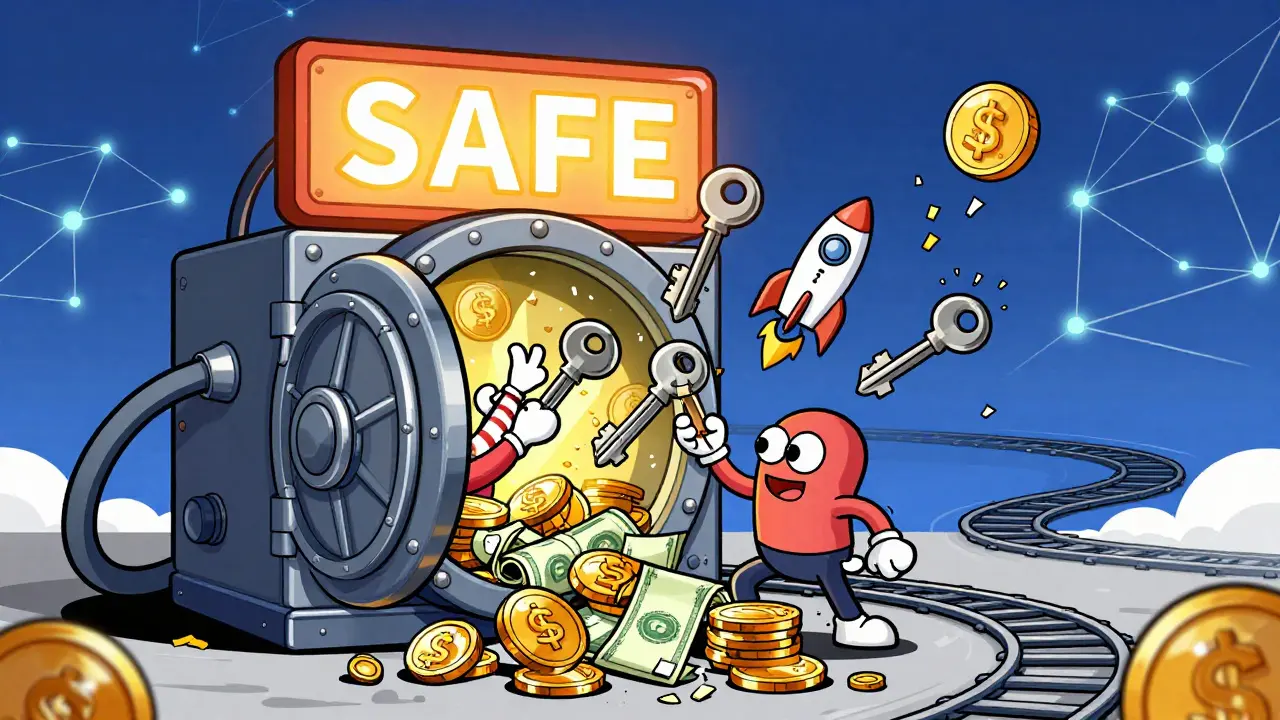
Most DAOs don’t keep cash in a checking account. They use multisig wallets - digital vaults that need multiple keys to open. The most common one is Safe (formerly Gnosis Safe), used across Ethereum and over 15 other blockchains. Think of it like a bank vault that needs three out of five people to show up with their keys before you can withdraw anything. This prevents one person from stealing everything. But it also creates delays. A $50,000 payment might take 24 to 72 hours just to get approved.
Here’s where things get dangerous. A 2023 study by Rise Works found that 85% of DAOs held over 70% of their treasury in their own native token - the token that gives members voting power. If that token crashes 50%, the DAO’s entire budget crashes with it. You can’t pay developers if your treasury is worth half what it was last month. And since most DAOs pay contributors in that same token, everyone’s salary drops too. It’s a death spiral.
Take CityDAO, for example. They bought 40 acres of land in Wyoming using cryptocurrency. Sounds bold. But if their native token had crashed right after the purchase, they wouldn’t have had enough left to pay for property taxes, legal fees, or even maintenance. That’s not a bug - it’s a design flaw many still ignore.
The Smart Way to Manage a DAO Treasury
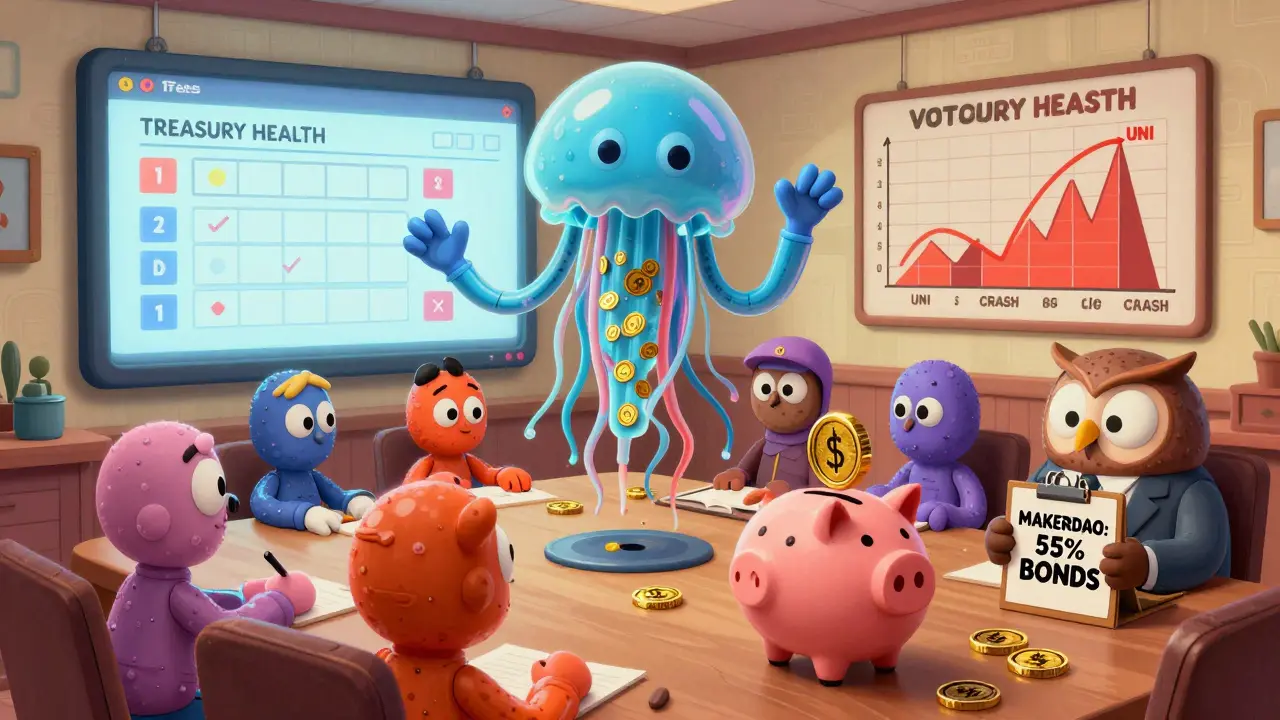
The best-run DAOs don’t gamble everything on one token. They diversify. Look at MakerDAO. By December 2024, over 55% of its $6.4 billion treasury was in U.S. Treasury bonds and corporate debt. That’s not crypto. That’s traditional, low-risk government securities. In 2024 alone, that move generated $127 million in stable yield - money that didn’t vanish when Bitcoin dipped.
Compare that to Uniswap. Its treasury holds $4.8 billion, with 62% in UNI tokens. It uses that to fund liquidity mining - basically paying people to use its exchange. It works because Uniswap’s revenue comes from fees, not token value. But if the price of UNI dropped 60%, Uniswap would still have to pay out in UNI. That’s risky. And it’s why 68% of DAOs with heavy token exposure saw delays in payments during the 2024 crypto bear market.
Then there’s BitDAO (now Mantle). Instead of holding tokens, it invested $1.2 billion into 85 other DeFi projects. It’s like a venture fund run by a community. It made a 22% annual return - but only because it didn’t rely on one token’s price to survive.
Experts agree: the safest model is a mix. The Blockchain Association’s 2025 framework recommends:
- 30% in stablecoins (USDC, DAI)
- 20% in BTC and ETH
- 50% in strategic assets - like tokenized bonds, other tokens, or real-world assets
DAOs following this model saw 65% less disruption during market crashes, according to LimeChain’s 2024 report. The lesson is simple: if your treasury is 90% crypto, you’re not a decentralized organization - you’re a crypto speculation fund with a voting system.
How Decisions Are Made - On-Chain vs. Off-Chain
Not every decision needs a blockchain vote. Some DAOs use off-chain polls on Discord or Snapshot, then lock the result on-chain. Others vote directly on the blockchain using token-weighted ballots. The difference matters.
On-chain voting means every vote is recorded forever. It’s transparent. But it’s slow. And expensive. Each transaction can cost $15-$50 in gas fees during peak times. A simple proposal to pay a contractor might cost $30 in fees. Multiply that by 20 proposals a month? That’s $600 just to vote.
That’s why many DAOs use hybrid models. They debate on Discord, then submit one final vote on-chain. It cuts costs and speeds things up. But it also creates trust issues. If a small group controls the off-chain discussion, they can manipulate the outcome before the vote even happens.
The most effective DAOs combine both. They use off-chain tools like Llama or Snapshot for discussion and polling, then lock the final decision on-chain. This balances speed, cost, and transparency.
Real Problems DAO Treasuries Face Every Day
It’s not just about how much crypto you hold. It’s about how you manage it.
One common issue: key security. In 2024, 32% of DAO treasury incidents came from compromised private keys. One person’s phone got hacked - and suddenly, $2 million was gone. That’s why hardware wallets and key rotation are now standard. Another problem? Fragmented visibility. A DAO might have funds on Ethereum, Polygon, and Arbitrum. Managing three separate wallets feels like running three companies. No single dashboard shows all balances. One Aragon user summed it up: “Managing treasury across chains feels like running three separate companies without consolidated reporting.”
Then there’s gas fees. A DAO trying to pay 10 contractors in a week might face $500 in fees just to send the money. That’s why tools like Request Finance became essential. It lets DAOs batch payments, reducing costs by up to 70%. According to a DAO Leadership Collective survey, 76% of treasury managers said Request Finance was “critical” for survival.
And don’t forget documentation. Many DAOs have no written treasury policy. No rules on how much to hold, when to sell, or who can approve spending. That’s a recipe for chaos. Safe’s documentation scores 4.7/5. Many newer tools? Only 3.2/5. If your team can’t figure out how to use the tool, they’ll make mistakes - and those mistakes cost money.
Regulation Is Coming - And It’s Changing Everything
DAOs have operated in a legal gray zone for years. But that’s ending. In 2021, Wyoming became the first U.S. state to recognize DAOs as LLCs. Tennessee followed in 2023. The EU’s MiCA regulations, effective in June 2024, now include DAOs under financial oversight. And in March 2025, the U.S. SEC released its first formal framework for DAOs - with a clear warning: if your treasury is mostly governance tokens and you’re paying people without a legal structure, you’re at risk.
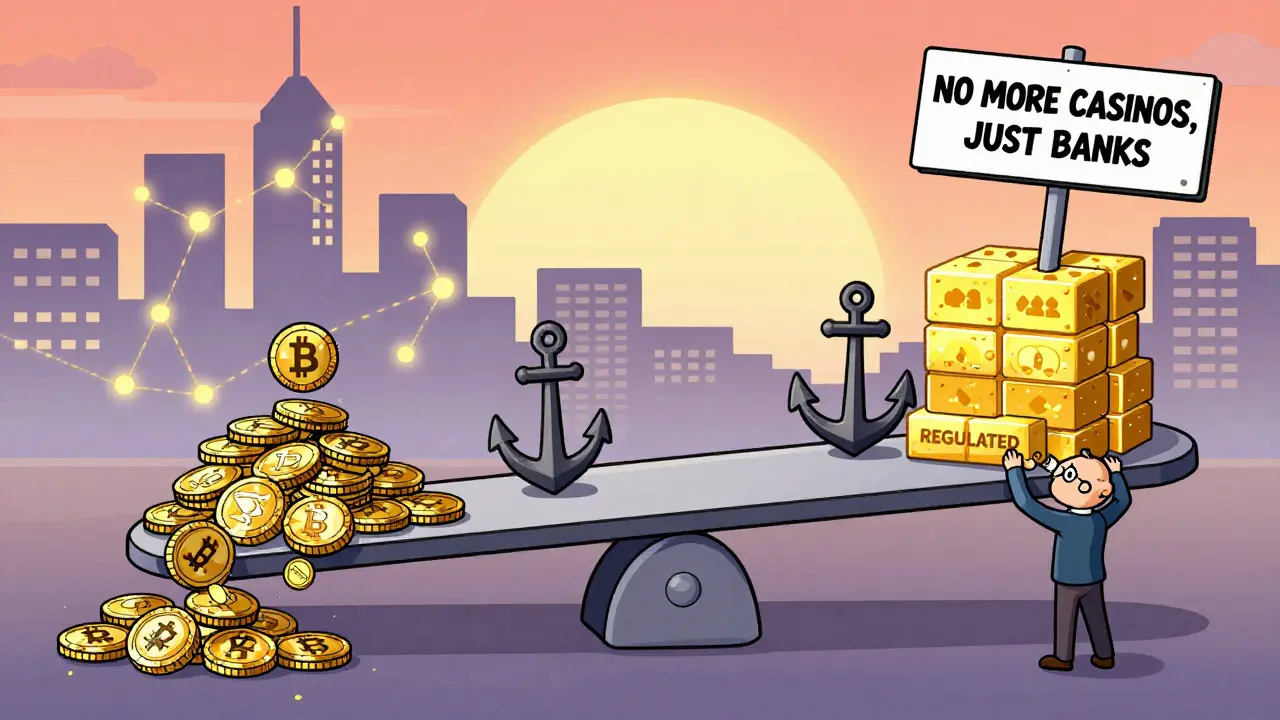
That’s why MakerDAO’s move into U.S. bonds isn’t just smart finance - it’s legal strategy. By holding real-world assets, they’re aligning with regulators who understand bonds, not tokens. Meanwhile, the Ethereum Foundation just mandated that all grant-receiving DAOs must hold at least 25% of their treasury in stablecoins. That’s not a suggestion. It’s a rule now.
Companies like Fidelity and Coinbase launched DAO-specific custody services in Q2 2025. Why? Because institutions want to invest in DAOs - but they can’t touch them unless there’s legal clarity and secure custody. The future of DAOs isn’t just code. It’s compliance.
What Works - And What Doesn’t
Look at Reddit threads from DAO contributors. One user, u/TreasuryGuardian, shared how their $2.1 million DAO survived the 2024 ETH crash by shifting 40% to USDC. They kept paying everyone. Another DAO? 92% of its treasury was in its own token. When the price dropped 68% in three weeks, it lost $4.7 million. Eighty-seven percent of members couldn’t get paid. That DAO shut down.
It’s not about how big your treasury is. It’s about how resilient it is. The DAOs that thrive have:
- Less than 50% of their treasury in native tokens
- A clear, written treasury policy
- Multi-chain visibility using tools like Llama
- Batched payments to cut gas fees
- Legal structure or clear intent to get one
And they avoid one fatal mistake: treating their treasury like a casino. If your DAO’s survival depends on your token going up, you’re not building a decentralized organization. You’re building a ponzi with a voting system.
The Future of DAO Treasuries
By 2027, analysts predict top DAOs will allocate:
- 40% to stable assets (stablecoins + real-world assets)
- 30% to strategic crypto (ETH, BTC, and select tokens)
- 30% to operational liquidity (cash for day-to-day spending)
That’s a 60% reduction in treasury volatility compared to 2024. It’s not magic. It’s discipline. It’s learning from failure. It’s recognizing that money - real money - needs to be protected, not speculated on.
The next wave of DAOs won’t be led by crypto maximalists. They’ll be led by people who understand finance - not just blockchain. Treasurers with real-world experience are 41% better at reducing risk, according to the DAO Leadership Collective. That’s the future: DAOs that don’t just move money on-chain - they manage it like a business.
What is the biggest risk to a DAO treasury?
The biggest risk is over-reliance on a single crypto asset - usually the DAO’s own governance token. If that token crashes 50%, the treasury loses half its value overnight. This can halt payments, freeze operations, and trigger community collapse. DAOs holding more than 70% of their treasury in native tokens have a 78% chance of operational disruption during major market corrections, according to Stanford’s 2024 analysis.
How do DAOs pay people without a bank account?
DAOs use multisig wallets like Safe to send crypto payments directly to contributors. Tools like Request Finance let them batch multiple payments into one transaction, cutting gas fees by up to 70%. Contributors receive payments in ETH, USDC, or the DAO’s native token. Some DAOs now integrate with traditional payroll systems via stablecoin bridges, allowing direct bank transfers.
Can a DAO hold U.S. Treasury bonds?
Yes. MakerDAO holds over $3.5 billion in U.S. Treasury bonds and corporate debt as of December 2024. This is done through regulated intermediaries like Maple Finance or Tokenized Asset Platforms. Holding real-world assets provides stable yield and reduces exposure to crypto volatility, making DAOs more resilient and legally defensible.
Why do DAOs use multisig wallets instead of single keys?
Single keys are a single point of failure. If one person’s device is hacked, the entire treasury is at risk. Multisig wallets require multiple signatures - typically 3-of-5 or 4-of-7 - to authorize transactions. This spreads trust across multiple people, making theft much harder. It also prevents any one person from making reckless decisions.
Is on-chain voting always better than off-chain?
No. On-chain voting is transparent but slow and expensive, costing $15-$50 per vote. Off-chain voting on platforms like Snapshot is faster and cheaper, but less verifiable. Most successful DAOs use a hybrid: off-chain discussion and polling, then one final on-chain vote to lock the decision. This balances efficiency with trust.
What happens if a DAO doesn’t have a legal structure?
Without a legal wrapper - like a DAO LLC in Wyoming or a foundation in Switzerland - the DAO has no legal identity. This exposes members to personal liability if the DAO is sued or fined. Regulators like the SEC have already taken action against 12 DAOs since 2022 for operating as unregistered securities offerings. Legal structure isn’t optional anymore - it’s survival.
How can a new DAO avoid treasury mistakes?
Start with a clear treasury policy: define acceptable assets, maximum exposure to any one token, spending limits, and approval thresholds. Use Safe for multisig, hold at least 30% in stablecoins, and integrate with Llama or Request Finance for visibility and payments. Avoid holding more than 50% in your own token. And get legal advice early - don’t wait until regulators come knocking.
DAOs are not just tech experiments. They’re new kinds of organizations - and like any organization, they need strong finance and governance. The ones that last won’t be the ones with the flashiest code. They’ll be the ones that treat their treasury like a bank, not a lottery ticket.




mark nine
10 Feb 2026 at 01:39Honestly the biggest issue isn't the tech it's the mindset. People treat DAO treasuries like crypto casinos instead of actual budgets. If your whole operation depends on your token price going up you're not building an organization you're running a pump. Saw a DAO shut down last year because they held 90% in their own token. One bad news cycle and poof 5 million gone. No one got paid. No one saw it coming. Just pure greed wrapped in decentralization.
Use stablecoins. Hold real assets. Diversify. It's not sexy but it keeps the lights on.