


Why Your Cloud VoIP Calls Sound Terrible (Even When You Did Everything Right)
You set up your cloud VoIP system perfectly. You bought quality phones, configured your router, enabled QoS, and marked every voice packet with DSCP 46. You even tested it on your local network - crystal clear. But as soon as calls leave your office, they start dropping, glitching, or turning into robotic noise. You’re not imagining it. The problem isn’t your setup. It’s the internet.
Most ISPs don’t care about your DSCP tags. They strip them. They ignore them. They rewrite them as default traffic. And that’s why your $50,000 VoIP investment sounds like a bad Zoom call from 2020.
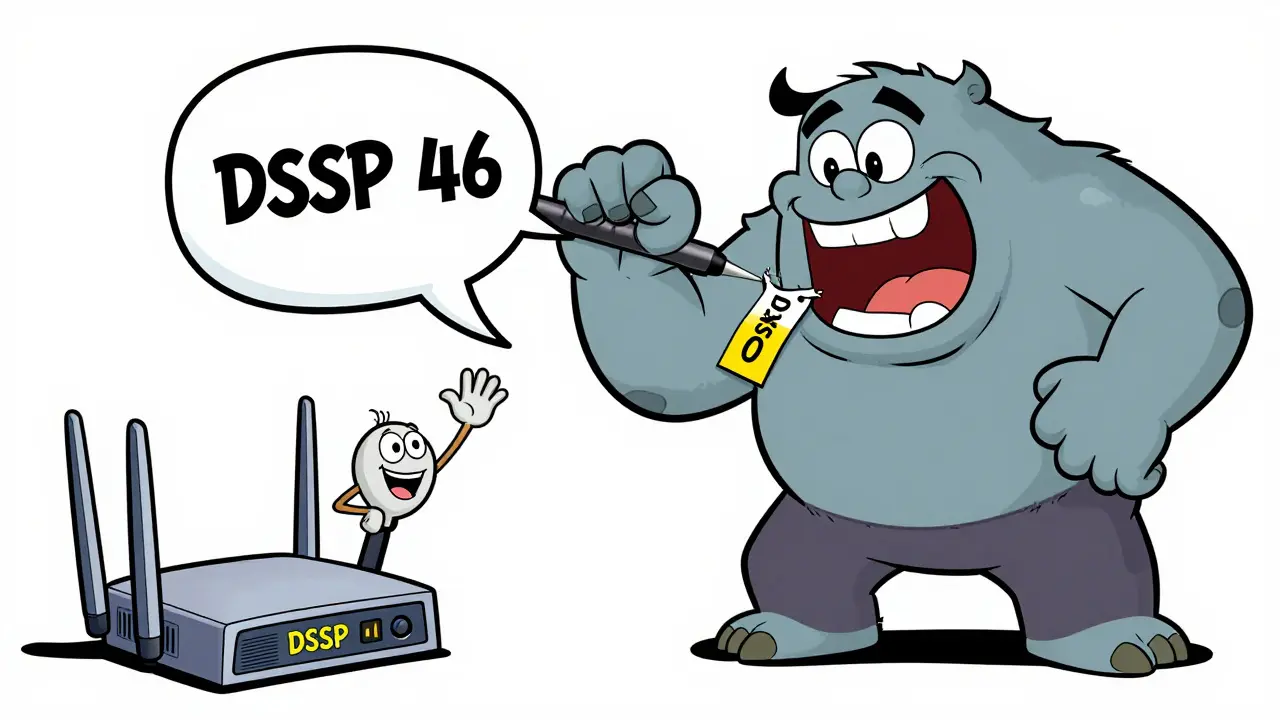
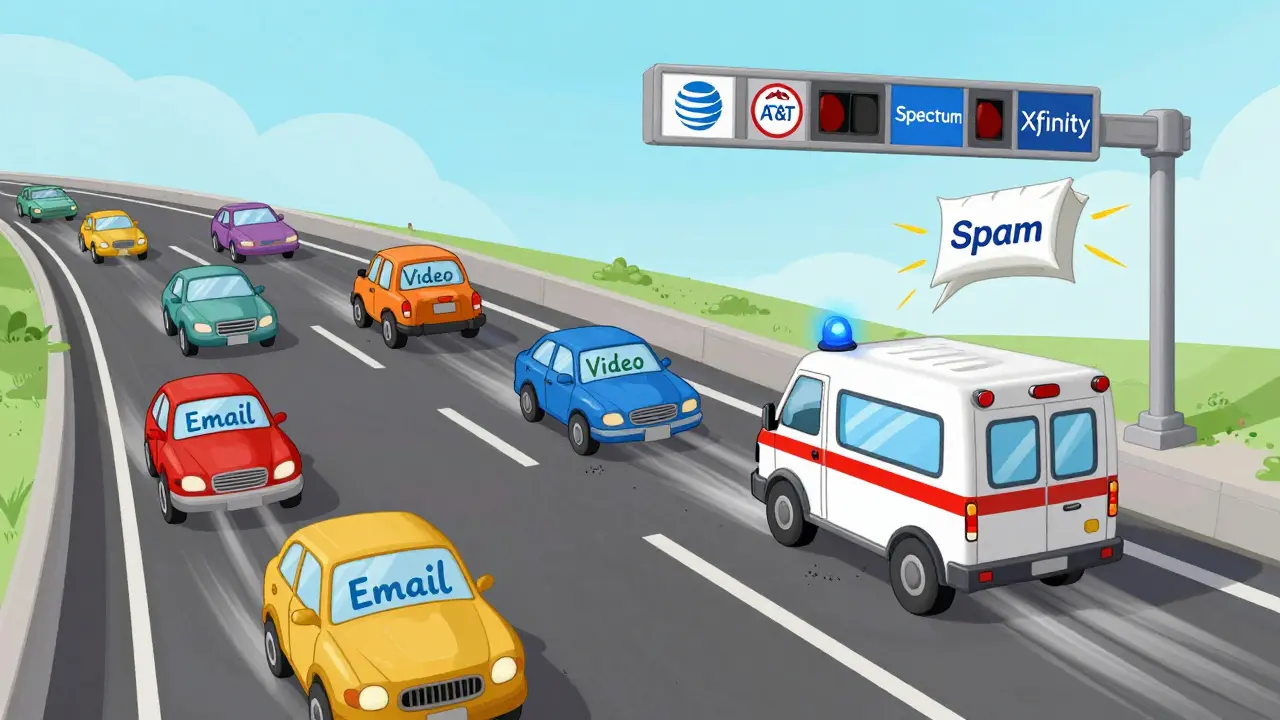
DSCP - or Differentiated Services Code Point - is a 6-bit field in the IP header that tells routers: "This packet is voice. Treat it like an ambulance, not a spam email." The standard for VoIP is DSCP 46, also known as Expedited Forwarding (EF). It’s been around since 2002. It works flawlessly inside your company’s network. But once your voice packets hit the public internet, they enter a black box where no one guarantees priority.
How DSCP 46 Is Supposed to Work (And Why It Doesn’t)
Here’s how it should work: Your IP phone or session border controller (SBC) tags every voice packet with DSCP 46. Your internal switch says, "Got it. Trust this marking." Your firewall passes it through. Your router prioritizes it. You get a clean, low-latency path. Your call gets a Mean Opinion Score (MOS) of 4.2 - crystal clear.
But here’s what actually happens: Your packet hits your ISP’s edge router. Instead of seeing "priority voice," it sees "just another packet." Most ISPs treat all traffic as "best effort" - meaning no special treatment. A 2023 ThousandEyes study found that 67% of internet paths between networks altered DSCP markings. Voice packets labeled DSCP 46 were often rewritten to DSCP 0 - the default, no-priority tag.
It’s not just one bad ISP. It’s the whole system. Network Journey’s 2023 analysis confirmed: "Generally, no. Most Internet Service Providers (ISPs) strip or ignore DSCP markings." Cisco’s 2024 QoS guide says the same thing: "DSCP markings are typically not preserved across public internet boundaries."
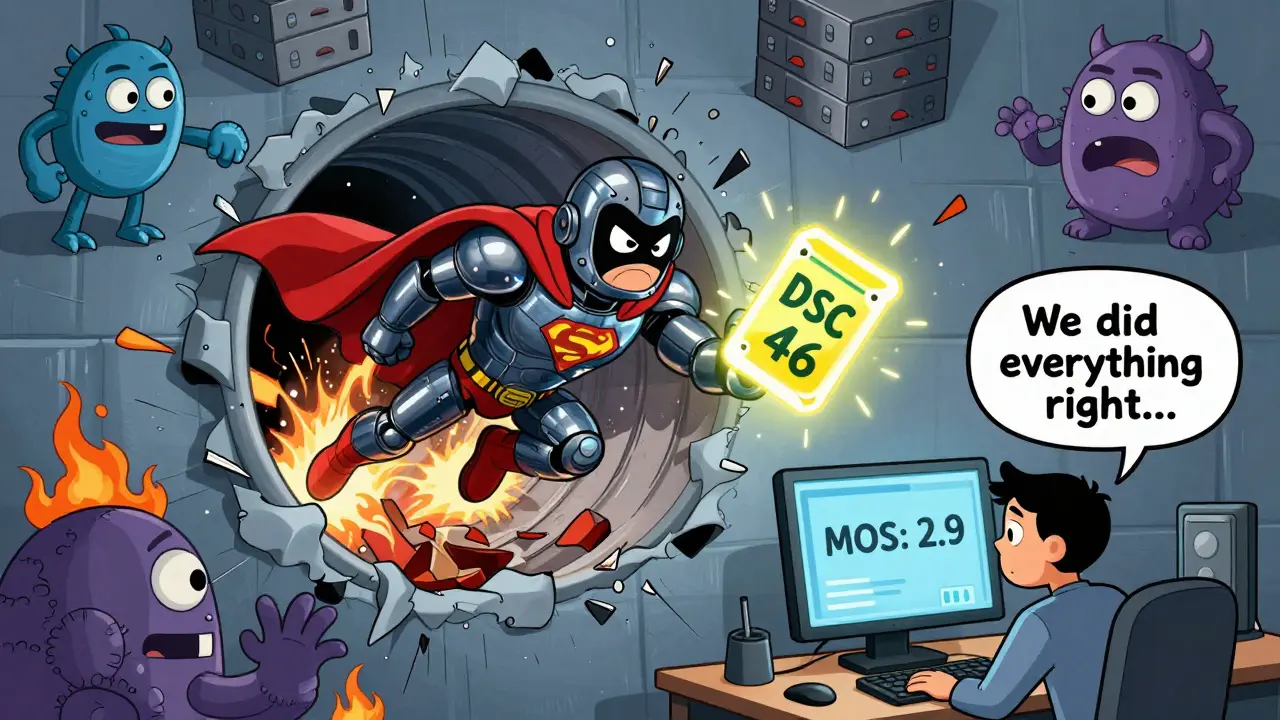
Even major providers like Comcast, AT&T, and Spectrum don’t prioritize VoIP traffic on their public networks. A Reddit user in Chicago reported his Cisco 9K switches were tagging DSCP 46 correctly - but within three hops, Comcast changed every voice packet to DSCP 0. His MOS dropped from 4.1 to 2.9. That’s not a glitch. That’s the norm.
The Real Cost of Ignoring DSCP: Call Quality That Breaks Compliance
When DSCP 46 gets stripped, you don’t just get bad audio. You get broken business.
Latency spikes from 50ms to 250ms. Jitter jumps from 10ms to 60ms. Packet loss goes from 0.1% to 3%. Calls drop. Echoes return. People hang up. In a 2024 UC Today case study, a 500-user company saw call drop rates jump from 0.5% to 8.7% after DSCP was stripped. That’s 43 extra dropped calls per day. For a sales team? Lost revenue. For a call center? Angry customers. For a hospital? Emergency calls failing.
And it’s not just annoying - it’s risky. The FCC’s 2024 Emergency Calling Order requires enterprises to maintain MOS scores above 3.5 for E911 calls. If your VoIP system can’t guarantee that because your ISP is rewriting DSCP, you’re not just violating best practices - you’re violating federal rules.
Healthcare and financial firms are feeling this hardest. Spiceworks’ 2025 SMB survey found that 78% of enterprises using standard broadband for VoIP had DSCP stripping issues. In regulated industries, that’s not a technical problem - it’s a legal one.
What Works: Private Networks, SD-WAN, and Tier-1 Carriers
So what do you do when the public internet won’t play nice?
Option 1: MPLS with a QoS SLA
Private networks like AT&T NetBond or Verizon Private IP preserve DSCP 46 with 99.8% reliability. Why? Because you’re paying for it. These services come with Service Level Agreements that guarantee voice traffic gets priority. One Fortune 500 company saw jitter drop from 45ms to 8ms and packet loss fall from 2.1% to 0.3% after switching from broadband to MPLS.
But there’s a catch: cost. MPLS with QoS SLA runs $300-$500 per Mbps/month. Standard broadband? $50-$100. That’s a 300-500% premium. Only large enterprises can justify it.
Option 2: SD-WAN with DSCP Encapsulation
SD-WAN solutions from Cisco, VMware, or Fortinet don’t rely on ISPs to honor DSCP. Instead, they wrap your voice traffic in an encrypted tunnel and carry the DSCP tag inside the header. Even if the ISP strips the outer IP tag, the inner DSCP 46 survives.
ThousandEyes testing shows SD-WAN preserves DSCP 85-92% of the time. That’s not perfect, but it’s a massive improvement over the 12-18% you get on regular broadband. Cisco’s SD-WAN market share jumped from 24.7% in 2023 to 31.2% in 2025 - mostly because companies needed better QoS.
Option 3: Route Through Tier-1 Carriers
AVOXI’s 2025 guide found that routing VoIP traffic through Tier-1 carriers like Lumen, Colt, or GTT preserves DSCP 92.4% of the time. These providers operate their own global backbone networks and have invested in QoS infrastructure. It’s not as expensive as MPLS, but you still need to configure your SBC or cloud provider to send traffic through them.
What Doesn’t Work: Relying on Your ISP or Consumer-Grade Gear
Don’t assume your business internet plan includes QoS. Even "business-grade" broadband from Spectrum or Xfinity doesn’t guarantee DSCP preservation. Most consumer routers and firewalls strip DSCP by default. SonicWall’s documentation warns: "Not all networking devices or ISPs support DSCP Class of Service."
And don’t trust "auto-QoS" on your switch. Cisco’s own benchmarks show that even with "auto-QoS" enabled, if your firewall or ISP strips the tag, you’re back to square one. You need to manually configure "trust dscp" on every interface that handles voice traffic - and verify it with tools like iperf3 or ThousandEyes.
Many IT teams spend days configuring QoS, only to realize their firewall is resetting DSCP. A 2023 Network Journey survey found 63% of deployments had DSCP stripped by security devices. The fix? Explicitly configure your firewall or SBC to preserve DSCP tags. That’s not optional. It’s mandatory.
How to Check If Your DSCP Is Being Stripped (And Fix It)
You can’t fix what you can’t measure. Here’s how to test your DSCP preservation:
- Use iperf3 with the
--dscp 46flag to send test traffic from your network to a public server. - Use ThousandEyes Path Trace (starting at $1,200/month) to see exactly where your DSCP tags get changed. It shows you which ISP hop is rewriting your packets.
- Check your SBC or VoIP provider’s logs. RingCentral, Zoom, and 8x8 all log whether incoming traffic is marked DSCP 46. If it’s showing as 0, your ISP is the culprit.
- On Cisco switches, run
show policy-map interfaceto confirm DSCP is being trusted and queued correctly.
If you find DSCP is being stripped, you have two choices: switch to SD-WAN or MPLS, or accept that your VoIP quality will be unpredictable. There’s no third option.
The Future: Is DSCP Preservation Getting Better?
There’s hope - but it’s slow.
Comcast’s "Dual Queue Networking" initiative, based on an IETF draft from October 2023, aims to preserve DSCP 46 for upstream traffic by 2026. Early trials in Philadelphia showed 78% preservation. That’s promising. But it’s just one ISP in one city.
The IETF’s L4S standard (RFC 9330) offers a longer-term solution by rethinking how networks handle congestion. But it requires upgrades to routers, switches, and endpoints - a multi-year rollout.
Analysys Mason predicts that by 2027, 45% of enterprise internet connections will include basic DSCP preservation - up from just 18% in 2025. That’s progress. But it still means over half of businesses will be flying blind.
The truth? The public internet was never built for guaranteed voice quality. It was built for web pages, videos, and emails. VoIP was tacked on. And until ISPs treat voice like critical infrastructure - not just another data stream - DSCP preservation will remain a luxury.
What You Should Do Right Now
If you’re using cloud VoIP over standard broadband:
- Test your DSCP preservation with ThousandEyes or iperf3 - don’t assume it’s working.
- Check your SBC and firewall settings - make sure they’re configured to preserve DSCP 46.
- If your MOS is below 3.5, you’re at risk of non-compliance with FCC rules.
- If you’re a mid-sized or large business, start evaluating SD-WAN. It’s the most practical fix for most companies.
- If you’re in healthcare, finance, or government, consider MPLS or a Tier-1 carrier connection. The cost of a failed emergency call is too high.
Cloud VoIP is powerful. But it’s not magic. It needs a reliable pipe. And right now, the public internet is the worst pipe you can choose for voice. You don’t need more features. You need better delivery.







Tina van Schelt
1 Feb 2026 at 09:31Okay, but let’s be real - if your VoIP sounds like a robot having a seizure, you didn’t fail. The internet did. I’ve seen IT teams waste weeks tweaking QoS only to find out Comcast’s edge router is just… deleting the DSCP tag like it’s spam. It’s not a configuration issue. It’s a societal failure. We treat voice like it’s just data, but when your grandma’s 911 call drops because a corporate ISP doesn’t give a damn, that’s not a glitch. That’s negligence.
SD-WAN isn’t a luxury anymore - it’s the bare minimum. And if your CFO says ‘but broadband is cheaper,’ hand them this article and walk away.
Also, why do we still act like ISPs are public utilities when they behave like gatekeepers with a vendetta against clarity?