



When Ethereum switched to Proof of Stake, staking became the way to earn rewards and help secure the network. But there was a big problem: once you staked your ETH, it was locked up. You couldn't trade it, use it in DeFi, or even sell it if you needed cash. That changed with liquid staking-and Lido Finance became the biggest name in it.
What Is Liquid Staking?
Liquid staking solves the liquidity problem. Instead of locking your ETH in a staking contract with no way out, you get a token in return-stETH. This token represents your staked ETH plus the rewards it earns. The magic? You can use stETH anywhere you’d use ETH: trade it, lend it, use it as collateral, or even stake it again in another protocol. Your original ETH keeps earning rewards in the background, while stETH gives you freedom.This isn’t just convenient-it’s revolutionary. Before liquid staking, only those with 32 ETH could run a validator. Now, you can stake 0.01 ETH and still earn rewards. That opens up staking to millions of people who couldn’t afford or manage a full validator node.
How Lido Works
Lido lets you deposit ETH into a smart contract. In seconds, you get stETH back. The protocol then delegates your ETH to professional node operators who run validators on Ethereum. These operators are chosen for reliability and uptime. If a validator goes offline or makes a mistake, penalties are applied-but they’re spread across all stakers, not just you.Every day, staking rewards are added to your stETH balance. Unlike some tokens that increase in price, stETH grows in quantity. So if you hold 100 stETH and earn 3% in a year, you’ll have 103 stETH. The value stays pegged to ETH because each stETH is backed by real staked ETH and its rewards.
Lido’s system is built to be simple: no need to install software, manage keys, or monitor hardware. You just deposit and forget. The protocol handles everything else-from validator selection to reward distribution.
Rewards: What You Can Expect
As of early 2026, Lido offers around a 3.10% annual percentage yield (APY). That’s competitive with other liquid staking options and slightly higher than solo staking in practice, thanks to Lido’s optimized validator set.Let’s say you stake 5 ETH. At 3.10% APY, you’d earn roughly 0.155 ETH in rewards over a year. But not all of that goes to you. Lido takes a 10% fee on rewards-so 0.0155 ETH goes to the protocol, and 0.1395 ETH stays with you. That’s still better than most centralized exchanges, which often take 20-30% or more.
The real advantage? You can stack yields. Use your stETH on Aave to earn interest. Add it to a Uniswap pool for trading fees. Or lock it in a yield aggregator like Yearn. Some users earn 5-8% total APY by combining staking with DeFi-something impossible with locked ETH.

Who’s Competing?
Lido dominates the market with over 9.2 million ETH staked-roughly 31% of all ETH on the network. Its main rival is Rocket Pool, which uses rETH and has about 685,000 ETH staked. Rocket Pool is more decentralized because users can run their own validators with as little as 0.1 ETH as collateral. But it’s more complex, requires more technical knowledge, and offers a lower APY of around 2.83%.Other options like Coinbase and Kraken offer staking too, but you don’t get a tradable token. Your ETH is locked on their platform, and you’re at their mercy. If they get hacked, freeze withdrawals, or go bankrupt, you lose access. With Lido, you hold stETH in your own wallet. The keys are yours.
The Risks You Can’t Ignore
Lido is popular for a reason-but that doesn’t mean it’s risk-free.Smart contract risk: Lido’s code is open-source and audited, but bugs still happen. If a flaw lets someone drain funds, your stETH could lose value. This hasn’t happened yet, but it’s a real possibility in DeFi.
Validator risk: Lido uses dozens of node operators. If a large group of them go offline at once-say, due to a software update or DDoS attack-your rewards could drop. Penalties for downtime are passed directly to stETH holders.
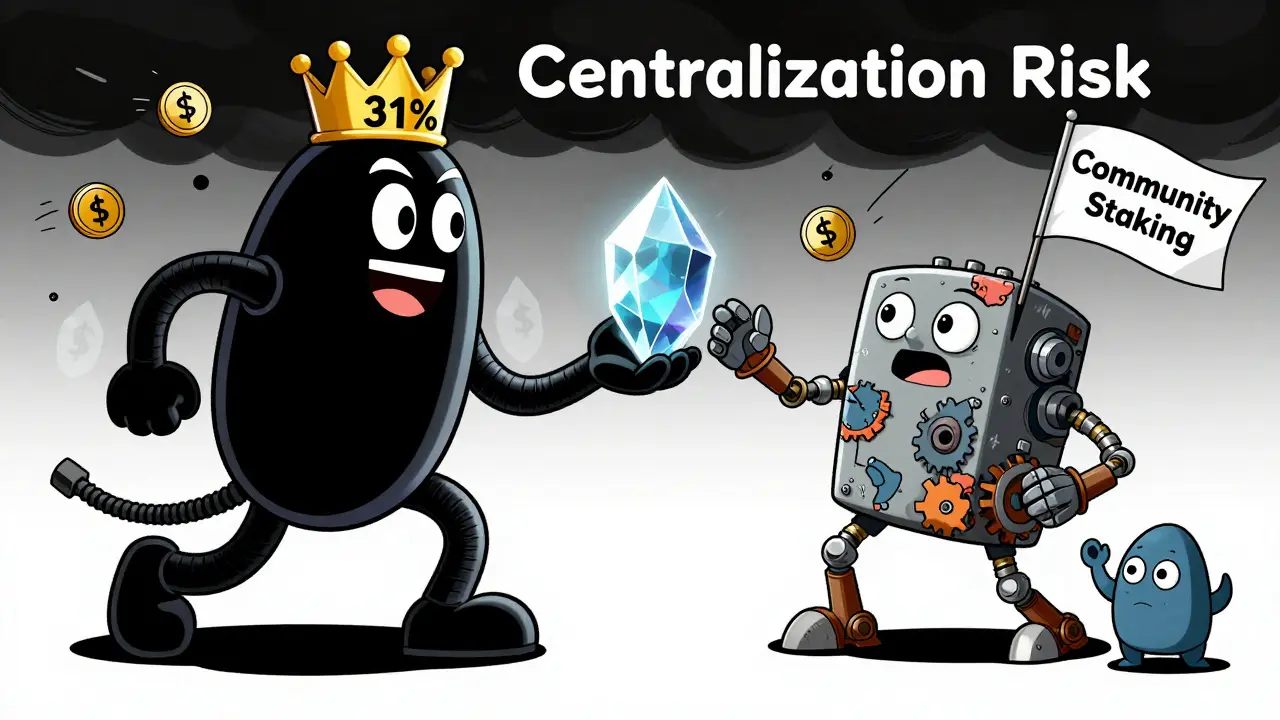
Centralization risk: Lido controls over 31% of all staked ETH. That’s a problem if Ethereum’s security model depends on distributed validators. If 30% of validators are controlled by one entity, it becomes a single point of failure. Ethereum’s developers are aware of this and are pushing for more decentralized alternatives like Rocket Pool and community-run validators.
Market risk: stETH is pegged to ETH, but during market crashes, the peg can slip. In March 2023, stETH briefly traded at 97 cents per ETH. While it recovered quickly, it showed that liquidity can dry up under stress. For most users, this isn’t a big deal-but if you need to sell fast, you might get a worse price.
Why Use Lido Over Other Options?
If you’re new to staking, Lido is the easiest path. No technical setup. No 32 ETH requirement. Just connect your wallet, deposit ETH, and get stETH. It’s plug-and-play.If you’re an experienced DeFi user, Lido gives you the most flexibility. stETH is accepted everywhere-unlike rETH or other tokens. You’ll find better liquidity, more lending options, and higher yields with stETH than with any other liquid staking token.
And if you care about decentralization? Lido’s governance is controlled by the Lido DAO, where token holders vote on changes. The DAO recently approved a “community staking” module that lets anyone become a node operator with less than 1 ETH as collateral. That’s a step toward reducing centralization.
Who Should Use Lido?
- Small ETH holders: If you have 1 ETH or 5 ETH, Lido is your only way to earn staking rewards without joining an exchange.
- DeFi power users: Want to maximize yield? Use stETH as collateral, add liquidity, or stake it again. Lido makes that possible.
- Long-term holders: If you believe in Ethereum, staking through Lido lets you earn passive income without selling.
- Not for you: If you want full control over your validator, or you’re uncomfortable with centralized operators, stick with solo staking or Rocket Pool.
What’s Next for Lido?
Lido isn’t standing still. It’s working on better validator selection tools, reducing gas fees for deposits, and improving how rewards are distributed. There’s also talk of integrating with Ethereum’s upcoming upgrades to make staking even more efficient.As Ethereum evolves, so does liquid staking. Lido’s role as the leading protocol gives it influence-but also responsibility. Its future depends on balancing growth with decentralization, rewards with security.
For now, Lido remains the simplest, most flexible way to stake ETH. It’s not perfect, but for most users, the benefits far outweigh the risks.
Is stETH the same as ETH?
No, stETH is not ETH, but it’s designed to track its value. stETH is a token you receive when you stake ETH through Lido. It represents your share of the staking pool and grows as rewards accumulate. While stETH trades close to ETH’s price, they are technically different assets. You can’t use stETH to pay for Ethereum transaction fees directly-you’d need to swap it back to ETH first.
Can I lose my ETH if I stake with Lido?
You won’t lose your ETH outright, but you can lose rewards-or see stETH temporarily trade below ETH’s value. If validators are penalized for downtime, your stETH balance grows slower. In extreme cases, a smart contract exploit could drain funds, though Lido has never been hacked. Your ETH is not withdrawn or locked; it’s still in the Ethereum staking system, just managed by Lido’s infrastructure.
Do I need 32 ETH to stake with Lido?
No. You can stake any amount of ETH with Lido-even 0.001 ETH. That’s one of its biggest advantages over solo staking, which requires exactly 32 ETH per validator. Lido pools all deposits together, so you don’t need to meet any minimum.
Are staking rewards taxed?
In the U.S., staking rewards are generally treated as ordinary income when you receive them. So if you get 0.1 ETH in stETH rewards, you owe taxes on the USD value of that ETH at the time it hits your wallet. You may also owe capital gains tax when you sell or swap stETH. Always consult a tax professional familiar with crypto.
What happens if Lido shuts down?
Lido is a decentralized protocol governed by its DAO, so it can’t be shut down by a single company. If the team disappeared, the smart contracts would still run. You could still withdraw your stETH and claim your ETH once Ethereum allows withdrawals (expected in 2026). Until then, stETH would still trade and be usable in DeFi, but you wouldn’t earn new rewards until the withdrawal function is activated.









Akhil Bellam
24 Feb 2026 at 12:00Lido? More like Lido-lose. 🤦♂️ You think stETH is ‘liquid’? Try selling 500 stETH during a black swan event and see how ‘pegged’ it really is. I’ve seen it dip to 0.92 ETH. And don’t get me started on the 31% centralization-Ethereum’s whole ethos is ‘don’t trust, verify,’ but here we are, putting 1/3 of the network’s security in one DAO’s hands. It’s like trusting a single bank with your life savings and calling it ‘decentralized.’ The APY looks nice, but you’re trading sovereignty for convenience. And don’t even mention ‘stacking yields’-that’s just DeFi roulette with extra steps. I’d rather solo stake with a $200 Raspberry Pi than play this game.