



You are looking at a quote for new office phones and your stomach drops. The price tag is steep, especially when you need to outfit an entire floor. You might think cutting corners on hardware is the only way to stay within budget. But what if I told you that buying used equipment isn't just about saving money-it can actually give you better reliability than some brand-new units? The secret lies in understanding the difference between "used" and "certified refurbished."
The market for refurbished VoIP gear is previously owned telecommunications equipment restored to manufacturer specifications through rigorous testing and component replacement. It has exploded in recent years. In fact, Reef Telecom’s 2024 data shows that refurbished Cisco phones now make up about 35% of all business telephony purchases. This isn't because businesses are desperate; it's because they are smart. They know that certified refurbished equipment offers identical functionality to new units but at a fraction of the cost.
How Much Can You Actually Save?
Let’s talk numbers, because that is usually why you are here. The savings are not marginal; they are massive. When you buy new, you are paying for the latest marketing campaign, the retail markup, and the pristine cosmetic condition. When you buy certified refurbished, you are paying for the internal performance, which is often indistinguishable from new.
Consider the specific pricing data from Cellular Professor’s 2023 analysis. A new Cisco 7800 series phone retails for around $369. The same model, certified refurbished, costs approximately $129. That is a 65% savings. If you look at Polycom VVX 500 models, the new price is $299, while the refurbished version sits at $149-a 50% drop. Samsung VoIP hardware often sees discounts up to 55%. For a small business needing 35 phones, switching from new to refurbished Cisco 8845 models (priced at $159 refurbished versus $369 new) saved one company over $10,000. That is money you can put back into hiring or training.
| Phone Model | New Price (Approx.) | Refurbished Price (Approx.) | Savings Percentage |
|---|---|---|---|
| Cisco 7800 Series | $369 | $129 | 65% |
| Polycom VVX 500 | $299 | $149 | 50% |
| Cisco 8845 | $369 | $159 | 57% |
The Warranty Gap: Risk vs. Reward
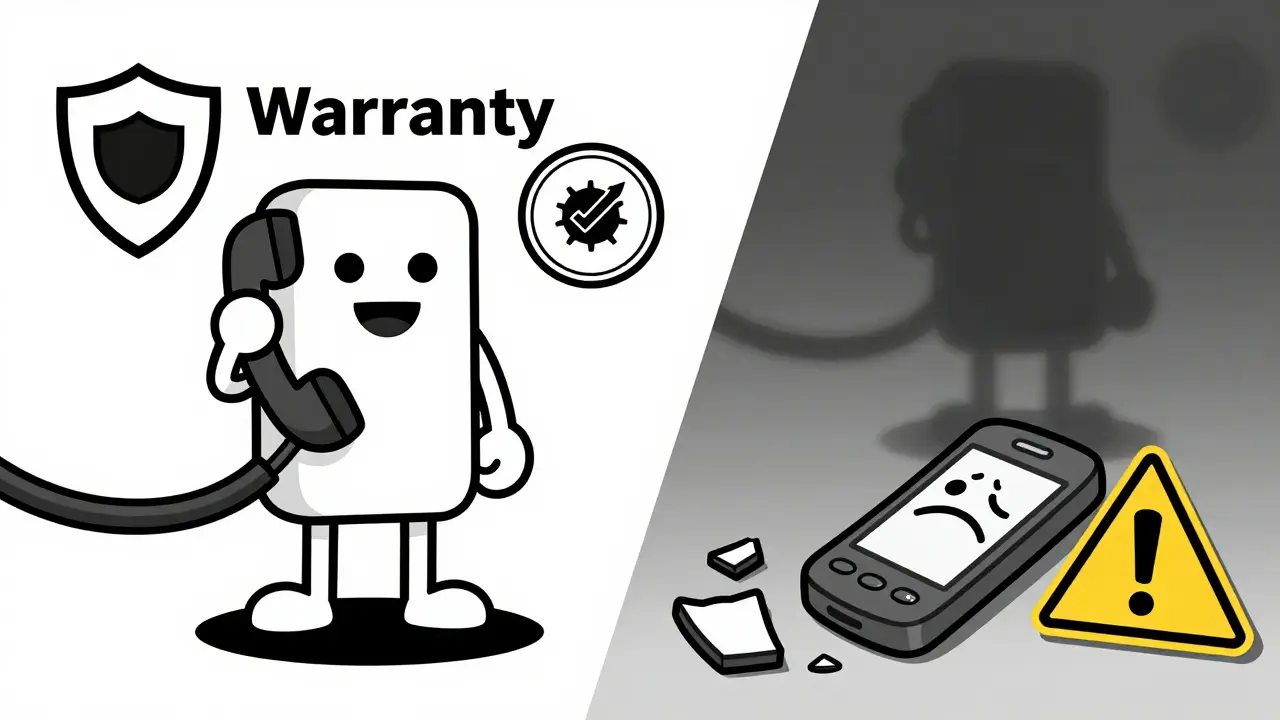
Here is where most people get scared. "If it’s used, what happens when it breaks?" This is the core trade-off. With new equipment, you have a standard manufacturer warranty, typically three to five years. With refurbished gear, the warranty terms depend entirely on who sells it to you.
This is the critical distinction: there are two types of sellers. First, you have authorized refurbishers like VoipSupply or manufacturer programs like Cisco Refresh. Second, you have general electronics resellers or random online marketplaces. Buying from the first group means you get robust protection. VoipSupply, for example, launched an enhanced program in March 2024 offering two-year warranties-one year standard plus an optional paid extension. Cisco also expanded their Refresh program warranty from 90 days to one full year in January 2024 to match new equipment coverage more closely.
If you buy from unauthorized sources, you might get no warranty at all. Cellular Professor analyzed over 1,200 user reviews and found that 63% of secondhand VoIP phones bought from non-authorized sources failed within the first year. Common complaints included incompatible firmware (42% of negative reviews) and undisclosed physical damage (29%). Without a warranty, you are on your own to fix these issues, which can quickly erase any upfront savings.
Performance and Reliability: Is It Really the Same?
You might worry that a refurbished phone will sound worse or crash more often. The data says otherwise. Cisco’s technical documentation confirms that their Refresh products meet the same Mean Time Between Failures (MTBF) rates as new units-specifically, 150,000 hours. That is essentially forever for a business environment.
Reef Telecom’s Chief Technology Officer, Mark Johnson, stated in a 2024 whitepaper that certified refurbished Cisco phones perform identically to new units. This is backed by hard testing. VoipSupply’s Director of Technical Operations, David Chen, confirmed that each refresh product undergoes a 47-point inspection process. This includes replacing worn components, resetting firmware to factory defaults, and comprehensive functionality testing. In controlled environments, both new and refurbished phones achieved a Mean Opinion Score (MOS) of 4.2 for call quality. To the human ear, there is zero difference.
Compatibility with Modern Systems
A major concern for IT managers is whether old hardware plays nice with new software. You might be running Microsoft Teams, RingCentral, or Cisco Unified Communications Manager. Reef Telecom’s 2024 testing showed 100% compatibility between properly refurbished phones and these modern cloud-based systems.
However, caution is needed with legacy systems. VoipSupply’s 2023 technical guide notes that 17% of businesses experience compatibility issues when integrating refurbished phones with infrastructure older than five years. Also, if you buy from unverified sources, 37% of those devices require complex firmware updates to work with modern platforms. These updates can take hours to configure, negating the time savings you hoped for. Always verify that the seller has already updated the firmware to the latest stable version supported by your platform.
Environmental Impact: The Hidden Benefit
Beyond the balance sheet, there is the planet. Manufacturing new electronics is resource-intensive. By choosing refurbished, you are directly reducing e-waste. Cellular Professor’s 2023 lifecycle analysis revealed that using refurbished phones reduces carbon emissions by 72% compared to manufacturing new ones. It also cuts e-waste by 85%. With the EU’s Circular Economy Directive and new SEC climate disclosure rules coming into play, many companies are under pressure to report sustainable practices. Buying refurbished VoIP gear is an easy win for your sustainability report.

Who Should Buy Refurbished? (And Who Shouldn’t)
Is this right for everyone? Gartner’s 2024 VoIP Equipment Report ranks certified refurbished equipment as "highly suitable for 95% of business use cases." However, they caution that mission-critical environments requiring the absolute latest security patches might prefer new gear due to potential firmware version limitations on older models.
If you are a startup or a mid-sized business (50-500 employees), refurbished is likely your best option. Seventy-eight percent of businesses in this size bracket now incorporate refurbished equipment into their infrastructure. It allows you to stretch your budget further, perhaps enabling you to hire more staff or invest in better software licenses.
If you are a large enterprise with over 1,000 employees, adoption is lower at 45%, often due to strict procurement policies rather than technical concerns. Even then, many large firms use refurbished units for overflow areas, conference rooms, or temporary staff, reserving new units for executive suites or high-security zones.
Red Flags to Watch Out For
Not all refurbished gear is created equal. Here is how to avoid getting burned:
- No Brand Name: Avoid generic "VoIP phones" without clear manufacturer branding. Stick to Cisco, Polycom, Yealink, or Fanvil.
- Missing Warranty Details: If the seller cannot clearly state the warranty length and coverage, walk away. Look for at least a 90-day warranty, preferably one year.
- Too Good to Be True Prices: If a Cisco phone is listed for $50, something is wrong. It could be broken, stolen, or missing essential parts like the handset cord or power adapter.
- Unclear Firmware Status: Ask the seller explicitly: "Has the firmware been updated to the latest version compatible with [Your Platform]?" If they don't know, don't buy.
Implementation and Support
Setting up refurbished phones is just as easy as setting up new ones. Reef Telecom’s installation data shows no difference in setup time-an average of 22 minutes per phone. The documentation provided by authorized refurbishers is identical to manufacturer specs. Cisco’s Refresh program even includes updated documentation reflecting any minor component changes made during refurbishment.
Support quality varies wildly. Authorized vendors like VoipSupply provide 24/7 phone support with an average response time of 8 minutes. Non-certified sellers often offer no support at all. If your IT team is small, having access to expert support can save you countless hours of troubleshooting. Make sure the vendor you choose has a reputation for quick resolution. Gartner noted that specialized refurbishers resolve warranty claims 3.2 times faster than general electronics refurbishers.
Are refurbished VoIP phones less secure than new ones?
Not if they are certified. Network security specialist Dr. Elena Rodriguez warns that businesses must verify all security patches are applied during refurbishment. Authorized programs like Cisco Refresh ensure firmware is reset to factory defaults and updated to the latest secure version. The risk comes from uncertified sellers who may skip this step, leaving vulnerabilities open.
What is the typical lifespan of a refurbished VoIP phone?
A certified refurbished VoIP phone has the same lifespan as a new one. Cisco states that their Refresh products have an MTBF of 150,000 hours. Since these phones are typically used 8-10 hours a day, this translates to decades of reliable service, assuming normal wear and tear on physical buttons and handsets.
Can I mix new and refurbished phones in the same system?
Yes, absolutely. As long as both sets of phones run compatible firmware versions, they will function identically on your network. Many businesses start with refurbished units and add new ones later as budgets allow. Just ensure your IT team manages firmware updates consistently across all devices to maintain stability.
Why do some refurbished phones lag behind current models?
Refurbished inventory typically lags 18-24 months behind current-generation models because it consists of returned or upgraded units from other businesses. If you need the absolute newest feature released this month, you may need to buy new. However, for 95% of business use cases, the features available in models from 2-3 years ago are fully sufficient.
Is it worth buying refurbished for a small office of 10 people?
For very small offices, the total savings might be modest ($1,000-$2,000). However, the environmental benefit and the ability to allocate funds elsewhere still make it a strong choice. If you plan to grow, buying refurbished now leaves room in your budget for future expansion. Just ensure you buy from a reputable source with good warranty terms to protect your investment.







selma souza
22 May 2026 at 19:46Your argument contains several grammatical inconsistencies that undermine its perceived authority. Specifically, the phrase "late-stage capitalism" is a colloquialism ill-suited for formal discourse on telecommunications infrastructure. Furthermore, you fail to distinguish between "used" and "certified refurbished," a critical distinction emphasized in the original post. The assertion that purchasing new hardware is solely a result of capitalist constructs ignores the tangible benefits of manufacturer warranties and immediate availability. One should strive for precision in language and logic before attempting to lecture others on ethics. Your tone is pretentious and your syntax is flawed. Please review standard English grammar rules before posting again.