



Imagine opening a new coffee shop in a busy downtown area. You have the best beans and the fastest espresso machine, but there’s one problem: nobody knows you’re there. No customers means no sales, which means you can’t pay your rent. In the world of decentralized finance (DeFi), this is exactly the problem every new protocol faces. They need traders to swap tokens, but traders won’t come if there isn’t enough money in the system to make those swaps happen smoothly.
This is where Liquidity Mining comes in. It is essentially a marketing strategy that pays users to deposit their crypto into a protocol’s pools. Instead of advertising on billboards, DeFi projects distribute their own tokens as rewards to anyone who provides liquidity. It sounds simple, but it has reshaped how financial markets operate on the blockchain.
Key Takeaways
- Liquidity mining incentivizes users to deposit assets into decentralized exchange (DEX) pools by offering additional token rewards.
- The primary goal for protocols is to reduce slippage and increase trading volume quickly without relying on professional market makers.
- Participants face significant risks, primarily impermanent loss and smart contract vulnerabilities, which can outweigh reward earnings.
- Modern strategies are shifting from raw TVL chasing to "liquidity targeting," focusing on cost-effective depth rather than just high APYs.
How Liquidity Mining Actually Works
To understand liquidity mining, you first need to grasp how decentralized exchanges function. Unlike traditional stock exchanges that use an order book matching buyers with sellers, most DEXs rely on Automated Market Makers (AMMs). An AMM uses a mathematical formula to set prices based on the ratio of tokens in a pool.
For example, if you want to trade Ethereum (ETH) for USDC, you need a pool containing both ETH and USDC. If that pool is empty or thin, you can’t trade, or the price you get will be terrible due to high slippage. This is where you, the user, step in. By depositing an equal value of both tokens-say, $1,000 worth of ETH and $1,000 worth of USDC-you become a Liquidity Provider (LP).
In return for locking up your capital, you earn two things:
- Trading Fees: Every time someone swaps tokens in that pool, they pay a small fee (typically 0.3%). This fee is distributed proportionally to all LPs based on their share of the pool.
- Mining Rewards: This is the core of liquidity mining. The protocol issues its native governance token (let’s call it TOKEN-X) and distributes it to LPs on top of the trading fees. These rewards are often substantial, sometimes promising annual percentage yields (APYs) of 100% or more.
The process is fully automated via smart contracts. When you deposit your assets, the contract mints LP tokens representing your share. As long as you hold these LP tokens, the contract automatically accrues TOKEN-X rewards for you. You can claim them at any time, provided the program is still active.
Why Protocols Rely on Token Incentives
You might wonder why protocols don’t just hire professional market makers like centralized exchanges do. Professional liquidity providers offer stability, but they are expensive, require complex legal agreements, and centralize control. For a new DeFi project, hiring pros is often impossible or too costly.
Liquidity mining solves this by crowdsourcing liquidity. It turns thousands of retail investors into market makers. According to industry analysts at TDMM, this approach allows for rapid liquidity acquisition. A new token can go from zero liquidity to millions of dollars in depth within days simply by announcing attractive token emissions.
There are three main benefits for the protocol:
- Speed: Bootstrapping a market takes weeks or months traditionally. With liquidity mining, it happens overnight.
- Decentralization: Distributing governance tokens to LPs spreads ownership across the community, aligning incentives and reducing reliance on a few large entities.
- Global Accessibility: Anyone with a crypto wallet can participate. There are no accreditation requirements or minimum capital thresholds beyond what fits in a single pool transaction.
However, this model relies heavily on the assumption that participants care about the long-term health of the protocol. Often, they don’t. They care about the yield.

The Hidden Costs: Impermanent Loss and Risks
If liquidity mining were risk-free, everyone would do it. But it carries a unique danger called Impermanent Loss (IL). This occurs when the price of the tokens in your pool changes relative to each other.
Let’s say you deposit ETH and USDC when ETH is $2,000. If ETH crashes to $1,500, the AMM algorithm rebalances your pool by selling some of your remaining ETH for USDC to maintain the 50/50 value ratio. When you withdraw, you end up with more USDC and less ETH than you started with. Compared to just holding those original assets in your wallet, you have lost value. This is impermanent loss because it only becomes permanent if you withdraw while the price divergence exists.
Here is a quick comparison of the risks involved:
| Risk Factor | Holding Assets | Liquidity Mining |
|---|---|---|
| Price Volatility | High (if crypto drops) | High (plus Impermanent Loss) |
| Smart Contract Risk | Low (if using reputable wallet) | Medium-High (depends on audit quality) |
| Opportunity Cost | None | Caps locked during lock-up periods |
| Manipulation Risk | None | Medium (wash trading can inflate fake volume) |
Beyond IL, there is the risk of smart contract bugs. If the code governing the reward distribution has a flaw, hackers could drain the pool. Security audits are critical, yet many rushed projects skip thorough testing to launch before competitors.
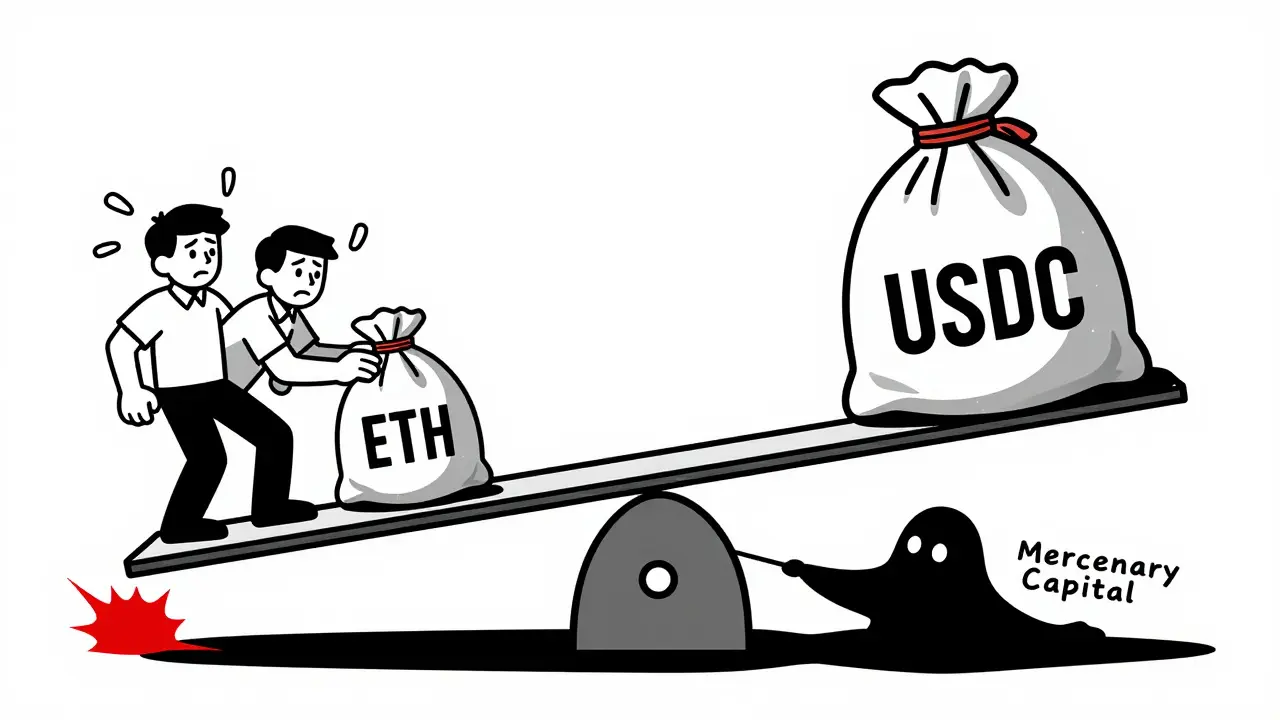
The Problem of Mercenary Capital
A major criticism of early liquidity mining programs was the rise of "mercenary capital." These are sophisticated actors who monitor multiple platforms for the highest APYs. They dump massive amounts of capital into a new pool to farm rewards, then withdraw immediately once the incentives drop or a better opportunity appears elsewhere.
This creates a fragile ecosystem. The protocol sees huge Total Value Locked (TVL) numbers, but the liquidity isn’t sticky. Traders experience high slippage because the mercenary capital leaves as soon as the free money stops. Empirica notes that this behavior undermines the goal of building sustainable, active markets.
To combat this, newer models are introducing vesting schedules. Instead of getting rewards instantly, LPs must keep their funds in the pool for 30, 60, or 90 days to unlock the full amount of token rewards. This encourages longer-term commitment and reduces the churn caused by mercenaries.
From TVL Chasing to Liquidity Targeting
The industry is maturing. Early projects focused on maximizing TVL at any cost, leading to hyperinflationary tokenomics where the reward token became worthless. Today, experts like Mechanism Capital advocate for "Liquidity Targeting."
Instead of throwing tokens at every pair, protocols calculate exactly how much liquidity they need to achieve specific goals, such as keeping slippage below 0.5% for trades under $10,000. They then calibrate token emissions to hit that target efficiently. This approach prioritizes capital efficiency over vanity metrics.
Hybrid models are also emerging. Some protocols use professional market makers for core pairs (like ETH/USDC) to ensure deep, stable liquidity, while using liquidity mining for long-tail assets or new token launches. This balances reliability with decentralization.
How to Participate Safely
If you decide to try liquidity mining, treat it like a business venture, not a lottery ticket. Here is a practical checklist to minimize risks:
- Check the Audits: Only use platforms whose smart contracts have been audited by reputable firms like CertiK or OpenZeppelin. Look for the audit report links on the project’s website.
- Calculate Impermanent Loss: Use online IL calculators to estimate potential losses based on historical volatility of the token pair. Stablecoin pairs (e.g., USDC/DAI) have near-zero IL, while volatile pairs (e.g., ETH/SOL) carry higher risk.
- Assess Token Sustainability: Is the reward token useful? Does it have governance rights or utility within the protocol? If the token has no intrinsic value, its price will likely crash, wiping out your gains.
- Start Small: Begin with an amount you can afford to lose. Familiarize yourself with the deposit, claim, and withdrawal processes before committing significant capital.
- Monitor Regularly: Don’t set it and forget it. Market conditions change. If a pool’s APY drops significantly or the token price plummets, reassess whether staying in the pool makes sense.
The Future of Liquidity Provision
Liquidity mining is here to stay, but it’s evolving. We are seeing a shift towards more dynamic incentive structures that adjust in real-time based on market conditions. Protocols are also integrating better data analytics to measure the true cost of liquidity versus the benefit it brings to trading quality.
As DeFi integrates more closely with traditional finance, we may see regulated liquidity mining programs that offer tax-efficient structures for institutional participants. For now, however, it remains a wild west of high yields and high risks. Success requires understanding not just how to click buttons, but how the underlying economics of token distribution and market depth work.
What is the difference between liquidity mining and yield farming?
While often used interchangeably, liquidity mining specifically refers to earning rewards by providing liquidity to AMM pools. Yield farming is a broader term that includes liquidity mining but also encompasses staking, lending, and complex strategies involving multiple protocols to maximize returns. All liquidity mining is yield farming, but not all yield farming is liquidity mining.
Is impermanent loss really a risk if I earn high APYs?
Yes. High APYs are designed to compensate for impermanent loss. However, if the token price diverges sharply and quickly, the loss can exceed the accumulated rewards. Always calculate the net return after accounting for potential IL, especially in volatile pairs.
Can I lose my entire principal in liquidity mining?
In rare cases, yes. While impermanent loss rarely wipes out 100% of value, smart contract hacks or exploits can drain a pool entirely. Additionally, if one of the tokens in the pair goes to zero (e.g., a rug pull), your entire position becomes worthless. Due diligence on the project team and code security is essential.
How do I choose the best liquidity pool?
Look for pools with high trading volume, as this generates more fee income. Check the tokenomics of the reward token to ensure it has sustainable emission schedules. Avoid pools with extremely high APYs that seem too good to be true, as these often indicate unsustainable inflation or high risk.
What is mercenary capital and why is it bad?
Mercenary capital refers to liquidity providers who move funds rapidly between protocols to chase the highest yields. It is considered detrimental because it creates artificial TVL spikes that vanish when incentives drop, leaving the protocol with insufficient liquidity for traders and undermining market stability.







Write a comment