



Ever been on a VoIP call where the other person’s voice cuts out like a broken radio-then suddenly snaps back, sounding weirdly smooth, like nothing happened? That’s not magic. It’s packet loss concealment-a behind-the-scenes trick that saves your conversations from falling apart when the internet stumbles.
VoIP calls don’t work like regular phone lines. Instead of a steady stream, your voice gets chopped into tiny digital packets, sent over the internet, and stitched back together on the other end. But the internet isn’t perfect. Routers get busy, Wi-Fi flutters, mobile networks drop signals. When packets go missing-called packet loss-the result should be silence, gaps, or robotic noise. But with PLC, you rarely notice. That’s because modern VoIP codecs have built-in algorithms designed to guess what was lost and fill it in, convincingly.
Why Packet Loss Matters More Than You Think
Most people assume VoIP calls are fine as long as they don’t freeze or drop entirely. But even small amounts of packet loss-5% to 10%-can wreck speech clarity. Studies show that without any concealment, 10% packet loss drops speech recognition accuracy by 15-20%. That means voice assistants, call center transcription systems, and even human listeners struggle to understand what’s being said.
Here’s the catch: you can’t just resend lost packets. VoIP is real-time. Waiting for a retry turns a conversation into a turn-based game of telephone. That’s why PLC exists-not to prevent packet loss, but to hide it. It works silently on the receiving end, after the codec has decoded the incoming audio.
How PLC Works: Three Main Approaches
Not all PLC is the same. There are three main ways modern codecs handle missing data, each with trade-offs in quality, speed, and power use.
- Zero Insertion: The simplest method. When a packet is lost, the system just plays silence. It’s cheap-needs less than 0.5 MIPS of processing power-but sounds jarring. Imagine someone pausing mid-sentence. It’s tolerable at low loss rates, but bad for long gaps.
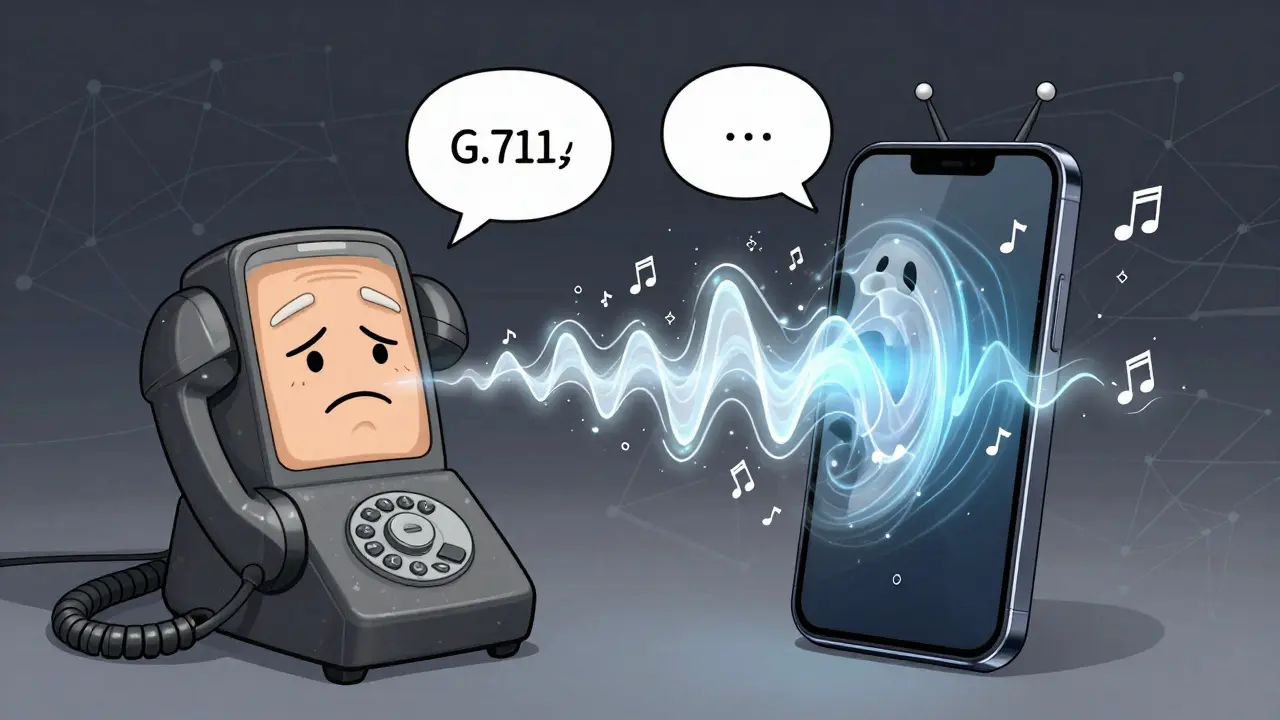
- Waveform Substitution: This is what G.711 Appendix I (the ITU’s 2008 standard) uses. Instead of silence, it repeats the last good audio frame and smoothly blends it into the next one using Overlap-Add (OLA) techniques. Think of it like copying and pasting a piece of speech, then fading it in so it doesn’t click. It needs 1-2 MIPS and works well for steady speech. At 5% packet loss, it keeps MOS scores above 3.8 (where 5 is perfect). But it struggles with sudden voice starts or bursts longer than 120ms.
- Model-Based Methods: The smartest approach. These use predictive models of human speech-like how vowels and consonants naturally flow-to generate new audio that fits the context. Google’s WaveNetEQ, introduced in 2018, uses a neural network trained on millions of voice samples to create near-realistic speech from thin air. At 10% packet loss, it hits a MOS of 4.1. But it’s heavy: needs 15 MIPS, making it impossible on old phones or cheap VoIP devices.
Most enterprise codecs like G.729 and iLBC use variations of waveform substitution. Open-source codecs like Opus combine multiple techniques and are especially good at adapting on the fly.
Real-World Performance: What Works and What Doesn’t
Not all PLC is created equal in practice. A 2023 survey of 127 VoIP administrators showed users rated PLC effectiveness differently across codecs:
- G.711: 7.2/10
- G.729: 6.8/10
- Opus (with SILK PLC): 8.5/10
Opus stands out because it doesn’t just copy-paste audio. It analyzes the structure of speech-pitch, energy, formants-and rebuilds lost frames with context-aware synthesis. That’s why users on trains, in crowded cafes, or on shaky mobile networks report Opus calls sounding “nearly normal” even at 15% packet loss.
But even the best PLC breaks down under extreme conditions. If a burst loss hits 500ms or more-say, from a Wi-Fi router reboot or a tunnel tunneling signal-most algorithms fail. Cisco Unified Communications Manager users reported robotic artifacts worse than silence. Microsoft Teams users describe the result as a “plastic” voice, like a bad voice modulator. These aren’t bugs. They’re limits.
And here’s the irony: PLC can make things worse. When it activates during double-talk (two people speaking at once), it can interfere with acoustic echo cancellation. One study found this increased residual echo by 22%. Cisco Webex fixed this in 2022 by adding PLC-AEC coordination-so the echo canceler knows when PLC is active and adjusts its filters.
Who’s Using What-and Why
Enterprise systems and consumer apps take different paths. Why?
Enterprises care about predictability. They don’t want surprises during a critical call. That’s why 68% stick with traditional waveform substitution. It’s stable, well-understood, and easy to troubleshoot. Cisco, Avaya, and 3CX all rely on built-in PLC in G.711 or G.729. It’s not flashy, but it works.
Consumer apps? They want magic. Zoom, WhatsApp, and Google Duo prioritize seamless experiences-even if it means higher CPU use. That’s why WaveNetEQ is everywhere in Google’s ecosystem. A Trustpilot review from March 2024 said: “Even with 15% packet loss on my train commute, WaveNetEQ makes calls sound nearly normal.” That’s the kind of experience that keeps users loyal.
But here’s the hidden cost: WaveNetEQ needs modern hardware. It won’t run on a 5-year-old smartphone or a budget IP phone. That creates a divide. High-end users get crystal-clear calls. Low-end users get glitches.

The Future: AI and the New Frontiers of PLC
PLC is evolving fast. In March 2024, ITU-T released G.729.1 Annex E, improving burst loss handling by 30%. Google announced WaveNetEQ 2.0 at I/O 2024, cutting its processing power from 15 to 8 MIPS-making it viable for more devices.
But the real game-changer is generative AI. Researchers at DeepMind published a paper in April 2024 showing a diffusion model PLC that achieved 4.3 MOS at 20% packet loss. That’s better than any existing commercial system. It doesn’t just guess-it imagines. It learns the rhythm of speech, the pauses, the breaths, and fills gaps like a human would.
That’s exciting. But it’s not without risk. A 2023 USENIX Security Symposium paper showed attackers could manipulate PLC algorithms to insert inaudible commands into reconstructed speech. Imagine someone whispering a fake voice command into your call-and the PLC system turns it into a real instruction your smart speaker hears.
For now, AI-based PLC is still niche. Only 12% of enterprise deployments use it in 2023. But Wainhouse Research predicts that number will hit 40% by 2026. The industry is moving toward hybrid systems: lightweight PLC for edge devices, AI-based for cloud servers.
What You Need to Know as a User or Admin
If you manage a VoIP system:
- Check your codec settings. Are you using G.711 or Opus? Opus is better for unstable networks.
- Don’t assume PLC fixes everything. If you’re seeing frequent gaps, the problem isn’t PLC-it’s network instability. Fix the root cause.
- Test PLC under burst loss conditions. Simulate a 300ms network drop. Does your system sound natural-or robotic?
- Update your firmware. Many older systems use outdated PLC implementations. Newer versions handle burst loss much better.
If you’re a regular user:
- Use apps that support Opus (like WhatsApp or Google Duo). They handle bad connections better.
- Don’t panic when you hear a brief glitch. PLC is likely working behind the scenes.
- If your calls sound “plastic” or unnatural, switch networks. It’s probably not the codec-it’s the connection.
PLC isn’t perfect. But it’s the reason your calls still work when your Wi-Fi is weak. It’s the unsung hero of VoIP. And as AI gets smarter, it’s going to get even better-quietly, seamlessly, and without you ever noticing.
What is packet loss concealment (PLC) in VoIP?
Packet Loss Concealment (PLC) is a technique used in VoIP systems to hide the effects of missing audio packets during a call. Instead of playing silence or distortion, PLC algorithms predict and reconstruct the lost speech using previous audio data, speech models, or AI. This keeps the conversation sounding natural even when the network drops packets.
Does PLC work with all VoIP codecs?
Most modern codecs include some form of PLC. G.711, G.729, iLBC, SILK (used in Opus), and Opus itself all have built-in concealment. Older codecs like G.723.1 have limited or no PLC. Opus is the most advanced, combining multiple techniques and adapting dynamically to packet loss levels.
Can PLC fix high packet loss like 20% or more?
PLC can mask up to 20% packet loss and still maintain acceptable quality (MOS above 3.5), but performance degrades. At 15-20% loss, traditional methods like waveform substitution drop to MOS 2.9-3.0, while AI-based methods like WaveNetEQ hold at 3.4-4.1. But if packet loss comes in long bursts (over 120ms), even the best PLC fails and sounds robotic or choppy.
Why does my VoIP call sound robotic during network issues?
Robotic sounds usually happen when PLC can’t generate realistic speech-often during burst losses, voice onset (like the start of a word), or when it conflicts with echo cancellation. Older PLC systems (like basic G.711) repeat audio frames too literally, creating unnatural echoes. AI-based PLC reduces this, but if the network is extremely unstable, even advanced systems struggle.
Is AI-based PLC worth it for businesses?
For most businesses, traditional PLC is still the better choice. It’s stable, low-power, and predictable. AI-based PLC (like WaveNetEQ) offers better quality but needs modern hardware and more processing power. It’s ideal for consumer apps and high-end cloud systems, but overkill for basic call centers. Wait until 2026-2027 when it becomes more efficient and widely supported.
How can I test if my VoIP system’s PLC is working?
Use a network simulator tool like iPerf or WANem to introduce 5-10% packet loss and 100-300ms bursts during a call. Listen for gaps, clicks, or robotic artifacts. If the speech stays smooth and natural, your PLC is working well. If you hear silence or distortion, check your codec settings and update firmware. Opus with SILK PLC usually performs best under stress.









kelvin kind
17 Dec 2025 at 13:35Been using Opus on WhatsApp for months now-even on my junky 4G connection, calls stay weirdly smooth. Never thought about how it’s doing that, but now I get it. PLC’s the real MVP.