

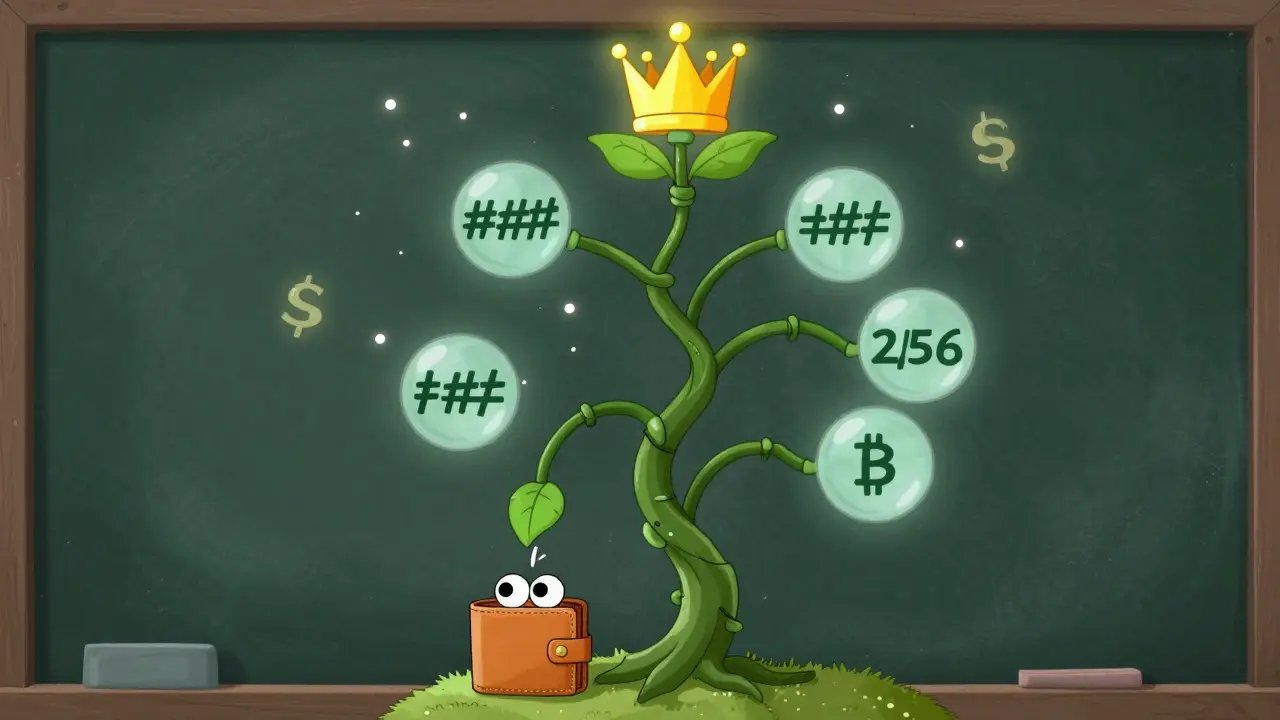

When you send Bitcoin to a friend, how does the network know it’s real? You don’t need to download the whole blockchain to check. That’s where the Merkle root comes in - a tiny cryptographic fingerprint that proves every transaction in a block is legitimate. It’s not flashy, but without it, Bitcoin and most cryptocurrencies wouldn’t work at scale.
What Is a Merkle Tree?
A Merkle tree is a way of organizing data using cryptography. Think of it like a family tree, but instead of people, it’s made of hashes - unique digital fingerprints of data. Every transaction in a Bitcoin block gets hashed using SHA-256. These hashes become the bottom layer, called leaf nodes. Then, pairs of hashes are combined and hashed again to create parent nodes. This keeps happening until there’s just one hash left at the top: the Merkle root.It’s called a binary tree because it always pairs things up. If you have an odd number of transactions, the last one gets duplicated so it can pair with itself. This process isn’t optional - it’s built into Bitcoin’s code. The result? A single 32-byte value that represents hundreds or thousands of transactions.
Why the Merkle Root Matters
The Merkle root sits in the block header, right next to the timestamp, nonce, and the hash of the previous block. This means every block carries proof of all its transactions in a tiny package. If even one transaction changes - say, someone tries to alter the amount sent - the entire Merkle root changes. That’s because hashes are sensitive. Change one letter, and the output becomes completely different.Imagine a block with 2,500 transactions. Without Merkle trees, verifying all of them would mean downloading and checking every single one - about 4MB of data. With Merkle trees? You only need 12 hashes to prove one transaction is real. That’s less than 1KB. This is why lightweight wallets like Electrum can verify payments on your phone without storing the whole blockchain. They just ask a full node for a Merkle proof, check the math, and move on.
How Verification Works in Practice
Let’s say you sent 0.5 BTC to someone, and they want to prove it was included in a block. Their wallet doesn’t need the whole block. It asks a full node for the transaction ID and a path to the Merkle root. The node sends back the transaction hash and a short list of sibling hashes needed to rebuild the path up to the root.The wallet then hashes the transaction, combines it with the first sibling, hashes that pair, and keeps going until it reaches the top. If the final hash matches the Merkle root in the block header, the transaction is verified. This whole process takes under 2 seconds on most phones.
Blockchain.com processes over 1.2 million of these verifications every day. Their success rate? 99.998%. That’s reliability built on math, not trust.
Real-World Examples and Edge Cases
There are moments when things get tricky. One Reddit user, u/BlockchainNewbie, ran into a problem with a block that had exactly 17 transactions. Because 17 is odd, the 17th transaction had to be duplicated to make a pair. Some older wallets didn’t handle this correctly and failed verification. It wasn’t a bug in Bitcoin - just a quirk in how some apps implemented the algorithm. Bitcoin Core’s code has handled this since 2010, but not every wallet got it right.Another example: the 2013 Bitcoin fork. Two mining pools accidentally created two competing blocks with different transaction lists. Their Merkle roots didn’t match. Nodes quickly rejected the invalid chain because the root was wrong. Without Merkle trees, this fork might have lasted longer - maybe even caused a split in the network.
How It Compares to Other Systems
Not all blockchains use the same structure. Ethereum uses something called a Merkle Patricia Tree. It’s more complex because it needs to track account balances, not just transactions. That means it has to update frequently - a wallet sends ETH, the balance changes, the tree changes. Merkle trees in Bitcoin are static after a block is mined. They’re perfect for that use case.Compared to other verification methods, Merkle trees cut computational load by 98%. Patricia trees handle dynamic data better, but they’re heavier. Bitcoin’s choice was simple: keep transactions immutable, and the Merkle tree becomes a perfect seal.
Limitations and Criticisms
Merkle trees aren’t perfect. If you need to update a transaction - like correcting a mistake - you have to rebuild the whole tree from the bottom up. That’s a 33% higher cost than systems designed for frequent changes. That’s why Ethereum went with a different structure.Some researchers warn about theoretical attacks. If a hash function like SHA-256 were broken - say, by a quantum computer - Merkle trees could be vulnerable. But SHA-256 is still solid. NIST, the U.S. government’s crypto standard body, still approves it. And even if it falls, the fix is already being researched. Projects like PQClean are working on quantum-resistant hash functions that could replace SHA-256 in future Merkle trees.
How Developers Use It
If you’re building a crypto app, you’ll likely use libraries like bitcoinjs-lib or btcd’s merkle package. These handle the heavy lifting: hashing, pairing, path generation. The code isn’t hard - Bitcoin Core developer Jimmy Song says it takes about 8 to 12 hours for a developer to build a working Merkle verifier from scratch. The tricky parts? Handling endianness (byte order) and making sure duplicated hashes are done right.Bitcoin Improvement Proposal 37 (BIP37) set the standard for how SPV wallets request Merkle proofs. It’s been around since 2012 and still works today. Over 1.8 million downloads of bitcoinjs-lib show how widely it’s adopted.
What’s Next?
Bitcoin’s Taproot upgrade in 2021 made Merkle trees even more efficient for complex transactions like multisignature deals. It cut the proof size by 25% by combining signatures smarter.Ethereum is testing Verkle trees - a next-gen version that could shrink proof sizes by 90%. That would make mobile wallets even faster and reduce bandwidth for light clients. But even with new designs, the core idea stays the same: one root, many transactions, zero trust needed.
Right now, 98.7% of the top 100 cryptocurrencies use Merkle trees. The EU’s MiCA regulation even recognizes them as a valid method for transaction validation. Whether it’s Bitcoin, Litecoin, or a supply chain blockchain from VMware, if it needs to prove transactions without storing everything, it uses a Merkle root.
Why This Matters to You
You don’t need to understand the math to use Bitcoin. But knowing how Merkle trees work gives you real confidence. Your wallet isn’t guessing. It’s doing a cryptographic check that’s impossible to fake. No middleman. No server to hack. Just math that’s been tested for over 15 years.It’s why you can send crypto across the world and know it’ll arrive - or be rejected - without anyone having to ask permission. The Merkle root doesn’t just secure data. It enables freedom.
What is a Merkle root?
The Merkle root is the single hash at the top of a Merkle tree that represents all transactions in a blockchain block. It’s created by recursively hashing pairs of transaction IDs until only one hash remains. This root is stored in the block header and allows anyone to verify that a transaction is part of the block without downloading all the data.
How does a Merkle tree help with blockchain scalability?
Instead of storing or transmitting every transaction to verify one, users only need the Merkle root and a short path of hashes (called a Merkle proof). For a block with 2,500 transactions, verification requires about 12 hashes - just a few kilobytes - instead of megabytes of data. This lets lightweight wallets run on phones and keeps network traffic low.
Can Merkle trees be tampered with?
No - not without changing the Merkle root. Any change to a single transaction alters its hash, which changes every parent hash up to the root. Since the root is included in the block header and hashed into the next block, tampering breaks the chain. This makes fraud instantly detectable.
Why does Bitcoin use SHA-256 for Merkle trees?
SHA-256 is fast, secure, and widely tested. It produces a fixed 32-byte output for any input, which is perfect for hashing transaction IDs. It’s also resistant to collision and preimage attacks. NIST and other standards bodies still endorse it, and no practical attack has been demonstrated on SHA-256 in Bitcoin’s context.
Do all blockchains use Merkle trees the same way?
No. Bitcoin uses a basic binary Merkle tree for transactions. Ethereum uses a Merkle Patricia Tree to handle account states and balances, which requires frequent updates. Other chains adapt the structure based on their needs - but nearly all rely on the core idea: one root to prove many transactions.
What happens if a block has an odd number of transactions?
The last transaction hash is duplicated to make a pair. This is required by Bitcoin’s protocol and has been handled correctly since its inception. Some early wallets had bugs when processing these edge cases, but modern software handles it without issue.
Is the Merkle root the only security feature in Bitcoin?
No. The Merkle root works with other elements like the block hash, nonce, and timestamp to create a secure chain. But it’s the key component that allows lightweight verification. Without it, Bitcoin couldn’t support SPV wallets or scale to millions of users.
Are Merkle trees used outside of cryptocurrency?
Yes. They’re used in distributed file systems, version control like Git, and enterprise blockchain solutions for supply chains. Any system that needs to verify large datasets efficiently uses Merkle trees. Their design makes them ideal for any scenario where data integrity matters and storage is limited.









Mbuyiselwa Cindi
7 Mar 2026 at 13:55Love how this breaks down Merkle trees without drowning you in math. I work with blockchain audit tools in South Africa, and honestly? The Merkle proof system is what lets us verify transactions on slow satellite connections. No need to download 4MB when 1KB does the trick. It’s wild how such a simple structure enables global trust.
Also, shoutout to the part about the 17-transaction block - that’s the kind of edge case that breaks wallets and makes devs cry. Glad Bitcoin Core handled it early.