



Imagine trying to buy groceries with cash while the store clerk records every detail of your purchase for a government database. That is essentially how transparent blockchains like Bitcoin work today. But there is a growing segment of the crypto market that refuses to play by those rules. Privacy coins are cryptocurrencies designed to hide transaction details and user identities using advanced cryptography, offering financial confidentiality in an era of increasing digital surveillance.
In 2025, global transactions involving privacy coins surpassed $250 billion. By early 2026, the total market capitalization exploded by over 335%, exceeding $34 billion. This isn't just a niche trend anymore; it's a massive financial movement driven by people who value their financial sovereignty. However, this growth is happening against a backdrop of intense regulatory crackdowns. Governments worldwide are waking up to the power of anonymous money, and they are not taking it lightly.
The Privacy Coin Giants: Monero, Zcash, and Dash
When we talk about privacy coins, three names dominate the conversation. Each takes a different approach to hiding your money, which affects how regulators treat them.
Monero (XMR) is the leading privacy coin that uses mandatory ring signatures, stealth addresses, and RingCT protocols to obscure all transaction data. With Monero, you don't have a choice. Every transaction is private by default. This makes it incredibly robust against analysis but also makes it the primary target for regulators. It remains the dominant platform by market presence and transaction volume.
Zcash (ZEC) is a privacy coin that offers selective transparency through shielded pools, allowing users to choose between transparent and private transactions. Zcash uses zk-SNARKs, a complex cryptographic proof system. Because users can opt out of privacy features, Zcash has faced slightly less aggressive bans than Monero, though its active addresses dropped 8% year-over-year in late 2025 due to stricter Know Your Customer (KYC) enforcement.
Dash is a cryptocurrency that provides optional privacy features through mixing protocols called PrivateSend. Dash started as a general-purpose payment coin and added privacy later. Its optional nature means it often gets lumped in with standard cryptocurrencies rather than being singled out as a "privacy threat," giving it a unique middle-ground status.
| Coin | Privacy Mechanism | Mandatory? | Regulatory Risk |
|---|---|---|---|
| Monero (XMR) | Ring Signatures, Stealth Addresses | Yes | High (Primary Target) |
| Zcash (ZEC) | zk-SNARKs (Shielded Pools) | No (Optional) | Medium-High |
| Dash | PrivateSend (Mixing) | No (Optional) | Medium |
The Regulatory Hammer: What Changed in 2026?
If you thought regulations were tough in 2023, wait until you see 2026. The number of countries introducing or updating privacy coin regulations jumped from 79 in 2023 to 97 by 2026. This isn't accidental; it's coordinated pressure aimed at stopping money laundering, terrorist financing, and sanctions evasion.
The biggest headache for everyone involved is the FATF Travel Rule. This rule mandates that cryptocurrency transfers include sender and receiver information, similar to traditional bank wire transfers. As of 2025, this rule impacts 57% of global crypto transactions. For privacy coins, complying with this rule is technically impossible without breaking their core promise. Consequently, 74% of blockchain firms cite FATF compliance as their top operational challenge.
Regional implementations have created a fragmented mess:
- Japan: Ceased all privacy coin support on registered exchanges in early 2025.
- European Union: Implemented MiCA and the Anti-Money Laundering Regulation (AMLR). The AMLR explicitly bans privacy coins for Crypto-Asset Service Providers (CASPs) effective 2027. Listings already dropped 22%.
- South Korea: Top five exchanges removed privacy tokens in Q1 2025 following regulatory guidance.
- United States: Introduced Form 1099-DA in early 2026, requiring custodial brokers to report digital asset proceeds. The IRS treats all crypto as taxable property, regardless of privacy features.
- Canada: Kraken exited the Canadian market specifically for privacy coin trading due to updated Anti-Money Laundering rules.
This patchwork of laws means if you live in one country, your access to privacy coins might look completely different from someone living just across the border.

The Great Migration: From Centralized to Decentralized Exchanges
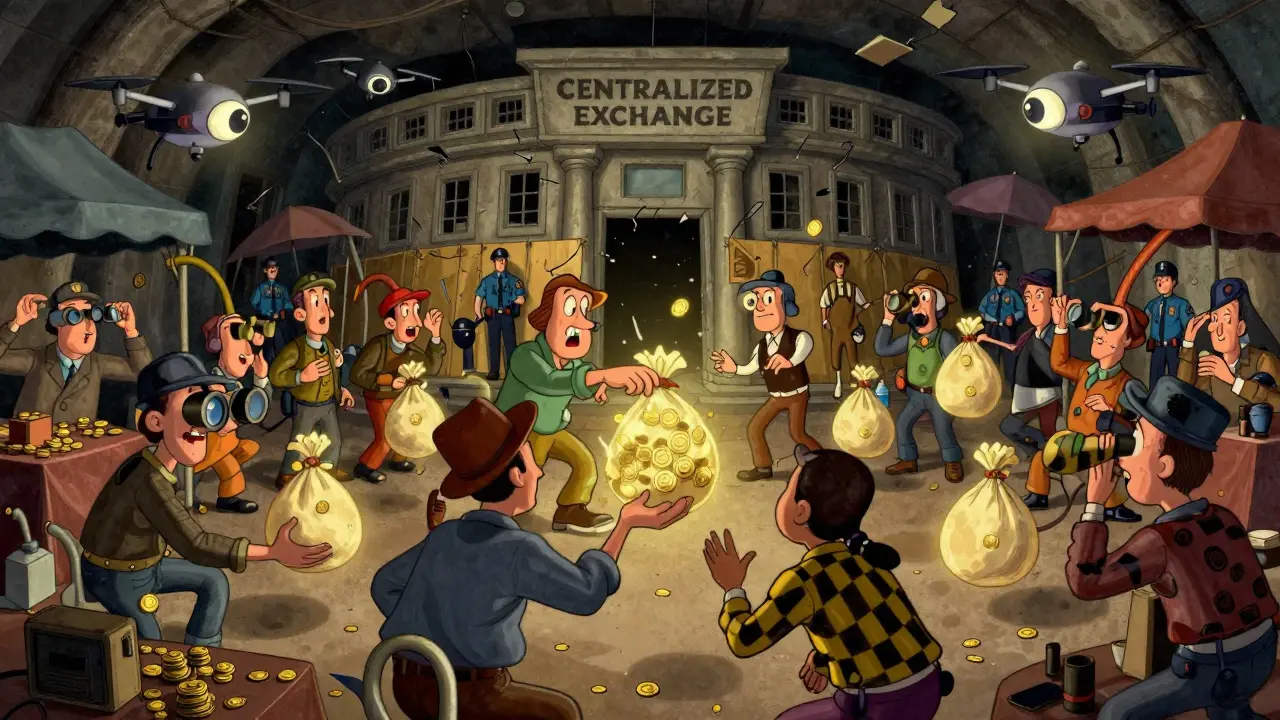
You can't ban something people want; you just push it underground. Or in this case, decentralized. The regulatory pressure has forced a massive shift in where privacy coins are traded.
A total of 73 centralized exchanges (CEXs) have delisted privacy coins globally. In regulated markets, CEXs reduced privacy coin trading pairs by 68%. If you still want to trade on a big exchange like Binance or Coinbase, you'll likely need to pass rigorous KYC checks, and even then, options are limited. Only 35% of centralized exchanges retain any privacy coin listings, and only for verified users.
So, where did the traders go? They moved to Decentralized Exchanges (DEXs). These platforms operate without a central authority, meaning no one can easily force them to delist a token. Following the CEX delistings, DEX privacy coin trading volume increased by 47%. Today, a staggering 81% of global privacy coin trading volume occurs on just 10 major DEX platforms.
Even peer-to-peer marketplaces like LocalMonero saw a 19% surge in user activity immediately after major delistings. Uniswap alone processed $2.1 billion in monthly privacy coin swaps. The liquidity hasn't disappeared; it has just become harder for regulators to monitor because it's spread across non-custodial channels.
Can Technology Outsmart the Regulators?
Regulators aren't sitting idle. They are investing heavily in blockchain forensics. Companies like Chainalysis released Reactor 3.0 in January 2025, boosting detection of suspicious privacy coin flows by 42%. Tookitaki’s analytics platforms achieved 89% accuracy in flagging high-risk privacy coin transactions in South Korea.
Here is the hard truth: privacy coin cryptography is not absolute. Graph models applied to Monero transactions achieve 20-30% success rates in compromising privacy under specific conditions. While this might sound low, it's enough for law enforcement to build cases when combined with other intelligence. Forensic tools deployed across the ecosystem prevented $750 million in potential fraud according to SQ Magazine analysis.
This creates an arms race. As forensic tools get better, privacy coin developers must upgrade their cryptography. Monero’s protocols have resisted sophisticated cryptanalysis for over a decade, but the gap is closing. This constant technical evolution ensures that privacy coins remain a high-stakes game of cat and mouse.
Why Demand Is Actually Growing Despite Bans
It seems counterintuitive, but regulatory restrictions are acting as a catalyst for adoption. Why? Because governments are simultaneously expanding their own surveillance capabilities.
The EU’s DAC8 Directive, which came into effect on January 1, 2026, requires automatic crypto tax reporting to all EU member states. Meanwhile, Central Bank Digital Currencies (CBDCs) piloted in China, India, and Europe feature full transaction traceability. Experts describe these moves as the single largest expansion to financial surveillance authorities since the 2001 PATRIOT Act.
When the state makes it easier to track your money, more people seek ways to protect it. Institutional investors are also entering the space, launching privacy coin trusts and funds. This brings legitimacy and liquidity. DeFi platforms are integrating privacy features to protect sensitive trading data, moving beyond simple value transfer to confidential lending and borrowing.
Market analysts predict that by 2027, nearly 25% of all blockchain transactions could feature built-in privacy features. Privacy is transitioning from a niche feature of specialized coins to a mainstream expectation of digital infrastructure.
Risks You Need to Understand Before Investing
Before you jump in, understand the risks. Privacy coins are volatile and legally precarious.
- Liquidity Issues: With fewer centralized exchanges listing these coins, buying and selling large amounts can be difficult without slippage.
- Legal Liability: Holding or trading privacy coins may be illegal in your jurisdiction. Always check local laws before transacting.
- Negative Perception: Despite evidence that privacy coins represent a small fraction of illicit crypto activity, the association with crime persists, leading to periodic bans and stigma.
- Technical Complexity: Using wallets correctly is crucial. Sending Monero to a transparent address or vice versa can result in permanent loss of funds or exposure of identity.
The use cases for privacy coins are real: remittance corridors, cross-border B2B transfers, and jurisdictions with hyperinflation or capital controls. In these areas, privacy coins provide functional advantages that traditional banking cannot match. But for everyday retail speculation, the regulatory headwinds are strong.
Are privacy coins legal in 2026?
Legality varies significantly by country. In Japan, South Korea, and parts of the European Union, trading privacy coins on regulated exchanges is banned or heavily restricted. In the United States, they are legal to hold but face strict reporting requirements via Form 1099-DA. Always consult local regulations before engaging with privacy assets.
Which privacy coin is the most secure?
Monero is generally considered the most secure due to its mandatory privacy features. Unlike Zcash or Dash, which offer optional privacy, Monero hides all transaction details by default, making it much harder for third parties to link senders and receivers.
Where can I buy privacy coins if exchanges delisted them?
Most trading has moved to Decentralized Exchanges (DEXs) like Uniswap or peer-to-peer platforms. Users swap other cryptocurrencies for privacy coins directly on-chain, bypassing centralized intermediaries. However, this requires more technical knowledge and carries higher risk of interacting with scams.
Will privacy coins survive the FATF Travel Rule?
They will survive, but primarily outside the regulated exchange ecosystem. The Travel Rule forces centralized exchanges to delist privacy coins, pushing volume to DEXs and peer-to-peer networks. The technology itself cannot comply with the rule without losing its privacy function, so a split market is the likely outcome.
Is it true that privacy coins are used mostly for crime?
No. While privacy coins attract negative attention, studies show they account for a very small percentage of overall cryptocurrency illicit activity compared to transparent coins like Bitcoin. Most users adopt them for legitimate reasons such as protecting financial data from hackers, avoiding inflation, or maintaining personal privacy.







mark nine
13 May 2026 at 22:10the shift to dexs is just common sense at this point. why give a central authority the keys to your digital life when you can just swap on chain. it feels like we are finally getting back to what crypto was supposed to be about. no middlemen. no gatekeepers. just code and math doing the heavy lifting for us.