



Trying to launch a crypto project or manage a digital asset fund in the United States often feels like walking through a minefield. One day you're told you're a commodity, the next you're a security, and suddenly you realize you're also a money services business. This "regulatory patchwork" isn't just a headache for lawyers; it's a legitimate business risk that has led 62% of U.S. crypto startups to consider moving their operations overseas. If you're operating in this space, you aren't just dealing with one regulator-you're dealing with four, and they don't always agree.
| Agency | Primary Focus | Key Tool/Test | Main Goal |
|---|---|---|---|
| SEC | Securities/Investment Contracts | Howey Test | Investor Protection |
| CFTC | Commodities & Derivatives | Commodity Exchange Act | Market Integrity |
| FinCEN | Money Laundering & Terror Financing | Bank Secrecy Act (BSA) | Financial Intelligence |
| OCC | National Banks & Trust Companies | Interpretive Letters | Banking Safety/Soundness |
The SEC and the Battle Over Securities
When people talk about "regulation by enforcement," they're usually talking about the Securities and Exchange Commission (SEC). The SEC views many digital assets as investment contracts. To figure this out, they use the Howey Test, a legal standard from 1946 that asks: Is there an investment of money in a common enterprise with a reasonable expectation of profits based on the efforts of others?
If your token meets these criteria, it's a security. This means you have to register the offering or find an exemption. The SEC doesn't play around; between 2018 and 2025, they collected $1.2 billion in crypto-related penalties. Take the Ripple Labs case, for example. While a 2023 ruling found that XRP sales on public exchanges weren't securities offerings, the battle over institutional sales continued. To fix this mess, the SEC created a Crypto Task Force in early 2025 to find a real path forward for broker-dealers and custodians, moving away from the idea that simply publishing open-source code makes a project "suspect."
The CFTC and the Commodity Route
On the other side of the fence is the Commodity Futures Trading Commission (CFTC). They generally handle assets that are seen as commodities-things that are interchangeable and not tied to a specific company's success. Since 2015, the CFTC has officially treated Bitcoin and Ethereum as commodities.
The CFTC's playground is mainly derivatives and futures markets. They approved Bitcoin futures on the CME back in 2017 and Ethereum futures in 2022. While they are often seen as "friendlier" than the SEC, they still hammer fraud. BitMEX, for instance, got hit with a $100 million penalty in 2020 for AML failures. The big shift is coming with the CLARITY Act, introduced in May 2025. This law aims to give the CFTC exclusive power over spot markets for digital commodities, which would finally stop the tug-of-war between the SEC and CFTC over who owns which token.
FinCEN: The Wide Net of Financial Intelligence
While the SEC and CFTC fight over whether a token is a security or a commodity, FinCEN (the Financial Crimes Enforcement Network) doesn't care about the label. For them, if you're moving value, you're likely a Money Services Business (MSB).
Under the Bank Secrecy Act, FinCEN requires crypto businesses to implement Anti-Money Laundering (AML) and Counter-Terrorism Financing (CFT) programs. This is where the "Know Your Customer" (KYC) rules come from. FinCEN is currently targeting "mixers"-services that blur the trail of transactions-labeling them as major money laundering concerns. If you're running a crypto exchange or a wallet service, FinCEN is the agency that ensures you aren't accidentally helping a rogue state hide its funds.

The OCC and the Bridge to Traditional Banking
For the big banks, the Office of the Comptroller of the Currency (OCC) is the point of contact. The OCC decides if a national bank can safely hold crypto for a client. Between 2020 and 2021, they issued a series of interpretive letters that basically gave banks the green light to provide custody services and participate in node verification.
By December 2025, about 47 national banks were offering crypto custody. However, there's a catch. The OCC and state supervisors don't have the same high-tech surveillance tools as the SEC. This means that if a bank's crypto desk starts manipulating the market, the Department of Justice often has to step in as the primary backstop for misconduct. Essentially, the OCC ensures the bank's balance sheet stays healthy, but they aren't necessarily watching every single trade in real-time.
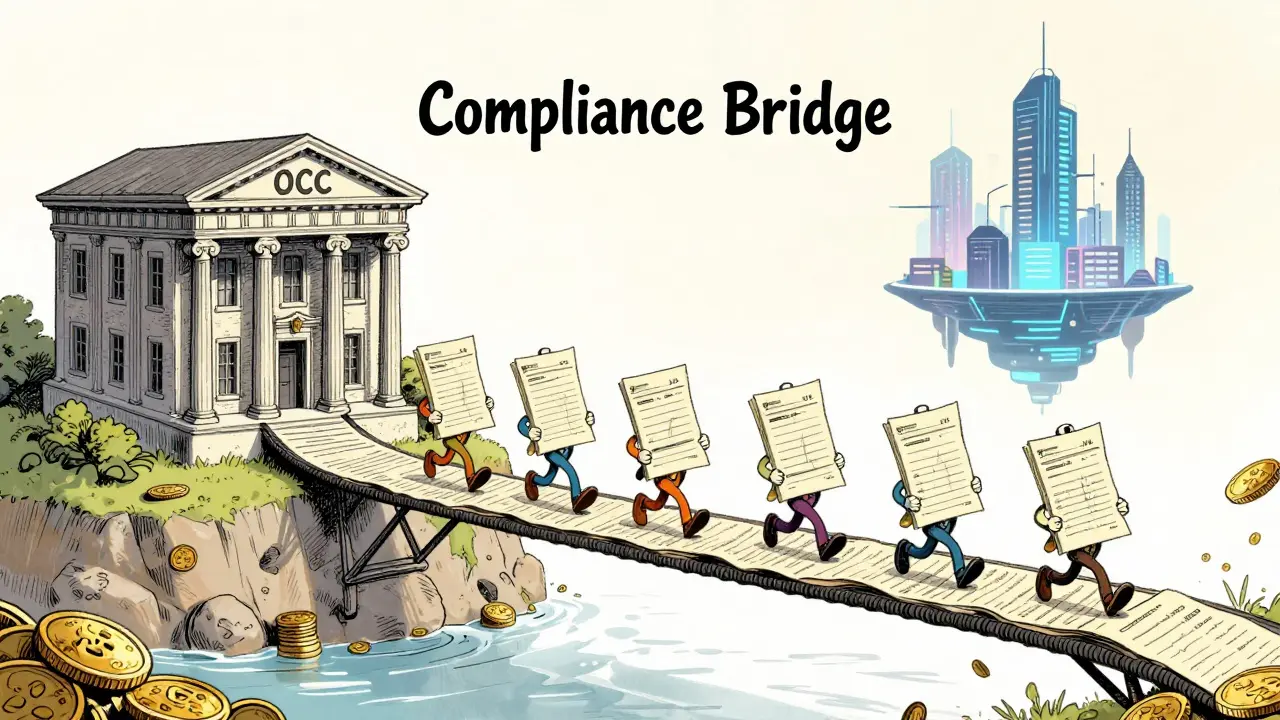
The Compliance Nightmare: Navigating Overlap
The real problem isn't any single agency; it's the overlap. You could be a crypto platform that is simultaneously regulated as an MSB by FinCEN, a commodity platform by the CFTC, and a security offering by the SEC. This "parallel action" risk means you could be fighting three different lawsuits for the same product.
For most firms, this is an expensive game. A 2025 survey found that 78% of crypto companies spend over $1 million annually just on compliance. This is why the "Harmonization Statement" of September 2025 was such a big deal. It was a rare moment where the SEC and CFTC publicly committed to working together to stop the contradictory guidance that has stifled innovation for years.
What's Next for US Crypto Law?
We are moving toward a more mature system, but we aren't there yet. The CLARITY Act is the most promising piece of legislation we've seen, potentially resolving the gap for payment stablecoins-which currently sit in a weird limbo where they aren't clearly securities or commodities. If it passes in 2026, it could provide the legal certainty needed to bring the 45 million active U.S. crypto users into a safer, more regulated environment.
Does the SEC always regulate every cryptocurrency?
No. The SEC only regulates assets that qualify as securities under the Howey Test. If a token is sufficiently decentralized and doesn't promise profits based on the efforts of a specific group, it may be classified as a commodity, falling under the CFTC's jurisdiction instead.
What is the difference between FinCEN and the SEC?
The SEC focuses on whether a token is an illegal investment contract and protects investors from fraud. FinCEN focuses on the movement of money, ensuring that crypto businesses follow AML and KYC laws to prevent money laundering and terrorism financing.
Can a bank legally hold crypto in the US?
Yes, provided they are a national bank and follow the OCC's guidelines. The OCC has authorized banks to provide custody services and hold stablecoin reserves, though banks must notify their supervisors before starting these activities.
What is the CLARITY Act?
Introduced in May 2025, the CLARITY Act is a legislative attempt to clearly divide the lines between the SEC and CFTC. Its main goal is to grant the CFTC exclusive jurisdiction over digital commodity spot markets and clarify the status of stablecoins.
What happens if a crypto company ignores FinCEN?
Companies that fail to register as Money Services Businesses (MSBs) or ignore AML requirements face heavy civil penalties. For example, ECS Mint was fined $110,000 for failing to meet these requirements early in the industry's history.
Next Steps for Businesses
If you're entering the US market, don't just pick one regulator to satisfy. Start by mapping your activity: Are you offering a token for investment? (Check the Howey Test). Are you facilitating payments? (Register with FinCEN). Are you offering futures? (Contact the CFTC). The safest bet in 2026 is a "multi-agency" compliance strategy that assumes you'll need to answer to at least two of these entities. Keep a close eye on the final passage of the CLARITY Act, as it will likely change the registration requirements for spot markets.









Ray Htoo
15 Apr 2026 at 16:23This breakdown is an absolute godsend for anyone trying to make sense of this bureaucratic labyrinth! It's wild how these agencies just bump heads while the actual innovators are left twisting in the wind. I'm honestly stoked to see if the CLARITY Act actually delivers on its promise or if it's just more political window dressing. The whole concept of using a 1946 test for digital assets is just peak absurdity, but hey, that's the US legal system for you!