



Remember when setting up a call center meant hauling heavy hardware into a basement office? Those days are gone. Today, VoIP call center solutions run entirely over the internet, turning any laptop into a powerful agent station. But it’s not just about making calls cheaper-it’s about using data to solve problems faster.
In 2026, the gap between a basic phone system and a smart contact center is massive. You aren't just buying phones; you're deploying artificial intelligence, real-time analytics, and omnichannel routing. If you’re looking to upgrade or launch a new support team, understanding these technologies isn't optional-it's survival. Here is what you need to know to pick the right tech stack without getting burned.
The Core Technology Behind Modern VoIP
To understand why VoIP dominates, you have to look under the hood. Traditional phone systems used circuit-switched networks-dedicated physical lines for each call. Voice over Internet Protocol (VoIP), on the other hand, breaks voice signals into digital packets and sends them over your existing data network. This shift changed everything.
Modern enterprise-grade implementations rely on cloud-based architecture. You don’t need a PBX box in your closet. Instead, the switching happens in remote data centers. For this to work smoothly, you need specific technical foundations:
- Bandwidth Requirements: A minimum of 100 Kbps per call is standard. If you have 50 agents, that’s 5 Mbps dedicated to voice traffic alone.
- Codecs: These compress audio. G.711 offers crystal-clear quality but uses more bandwidth (64 Kbps). G.729 is efficient (8 Kbps) but slightly lower fidelity. Most modern platforms use Opus for adaptive quality.
- Latency: With 5G integration, latency has dropped to 1-10 milliseconds. Older broadband connections often sat at 30-60ms, which causes noticeable lag in conversations.
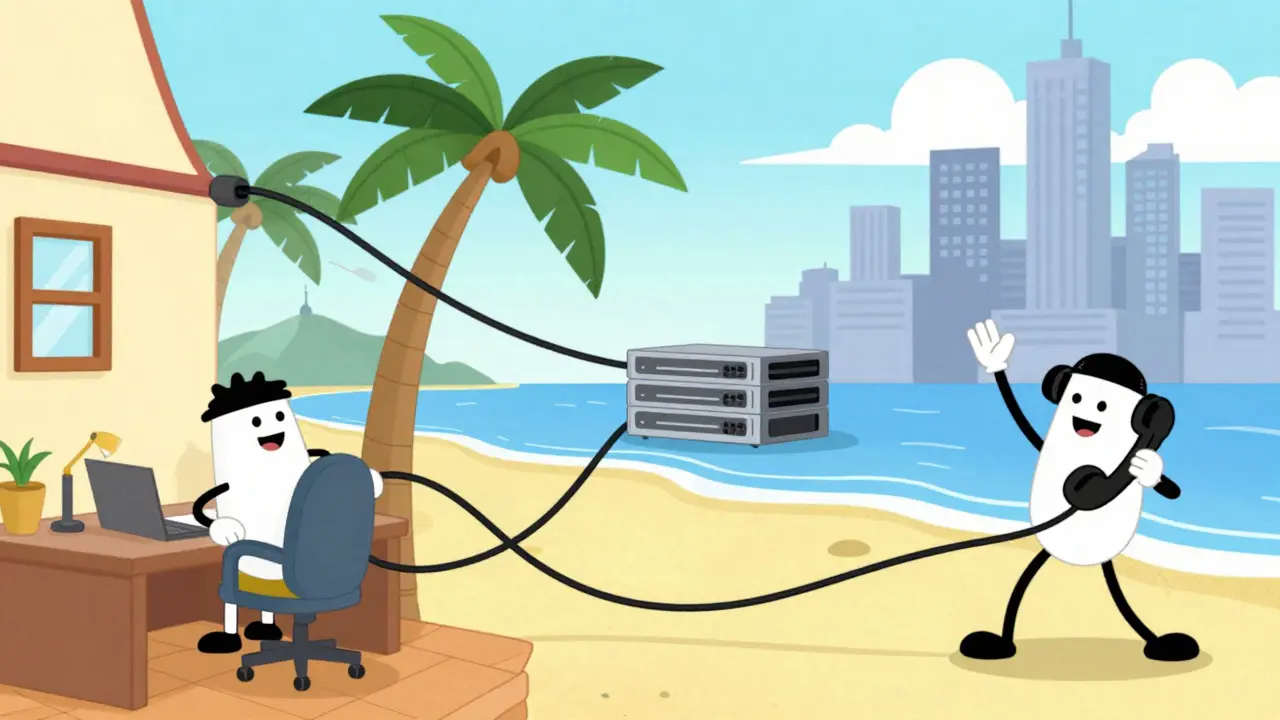
The result? Crystal-clear voice even in congested networks. According to SPARK Services (2024), this reliability holds up even in high-traffic areas, provided your infrastructure supports it. The biggest win here is flexibility. Your agents can work from Madison, Miami, or Madrid with the same system performance.
Essential Features That Drive Efficiency
A VoIP platform is only as good as its features. In 2026, "making calls" is the bare minimum. You need tools that manage the flow of interactions intelligently. Here are the non-negotiables:
1. Interactive Voice Response (IVR)
IVR is the automated menu system (“Press 1 for Sales…”). Modern IVRs are no longer rigid scripts. They use natural language processing. GetVoIP’s 2024 study found that advanced IVR systems handle twice as many interactions as a single human agent at 48 times lower cost. They filter out simple queries before they ever reach an agent.
2. Automatic Call Distribution (ACD)
ACD routes incoming calls to the best available agent. It doesn’t just pick the first person free; it uses skills-based routing. If a customer calls about billing issues in Spanish, the ACD routes them to an agent who speaks Spanish and is trained in billing. Nextiva reports this achieves 92% accurate call placement, drastically reducing transfer rates.
3. Omnichannel Integration
Customers switch between channels constantly. They might start with email, then chat, then call. An omnichannel platform merges these into one timeline. When an agent picks up the phone, they see the previous email thread. This context switch saves time and frustrates customers less.
4. Real-Time Analytics
You can’t improve what you don’t measure. Modern dashboards show queue lengths, average handle time, and sentiment scores in real-time. Supervisors can jump into a live call if they detect frustration, turning a potential complaint into a loyalty moment.
The AI Revolution in Customer Service
Artificial Intelligence is the biggest game-changer in VoIP right now. It’s not sci-fi anymore; it’s deployed in thousands of centers globally. But how does it actually help?
AI-powered voice analytics processes 100% of calls in real-time. Loris.ai’s 2025 analysis shows sentiment analysis accuracy has hit 87%. This means the system knows if a customer is angry, confused, or happy-and flags it for review.
Consider conversational AI. Gartner analyst Megan Fernandez predicted that by 2026, 75% of customer service interactions will be handled without human agents. Chatbots and voice bots handle Tier-1 support (password resets, order status). This frees up humans for complex issues. However, Forrester’s Craig Johns warns that over-automation risks alienating 43% of customers who prefer humans for complex problems. The key is balance: use AI for speed, humans for empathy.
Another critical feature is predictive behavioral routing. This anticipates customer needs with 85% accuracy. If a customer frequently calls about shipping delays, the system proactively offers tracking info before they even ask. Early implementations show a 31% improvement in sales conversion rates because agents are prepared.
Cost Analysis: VoIP vs. Traditional Systems
Money talks. Let’s look at the numbers. Convoso’s 2025 benchmark study reveals that VoIP call centers provide 40-60% cost savings over traditional PRI (Primary Rate Interface) systems. Where does that money go?
- Hardware Elimination: No more expensive desk phones or PBX maintenance contracts.
- Long Distance: Calls are data. Domestic long-distance fees vanish. International rates drop significantly.
- Scalability: Adding a new agent takes minutes, not weeks. Talkroute demonstrated instant addition of 1,000+ concurrent agents for an e-commerce client during peak season.
Pricing models vary. Entry-level solutions like Aircall start around $30/user/month. Mid-range options like Nextiva sit near $79.95/user/month for premium features. Enterprise solutions exceed $100/user/month. Remember to watch for hidden costs like overage charges or API access fees.
| Feature | Traditional PRI/PBX | Cloud VoIP Solution |
|---|---|---|
| Deployment Time | Weeks to Months | Days (Avg. 14 days) |
| Uptime Reliability | 99.5% | 99.995% |
| Scalability | Low (Hardware dependent) | High (Instant scaling) |
| Remote Work Support | Poor | Excellent |
| Upfront Cost | High ($10k-$50k+) | Low (Subscription based) |
Security and Compliance in 2026
Security is paramount. You’re handling sensitive customer data. Modern VoIP providers must adhere to strict standards. Look for these certifications and protocols:
- Encryption: TLS 1.3 for signaling and SRTP for media encryption ensures calls cannot be intercepted.
- STIR/SHAKEN: Mandated by the FCC since June 2023, this combats robocalls by authenticating caller ID information.
- Data Sovereignty: If you’re in government or healthcare, check where data is stored. Some regions require local servers. IDC notes that 68% of government organizations maintain hybrid systems for this reason.
- TCPA Compliance: Fines for violating telemarketing rules range from $500 to $1,500 per violation. Integrated compliance tools track consent timestamps and automate Do Not Call list management.
Don’t skimp on security. A breach costs far more than the subscription fee.
Implementation Challenges and Best Practices
Switching systems isn’t painless. Gartner surveys show 37% of users face CRM integration complexities. Another 29% deal with agent resistance to new workflows. How do you avoid these pitfalls?
Phased Rollouts: Don’t flip the switch overnight. Start with a pilot group. McKinsey’s 2025 study shows phased rollouts reduce adoption time by 45%.
Training Matters: Agents need 8-16 hours of training for basics. Supervisors need 24-40 hours for analytics. Administrators need 80+ hours. Invest in this time. Poor training leads to low morale and errors.
Backup Plans: VoIP relies on internet. If your ISP goes down, your phone system dies. 22% of businesses reported service disruption during major ISP failures in 2024. Use mobile failover apps or redundant internet connections.
Documentation quality varies wildly. RingCentral scores 4.7/5 for comprehensiveness, while smaller providers struggle. Check reviews before signing.
Market Leaders and Vendor Landscape
Who should you choose? The market is consolidating. RingCentral leads the UCaaS segment with 22% share. Zoom Phone follows at 18%. For pure-play contact centers, Five9 dominates with 31% share. However, Microsoft Teams Contact Center is gaining ground by integrating meetings and messaging.
User feedback matters. On G2 (Q1 2025), RingCentral scored 4.6/5, praised for seamless CRM integration saving agents 2.7 hours daily. Dialpad scored lower at 4.0/5, with complaints about complex IVR configuration. Read recent reviews. Look for mentions of “real-time analytics” and “support responsiveness.”
Be wary of vendor lock-in. Ensure your chosen platform offers open APIs so you can integrate with your existing tech stack (Salesforce, HubSpot, Zendesk, etc.).
Future Trends: What’s Next?
The industry is moving toward unified experience platforms. By 2027, 92% of enterprises plan full migration from legacy systems. Expect deeper AI integration, including voice cloning for personalized outreach (though 68% of consumers express discomfort with this, per PwC).
Video calling is becoming standard. 73% of enterprise platforms now offer 4K video capabilities. As remote work stabilizes, visual cues in customer service will become more common, especially for technical support.
Finally, expect tighter regulation around AI ethics. As bots become indistinguishable from humans, disclosure laws will tighten. Stay informed.
What is the difference between VoIP and traditional phone systems?
Traditional systems use dedicated physical copper lines (circuit-switched). VoIP converts voice into digital data packets sent over the internet (packet-switched). This makes VoIP cheaper, more flexible, and easier to scale remotely.
How much bandwidth do I need for a VoIP call center?
You need at least 100 Kbps per concurrent call. For a team of 20 agents, ensure you have a stable connection with at least 2-3 Mbps dedicated to voice traffic to prevent jitter and latency issues.
Is VoIP secure enough for financial services?
Yes, if configured correctly. Modern providers use TLS 1.3 and SRTP encryption. Financial institutions should also ensure STIR/SHAKEN compliance and verify data sovereignty locations to meet regulatory requirements.
What are the best VoIP call center software options in 2026?
Top contenders include RingCentral for overall usability, Five9 for specialized contact center features, and Zoom Phone for teams already using Zoom Meetings. Choose based on your specific need for CRM integration and AI analytics.
Can VoIP work during an internet outage?
Not directly. VoIP requires an active internet connection. However, most providers offer mobile failover apps that route calls to cell phones via 4G/5G networks, ensuring continuity during local broadband failures.






Write a comment