

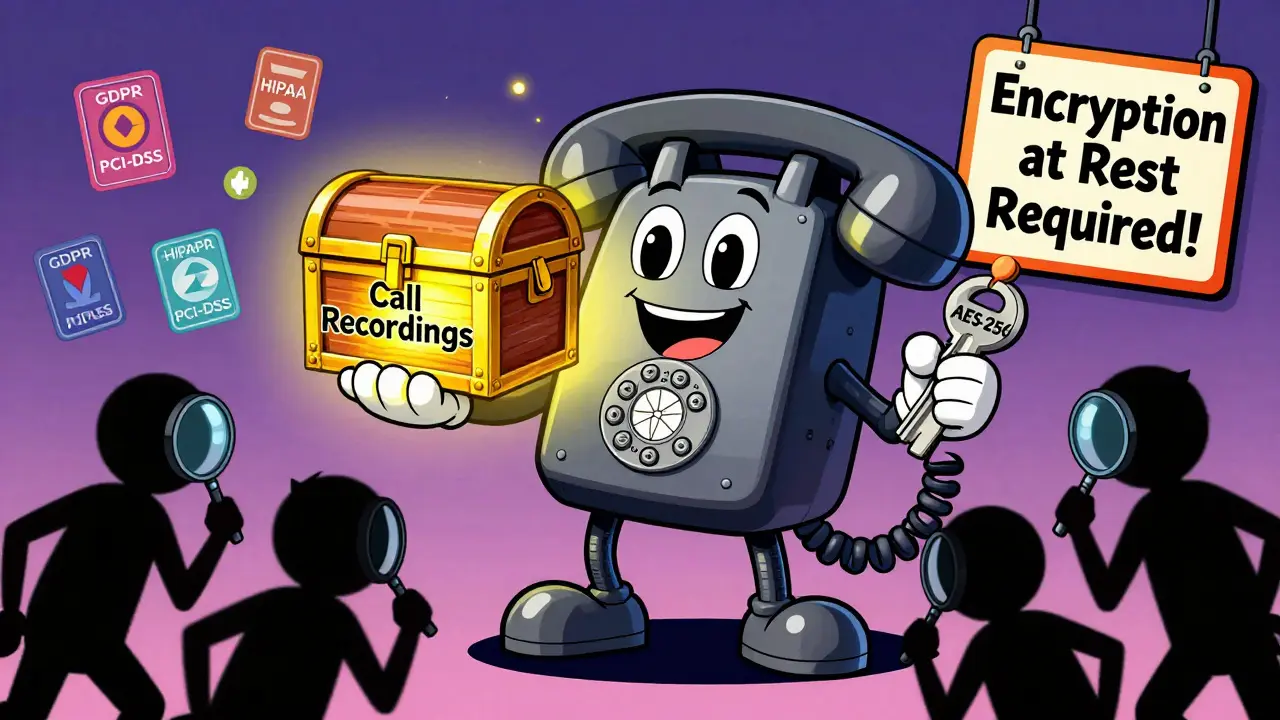

When you record a customer call, you’re not just saving a conversation-you’re storing sensitive data. Credit card numbers, Social Security numbers, medical details, even personal emotions. If that recording falls into the wrong hands, it’s not just a privacy breach-it’s a legal disaster. And yet, many businesses still treat VoIP call recordings like ordinary files, stored without real protection. That’s dangerous. The truth is, encryption at rest and access controls aren’t optional features. They’re the bare minimum for any organization handling recorded calls in 2026.
Why VoIP Call Recordings Are a High-Risk Target
VoIP systems make it easy to record calls. But that convenience hides a big problem: recorded calls are often stored in plain text or weakly encrypted databases. Unlike live calls, which are protected during transmission with protocols like SRTP or TLS, recordings sit idle-waiting to be accessed. And attackers know it. In 2024, 73% of call recording breaches happened because someone inside the company-or an outsider who stole credentials-accessed unencrypted files. These weren’t random hacks. They were targeted grabs for data that could be sold, leaked, or used for identity theft. Regulations like GDPR, HIPAA, and PCI-DSS don’t just say “protect data.” They demand specific technical safeguards. For example, GDPR Article 32 requires “appropriate technical measures” for personal data. HIPAA’s Security Rule says protected health information must be encrypted when stored. If your call recordings aren’t encrypted at rest, you’re already non-compliant. And the fines? They’re not small. A single GDPR violation involving voice data can cost over €1.87 million, according to a 2025 analysis by Clearspan Communications.What Encryption at Rest Actually Means
Encryption at rest means your recorded calls are scrambled before they hit the hard drive. Even if someone steals your storage server, they can’t play the files without the key. This isn’t the same as encrypting calls while they’re being transmitted. That’s important, but it doesn’t help once the call ends and the file is saved. The industry standard is AES-256 encryption. That’s the same level used by banks and government agencies. It’s not just a buzzword-it’s a technical requirement. NIST SP 800-58, updated in 2019 and still the go-to guide, explicitly recommends AES-256 for stored voice data. But here’s the catch: encryption at rest isn’t just about turning on a setting. You need to protect the entire storage path. That means:- Encrypted recordings on your main server
- Encrypted backups
- Encrypted archives
- Encrypted cloud storage if you use AWS, Azure, or Google Cloud
Access Controls: Who Gets to Listen?
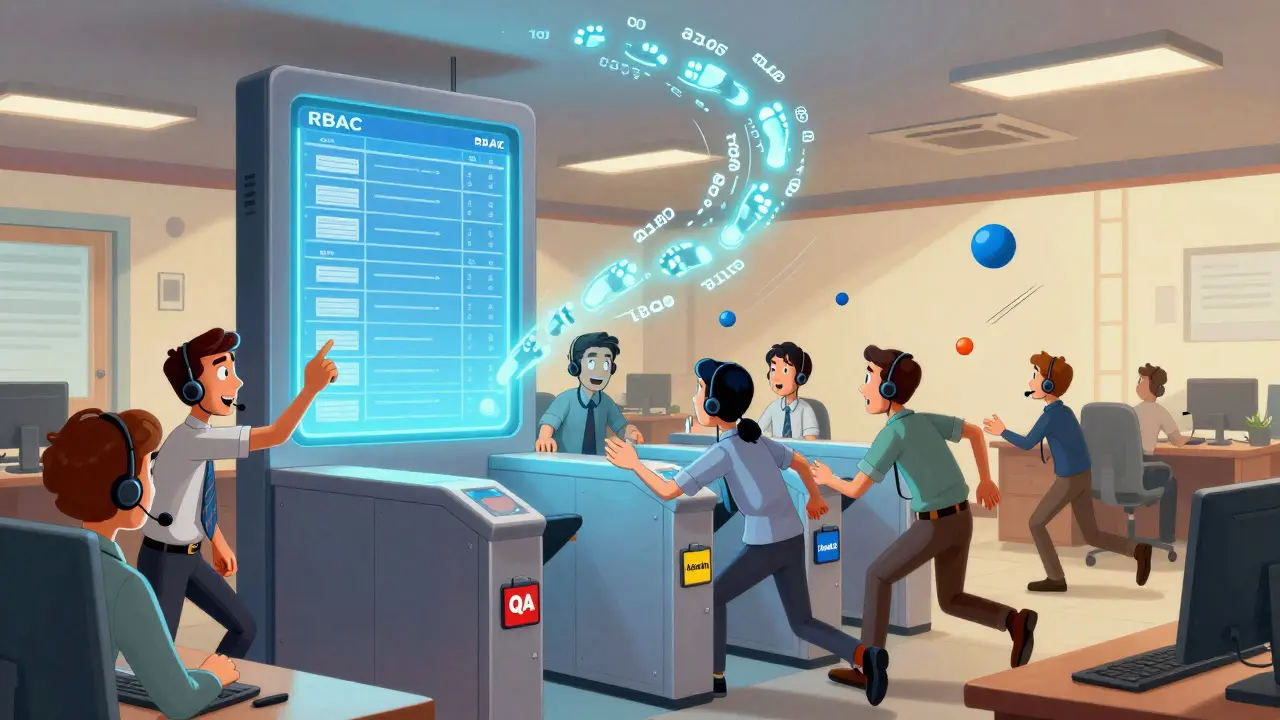
Encryption keeps the data locked. Access controls decide who has the key. And here’s where most companies fail. Too many organizations give “admin access” to everyone in IT, or let call center supervisors download recordings without approval. That’s a recipe for abuse. The right approach is role-based access control (RBAC). That means:- Customer service reps can only listen to their own calls
- Quality assurance staff can access calls for training, but only with supervisor approval
- Compliance officers can search and export recordings-but only after logging in with multi-factor authentication (MFA)
- IT admins can’t access recordings unless they’re in a specific security group
Real-World Impact: Successes and Failures
A contact center in Chicago with 500 employees switched to Vonage’s platform in late 2024 and implemented AES-256 encryption with strict RBAC. They spent eight weeks configuring everything. Result? Their compliance audit findings dropped by 92%. That’s not just savings on fines-it’s peace of mind. But it doesn’t always go smoothly. A financial services firm in Ohio upgraded their system but didn’t upgrade their storage. The encryption slowed down search times by 30%. Compliance teams couldn’t find recordings fast enough to meet legal deadlines. They ended up spending $47,000 on faster SSD storage just to fix it. The lesson? Encryption adds overhead. Plan for it. User ratings tell the real story. Providers with strong encryption and access controls average 4.6 out of 5 stars on review platforms like G2 Crowd. Those without? They sit at 3.2. Customers and partners notice. Trust isn’t built on marketing-it’s built on security.What You Need to Implement This Right
If you’re starting from scratch, here’s your checklist:- Inventory your recordings. Where are they stored? On-prem? In the cloud? In backups? Make a map.
- Choose AES-256 encryption. Don’t accept anything less. Ask your VoIP provider for proof it’s implemented correctly.
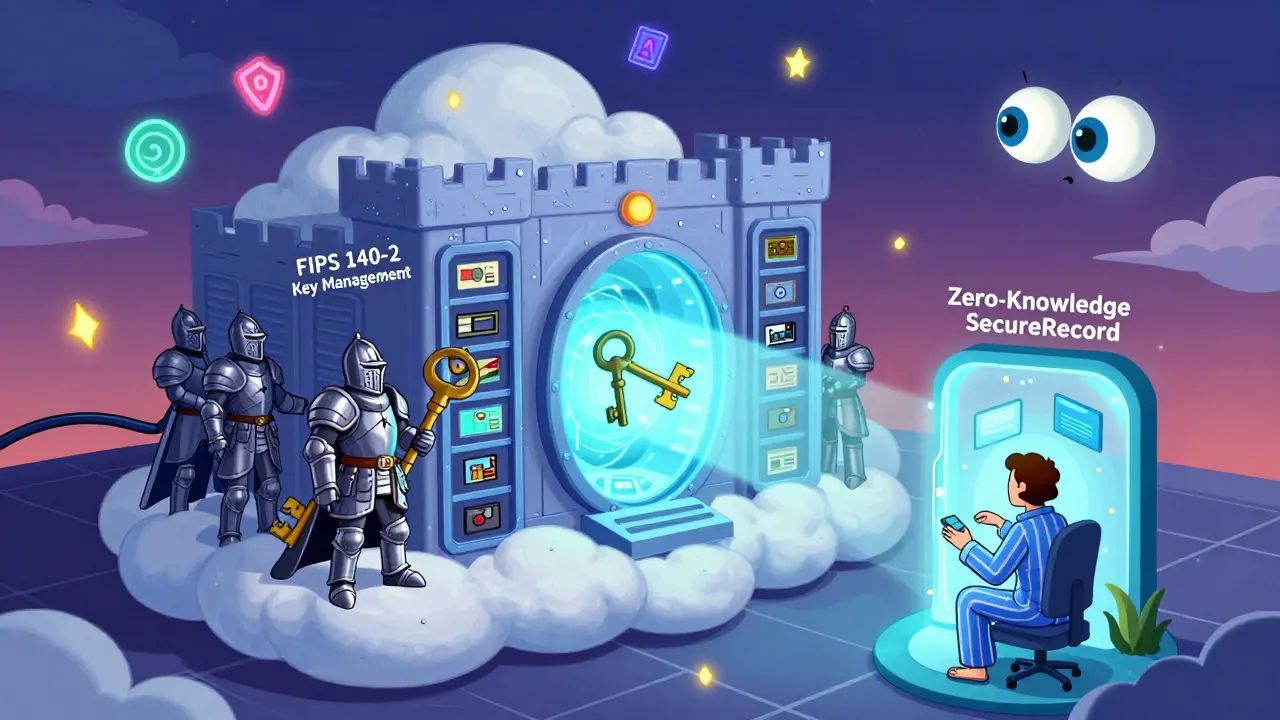
- Set up a FIPS 140-2 validated key management system. This isn’t something you build yourself. Use a trusted vendor like HashiCorp Vault or AWS KMS.
- Define roles and permissions. Map out who needs access and why. Start tight-then expand only if necessary.
- Require MFA for all recording access. No exceptions. Not even for admins.
- Enable detailed logging. Every access, every export, every deletion.
- Test your setup. Simulate a breach. Can someone with stolen credentials access recordings? If yes, you’re not done.
The Future Is Already Here
In January 2026, Cisco announced integration between its AnyConnect client and call recording systems. That means remote workers can securely access encrypted recordings without ever exposing the decryption keys. In September 2025, Vonage launched “SecureRecord”-a zero-knowledge system where even Vonage can’t decrypt your calls. That’s the future: security that doesn’t rely on trust. Looking ahead, homomorphic encryption will let you search encrypted recordings without decrypting them. AI systems will flag unusual access patterns-like someone downloading 200 calls at 2 a.m. That’s not science fiction. Gartner predicts 45% of enterprises will use homomorphic encryption by 2028. The bottom line? Call recording security is no longer a nice-to-have. It’s a legal requirement, a customer expectation, and a competitive advantage. If you’re still storing recordings without AES-256 encryption and strict access controls, you’re not just risky-you’re behind. And in 2026, being behind means you’re already exposed.What Happens If You Do Nothing?
IBM’s 2025 Cost of a Data Breach Report found that breaches involving voice data cost 23% more than standard data breaches. Why? Because recorded calls are harder to contain. They’re emotional. They’re personal. They’re often tied to regulated data. And once leaked, they can’t be undone. You’ll face:- Fines from regulators
- Lawsuits from customers
- Reputational damage that takes years to repair
- Loss of contracts-especially in healthcare, finance, and government
Is encryption at rest mandatory for VoIP call recordings?
Yes, if you handle personal, financial, or health data. Regulations like GDPR, HIPAA, and PCI-DSS require encryption of stored sensitive information. Even if your country doesn’t enforce it, major clients and partners will demand it. Not encrypting recordings is a compliance violation, not a technical oversight.
Can I use AES-128 instead of AES-256 for call recordings?
Technically, yes-but you shouldn’t. AES-128 is still secure for most uses, but NIST and industry standards recommend AES-256 for long-term storage of sensitive data. If you’re storing recordings for more than a few years, or if they contain regulated information, AES-256 is the only acceptable choice. It’s also the standard required by most enterprise contracts and compliance audits.
Do I need to encrypt call recordings stored in the cloud?
Absolutely. Cloud providers like AWS and Azure don’t automatically encrypt your data by default. You must enable encryption at rest yourself, and manage the keys. Many businesses assume the cloud is secure, but the responsibility for data protection always lies with you. Never rely on the provider’s default settings for sensitive recordings.
How do access controls affect call search performance?
Strong encryption can slow down searches because the system must decrypt files before indexing them. This is especially true if you’re using basic storage. The fix? Upgrade to SSD-based storage and use specialized encrypted search tools that tokenize metadata without decrypting the audio. Companies that skip this step often find compliance reviews taking 2-3 times longer than they should.
Can employees record calls on their personal phones and bypass security?
If they can, you have a serious policy gap. Personal devices, consumer apps like WhatsApp or Zoom, and unmanaged phones are major security risks. Your policy must require all business calls to be recorded only through your approved VoIP system. Enforce this with endpoint management tools and regular audits. Otherwise, your encryption and access controls are meaningless.
What’s the biggest mistake companies make with call recording security?
Assuming that because a call was encrypted during transmission, it’s safe once stored. That’s like locking your front door but leaving your safe wide open in the backyard. Encryption in transit protects the call while it’s moving. Encryption at rest protects it when it’s sitting on a server. You need both. Most breaches happen because only one layer exists.







Mike Marciniak
30 Jan 2026 at 04:41They say AES-256 is the standard but let’s be real - if the government can’t keep their own encryption keys secure, why should I trust some SaaS vendor with my call recordings? I’ve seen too many ‘secure’ systems get breached from the inside. No one talks about the admin who exports 300 recordings because they’re bored. Encryption at rest means nothing if the keys are sitting in a config file on the same server. And don’t even get me started on cloud providers. AWS doesn’t care about your compliance - they care about your monthly bill.