



Imagine trying to pay for your morning coffee with cash, but the barista demands to know your name, your tax ID, and exactly where every dollar in your wallet came from before handing you the cup. That is essentially what regulators are asking of privacy coins in 2026. For years, these digital assets promised financial freedom through anonymity. Now, they face a harsh reality check. The EU’s new rules and global anti-money laundering pressures are forcing a split between those who want total secrecy and those willing to prove their legitimacy without revealing everything.
This isn't just about tech geeks arguing on forums. It affects your portfolio, your exchange access, and how money moves across borders. If you hold Monero (XMR) or Zcash (ZEC), you need to understand why their prices swung wildly last year and what that means for your next move. We’re seeing a shift from "hide everything" to "prove compliance." Let’s break down what’s happening, why it matters, and which privacy solutions might actually survive the regulatory storm.
The Rise and Fall of Anonymity Enhanced Coins
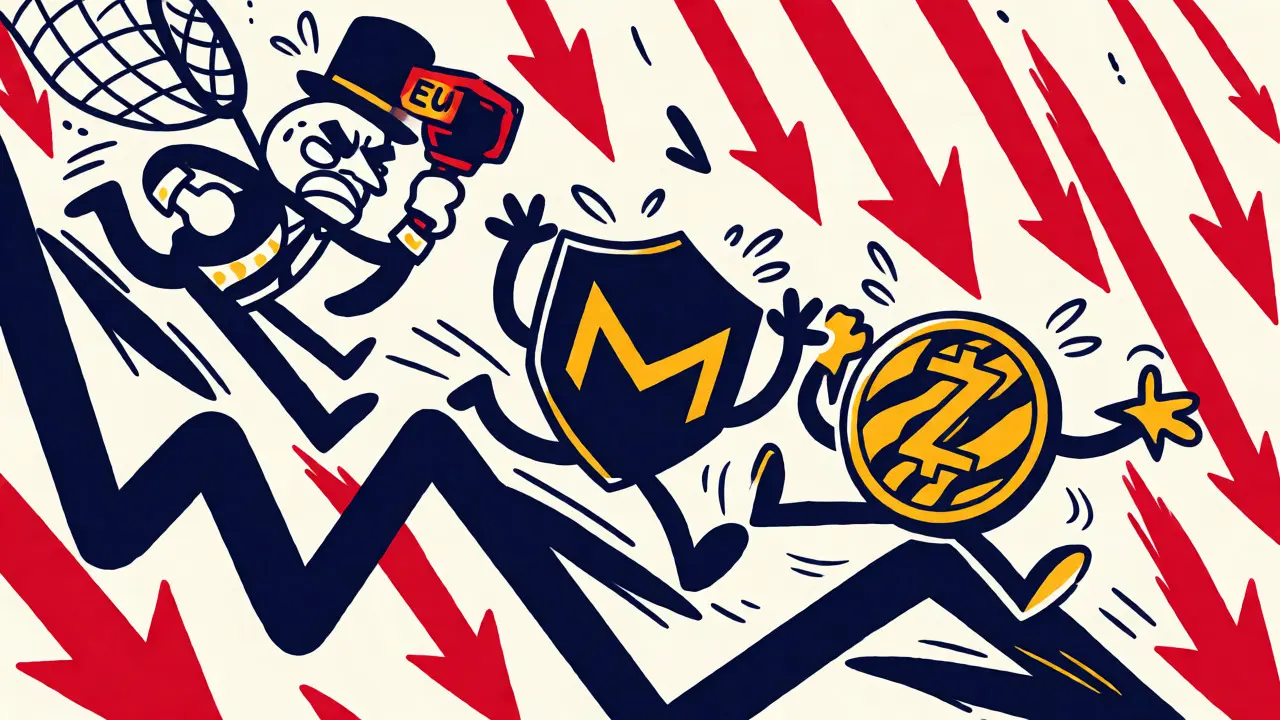
Back in 2025, privacy coins were the darlings of the crypto market. Zcash surged by 820%, while Monero climbed 130%. These numbers dwarfed Bitcoin and Ethereum. Why? Because people wanted confidentiality in an increasingly transparent blockchain world. But then 2026 hit, and the party ended abruptly. Monero dropped nearly 29% in a single week, and Zcash fell over 33%. Smaller projects like ZANO barely blinked, losing only 1.4%.
What caused this divergence? The market started pricing in risk. Investors realized that the biggest privacy coins were also the most exposed to government crackdowns. When regulators threaten delisting, liquidity dries up fast. The drop wasn't just a market correction; it was a signal that pure anonymity comes with a heavy premium. You aren't just paying for privacy; you're paying for the risk that your asset might become illegal to trade on major platforms overnight.
The EU Strikes Back: Understanding DAC8
The primary driver of this chaos is Europe. Effective January 1, 2026, the Directive on Administrative Cooperation (DAC8) changed the game. This rule requires Crypto-Asset Service Providers (CASPs) to report detailed transaction data, user identities, and tax IDs for anyone in the EU. Think of it as the IRS getting a direct feed into your crypto wallet.
Here’s the problem: Privacy coins are designed to hide this exact data. A CASP cannot accurately report a Monero transaction because the sender, receiver, and amount are often obscured by cryptography. This creates a compliance bottleneck. Exchanges can’t meet the reporting requirement if the underlying asset doesn’t provide the necessary visibility. Consequently, many exchanges are choosing to delist or restrict these coins rather than fight the regulator. The EU’s Anti-Money Laundering Regulation explicitly bans anonymous accounts, favoring traceability. If you’re holding privacy coins on a European exchange, you might find yourself unable to withdraw them soon.
| Coin | Primary Feature | Compliance Path | 2026 Market Risk |
|---|---|---|---|
| Monero (XMR) | Mandatory privacy via Ring Signatures | Difficult; lacks native selective disclosure | High (Delisting risk) |
| Zcash (ZEC) | Optional privacy via Shielded Transactions | Viable; supports viewing keys for audits | Medium (Adaptable) |
| Concordium | On-chain identity & privacy | Built-in KYC integration | Low (Designed for compliance) |
Why Law Enforcement Struggles with Privacy Tech
It’s not just about taxes. Police and prosecutors hate privacy coins. They make tracing illicit funds-like ransomware payments or drug proceeds-extremely hard. Traditional blockchains like Bitcoin leave a paper trail. Every coin has a history. Privacy coins break that chain. When investigators try to present evidence in court, they often hit a wall. How do you prove someone paid for something illegal if the transaction details are mathematically hidden?
This technical complexity frustrates legal systems. Judges aren't cryptographers. Explaining zero-knowledge proofs or ring signatures to a jury takes time and expertise. As a result, law enforcement agencies lobby aggressively for bans. They argue that if you can’t see the money, you can’t stop the crime. This pressure leads to blunt instruments like outright bans, seen recently in the United Arab Emirates, rather than nuanced regulations.
The Pivot to Compliant Privacy
So, is privacy dead? Not quite. The industry is pivoting toward "compliant privacy." The idea is simple: users should be able to prove they aren’t criminals without handing over their entire life story to the bank. Varun Kabra from Concordium argues that survival depends on separating privacy from anonymity. You don’t need to be invisible; you just need to verify your legitimacy.
This approach changes the architecture of privacy coins. Instead of hiding everything by default, protocols enable selective disclosure. You share a cryptographic proof that says, "I have enough funds," or "My source of funds is verified," without revealing who sent the money. This satisfies regulators’ need for assurance while preserving user dignity. It’s a middle ground. Regulators get their checks and balances; users keep their secrets.
Zcash vs. Monero: The Structural Advantage
This is where Zcash gains an edge over Monero. Monero is built for absolute privacy. It’s great for freedom, but terrible for compliance. Zcash, however, offers shielded transactions that can be decrypted using viewing keys. This feature allows users to disclose transaction details to auditors or regulators when required, while keeping them private from the public eye.
Analysts call this "compliant privacy." It positions Zcash as structurally better equipped to engage with exchanges. If a regulator asks, "Who did Alice send money to?", Zcash can answer yes or no based on a shared key. Monero struggles to provide that specific audit trail without compromising its core design. In a world where exchanges fear fines more than lost trading volume, Zcash’s flexibility makes it a safer bet for institutional adoption.

Where Do Users Go Next?
If exchanges delist privacy coins, do they disappear? History suggests no. Demand for privacy is stubborn. If centralized exchanges ban XMR or ZEC, users will migrate to decentralized exchanges (DEXs), Layer 2 protocols, and self-custody tools. The "herd effect" that strengthens privacy networks might weaken temporarily, but the underlying need remains.
We’re already seeing this shift. People are moving away from fragile reliance on centralized on-ramps toward censorship-resistant networks. Decentralized pools allow peer-to-peer swaps without a central authority to freeze assets. While this adds friction-you might need more technical skill-it ensures survival. The ecosystem evolves from "easy to use but risky" to "harder to use but resilient."
The Future Is Infrastructure, Not Just Currency
Finally, consider that privacy isn't just about money. Products like Mixin Messenger show how "secrets-as-a-service" can protect communications, not just transactions. The future of privacy tech may lie in broader infrastructure. It’s not just about hiding your balance; it’s about protecting your data, your identity, and your digital footprint.
For investors and users, the takeaway is clear. Pure anonymity faces headwinds. Selective disclosure is the lifeline. Watch for protocols that build compliance into their DNA. Those that force regulators to trust technology rather than demand total surveillance will win. The rest will struggle to stay listed.
Why are privacy coins being banned or delisted?
Privacy coins obscure transaction details, making it difficult for Crypto-Asset Service Providers (CASPs) to comply with regulations like the EU's DAC8, which mandates detailed reporting of user identities and transaction sources. To avoid fines and legal complications, many exchanges choose to delist these assets rather than manage the compliance burden.
Is Zcash safer than Monero for regulatory compliance?
Generally, yes. Zcash uses optional shielding and viewing keys, allowing users to selectively disclose transaction data to auditors or regulators. Monero provides mandatory privacy, which makes it harder to integrate with traditional KYC/AML frameworks, leading to higher delisting risks on regulated exchanges.
What is the DAC8 directive?
The Directive on Administrative Cooperation (DAC8) is an EU regulation effective January 1, 2026. It requires crypto service providers to report detailed transaction data, including user identities and tax identification numbers, to tax authorities. This clashes with the anonymity features of privacy coins.
Will privacy coins disappear completely?
Unlikely. While centralized exchanges may restrict them, demand for financial privacy persists. Users are expected to migrate to decentralized exchanges, Layer 2 solutions, and self-custody wallets, creating a more resilient but less accessible ecosystem for privacy-focused assets.
How does "selective disclosure" work?
Selective disclosure allows a user to prove specific attributes of a transaction (e.g., "the sender has sufficient funds") without revealing the full details (e.g., the sender's identity). This is achieved through cryptographic techniques like zero-knowledge proofs, satisfying regulatory requirements while maintaining privacy.




Write a comment