

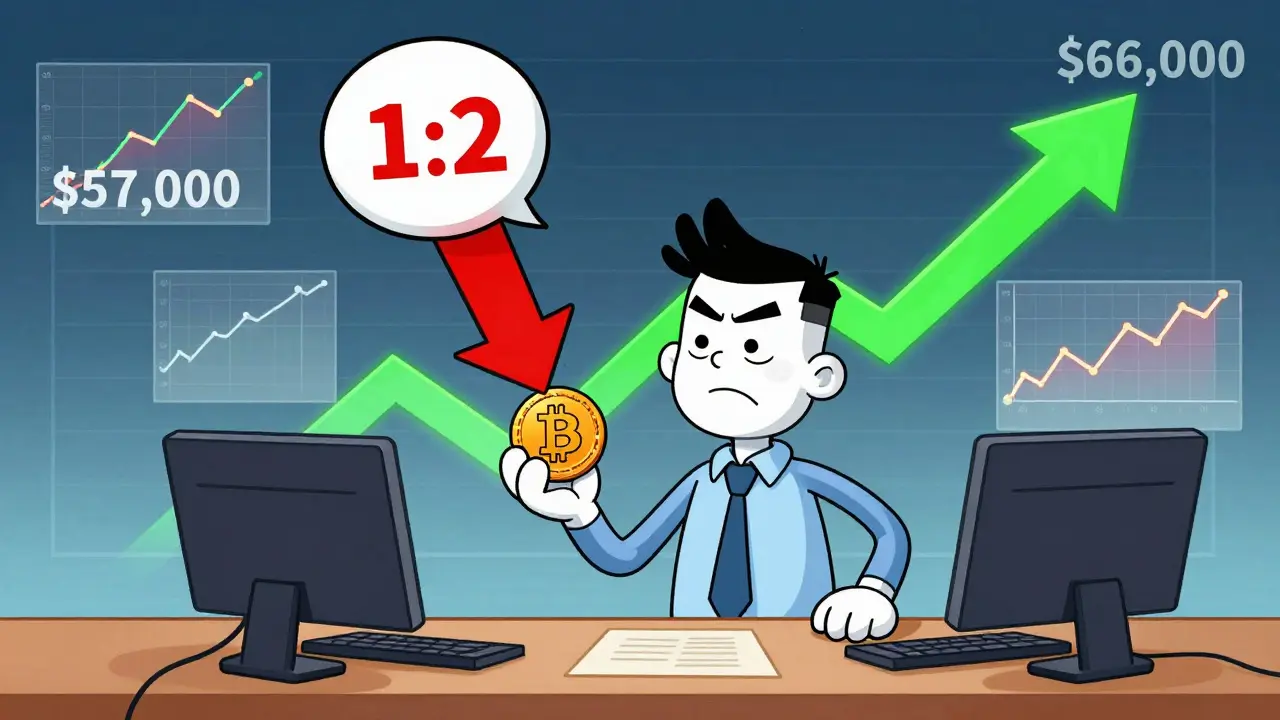

When you trade cryptocurrency, it's not enough to guess which coin will go up. You need a system. One that tells you when to get in, when to get out, and how much to risk on each trade. That system starts with two things: your risk-reward ratio and how you size your positions. Get these right, and even a losing trade can still help you win overall.
What Is Risk-Reward Ratio?
The risk-reward ratio is simple: it compares how much you stand to lose versus how much you stand to gain on a trade. If you buy Bitcoin at $60,000, set a stop-loss at $57,000, and plan to sell at $66,000, you’re risking $3,000 to make $6,000. That’s a 1:2 ratio. You risk one dollar to make two.Most beginners think a 1:1 ratio is fine. If you win half your trades, you break even. But crypto doesn’t work that way. Prices swing hard and fast. A 1:1 ratio means you need to win more than half your trades just to make money. And in crypto, that’s hard.
Experienced traders aim for at least 1:2. Some go for 1:3 or even 1:4. Why? Because you don’t need to win every trade. If you have a 1:3 ratio and win just 25% of your trades, you break even. Win 30%? You’re ahead. Win 40%? You’re doing great. The math works in your favor when the reward is bigger than the risk.
How to Set Your Risk-Reward Ratio
Setting a good ratio isn’t about guessing. It’s about using the market.- Look at support and resistance levels. If Bitcoin just bounced off $58,000 three times, that’s a strong support zone. Your stop-loss should go below it - maybe $57,500.
- Find the next clear resistance. If price struggled at $67,000 before, that’s a realistic target. Don’t pick $75,000 because you “feel” it’ll go there.
- Measure the distance. Entry at $60,000, stop at $57,500 (loss = $2,500), target at $67,000 (profit = $7,000). That’s a 1:2.8 ratio. Solid.
Use candlestick patterns too. A bullish engulfing after a dip? That’s a signal. But don’t ignore the price levels around it. The pattern gives you the “why,” the levels give you the “how much.”
Don’t force a ratio just to make it look good. If the market only gives you a 1:1 setup, skip it. Wait for a better one. Patience beats desperation every time.
Why Position Sizing Matters More Than You Think
You can have the perfect risk-reward ratio, but if you bet too much on one trade, you’re still in danger.Imagine you risk 10% of your portfolio on a single trade. If it goes bad, you lose 10%. Now you need an 11% gain just to get back to even. That’s hard. And if you do it twice? You’re down 19%. Now you need a 23% gain to recover. That’s not trading - that’s gambling.
Most pros risk no more than 1% to 2% of their total portfolio on a single trade. That means even if you lose five trades in a row, you’re only down 5% to 10%. You’re still in the game.
Here’s how to calculate position size:
- Decide how much of your portfolio you’re willing to risk on one trade (e.g., 1%)
- Find your stop-loss level
- Calculate how many units of the crypto you can buy so your loss equals that 1%
Example: You have $50,000. You risk 1% = $500. You buy Solana at $150, stop-loss at $140. That’s a $10 loss per coin. $500 ÷ $10 = 50 coins. You buy 50 Solana. If you’re wrong, you lose $500. If you’re right, you make $500 × your risk-reward ratio.
This keeps you alive. No big blowups. No emotional decisions after a loss.

How Crypto Fits Into Your Broader Portfolio
Crypto isn’t your whole portfolio. It’s a piece of it. And how much you allocate changes everything.VanEck studied 60/40 portfolios (60% stocks, 40% bonds) and added crypto. They found that adding just 6% total - 3% Bitcoin, 3% Ethereum - boosted returns per unit of risk by nearly double. The portfolio didn’t get more volatile. It got smarter.
Why? Because crypto moves differently than stocks. When the market drops, Bitcoin sometimes goes up. Or at least, it doesn’t always drop with everything else. That’s diversification.
For conservative investors: 2% to 5% crypto is enough. For aggressive ones: up to 20% can still improve your risk-adjusted returns. But here’s the catch: the best mix isn’t 50/50 Bitcoin and Ethereum. It’s about 70% Bitcoin, 30% Ethereum. Bitcoin is the anchor. Ethereum adds growth. Together, they balance.
Don’t go all-in on Solana, Dogecoin, or some meme coin. Stick to the top two. They have the liquidity, the history, and the institutional backing. That’s what keeps your portfolio stable.
Stop-Losses Are Non-Negotiable
A stop-loss isn’t a sign of fear. It’s a sign of discipline.Without one, you’re trusting luck. With one, you’re in control. Set it at a logical level - below support, above resistance, or based on ATR (Average True Range) to account for volatility.
Use market orders only if you’re trading on an exchange that doesn’t delay execution. Otherwise, use limit stop-losses. They ensure you don’t get trapped in a flash crash.
And never move your stop-loss further away because you’re “hoping” the price comes back. That’s how people lose everything.
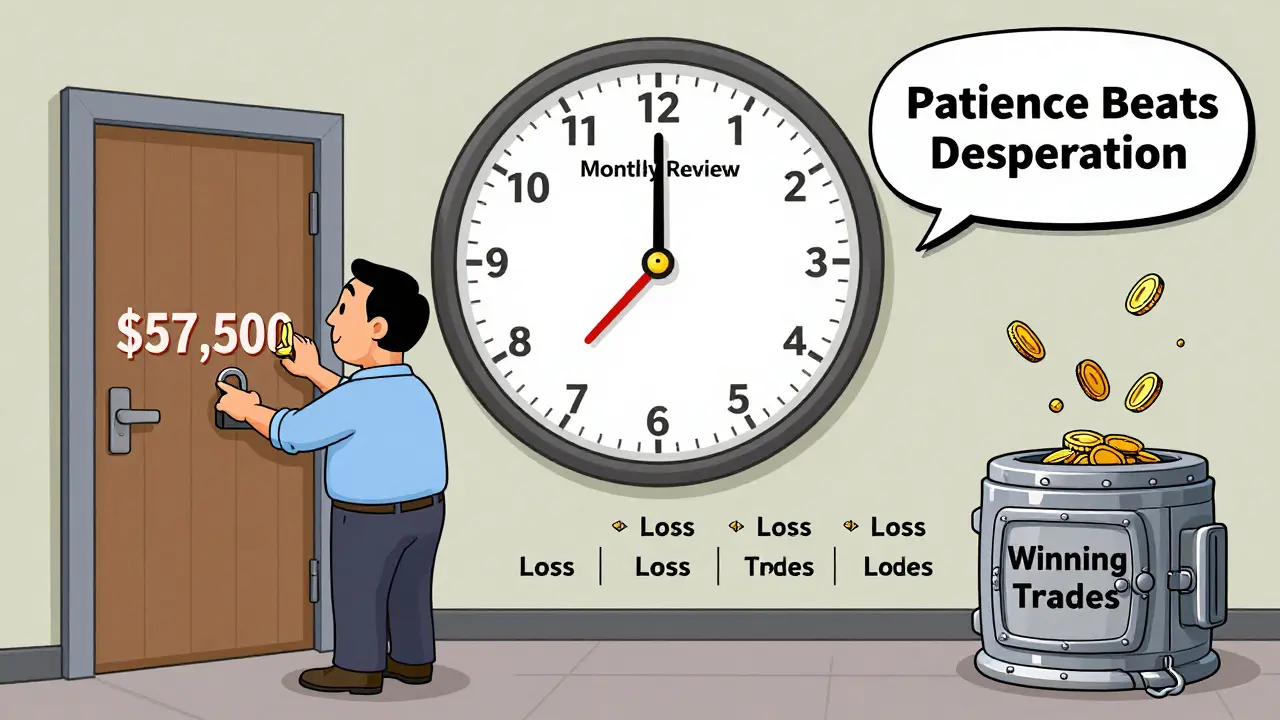
Review and Adapt
Markets change. Your strategy should too.Every month, look at your last 10 trades:
- What was your average risk-reward ratio?
- What was your win rate?
- Did you stick to your position sizing?
If your average ratio was 1:1.2 and you won 40% of trades, you’re losing money. Time to adjust. Either raise your targets, tighten your stops, or wait for better setups.
Also, check your portfolio allocation. If Bitcoin jumped 80% and now makes up 15% of your total portfolio, you’re overexposed. Rebalance. Sell a little. Lock in profits. Stay in control.
Common Mistakes to Avoid
- Ignoring risk-reward entirely - trading based on FOMO or hype
- Using the same position size for every trade - big moves deserve small bets
- Setting stop-losses too tight - you get stopped out by normal noise
- Putting 50% of your portfolio into crypto - that’s not investing, that’s gambling
- Not reviewing your trades - you’re flying blind
The market doesn’t care how smart you think you are. It only cares if you’re consistent. And consistency comes from rules, not feelings.
What is a good risk-reward ratio for crypto trading?
A good risk-reward ratio for crypto is at least 1:2, meaning you aim to make twice as much as you risk. Many traders prefer 1:3 or higher because crypto is volatile. With a 1:3 ratio, you only need to win one out of every four trades to break even. This gives you room for mistakes and lets winning trades carry your portfolio.
How much of my portfolio should I allocate to crypto?
For most investors, 2% to 6% is ideal. VanEck’s research shows that adding 3% Bitcoin and 3% Ethereum to a traditional 60/40 portfolio nearly doubles the Sharpe ratio - meaning better returns per unit of risk. Aggressive investors can go up to 20%, but only if you’re comfortable with high volatility. Never go beyond your personal risk tolerance.
Should I use stop-loss orders in crypto trading?
Yes. Stop-loss orders are essential. They remove emotion from trading and protect you from sudden crashes. Set them based on technical levels - not arbitrary numbers. For example, if Bitcoin supports at $58,000, place your stop at $57,500. This lets the market breathe while protecting your capital.
Can I make money with a low win rate in crypto?
Absolutely. If you use a 1:3 risk-reward ratio and win only 30% of your trades, you still make a profit. For example: 3 wins × $300 profit = $900. 7 losses × $100 loss = $700. Net profit = $200. The key isn’t winning every trade - it’s letting winners run and cutting losers fast.
Is Bitcoin and Ethereum the best crypto for portfolio allocation?
Yes. Bitcoin is the most liquid and least correlated with traditional markets. Ethereum adds smart contract utility and growth potential. VanEck’s data shows that a 70/30 split between Bitcoin and Ethereum delivers the best risk-adjusted returns. Altcoins are riskier, less liquid, and harder to value. Stick to the top two unless you have deep research on others.
Trade with rules. Not guesses. Your portfolio will thank you.








Nick Rios
25 Feb 2026 at 06:53I've been trading crypto for five years, and this is hands-down the most practical breakdown I've seen. Risk-reward isn't some guru nonsense-it's arithmetic. If you're risking $100 to make $100, you're not trading, you're gambling with a spreadsheet. I stick to 1:3 minimum. Even if I'm wrong 6 out of 10 times, I'm still up. Position sizing is the real hero though. I used to risk 5% per trade. Lost three in a row once. Took me six months to recover. Now it's 1.5%. I sleep better, and my portfolio grows slower but steadier.