

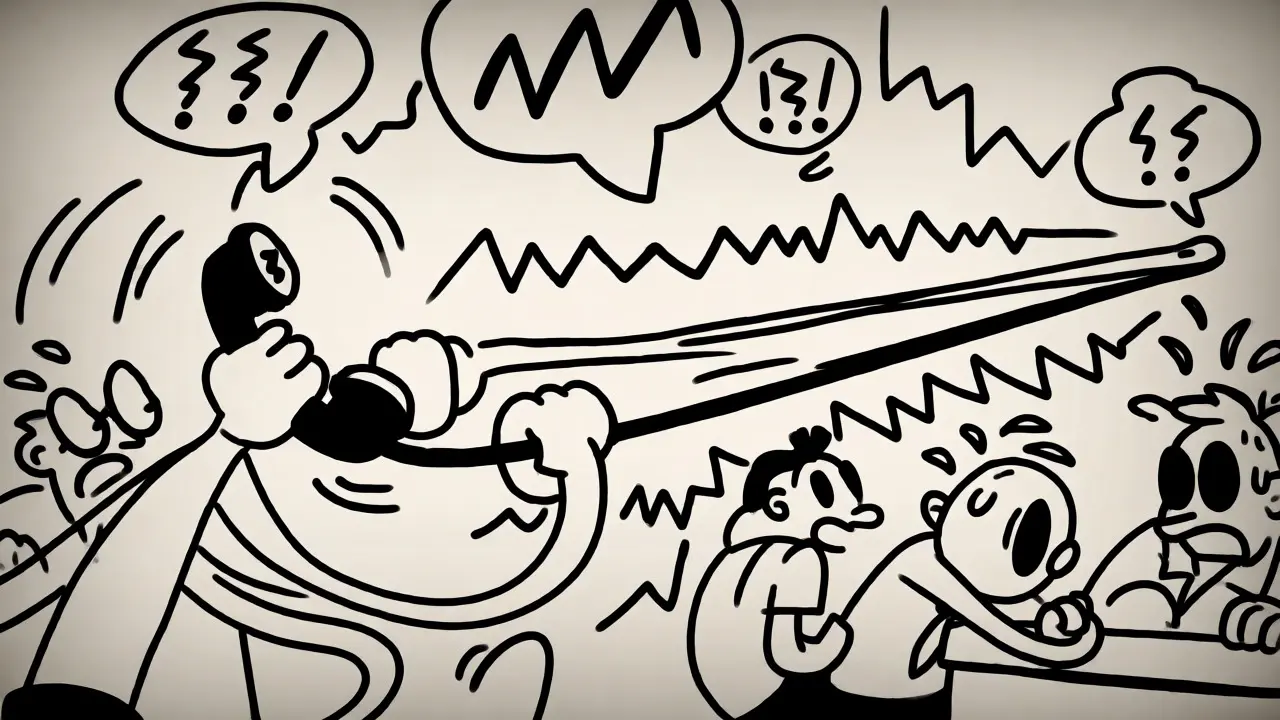

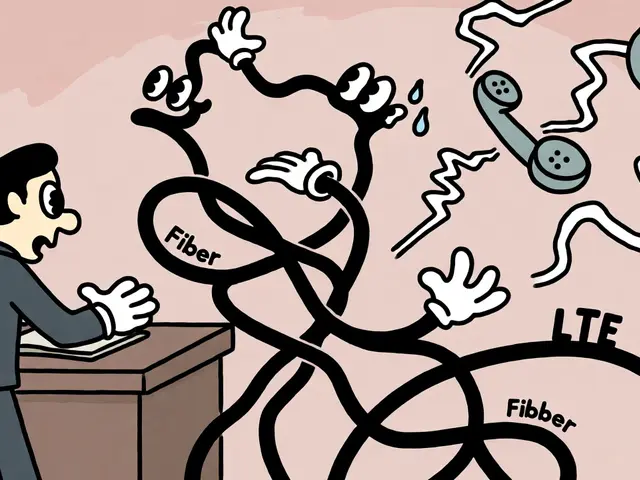
You’ve probably been there. It’s Monday morning, everyone is logging in, and suddenly the phone system goes haywire. Calls drop, voices sound robotic, or worse, callers just hear silence. You check your dashboard, and everything looks "green." The internet connection is fine. The server is humming along. So what went wrong? Chances are, you hit an invisible ceiling called oversubscription. This happens when more people try to make calls than your network can actually handle at once.
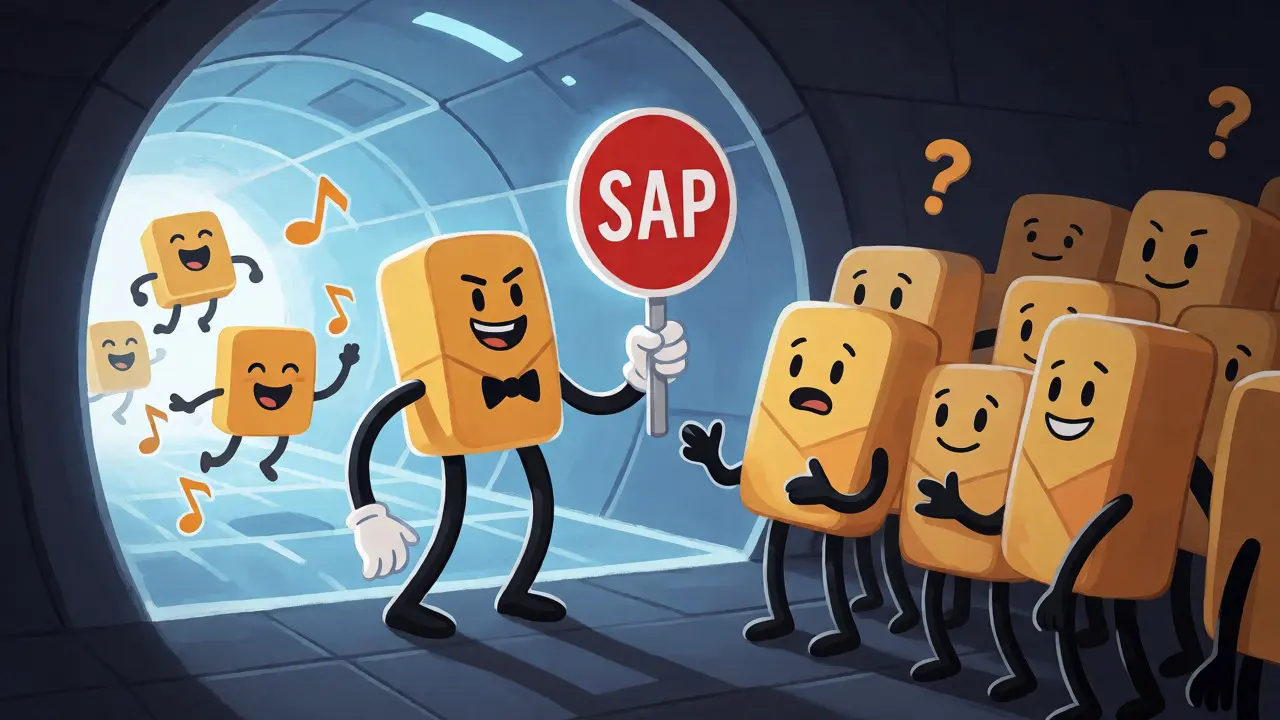
This is where Call Admission Control (CAC) comes in. Think of it as a bouncer for your voice traffic. Before a new call starts, CAC checks if there’s enough room on the dance floor-meaning enough bandwidth and low enough latency-to let that call join without ruining the party for everyone else. If there isn’t space, it politely declines the new call rather than letting it crash the system. Without this mechanism, one extra call doesn’t just hurt itself; it degrades every active call on the line.
Why Voice Traffic Is Different From Data
To understand why CAC matters, you have to look at how voice behaves differently than email or web browsing. Data applications are elastic. If your network gets congested while you’re downloading a file, the download just slows down. You might notice it, but it still finishes. Voice over Internet Protocol (VoIP) is real-time and inelastic. It demands consistent delivery within tight time windows.
RTP (Real-time Transport Protocol) packets carry the actual audio. If these packets arrive late, out of order, or not at all, the human ear hears glitches, gaps, or robotic artifacts. Unlike data, voice cannot simply wait in a queue until things calm down. A packet arriving 150 milliseconds late is useless for natural conversation. When you allow too many concurrent calls, you introduce jitter and packet loss. Because voice streams don’t throttle back gracefully like TCP does, the quality of all existing calls drops simultaneously. That’s the nightmare scenario CAC prevents.
The Core Mechanism: Pre-Call Decisions
CAC isn’t a codec or a specific piece of hardware you buy off the shelf. It’s a policy and signaling process. According to standards defined by the IETF in RFC 4594, CAC is a deterministic decision made before the media session establishes. It asks a simple question: "Do we have the resources to guarantee acceptable quality for this new call?"
If the answer is yes, the call proceeds. If no, the system rejects the call or routes it to voicemail immediately. This prevention-based approach is critical. Once a call is up and running, it’s much harder to fix quality issues. By making the decision upfront, you protect the integrity of ongoing conversations. Cisco Systems, a major player in enterprise networking, defines CAC as essential for maintaining Quality of Service (QoS). They emphasize that telephony networks are often configured with oversubscription ratios-meaning you expect fewer people to talk at peak times than have phones. But when that expectation fails, CAC acts as the safety net.
How Oversubscription Happens
Oversubscription sounds scary, but it’s actually a standard design practice. Why? Because building a network that can handle 100% of users talking at 100% capacity all the time is prohibitively expensive. Most businesses assume that if they have 100 employees, maybe only 10 will be on the phone at any given moment. This statistical multiplexing saves money on bandwidth and hardware.
The problem arises when assumptions break. Maybe there’s a sales contest, a crisis, or a scheduled conference call that overlaps with regular operations. Suddenly, you have 30 active calls instead of 10. Without CAC, your router tries to push them all through. The result is congestion. With CAC, the first 15 calls get admitted. The next 5 might be rejected or queued, preserving crystal-clear audio for the first group. It’s better to tell five people "try again later" than to give thirty people a bad experience.
Implementing CAC: Counters vs. Bandwidth Limits
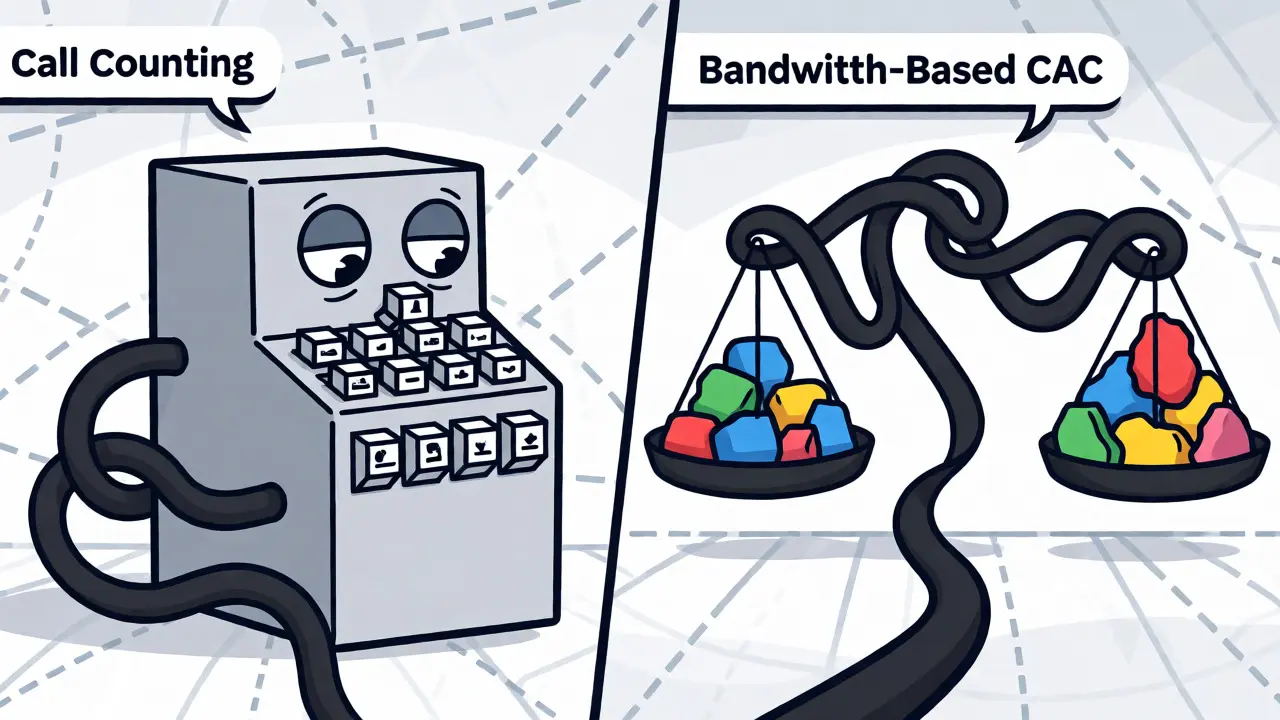
There are two primary ways to configure CAC, each with its own pros and cons. Choosing the right one depends on your infrastructure and how predictable your traffic is.
Call Counting
This method is straightforward. You set a hard limit on the number of simultaneous calls allowed across a link or interface. For example, you might decide your T1 line can support exactly 24 concurrent G.711 calls. Once the 25th call attempts to start, CAC blocks it.
- Pros: Easy to configure and understand. Works well when all calls use the same high-bandwidth codec.
- Cons: Inflexible. If you switch to a compressed codec like G.729, which uses less bandwidth, you’re leaving capacity unused because the counter hasn’t changed. It also ignores bursty traffic patterns.
Bandwidth-Based CAC
This approach monitors actual resource usage. Instead of counting calls, it calculates the total bandwidth consumed by active RTP streams. If a new call requires 80 Kbps (for G.711 with overhead) and only 50 Kbps remains, the call is denied.
- Pros: More accurate and efficient. It adapts to different codecs automatically. It accounts for the true cost of each call.
- Cons: More complex to set up. Requires precise knowledge of codec overheads and potential fragmentation issues.
| Feature | Call Counting | Bandwidth-Based CAC |
|---|---|---|
| Metric Used | Number of sessions | Total Kbps/Mbps |
| Codec Awareness | Low (static) | High (dynamic) |
| Configuration Complexity | Low | Medium/High |
| Best For | Uniform environments (all G.711) | Mixed codec environments |
| Risk | Wasted bandwidth | Complexity errors |
Signaling Protocols and CAC
CAC decisions rely heavily on the signaling protocol used to set up the call. The two most common protocols in VoIP are SIP and H.323, though modern cloud systems often use proprietary APIs.
In a SIP environment, CAC logic usually resides in the Session Border Controller (SBC) or the IP-PBX. When a user dials, the SBC checks its internal database against the current load. If resources are available, it sends a "200 OK" response. If not, it might send a "486 Busy Here" or a custom error code. This happens before the RTP stream even begins flowing.
Some advanced setups use RSVP (Resource Reservation Protocol), defined in RFC 2205. RSVP allows devices to explicitly request bandwidth reservations from routers along the path. While powerful, RSVP is heavy and complex to maintain across large networks. Many enterprises find that simpler, policy-based CAC at the edge (using SBCs) provides sufficient protection without the overhead of end-to-end reservations.
Common Pitfalls and Pro Tips
Even with CAC enabled, things can go wrong if you aren’t careful. Here are a few traps to avoid.
Ignoring Codec Overhead: Don’t just calculate payload size. G.711 sends 64 Kbps of audio, but with IP, UDP, and RTP headers, plus Layer 2 encapsulation, the actual bandwidth consumption can jump to 87 Kbps per call. If you budget based on 64 Kbps, you’ll hit congestion before you think you should.
Forgetting Jitter Buffers: CAC manages bandwidth, but jitter buffers manage delay variation. If your CAC threshold is too tight, you might reject calls unnecessarily. If it’s too loose, jitter buffers fill up, causing latency. Monitor Mean Opinion Score (MOS) trends alongside CAC rejection rates to find the sweet spot.
Static Thresholds in Dynamic Environments: If your company has seasonal spikes, static limits might block legitimate business during busy periods. Consider dynamic thresholds that adjust based on time of day or integration with calendar systems for known meeting times.
The Future of CAC in Cloud VoIP
As more companies move to Unified Communications as a Service (UCaaS), traditional CAC changes shape. You don’t control the core router anymore; the provider does. However, CAC principles remain vital at the customer edge. Modern platforms use AI-driven analytics to predict congestion. Instead of rigid counters, they analyze historical traffic patterns to dynamically allocate bandwidth shares per department or user group.
Cloud providers often implement "soft" CAC, where they prioritize VIP users or critical departments during congestion. Understanding how your provider handles oversubscription is part of due diligence. Ask them: "What happens when my site hits its committed information rate (CIR)? Do calls drop, degrade, or queue?" The answer reveals their underlying CAC strategy.
Frequently Asked Questions
Does Call Admission Control affect video calls?
Yes, absolutely. Video consumes significantly more bandwidth than voice. RFC 4594 specifically mentions video conferencing as benefiting from admission control. Because video streams are larger and more sensitive to jitter, CAC helps prevent a single video call from starving voice traffic or other data applications on the same link.
Can I use QoS instead of CAC?
QoS and CAC work together, but they are not substitutes. QoS prioritizes traffic queues once packets are already on the wire. CAC decides whether to admit the call in the first place. If you have massive oversubscription, QoS alone can’t save you because the physical pipe is full. You need CAC to prevent the pipe from overflowing in the first place.
What happens to a call rejected by CAC?
Typically, the caller receives a fast busy signal, a recorded message saying lines are busy, or is routed directly to voicemail. Some systems offer a callback option or queue the call if the expected wait time is short. The key is that the rejection happens quickly, so the caller isn’t left hanging indefinitely.
Is CAC necessary for small offices?
It depends on your bandwidth and user count. A small office with 5 users and a fiber connection likely won’t face oversubscription. However, if you have limited bandwidth (like DSL or LTE failover) or many remote workers connecting via VPN, CAC becomes crucial to ensure that internal calls don’t starve external ones, or vice versa.
How do I test if my CAC is working?
Set up a controlled test. Configure a low bandwidth limit or call count limit. Then, use a script or multiple handsets to initiate calls simultaneously beyond that limit. Observe the behavior: Do additional calls get rejected? Does the audio quality of the first calls remain stable? Monitoring logs for "CAC rejection" events confirms the mechanism is active.





Write a comment