

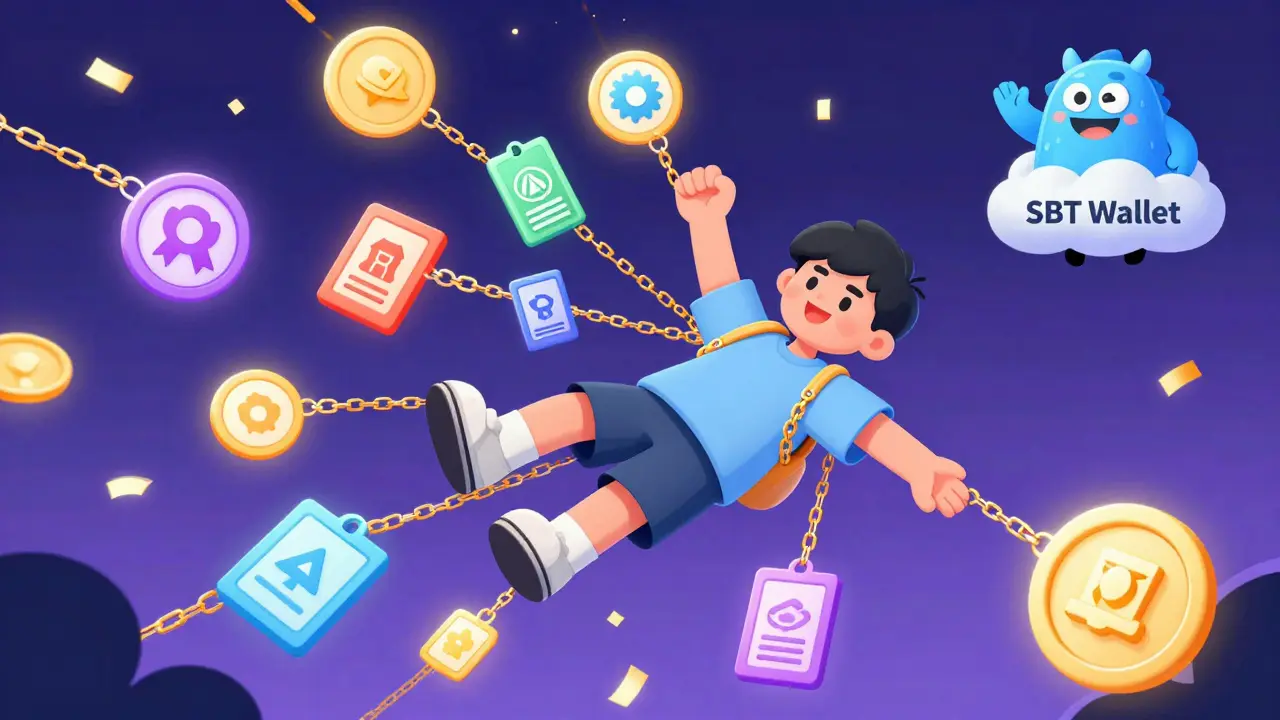

Imagine earning a college degree, completing a professional certification, or even attending a major conference-and instead of getting a paper certificate or a PDF, you get a digital badge that’s permanently tied to you. It can’t be sold. It can’t be stolen. It can’t be faked. That’s what soulbound tokens are: non-transferable NFTs designed to represent who you are, not what you own.
Unlike regular NFTs, which are often bought, sold, and traded like digital art or collectibles, soulbound tokens (SBTs) are meant to stay with you forever. They’re not about speculation. They’re about proof. Proof of your education, your work history, your memberships, your achievements. Think of them as your digital resume, but built on blockchain and impossible to fake.
How Soulbound Tokens Are Different From Regular NFTs
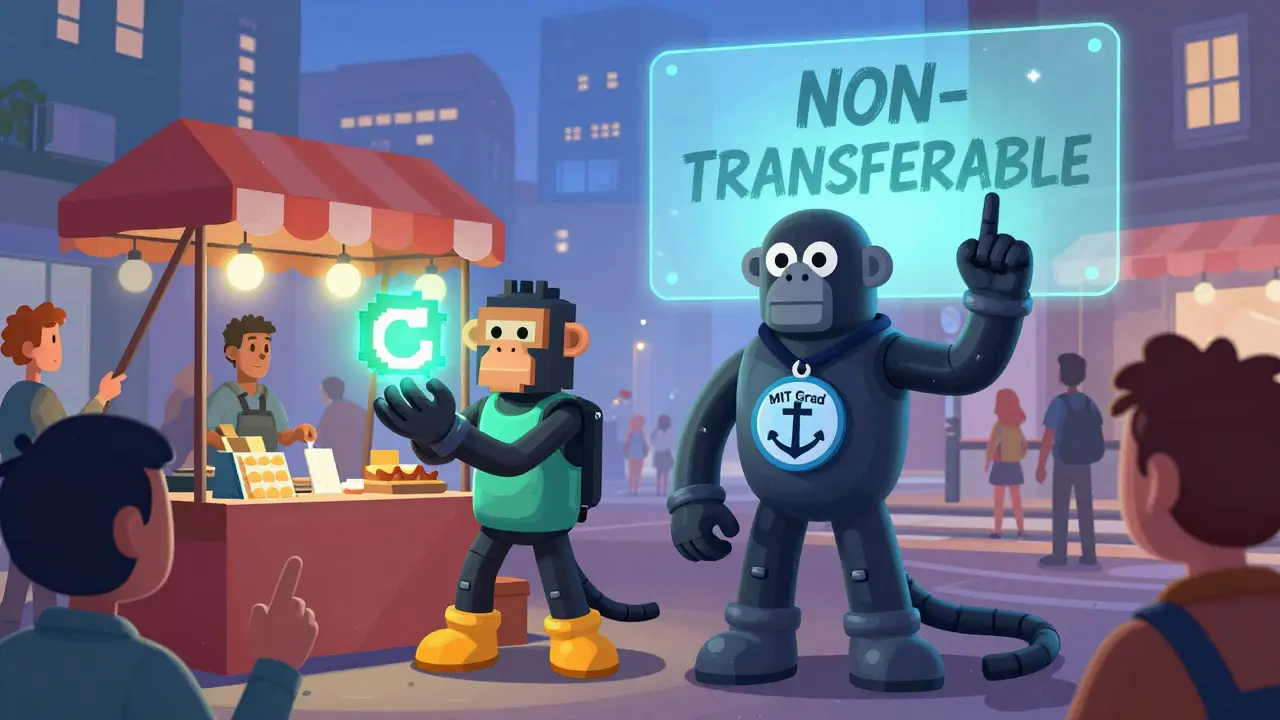
Regular NFTs are unique, but they’re also mobile. You can buy one, sell it, send it to a friend, or flip it for profit. That’s fine for a pixelated ape or a song clip. But what if that NFT represented your medical record, your university diploma, or your work experience? If it’s transferable, someone else could claim it. That’s where SBTs change everything.
Soulbound tokens are permanently locked to a single wallet-your digital identity. Once you receive one, you can’t send it to anyone else. You can’t list it on OpenSea. You can’t trade it. It’s yours, and only yours. The name comes from World of Warcraft, where soulbound gear can’t be traded between characters. It’s yours until you die. SBTs work the same way.
Technically, SBTs are built on the same Ethereum standards as NFTs-like ERC-721-but with one critical change: the transfer function is removed or blocked. You can’t move them. That’s it. Simple. But powerful.
The Standards Behind SBTs: ERC-5114 and ERC-5484
Not all soulbound tokens are created equal. The Ethereum community has developed two main standards to handle different use cases:
- ERC-5114 creates Soulbound Badges. These are attached to an existing NFT and stay with it forever. For example, if you own a special NFT from a conference, you can get a badge proving you attended. That badge can’t be moved off your NFT. It’s permanently linked.
- ERC-5484 adds more control. It requires mutual consent before a token is issued. That means you have to agree to receive it. It also lets the issuer revoke the token if needed-say, if a credential turns out to be false. It’s more flexible for things like credit scores or professional licenses.
These aren’t just tech specs. They’re solutions to real problems. A university can’t just slap a diploma on a blockchain and call it done. What if someone cheats? What if they get expelled later? ERC-5484 lets institutions revoke the token. ERC-5114 makes sure your attendance record stays with your event NFT. Both standards make SBTs usable in real life.
Why SBTs Are a Game-Changer for Identity
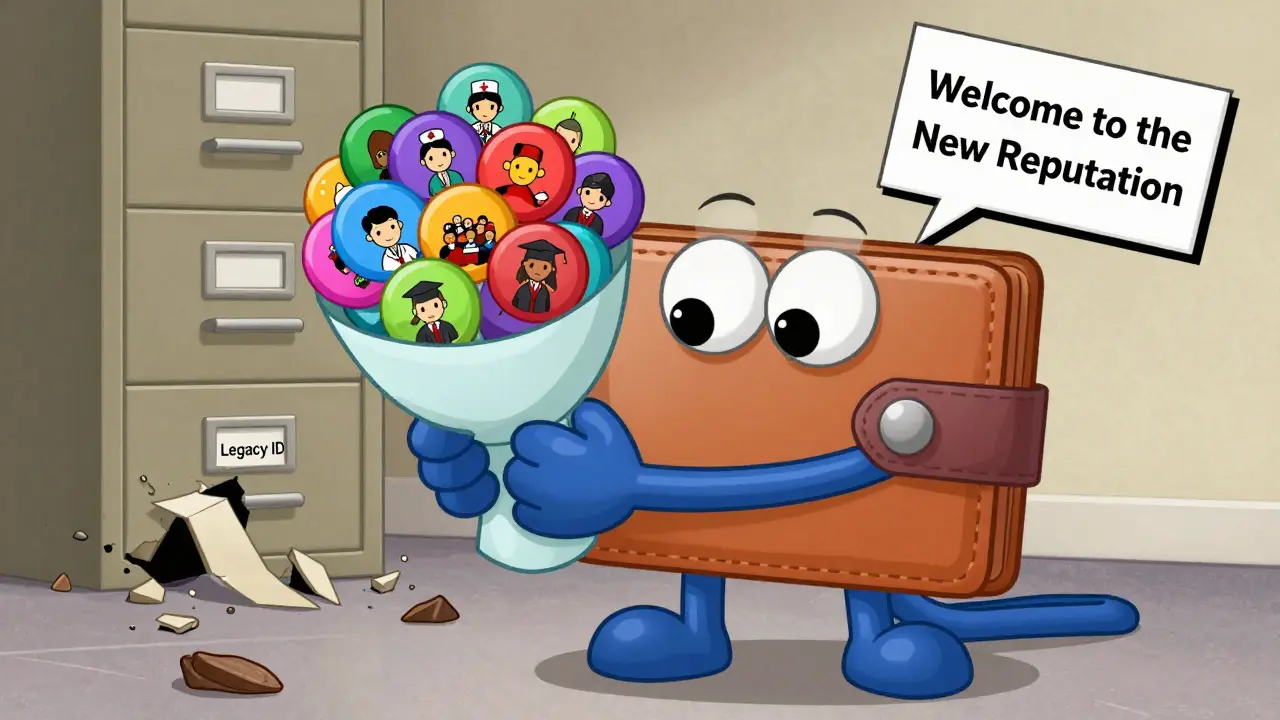
Right now, your identity is scattered. Your resume is on LinkedIn. Your degree is in a file cabinet. Your work history is in HR databases. Your credit score is locked inside Equifax. These systems are slow, centralized, and vulnerable. Hackers steal data. Employers can’t verify credentials quickly. Fraud is common.
SBTs fix that. They turn your identity into a collection of verifiable, self-owned tokens. Want to apply for a job in Germany? Show your SBT proving you graduated from Harvard. Want to rent an apartment? Show your SBT for your rental history. No more waiting weeks for transcript verification. No more fake degrees.
And here’s the kicker: you control who sees what. You don’t have to hand over your entire life story. You can share just the SBTs you want. Your medical history? Locked. Your credit score? Shared only with lenders you trust. Your event attendance? Public. It’s like having a digital wallet full of verified facts-only you decide what to show.
Real-World Use Cases Already in Motion
SBTs aren’t just theory. They’re being tested-and used-right now.
- Educational credentials: Universities like MIT and Stanford are piloting SBTs for diplomas. Students get a token that proves they graduated. Employers can verify it instantly, without calling the school.
- Professional licenses: Nurses, electricians, and architects could receive SBTs for their certifications. No more renewing paper cards. The token updates automatically when you complete continuing education.
- Event access: Conferences like DevCon and Web Summit are issuing SBTs to attendees. These tokens unlock future events, speaker discounts, or exclusive content. They also prove you were there-no fake tickets.
- Credit and finance: Startups are experimenting with SBTs for credit history. Instead of relying on credit bureaus, your repayment history is stored as a token. Missed payments? The token updates. Paid off debt? The token reflects that. No more errors from outdated reports.
Even gaming is adopting SBTs. In Web3 games, you might earn an SBT for completing a 100-hour quest. That token stays with your wallet forever. It doesn’t matter if you switch games. Your achievement follows you. That’s the future of digital reputation.
What SBTs Can’t Do (And Why That’s Okay)
SBTs aren’t magic. They have limits.
First, they can’t prove who you are in the real world. If someone steals your phone or hacks your wallet, they can access your SBTs. That’s why most SBT systems require multi-factor authentication and backup recovery options.
Second, they’re not anonymous. If your wallet is tied to your real name, your SBTs are too. That’s intentional. SBTs are about identity, not privacy. But if you want anonymity, you can use a separate wallet for SBTs-keeping your credentials separate from your trading wallet.
Third, they’re not yet universal. Right now, only a few organizations issue them. But that’s changing fast. As more institutions adopt blockchain, SBTs will become the default way to prove credentials.
The key is this: SBTs don’t replace existing systems. They enhance them. They make verification faster, cheaper, and more trustworthy.
The Bigger Picture: Web3’s Soul
The term “soulbound” comes from a 2022 research paper by Vitalik Buterin, Glen Weyl, and Puja Ohlhaver. They called it Decentralized Society: Finding Web3’s Soul. Their idea was simple: Web3 is too focused on money. It’s all about buying, selling, and trading. But what about trust? What about reputation? What about the things that make us who we are?
SBTs are the answer. They’re not about wealth. They’re about worth. Your education. Your experience. Your contributions. Your history. These are the things that can’t be bought. And now, they can be owned-digitally, permanently, and securely.
This is the next step in blockchain. Not just finance. Not just art. But identity. Reputation. Trust. And it’s built on a simple idea: some things shouldn’t be transferable. Some things should belong to you-and only you-for life.
Can soulbound tokens be stolen or hacked?
Soulbound tokens themselves can’t be transferred, so you can’t lose them by sending them to the wrong wallet. But if someone gains access to your wallet-through a hacked device, phishing, or weak passwords-they can use your SBTs. That’s why using a hardware wallet and enabling multi-factor authentication is critical. Think of SBTs like a passport: the document is secure, but you still need to protect the bag it’s in.
Can you have multiple soulbound tokens?
Yes. In fact, you’re meant to. Your digital identity isn’t one thing-it’s many. You can have one SBT for your college degree, another for your CPR certification, another for attending a tech conference, and another for being a member of a professional association. Each token is a piece of your story. Together, they form a complete profile.
Can institutions revoke a soulbound token?
Yes, if the token was created using standards like ERC-5484. This allows issuers-like universities or licensing boards-to revoke a token if fraud is discovered, if a credential expires, or if someone violates rules. For example, if a doctor loses their license, the SBT proving they were licensed can be revoked. This prevents false claims and keeps the system trustworthy.
Do you need cryptocurrency to use soulbound tokens?
Not necessarily. You need a blockchain wallet (like MetaMask), but you don’t need to buy or trade crypto to receive or hold an SBT. Many educational and professional organizations issue SBTs for free. You just need a wallet to store them. Think of it like getting an email-no payment needed.
Are soulbound tokens the future of digital identity?
They’re one of the strongest candidates. Unlike centralized systems like Facebook or government IDs, SBTs are owned by you, verifiable by anyone, and impossible to forge. They work across borders, apps, and platforms. As more institutions adopt them, they’ll become the standard for proving who you are online-no middlemen, no delays, no lies.





Ian Cassidy
27 Feb 2026 at 18:55Soulbound tokens are wild. Imagine your LinkedIn profile but actually verifiable-no more fake degrees or inflated resumes. It’s like your digital soul got a blockchain tattoo. No selling, no trading, just you and your creds, locked in forever. I’ve seen universities test this, and honestly? It’s the first Web3 thing that feels useful, not just another NFT scam.
Also, the fact that you can revoke them if someone gets kicked out of med school? That’s genius. No more shady certs floating around.