



Most business owners look at the monthly price tag when choosing a new phone system. You see a plan for $25 per user and think you’ve found your budget. But that number is just the tip of the iceberg. If you only look at the sticker price, you might be walking into a financial trap that costs more over time than the old landline system you’re trying to replace.
To get the real picture, you need to calculate the Total Cost of Ownership (TCO), which is the complete financial impact of acquiring, operating, and retiring a technology asset over its entire lifecycle. For Voice over Internet Protocol (VoIP), a three-year window is the standard industry benchmark. It’s long enough to capture ongoing maintenance and growth but short enough to remain predictable. This analysis breaks down every dollar you’ll spend, from the initial setup fees to the hidden costs of downtime and training, so you can make a decision based on reality, not marketing brochures.
The Upfront Investment: CapEx vs. OpEx Shift
Traditionally, buying a business phone system meant a massive capital expenditure (CapEx). You’d buy a physical Private Branch Exchange (PBX) server, rack it in your closet, and pay thousands for installation. With modern cloud VoIP or Unified Communications as a Service (UCaaS), that model flips. Most of your cost becomes an operating expense (OpEx)-a monthly subscription.
However, "zero upfront cost" is rarely true. Even with cloud solutions, Year 1 usually involves specific hardware and migration expenses. Here is what typically falls under your initial investment:
- IP Handsets or Headsets: While softphones (apps on laptops/phones) are free, desk phones still matter for many offices. High-quality IP phones range from $80 to $300 each.
- Network Hardware: VoIP demands stable internet. You may need Power over Ethernet (PoE) switches to power phones via network cables, or Session Border Controllers (SBCs) for security if you have a large deployment.
- Professional Services: Moving from a legacy system isn’t just plugging in a cable. It requires porting numbers, configuring call flows, and integrating with CRM tools like Salesforce or HubSpot.
- Internet Upgrades: If your current bandwidth is saturated, adding voice traffic can cause jitter and dropped calls. Upgrading your circuit is often a necessary Year 1 cost.
For a small business of 20 users, this initial CapEx might range from $2,000 to $5,000 depending on whether you buy or lease phones and how complex your integration needs are. In a traditional PBX scenario, this number would likely exceed $15,000 due to server hardware alone. The shift to OpEx means you avoid huge cash outlays, but you must account for these startup costs in your Year 1 total.
Recurring Costs: More Than Just the Subscription
Once the system is live, the monthly bills start. This is where most people stop their calculation, but a true TCO analysis digs deeper. Your recurring Operating Expenditures (OpEx) include several layers:
- Base Subscription Fees: This is the advertised price per user. Plans vary from basic voice ($15-$20/user/month) to full UCaaS suites with video conferencing and team messaging ($30-$45/user/month).
- Taxes and Regulatory Surcharges: This is the silent killer of VoIP budgets. Telecom taxes vary by state and local jurisdiction. Providers often add a 10% to 20% surcharge on top of the base rate for universal service funds, E911 fees, and state taxes. Over 36 months, this adds up significantly.
- Bandwidth Costs: Every minute of VoIP usage consumes data. While minimal per call, high-volume centers or poor network efficiency can drive up your internet bill. Ensure your Quality of Service (QoS) settings are optimized to prevent needing excessive bandwidth upgrades later.
- Internal Labor: Who manages the system? Even with cloud VoIP, someone needs to add new hires, update call routing, and troubleshoot issues. Calculate the hourly wage of your IT staff multiplied by the hours they spend on telephony tasks each month.
If you ignore the tax surcharges and internal labor, your projected savings will be inflated. For example, a $25/month plan might actually cost $30/month after fees. Over three years for 20 users, that $5 difference equals $3,600-a sum that could cover all your hardware costs.

Hidden Costs: Training, Downtime, and Security
The most expensive part of any technology project is often what you don’t see on the invoice. These indirect costs can derail your ROI if not planned for.
Training and Onboarding
New systems change how people work. Employees need time to learn softphones, voicemail-to-email features, and auto-attendant menus. During this learning curve, productivity drops. Estimate 2-4 hours of lost productivity per employee during the first month. Multiply that by their hourly wage to get a tangible cost figure.
Downtime Impact
VoIP relies entirely on internet connectivity. If your ISP goes down, your phones go down. Unlike landlines, which often worked during power outages (if battery-backed), VoIP needs both power and data. Calculate the cost of lost sales or support tickets during an average outage. If your carrier has a 99.9% uptime SLA, that still allows for ~8.7 hours of downtime per year. Over three years, that’s nearly 26 hours of potential disruption. Mitigate this by budgeting for backup LTE failover devices.
Security and Compliance
If you operate in healthcare (HIPAA) or finance (GDPR/PCI-DSS), VoIP introduces new compliance vectors. Call recording encryption, secure SIP trunks, and audit logs may require higher-tier plans or third-party security tools. Ignoring these can lead to fines far exceeding the cost of proper configuration.
| Cost Category | Legacy On-Premise PBX | Cloud VoIP / UCaaS |
|---|---|---|
| Initial Hardware (CapEx) | High ($10k-$50k+ for servers/switches) | Low ($1k-$5k for phones/network gear) |
| Monthly Service Fees | Moderate (Maintenance contracts + PSTN lines) | Variable (Per-user subscription + taxes) |
| Upgrades & Maintenance | High (Forklift upgrades every 5-7 years) | None (Software updates included) |
| Scalability Cost | High (Hardware limits, long lead times) | Low (Instant activation, no hardware needed) |
| IT Labor Burden | High (On-site troubleshooting required) | Low (Vendor-managed infrastructure) |
End-of-Life and Lifecycle Management
A three-year analysis doesn’t end when the contract does. You must consider the lifecycle of the assets involved. With legacy PBX, the system lasts 10+ years, but it becomes obsolete technologically. With VoIP, the software never ages, but the hardware (phones, routers) depreciates.
Standard IT depreciation schedules often write off VoIP endpoints over 3 to 5 years. By Year 3, your initial handsets may be nearing the end of their useful life. Plan for a refresh cycle. Will you buy new models? Lease them? Factor in the cost of decommissioning old equipment-data wiping, recycling fees, and disposing of legacy PBX hardware if you haven’t already.
Additionally, consider the "exit cost." If you decide to switch providers after three years, are there early termination fees? Are your number porting fees waived? Some vendors lock you in with aggressive multi-year discounts that penalize you for leaving. A true TCO includes the cost of flexibility-or the penalty for lacking it.
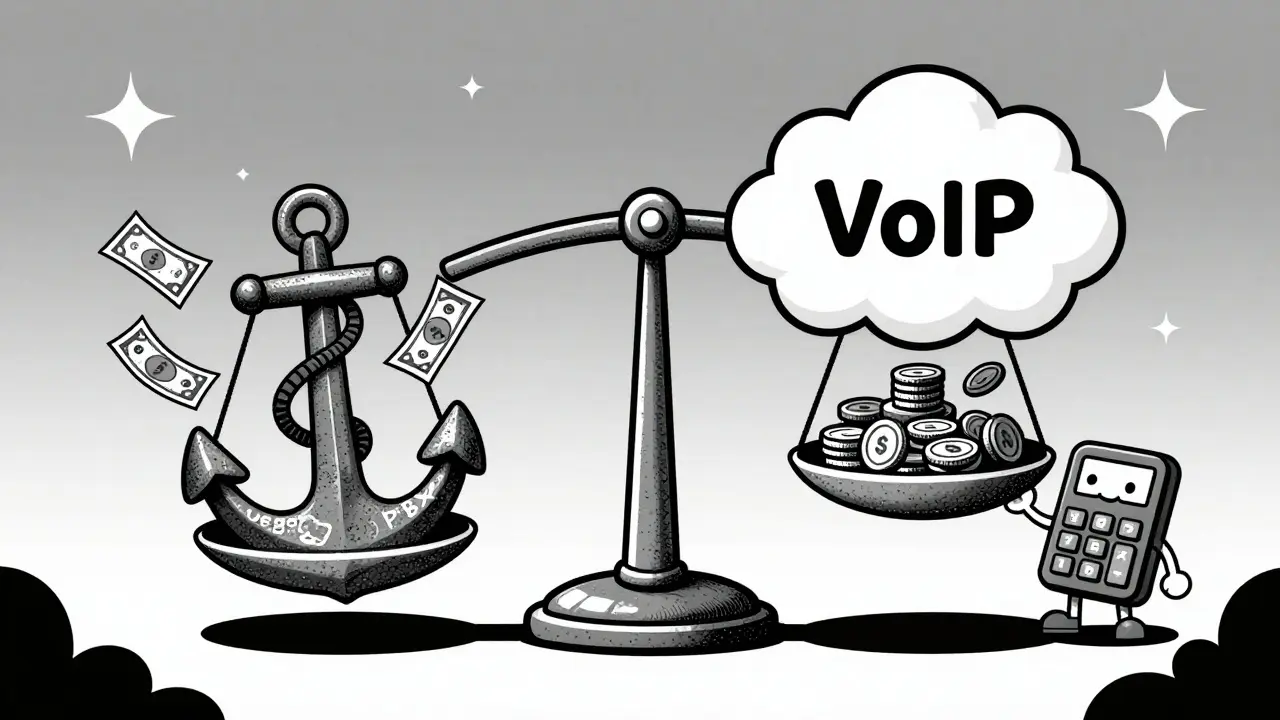
Calculating Your Break-Even Point
To determine if VoIP makes sense for your specific situation, use this simple formula to find your break-even point:
Break-Even Months = Total Upfront Costs ÷ Monthly Savings vs. Current System
Let’s say your current landline system costs $600/month. A comparable VoIP plan costs $450/month (including taxes). Your monthly savings are $150. If your upfront hardware and migration costs were $3,000, your break-even point is 20 months ($3,000 / $150). After month 20, you are purely saving money. By month 36, you’ve saved an additional $2,400 in pure operational costs, plus gained value from improved features and mobility.
Industry data suggests that businesses typically see 30% to 60% savings over legacy systems over a three-year period. For small businesses (10-100 users), this can stretch to 50-70% because the fixed costs of maintaining a physical PBX are disproportionately high relative to the number of users.
Strategic Considerations for 2026 and Beyond
As we move through 2026, the line between voice and collaboration is blurring. Choosing a VoIP provider isn’t just about cheap calling; it’s about consolidating tools. Platforms that integrate voice, video, chat, and contact center capabilities into one subscription reduce the need for separate licenses for Zoom, Slack, or specialized helpdesk software. This consolidation lowers TCO by reducing vendor management overhead and simplifying billing.
Also, keep an eye on AI-driven features. Many modern UCaaS platforms now include AI transcription, sentiment analysis, and automated call routing. These features, once expensive add-ons, are increasingly bundled into base plans. They offer indirect TCO benefits by improving customer satisfaction and agent efficiency, metrics that are hard to quantify but vital for long-term growth.
Finally, remember that remote work is permanent. A VoIP system that supports seamless hybrid work reduces the need for physical office space expansion. When you factor in the real estate savings associated with fewer desks and phone jacks, the TCO advantage of cloud VoIP becomes even more pronounced.
What is the typical TCO savings of VoIP compared to traditional PBX?
Businesses typically save between 30% and 60% over a three-year period. For smaller organizations (10-100 users), savings can reach 50-70% due to the elimination of expensive on-premise hardware and maintenance contracts.
Why is a 3-year period used for VoIP TCO analysis?
Three years is a standard IT asset depreciation cycle for hardware like phones and routers. It is also long enough to capture significant operational savings while remaining short enough to predict market changes and technology shifts accurately.
What are the biggest hidden costs in VoIP TCO?
The most common hidden costs are regulatory taxes and surcharges (which can add 10-20% to monthly bills), employee training time during migration, productivity loss during downtime, and the internal IT labor required to manage the system.
Do I need to buy new phones for VoIP?
Not necessarily. Many VoIP systems support "softphones," which are apps installed on existing smartphones, tablets, or computers. However, dedicated IP desk phones are recommended for high-call-volume roles to improve ergonomics and call quality.
How does internet bandwidth affect VoIP TCO?
VoIP requires stable, low-latency internet. If your current connection is insufficient, you may need to upgrade your service plan or install QoS-enabled routers. These infrastructure costs must be included in your initial CapEx to ensure call quality and avoid recurring performance issues.






Edward Gilbreath
7 Jun 2026 at 12:54you guys really think the big telecom companies are just gonna let you save money on their dime? nah. they put backdoors in every sip trunk so they can listen to your calls and sell the data to advertisers or worse. the whole 'cloud' thing is just a fancy word for them owning your infrastructure while you pay rent. i tried setting up my own asterisk box years ago and suddenly my isp throttled me because they knew what i was doing. dont trust the monthly fee. its a trap designed to keep you dependent on their surveillance state network. also why do we need ip phones when our laptops already have microphones? corporate greed pushing hardware sales.