


When you make a VoIP call, you’re not just talking over the internet-you’re sending sensitive voice data through networks that can be intercepted, replayed, or hijacked. Without proper security, your business conversations, customer data, and even financial details are at risk. The foundation of secure VoIP isn’t firewalls or encryption apps-it’s the TLS protocol. And not just any version: TLS 1.3 is now the only acceptable standard for new deployments. Legacy TLS 1.2 is no longer safe enough, and TLS 1.0 or 1.1? They’re active security liabilities.
Why TLS Matters More Than You Think in VoIP
VoIP doesn’t just use one protocol. It relies on SIP (Session Initiation Protocol) to set up calls and SRTP (Secure Real-time Transport Protocol) to carry the actual voice. Both need encryption. TLS handles SIP signaling. DTLS (Datagram TLS) handles SRTP media streams over UDP. If TLS is weak or misconfigured, attackers can eavesdrop on calls, inject fake messages, or even redirect your entire phone system. The difference between TLS 1.2 and TLS 1.3 isn’t just about newer features-it’s about survival. TLS 1.3 removes 11 known-vulnerable algorithms like RC4, 3DES, MD5, and SHA-1. These were kept in TLS 1.2 for backward compatibility, but in VoIP, backward compatibility is a liability. A 2023 SANS Institute report found that 68% of VoIP breaches happened on systems still using TLS 1.0 or 1.1. That’s not a coincidence-it’s a pattern.TLS 1.3 vs TLS 1.2: The Real Differences
TLS 1.3 isn’t just an update. It’s a redesign. Here’s what changes:- Handshake speed: TLS 1.2 takes about 350ms to establish a secure connection. TLS 1.3 does it in 220ms. That’s a 37% drop in call setup time. In VoIP, delays over 500ms feel like lag. Every millisecond counts.
- Forward secrecy: TLS 1.3 makes it mandatory. Even if an attacker records your encrypted traffic today, they can’t decrypt it tomorrow-even if they steal your server’s private key. TLS 1.2 allows non-forward-secret ciphers, which is why many older systems are still vulnerable to retroactive decryption.
- Zero-round-trip (0-RTT): Returning clients can send data immediately on reconnect. This improves user experience but introduces replay attack risks if not properly handled. Many VoIP platforms still misconfigure this feature.
- Cipher suite reduction: TLS 1.3 only supports five secure cipher suites. TLS 1.2 supports over 40, many of them broken. More options don’t mean better security-they mean more ways to mess up.
According to Cloudflare’s 2018 analysis, TLS 1.3 eliminates 35% of the cryptographic weaknesses found in TLS 1.2. Gartner’s 2023 report says organizations using TLS 1.2 for VoIP face 3.2x higher risk of session hijacking. The math is clear: TLS 1.3 isn’t optional. It’s the baseline.
DTLS 1.3: The Missing Piece for Real-Time Audio
SIP runs over TCP. But voice? That’s UDP. And UDP doesn’t wait for acknowledgments-it just sends. That’s why SRTP (the protocol that encrypts your voice) needs DTLS, not TLS. DTLS 1.3, released in 2022 (RFC 9147), brings the same security improvements as TLS 1.3 to real-time media. WebRTC, used in browser-based VoIP and softphones, requires DTLS-SRTP. If your system uses WebRTC and still runs DTLS 1.2, you’re exposing your media stream to man-in-the-middle attacks. Browser support for DTLS 1.3 is solid: Chrome 67+, Firefox 61+, Safari on macOS 10.13+, iOS 11+. But many enterprise SIP phones? Still stuck on DTLS 1.0. A network admin on Reddit reported replacing 12 SIP phones after upgrading to TLS 1.3 because their hardware didn’t support modern ciphers. Those phones weren’t broken-they were obsolete. And they were costing the company security.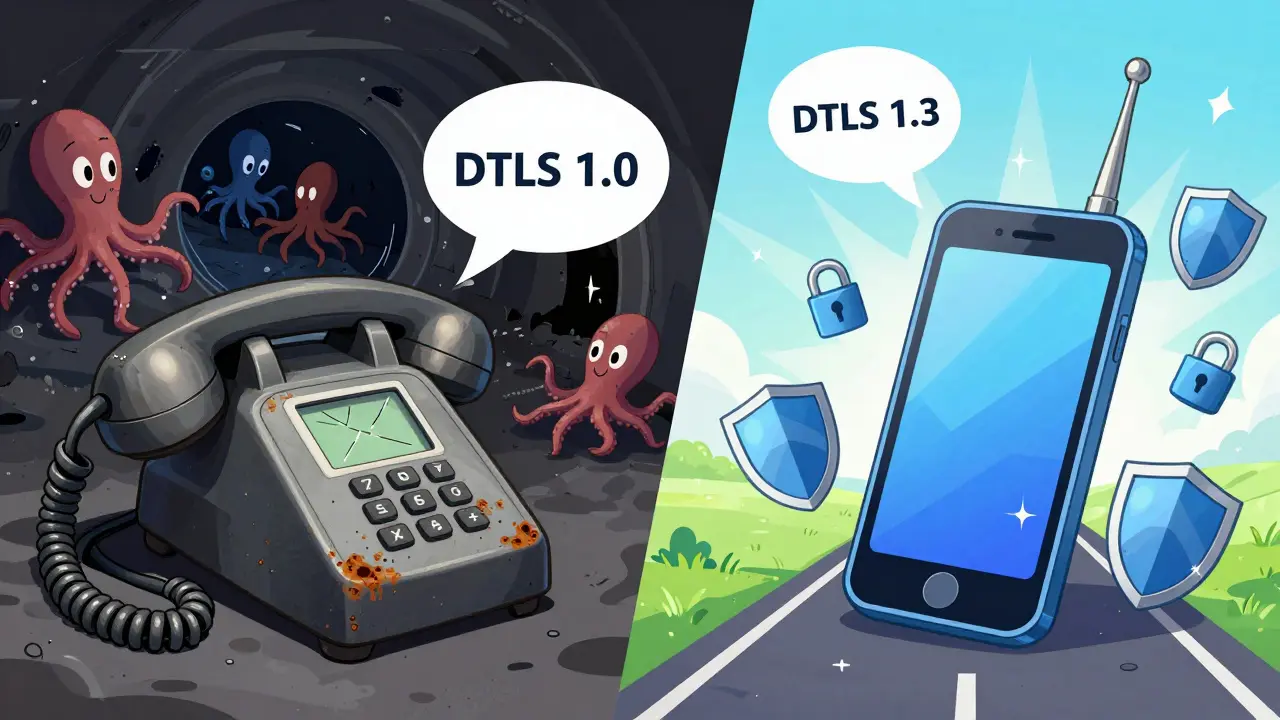
Hardening Your VoIP System: What You Must Do
Switching to TLS 1.3 isn’t enough. You need to harden it. Here’s what works:- Disable TLS 1.0, 1.1, and SSLv3 completely. Even if one device still uses them, attackers can force a downgrade. Use tools like SSL Labs’ test to verify.
- Use only approved cipher suites. For TLS 1.2 (if you must use it), stick to these per IETF RFC 7525:
- TLS_ECDHE_ECDSA_WITH_AES_128_GCM_SHA256
- TLS_ECDHE_RSA_WITH_AES_128_GCM_SHA256
- TLS_ECDHE_ECDSA_WITH_AES_256_GCM_SHA384
- For TLS 1.3, use only these:
- TLS_AES_256_GCM_SHA384
- TLS_CHACHA20_POLY1305_SHA256
- Enforce certificate pinning. Prevent attackers from using fake certificates issued by compromised CAs.
- Use HSTS on web portals. If your PBX has a web interface, force HTTPS-only access.
- Automate certificate renewal. 58% of VoIP admins report certificate expiration as a top issue. Set up alerts. Use Let’s Encrypt or a trusted enterprise CA.
According to Nextiva’s 2023 implementation guide, a mid-sized enterprise can expect 40-80 hours of configuration time for full TLS hardening. That’s not a cost-it’s insurance. The average cost of a VoIP breach? Over $4 million, according to IBM’s 2024 report.
Compliance Isn’t Optional-It’s Mandatory
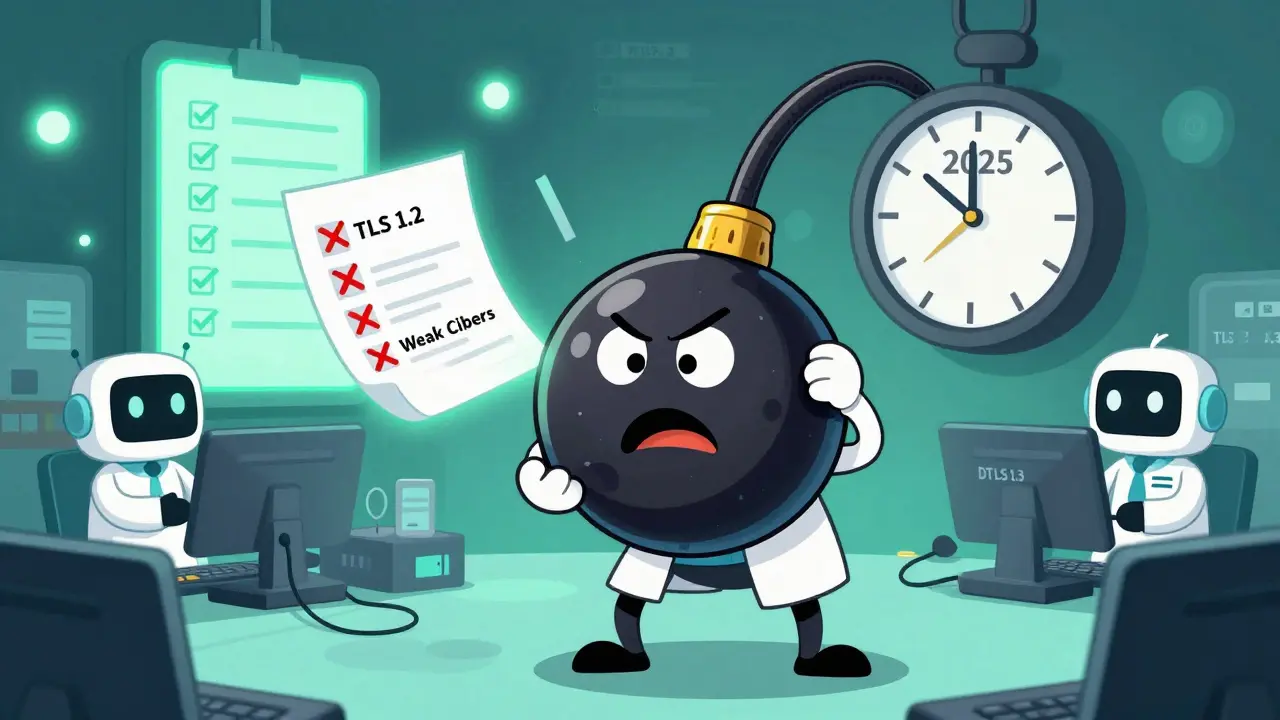
Regulations are catching up. PCI DSS v4.0, effective March 2024, requires TLS 1.2 or higher for any VoIP system handling payment data. HIPAA guidance updated in January 2023 explicitly recommends TLS 1.3 for healthcare VoIP. NIST SP 800-52 Rev. 2 mandates TLS 1.0 and 1.1 be decommissioned by January 1, 2024. TLS 1.2 is only allowed until January 1, 2025-if it uses only strong cipher suites. If you’re in finance, healthcare, or government, you’re not just securing calls-you’re complying with federal law. Falling behind isn’t a technical issue. It’s a legal risk.What About Legacy Systems?
You can’t replace every SIP phone overnight. But you can mitigate. Here’s how:- Isolate legacy devices. Put them on a separate VLAN with no internet access. Only allow SIP traffic from your PBX.
- Use a TLS proxy. Tools like Kamailio or Asterisk with TLS termination can convert TLS 1.3 from your PBX to TLS 1.2 for old phones. But know this: you add latency. One user reported an 80ms delay after adding a proxy-enough to cause noticeable lag in conversations.
- Plan for replacement. Cisco, Yealink, and Polycom released TLS 1.3-compatible phones starting in 2020. If your phones are older than 2018, they’re a liability.
Don’t treat legacy systems as permanent. Treat them as a temporary bridge to a secure future.
The Future: TLS 1.4 and Quantum Resistance
TLS 1.4 is still in draft (expected 2025), but it’s already being tested by Google and Cloudflare. The goal? Integrate post-quantum cryptography. Quantum computers could break today’s RSA and ECC encryption. Hybrid key exchanges-combining classical and quantum-resistant algorithms-are already in testing. By 2026, Gartner predicts 95% of new VoIP deployments will use TLS 1.3 as the baseline. The question isn’t whether you’ll upgrade. It’s whether you’ll be caught using TLS 1.2 after 2025.Real-World Results: What Happens When You Do It Right
A 500-user company switched from TLS 1.2 to TLS 1.3. SIP registration time dropped from 420ms to 270ms. Call quality improved. Help desk tickets about dropped calls fell by 40%. Their security audit passed with zero findings. Another company ignored the upgrade. In 2023, an attacker intercepted SIP REGISTER messages, impersonated an employee, and redirected 142 calls to a fraud call center. The cost? $287,000 in losses and a 3-week system outage. The difference isn’t theoretical. It’s financial, operational, and legal.Final Checklist: Are You Secure?
Use this to audit your VoIP system:- ✅ TLS 1.3 enabled on all SIP signaling endpoints
- ✅ DTLS 1.3 enabled on all media streams (WebRTC, SRTP)
- ✅ TLS 1.0 and 1.1 completely disabled
- ✅ Only approved cipher suites are active
- ✅ Certificates are renewed automatically and pinned
- ✅ Legacy devices are isolated or replaced
- ✅ Web interfaces enforce HSTS
- ✅ Regular penetration tests include VoIP protocol analysis
If you checked fewer than 6 of these, you’re not secure. You’re just waiting for the next breach.
Is TLS 1.2 still safe for VoIP in 2025?
No. While TLS 1.2 is still technically functional, it’s no longer considered secure for VoIP. It supports outdated ciphers like RC4 and SHA-1, and lacks mandatory forward secrecy. NIST and PCI DSS require TLS 1.3 for new deployments, and TLS 1.2 will be fully deprecated for VoIP by January 2025. Systems still using TLS 1.2 face significantly higher risks of interception and session hijacking.
What’s the difference between TLS and DTLS in VoIP?
TLS secures SIP signaling (call setup) over TCP. DTLS secures the actual voice stream (SRTP) over UDP. Since VoIP uses UDP for real-time audio, DTLS is required for media encryption. DTLS 1.3 is the updated version that brings TLS 1.3 security to UDP-based traffic. You need both for full protection.
Can I use TLS 1.3 with my old SIP phones?
Most SIP phones made before 2020 don’t support TLS 1.3. You’ll need to either replace them or use a TLS proxy that translates between TLS 1.3 (from your PBX) and TLS 1.2 (for the phone). But proxies add latency and complexity. Replacing outdated hardware is the only reliable long-term solution.
Why does TLS 1.3 make VoIP calls faster?
TLS 1.3 reduces the handshake from two round trips (TLS 1.2) to just one. For returning clients, it can even use zero-round-trip (0-RTT) resumption. This cuts call setup time from 350ms to around 220ms. In VoIP, delays over 500ms are noticeable. Faster handshakes mean calls connect quicker and feel more natural.
What are the most common mistakes in VoIP TLS setup?
The biggest mistakes are: leaving TLS 1.0/1.1 enabled, using weak cipher suites (like AES-CBC), not enforcing certificate pinning, letting certificates expire, and misconfiguring 0-RTT in TLS 1.3 (which can enable replay attacks). According to SANS, 73% of TLS-related VoIP breaches come from misconfiguration-not protocol flaws.
How do I test if my VoIP system is properly secured?
Use SSL Labs’ SSL Test (for SIP endpoints) and Wireshark to inspect TLS handshakes. Check that only TLS 1.3 is negotiated and that only strong ciphers like TLS_AES_256_GCM_SHA384 are used. Also, verify DTLS 1.3 is active on media streams. Regular penetration tests that include VoIP protocol analysis are essential.




LeVar Trotter
16 Dec 2025 at 13:46TLS 1.3 isn’t just an upgrade-it’s a mandatory pivot for VoIP. The handshake reduction alone saves enough latency to make call quality feel native, not buffered. And let’s be real: if you’re still running TLS 1.2 in 2025, you’re not being pragmatic-you’re just delaying the inevitable breach. I’ve seen orgs cling to legacy SIP phones for ‘budget reasons’… until their call logs get harvested by a botnet and they’re on the hook for GDPR fines. The math doesn’t lie. Upgrade or get out of the game.
Also, DTLS 1.3 support on WebRTC clients is now near-universal. If your softphone or browser-based app still negotiates DTLS 1.2, check your SDP offer/answer. More times than not, it’s a misconfigured ICE candidate or a stale policy in your SFU.
Don’t just enable TLS 1.3-audit your cipher suite whitelist. I’ve seen configs where TLS_AES_256_GCM_SHA384 was listed but TLS_CHACHA20_POLY1305_SHA256 was accidentally disabled. That’s like locking your front door but leaving the back window open.
And yes, certificate pinning matters. Even if you use Let’s Encrypt, pin the intermediate. One compromised CA and your whole SIP trunk is toast.